Fringillidae
The Key to Scientific Names
Legend Overview
Fringillidae Finches, Euphonias, and Allies
Version: 1.0 — Published March 4, 2020


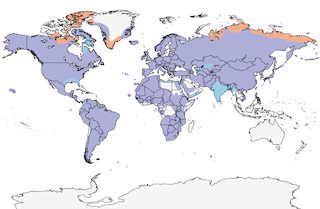
- Year-round
- Breeding
- Non-breeding
Full content is available exclusively to Birds of the World subscribers. Sign in Learn more
Introduction
Fringillids vary widely, from the streaky brown of the European Twite to the brilliant colors of Neotropical euphonias, and from the sharp, simple bills of siskins to the massive seedcrackers of hawfinches and the chisels and decurved probes of Hawaiian honeycreepers. Yet this diversity masks some interesting shared traits. They are almost universally fond of fruits and seeds, so much so that even the nestlings are reared on them. Their mobility helps explain why they are the most widely distributed of all the nine-primaried oscines—and also why it is no big surprise that the spectacular diversification of Hawaii’s honeycreepers was seeded by a fringillid ancestor that colonized this isolated archipelago many millions of years ago.
General Habitat
Diet and Foraging
Breeding
Conservation Status
Systematics History
Conservation Status
| Least Concern |
66.9%
|
|---|---|
| Near Threatened |
3.8%
|
| Vulnerable |
3%
|
| Endangered |
4.7%
|
| Critically Endangered |
3.4%
|
| Extinct in the Wild |
0%
|
| Extinct |
9.3%
|
| Not Evaluated |
0%
|
| Data Deficient |
0.42%
|
| Unknown |
8.5%
|
Data provided by IUCN (2025) Red List. More information