
Cape Weaver Ploceus capensis Scientific name definitions
- LC Least Concern
- Names (28)
- Monotypic
Revision Notes
Sign in to see your badges
Species names in eBird-supported languages
| Language | Common name |
|---|---|
| Afrikaans | Kaapse Wewer |
| Bulgarian | Капски тъкач |
| Catalan | teixidor social del Cap |
| Chinese (SIM) | 南非织雀 |
| Croatian | kapska pletilja |
| Czech | snovač kapský |
| Danish | Kap Væver |
| Dutch | Kaapse Wever |
| English | Cape Weaver |
| English (AVI) | Cape Weaver |
| English (United States) | Cape Weaver |
| Estonian | aaloe-kangurlind |
| Finnish | kapinkutoja |
| French | Tisserin du Cap |
| German | Kapweber |
| Icelandic | Höfðavefari |
| Japanese | ケープハタオリ |
| Norwegian | kappvever |
| Polish | wikłacz złotolicy |
| Russian | Капский ткач |
| Serbian | Kapska tekstor tkalja |
| Slovak | pletiarka žltkastá |
| Spanish | Tejedor de El Cabo |
| Spanish (Spain) | Tejedor de El Cabo |
| Swedish | kapvävare |
| Turkish | Kap Dokumacısı |
| Ukrainian | Ткачик іржастощокий |
| Zulu | ihlokohlokelikhulu |
Revision Notes
This account is part of the 8th edition of Roberts Birds of Southern Africa. This project is a joint collaboration between the John Voelcker Bird Book Fund and the Cornell Lab of Ornithology. H. Dieter Oschadleus revised the account.
Ploceus capensis (Linnaeus, 1766)
Definitions
- PLOCEUS
- capense / capensis
The Key to Scientific Names
Legend Overview
Content Partner


Full content is available exclusively to Birds of the World subscribers. Sign in Learn more
Introduction
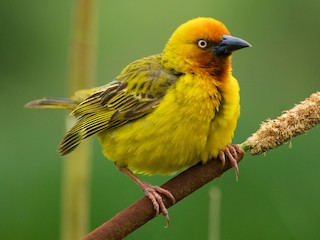
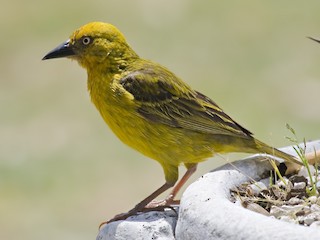
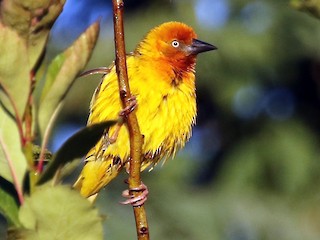
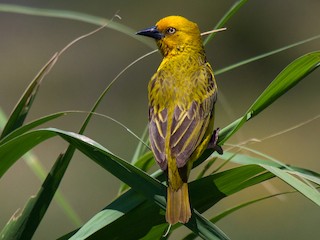
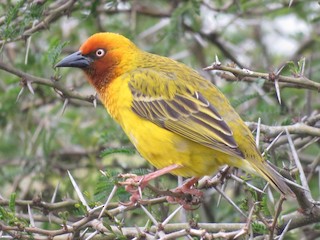
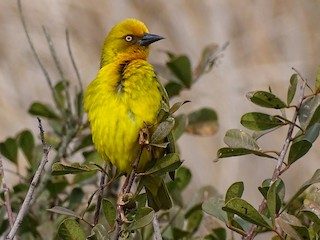
The Cape Weaver is a large, long-billed weaver. In breeding plumage, the adult male is bright yellow with varying amounts of orange brown on the face, a black bill, and pale eyes. The female is principally olive, with a yellow throat and belly, brown eyes, and a pale horn-colored bill. Although adult females usually have brown eyes, about 19% have pale eyes in summer, so eye color alone cannot be used to sex this species. Males assume a nonbreeding plumage for a relatively short period, during which time they resemble females but are yellower below and retain the pale eye. The juvenile is duller than adults but has a yellowish belly.
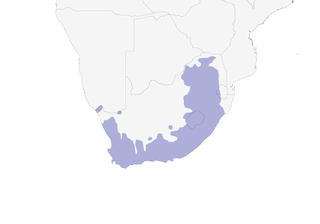
The Cape Weaver is found mainly in South Africa and Lesotho, but extends marginally into western Eswatini. It is a monotypic species, but clinal variation in size and plumage coloration exists. The species’ stronghold is in the Western Cape, South Africa. It inhabits open country with some trees and permanent water. In hot and drier regions, the species is restricted to montane areas. The Cape Weaver never occurs in forests. The species is found in flocks, and it forms large roosts throughout the year, which may be shared with other weavers and other bird species. In some areas, they vacate their breeding sites and do not return until the following season. Anting has been recorded. The species bathes regularly and may do so even in misty or rainy conditions.
Its relatively long bill is adapted to feeding on a wide variety of vegetable and animal matter. There is a long list of recorded food items, including various invertebrates, seeds, nectar, and fruit. Females appear to have a more varied intake than males. They forage mainly on the ground, often turning over small stones, leaf litter, and dried cow pats. They also search the bark of trees for insects and will occasionally hawk flying insects. It is a generalist nectar feeder and is considered one of the major pollinators of aloes.
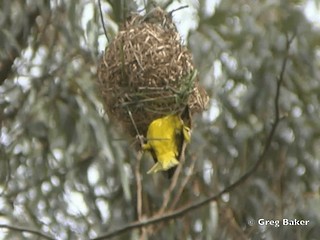
It breeds colonially and is highly polygynous, with up to seven females mating with each male. Males are strongly territorial within a colony and chase intruders from neighboring territories. The nest is built by the male alone, but lined with fine grass by the female when she accepts the nest. The nest itself is a bulky, kidney-shaped structure with an entrance below and, usually, no entrance tunnel. Males display from their nests to attract females. Cape Weaver nests are constructed mostly in a variety of trees, often exotics such as gum (e.g., Eucalyptus spp.), poplars (e.g., Populus spp.), and willows (e.g., Salix spp.), but also in indigenous trees such as Vachellia species. Nests are also built in reeds and on artificial structures such as telephone wires. Colonies may be large, with up to 348 nests recorded in a single colony, but the mean colony size is ~20 nests. The Cape Weaver also builds its nests near those of larger birds, like the Hadada Ibis (Bostrychia hagedash) or in heronries. Old nests may be reused by other passerines, including the Cape Sparrow (Passer melanurus) or African Dusky Flycatcher (Muscicapa adusta).
- Year-round
- Migration
- Breeding
- Non-Breeding