


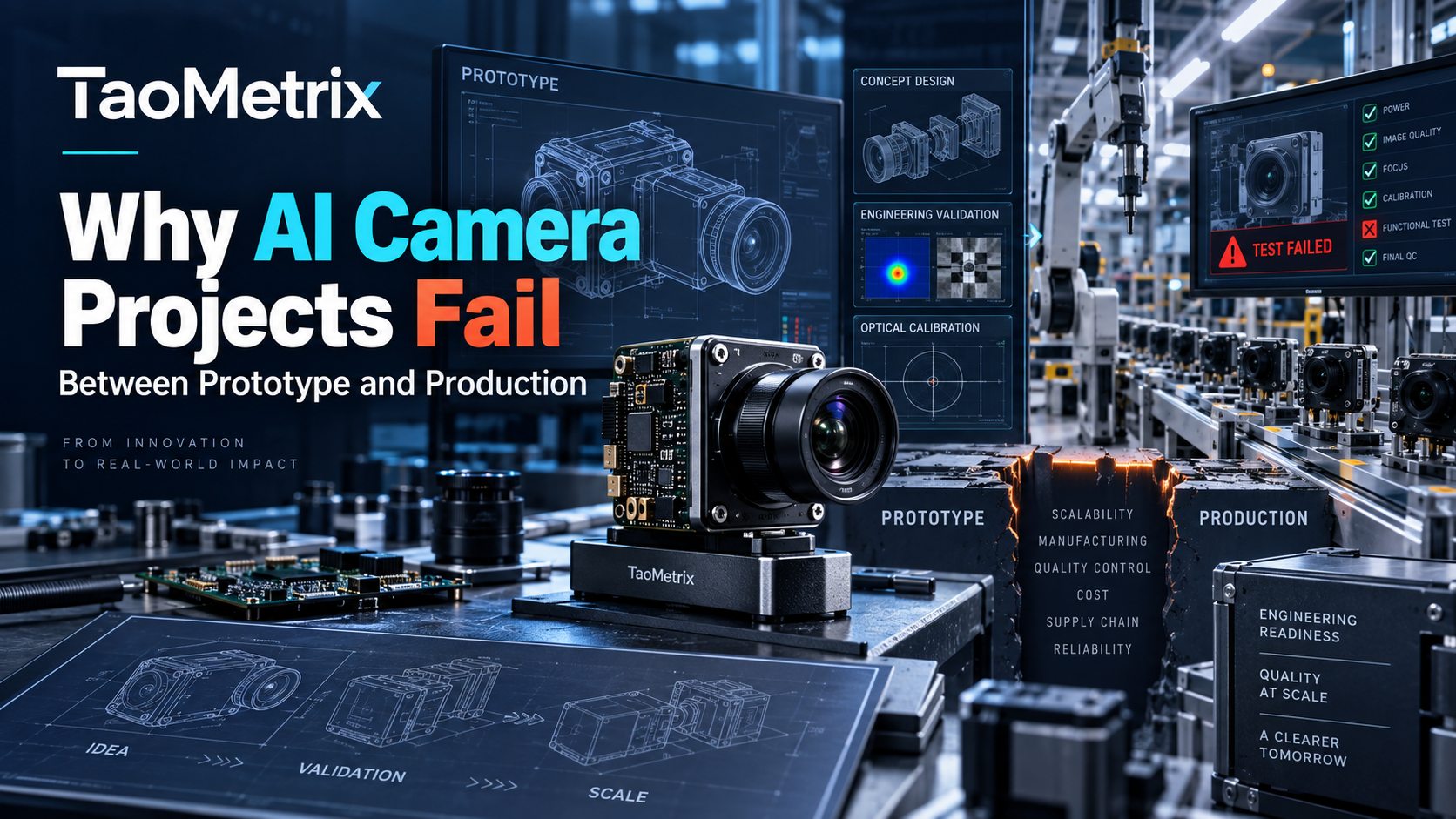
AI cameras are becoming common in industrial inspection, smart retail, robotics, security, healthcare, and connected infrastructure.
The technology is advancing quickly, but many AI camera projects still struggle to move beyond the prototype stage. The problem is often not the AI model itself. It is the gap between a working demonstration and a product that can operate reliably in real environments and be manufactured consistently.
At TaoMetrix, we work with AI hardware teams to identify this gap early and build a practical path from prototype to production.
A Prototype Proves Possibility. Production Proves Repeatability.
A prototype may work with:
- One camera module
- One firmware version
- Controlled lighting
- Stable network access
- A small number of manually assembled units
- An engineer monitoring the system closely
A production product must perform across:
- Different units
- Different component batches
- Different lighting conditions
- Different temperatures
- Long operating periods
- Network interruptions
- Multiple assembly operators
- Real installation environments
This is why product teams need to think about manufacturing, testing, and serviceability before the prototype is considered complete.
1. The Product Has No Clearly Defined Visual Task
Many projects begin with a general goal such as “use AI to analyze video.”
That is not specific enough for engineering.
The team needs to define:
- What must be detected?
- How large is the target object?
- How far away is it?
- What lighting conditions are expected?
- How quickly must the system respond?
- What is an acceptable false-positive rate?
- What happens when the system is uncertain?
- Must the system operate offline?
- How long will it run every day?
A retail people-counting system, an industrial inspection camera, and a robot-navigation camera may all use similar components, but their hardware and testing requirements are very different.
At TaoMetrix, we begin by connecting the visual task to the product architecture and validation plan.
2. The Camera Is Selected Before the Environment Is Understood
A camera sensor should be selected based on the real environment, not only its resolution or price.
Important factors include:
- Lighting range
- Lens distortion
- Field of view
- Motion
- Reflection
- Object distance
- Color accuracy
- Focus behavior
- Dust and moisture
- Mounting angle
- Vibration
For example, a camera designed for indoor consumer use may not be suitable for an outdoor industrial environment. A wide-angle lens may cover more area but create distortion that affects measurement or recognition.
A production-ready AI camera needs a complete image system: sensor, lens, lighting, enclosure, processing pipeline, and mounting position.
3. The AI Model Is Too Large for the Hardware
An AI model may perform well on a development computer but fail to meet the power, latency, or thermal limits of the final product.
Before selecting the platform, the engineering team should review:
- Model size
- Input resolution
- Frame rate
- Inference latency
- Memory requirements
- Local storage
- NPU, VPU, GPU, or CPU performance
- Software framework compatibility
- Firmware update strategy
- Power consumption
The most powerful processor is not always the best choice. A practical product needs a balance between performance, cost, power, heat, availability, and long-term support.
4. The Enclosure Creates New Technical Problems
The enclosure does more than protect the electronics.
It also affects:
- Camera alignment
- Lens protection
- Thermal performance
- Wireless signal quality
- Cable routing
- Service access
- Installation stability
- Water and dust resistance
A camera that is perfectly aligned during prototype assembly may shift during volume production if the mechanical tolerances are not controlled.
This is why mechanical design and camera calibration should be reviewed together.
5. The Product Has No Production Test Strategy
A common mistake is to postpone testing until after the hardware is finished.
An AI camera may require several types of production tests:
- Power-on testing
- Firmware programming
- Camera detection
- Image-quality checks
- Focus or alignment verification
- Wireless connectivity
- Storage verification
- Sensor testing
- Thermal monitoring
- AI inference checks
- Final functional testing
The test process should be fast enough for production but detailed enough to identify meaningful failures.
If a test cannot distinguish between a camera problem, a firmware problem, a wireless problem, and a power problem, the production team will spend more time debugging and reworking units.
6. Component Availability Is Ignored
AI camera projects often depend on specialized components:
- Camera sensors
- Lenses
- AI processors
- Memory
- Wireless modules
- Storage
- Connectors
- Batteries
- Thermal materials
A prototype may be built with available components, but the same parts may later become difficult to source, experience long lead times, or reach end of life.
The BOM should be reviewed for:
- Supplier availability
- Lifecycle status
- Lead time
- Approved alternatives
- Firmware compatibility
- Mechanical compatibility
- Certification impact
- Cost at the target volume
A lower-cost substitute may still require new testing, new firmware, mechanical changes, or customer approval.
7. Field Conditions Are Different from Laboratory Conditions
An AI camera should be tested in the environment where it will actually operate.
That may include:
- Low light
- Direct sunlight
- Rain or humidity
- Dust
- Vibration
- Reflections
- Crowded scenes
- Moving objects
- Network loss
- Long-duration operation
- Temperature changes
The objective is not to claim perfect accuracy in every situation. The objective is to define realistic operating limits and establish what the device should do when conditions fall outside those limits.
How TaoMetrix Helps Reduce Production Risk
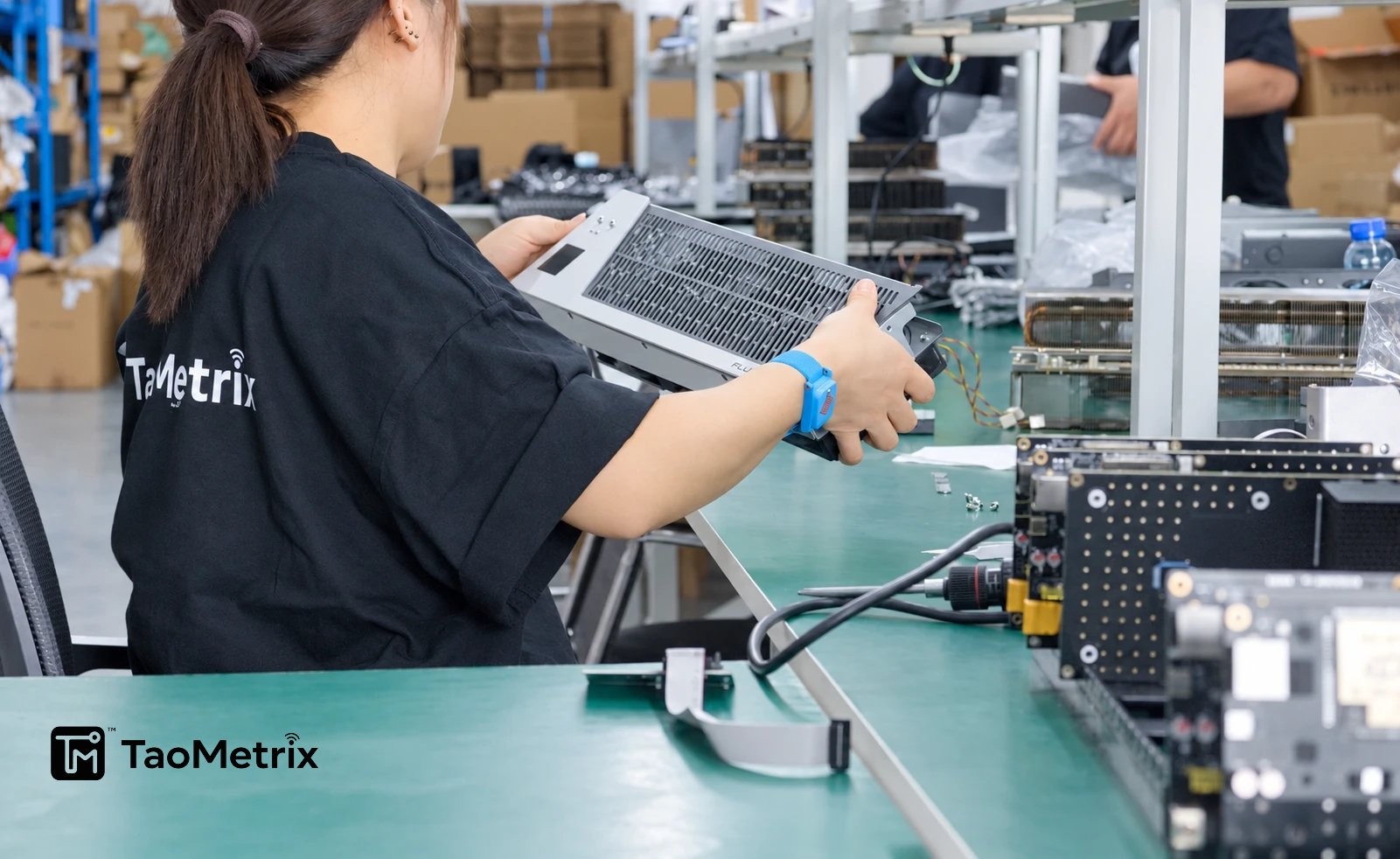
TaoMetrix supports AI camera and edge vision projects through:
- Product requirement review
- Hardware architecture coordination
- Camera and sensor integration
- PCBA and SMT assembly
- Processor, memory, and wireless integration
- Power and battery-system assembly
- Thermal and enclosure coordination
- Firmware programming
- Functional and connectivity testing
- DFM and DFT review
- Pilot production
- Quality inspection
- OEM, ODM, and JDM manufacturing support
Our Shenzhen manufacturing facility covers approximately 20,000 square meters and includes 12 SMT production lines, 6 DIP assembly lines, and 4 final assembly lines, according to information published on the TaoMetrix website.
The actual manufacturing plan depends on the product architecture, target market, test requirements, expected volume, and customer specifications.
A Practical Path from AI Concept to Production
A strong AI camera project usually follows a staged process:
Stage 1: Define the visual task
Identify the users, environment, objects, performance targets, and failure conditions.
Stage 2: Review the system architecture
Select the camera, processor, memory, storage, wireless system, power design, and enclosure direction.
Stage 3: Build engineering prototypes
Validate image quality, AI performance, power, thermal behavior, connectivity, and mechanical integration.
Stage 4: Complete DFM and DFT reviews
Prepare the assembly process, production fixtures, firmware programming, calibration, and testing.
Stage 5: Run a pilot build
Use production-intent materials and controlled processes to identify manufacturing problems.
Stage 6: Prepare for production scale-up
Confirm quality standards, material availability, test coverage, traceability, and customer acceptance criteria.
Frequently Asked Questions
What is the most common reason an AI camera project is delayed?
The most common reasons include unclear visual requirements, late hardware changes, unstable components, insufficient testing, thermal problems, and a lack of production-ready assembly procedures.
Can an AI camera run entirely offline?
Some AI cameras can perform local inference, while others depend on cloud processing for more complex tasks. The right architecture depends on latency, privacy, power, connectivity, and cost requirements.
How early should TaoMetrix become involved?
The earlier the better—ideally during product definition, hardware architecture, or prototype review. Early manufacturing input can help identify component, assembly, test, and supply-chain risks before they become expensive changes.
Is a camera module enough to build an AI camera?
No. A complete AI camera also requires image processing, memory, storage, power management, thermal design, firmware, connectivity, mechanical integration, testing, and a clear production process.
Conclusion
AI camera projects succeed when the team treats the product as a complete system.
The camera, AI model, processor, power system, enclosure, software, test plan, supply chain, and production process must work together.
TaoMetrix helps global product teams identify manufacturing risks early and build a practical path from engineering prototype to repeatable production.
The goal is not only to make an AI camera that works once. It is to build an AI camera that works reliably, can be tested efficiently, and is ready for the real world.


 扫一扫
扫一扫


 689
689

 被折叠的 条评论
为什么被折叠?
被折叠的 条评论
为什么被折叠?
 到【灌水乐园】发言


