



 本文介绍了一种高效算法,用于找到循环链表中环的起始节点。通过使用两个速度不同的指针,最终能够在一次遍历后准确地定位到循环的开始位置。
注:出自cracking the coding interview 4ed
Given a circular linked list, implement an algorithm which returns node at the beginning of the loop.
DEFINITIONCircular linked list: A (corrupt) linked list in which a node’s next pointer points to an earlier node, so as to make a loop in the linked list.
EXAMPLE
Input: A -> B -> C -> D -> E -> C [the same C as earlier]
Output: C
If we move two pointers, one with speed 1 and another with speed 2, they will end up meeting if the linked list has a loop. Why? Think about two cars driving on a track—the faster car will always pass
the slower one!
The tricky part here is finding the start of the loop. Imagine, as an analogy, two people racing around a track, one running twice as fast as the other. If they start off at the same place, when will they next meet? They will next meet at the start of the next
lap.
Now, let’s suppose Fast Runner had a head start of k meters on an n step lap. When will they next meet? They will meet k meters before the start of the next lap. (Why? Fast Runner would have made k + 2(n - k) steps, including its head start, and Slow Runner
would have made n - k steps. Both will be k steps before the start of the loop.)
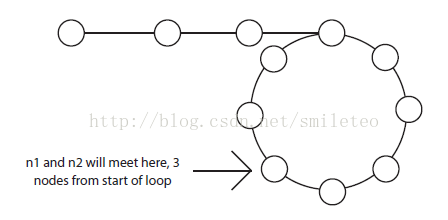
Now, going back to the problem, when Fast Runner (n2) and Slow Runner (n1) are moving around our circular linked list, n2 will have a head start on the loop when n1 enters. Specifically, it will have a head start of k, where k is the number of nodes before
the loop. Since n2 has a head start of k nodes, n1 and n2 will meet k nodes before the start of the loop.
So, we now know the following:
1. Head is k nodes from LoopStart (by definition).
2. MeetingPoint for n1 and n2 is k nodes from LoopStart (as shown above).
Thus, if we move n1 back to Head and keep n2 at MeetingPoint, and move them both at the same pace, they will meet at LoopStart.
LinkedListNode FindBeginning(LinkedListNode head) {
 LinkedListNode n1 = head;
 LinkedListNode n2 = head;

 // Find meeting point
 while (n2.next != null) {
 n1 = n1.next;
 n2 = n2.next.next;
 if (n1 == n2) {
 break;
 }
 }

 // Error check - there is no meeting point, and therefore no loop
 if (n2.next == null) {
 return null;
 }

 /* Move n1 to Head. Keep n2 at Meeting Point. Each are k steps
 /* from the Loop Start. If they move at the same pace, they must
 * meet at Loop Start. */
 n1 = head;
 while (n1 != n2) {
 n1 = n1.next;
 n2 = n2.next;
 }
 // Now n2 points to the start of the loop.
 return n2;
29 }





 扫一扫
扫一扫


 被折叠的 条评论
为什么被折叠?
被折叠的 条评论
为什么被折叠?
 到【灌水乐园】发言





