hdu1348 Wall 凸包

【华为OD机试】真题E卷-一种字符串压缩表示的解压(C++) 有一种简易压缩算法:针对全部为小写英文字母组成的字符串,将其中连续超过两个相同字母的部分压缩为连续个数加该字母,其他部分保持原样不变。例如:字符串aaabbccccd 经过压缩变成字符串 3abb4cd请您编写解压函数,根据输入的字符串, 判断其是否为合法压缩过的字符串若输入合法则输出解压缩后的字符串 否则输出字符串!error来报告错误。 阅读详情

Wall

Time Limit: 2000/1000 MS (Java/Others)    Memory Limit: 65536/32768 K (Java/Others)
Total Submission(s): 4839    Accepted Submission(s): 1392


Problem Description
Once upon a time there was a greedy King who ordered his chief Architect to build a wall around the King's castle. The King was so greedy, that he would not listen to his Architect's proposals to build a beautiful brick wall with a perfect shape and nice tall towers. Instead, he ordered to build the wall around the whole castle using the least amount of stone and labor, but demanded that the wall should not come closer to the castle than a certain distance. If the King finds that the Architect has used more resources to build the wall than it was absolutely necessary to satisfy those requirements, then the Architect will loose his head. Moreover, he demanded Architect to introduce at once a plan of the wall listing the exact amount of resources that are needed to build the wall.
Your task is to help poor Architect to save his head, by writing a program that will find the minimum possible length of the wall that he could build around the castle to satisfy King's requirements.
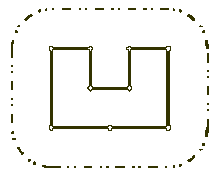


The task is somewhat simplified by the fact, that the King's castle has a polygonal shape and is situated on a flat ground. The Architect has already established a Cartesian coordinate system and has precisely measured the coordinates of all castle's vertices in feet.
 

Input
The first line of the input file contains two integer numbers N and L separated by a space. N (3 <= N <= 1000) is the number of vertices in the King's castle, and L (1 <= L <= 1000) is the minimal number of feet that King allows for the wall to come close to the castle.

Next N lines describe coordinates of castle's vertices in a clockwise order. Each line contains two integer numbers Xi and Yi separated by a space (-10000 <= Xi, Yi <= 10000) that represent the coordinates of ith vertex. All vertices are different and the sides of the castle do not intersect anywhere except for vertices.
 

Output
Write to the output file the single number that represents the minimal possible length of the wall in feet that could be built around the castle to satisfy King's requirements. You must present the integer number of feet to the King, because the floating numbers are not invented yet. However, you must round the result in such a way, that it is accurate to 8 inches (1 foot is equal to 12 inches), since the King will not tolerate larger error in the estimates.

This problem contains multiple test cases!

The first line of a multiple input is an integer N, then a blank line followed by N input blocks. Each input block is in the format indicated in the problem description. There is a blank line between input blocks.

The output format consists of N output blocks. There is a blank line between output blocks.
 

Sample Input
1 9 100 200 400 300 400 300 300 400 300 400 400 500 400 500 200 350 200 200 200
 

Sample Output
1628


求这些点的凸包的周长,然后加上以要求距离为半径的圆的周长即为所求


#include <cstdio>
#include <iostream>
#include <algorithm>
#include <cmath>

using namespace std;

int n;
const int maxn = 1005;
const double PI = acos(-1);

struct Point {
	int x, y;
}p[maxn], stack[maxn];

int cross(Point a, Point b, Point c) {  //ab x ac
	return (b.x - a.x) * (c.y - a.y) - (b.y - a.y) * (c.x - a.x);
}

double dis(Point a, Point b) {  //两点距离
	return sqrt((a.x - b.x) * (a.x - b.x) + (a.y - b.y) * (a.y - b.y));
}

bool cmp(const Point& a, const Point& b) {  //以p[0]为基准按照极角逆时针排序
	int t = cross(p[0], a, b);
	if (t < 0 || (t == 0 && dis(p[0], a) > dis(p[0], b)))
		return false;
	return true;
}

double Gram() {  //凸包Graham算法
	int mi = 0, x = p[0].x, y = p[0].y;
	for (int i = 1; i < n; i++) {  //找最坐下角的点
		if (p[i].x < x || (p[i].x == x && p[i].y < y)) {
			mi = i;
			x = p[i].x;
			y = p[i].y;
		}
	}
	Point tem = p[0];
	p[0] = p[mi];
	p[mi] = tem;

	sort(p + 1, p + n, cmp);  //逆时针排序

	p[n] = p[0];

	/*栈初始化,因为排序是逆时针,所以p[0]p[1] x p[0]p[2]
	*一定大于等于零,stack[2]可以直接入栈
	*/
	stack[0] = p[0];
	stack[1] = p[1];
	stack[2] = p[2];

	int top = 2;

	for (int i = 3; i <= n; i++) {
		//若有右拐且栈内元素大于等于两个,弹出栈顶元素
		while (cross(stack[top - 1], stack[top], p[i]) <= 0 && top >= 2) --top;
		stack[++top] = p[i];
	}
	double ans = 0;
	for (int i = 0; i < top; i++) {
		ans += dis(stack[i], stack[i + 1]);
	}
	return ans;
}

int main()
{
	int T, L;
	bool first = true;
	scanf("%d", &T);
	while (T--) {
		scanf("%d%d", &n, &L);
		for (int i = 0; i < n; i++)
			scanf("%d%d", &p[i].x, &p[i].y);
		if (!first)
			puts("");
		else
			first = false;
		printf("%.0f\n", Gram() + 2.0 * PI * L);  //凸包周长加上圆周长
	}
	return 0;
}



insightface scrfd人脸检测测试 pip install mmdet 自动安装mmcv win10上可以,服务器上没成功 阅读详情

相关推荐

kali2020.2安装出现的问题并附详细解决办法

kali2020.2的安装

weixin_48776804的博客 3050

1113 Wall

Wall Time Limit: 1000MS   Memory Limit: 10000K Total Submissions: 20496   Accepted: 6725 Description Once upon a time there was a greedy King who ordered his chief Arch

Stay foolish, stay hungry 457

芯片测试中的DC与AC模式详解:如何选择最适合你的测试方案?

本文深入解析了芯片测试中DC(直流)与AC(交流)模式的核心差异与互补性。DC测试关注静态电气特性,如固定型故障;而AC测试则聚焦于芯片在额定工作速度下的动态时序行为。文章从VLSI设计、电路模块、成本约束、可测试性设计和应用场景五大维度,提供了如何根据工艺节点、工作频率及具体需求,在testMode配置、时钟复位策略和输入输出接口设计中,平衡两种测试模式以制定最优方案的决策框架。

bb456的博客 1092

(hdu step 7.1.4)Surround the Trees(求凸包的周长——计算将所有点都包围起来的最小凸多边形的周长)

题意:Surround the TreesTime Limit: 2000/1000 MS (Java/Others) Memory Limit: 65536/32768 K (Java/Others)Total Submission(s): 209 Accepted Submission(s): 104 Problem DescriptionThere are a lot of trees in

黄俊东的专栏 1739

电流舵DAC设计(一)

如果分辨率继续增加,温度计码译码逻辑成为面积的主要决定因素,数字版图面积增加,总的面积消耗成上升趋势。缺点是:对于高分辨率的 DAC,高位码元和低位码元权重相差很大,当输入码元转换时(以 8 位二进制型 DAC 为例)尤其是中码转换(从 01111111 转换到 10000000),因为此时电流源的选通动作并非理想情况下的绝对一致等因素,导致在极短的时间内,码元会从 01111111 跳转到 11111111 再跳到10000000,这个过程中所有开关都参与转换,会引起最大幅度的尖峰毛刺(glitch);

模拟芯片设计 2883

OpenClaw安卓手机攻略

想在安卓手机上安装 OpenClaw,目前主要有两种主流方法:一种是使用专门的,操作简单直观;另一种是在命令行环境下进行,自由度更高。你可以根据自己的偏好和动手能力来选择。

suny8的专栏 2907

POJ 1113 Wall (凸包+求周长)

Wall Time Limit: 1000MS Memory Limit: 10000K Total Submissions: 21502 Accepted: 7048 Description Once upon a time there was a greedy King who ordered his ch

K键盘里的青春K 478

使用 MATLAB/Simulink 对一个开关磁阻电机进行建模

*开关磁阻电机(Switched Reluctance Motor, SRM)**是一种新型的无刷电机,以其简单的机械结构、宽广的调速范围和较高的效率在工业应用中得到了广泛关注。SRM的独特之处在于其定子和转子均为凸极结构,并且通过改变绕组电流的方向来实现转矩的产生和控制。本教程将详细介绍如何使用对一个开关磁阻电机进行建模,并探讨其基本控制策略,特别是针对双凸极结构的SRM。本文介绍了如何使用构建一个开关磁阻电机的双凸极结构模型,并探讨了其基本控制策略。

amy_mhd的博客 207

二维凸包详解

凸包大意:给一堆点,让你求一个最小的多边形使得其囊括所有点。 实际上就是拿条绳子在一堆钉子外面绕一圈,绕成的图形就是所求多边形,即绕绳法。 但这里并不讨论绕绳法,而是介绍一种叫Graham的算法。 前置芝士:叉积(a×b=a.x·b.y+a.y·b.x) 叉积不同于点积,叉积的结果是向量,而点积的结果是标量。 设平面直角坐标系有三点A(x0,y0),B(x1,y1),C(x2,y2)。 有共起点...

tylon2006的博客 2029

Arcgis模型构建器01——写一个简单的模型

在使用模型构建器解决这个需求之前,我们要想清楚如果我们手动解决的话,应该如何去处理,因为构建模型的过程正是基于我们手动处理的过程来构建的。我有一个全国的dem影像数据和一个陕西省边界范围矢量,现在我想获取陕西省的dem影像的坡度数据。填写完之后点击确定,我们发现,两个输入数据和工具连接起来了,并且通过裁剪工具得到一个中间结果,即。我们发现工具框和中间数据框都存在阴影,说明已经运行过了这个模型,不报错就说明模型运行成功!现在我们就把数据和工具都串联起来了,成功构建好了模型。

爱吃雪糕的小布丁的博客 926

【ComfyUI报错解决】K采样器 mat1和mat2形状不匹配错误分析与修复 mat1 and mat2 shapes cannot be multiplied (77x2048 and 4096x

如果你在 ComfyUI 里遇到K采样器报错:mat1 和 mat2 shapes cannot be multiplied确认大模型和 LoRA 是否是同一版本(SDXL vs SD1.5,不能混用)。如果用了双 CLIP 加载器,要确认加载的类型和选择的模型类型是否匹配。加载→ 类型选flux加载 SDXL 专用的 clip/t5 → 类型选sdxl避免不同版本模型和 LoRA 混搭,保持一致性。模型+LoRA+CLIP 类型必须保持同一版本,不然就会报错。

代码简单说 Vue、JAVA、PHP、Node.js 熟练运用,接口、架构、性能全搞定。 2417

poj1113(凸包 卷包裹法)

#include #include #include #include using namespace std; struct Point{ int x,y; }s[1005]; bool cmp(Point a,Point b) //选择最下左的点作为起点 { if(a.y==b.y) return a.x<b.x; else return a.y<b.y; } int cross(

zizahn的博客 451

android 14.0 去掉usb授权提示框 默认给予权限

在14.0的系统rom产品开发中,在进行iot关于插入usb设备的开发过程中,在插入usb设备时会弹出usb授权提示框,也带来一些不便, 这个需要默认授予USB权限,插拔usb都不弹出usb弹窗所以这要从usb授权相关管理页默认给与usb权限,接下来分析下 相关的实现功能流程

安卓兼职framework和app工程师的博客 2268

Wall HDU1348(计算几何+凸包)

WallHDU - 1348 Once upon a time there was a greedy King who ordered his chief Architect to build a wall around the King's castle. The King was so greedy, that he would not listen to his Architect's p...

勉強しているユキさんです 316

深度学习工具包 DeepLearningToolbox

深度学习工具包Deprecation notice.-----This toolbox is outdated and no longer maintained.There are much better tools available for deep learning than this toolbox, e.g. [Theano](http://deeplearning.net/software/theano/), [torch](http://torch.ch/) or [tensorflow](http://www.tensorflow.org/)I would suggest you use one of the tools mentioned above rather than use this toolbox.Best, Rasmus.DeepLearnToolbox================A Matlab toolbox for Deep Learning.Deep Learning is a new subfield of machine learning that focuses on learning deep hierarchical models of data.It is inspired by the human brain's apparent deep (layered, hierarchical) architecture.A good overview of the theory of Deep Learning theory is[Learning Deep Architectures for AI](http://www.iro.umontreal.ca/~bengioy/papers/ftml_book.pdf)For a more informal introduction, see the following videos by Geoffrey Hinton and Andrew Ng.* [The Next Generation of Neural Networks](http://www.youtube.com/watch?v=AyzOUbkUf3M) (Hinton, 2007)* [Recent Developments in Deep Learning](http://www.youtube.com/watch?v=VdIURAu1-aU) (Hinton, 2010)* [Unsupervised Feature Learning and Deep Learning](http://www.youtube.com/watch?v=ZmNOAtZIgIk) (Ng, 2011)If you use this toolbox in your research please cite [Prediction as a candidate for learning deep hierarchical models of data](http://www2.imm.dtu.dk/pubdb/views/publication_details.php?id=6284)```@MASTERSTHESIS\{IMM2012-06284, author = "R. B. Palm", title = "Prediction as a candidate for learning deep hierarchical models of data", year = "2012",}```Contact: rasmusbergpalm at gmail dot comDirectories included in the toolbox-----------------------------------`NN/` - A library for Feedforward Backpropagation Neural Networks`CNN/` - A library for Convolutional Neural Networks`DBN/` - A library for Deep Belief Networks`SAE/` - A library for Stacked Auto-Encoders`CAE/` - A library for Convolutional Auto-Encoders`util/` - Utility functions used by the libraries`data/` - Data used by the examples`tests/` - unit tests to verify toolbox is workingFor references on each library check REFS.mdSetup-----1. Download.2. addpath(genpath('DeepLearnToolbox'));Example: Deep Belief Network---------------------```matlabfunction test_example_DBNload mnist_uint8;train_x = double(train_x) / 255;test_x = double(test_x) / 255;train_y = double(train_y);test_y = double(test_y);%% ex1 train a 100 hidden unit RBM and visualize its weightsrand('state',0)dbn.sizes = [100];opts.numepochs = 1;opts.batchsize = 100;opts.momentum = 0;opts.alpha = 1;dbn = dbnsetup(dbn, train_x, opts);dbn = dbntrain(dbn, train_x, opts);figure; visualize(dbn.rbm{1}.W'); % Visualize the RBM weights%% ex2 train a 100-100 hidden unit DBN and use its weights to initialize a NNrand('state',0)%train dbndbn.sizes = [100 100];opts.numepochs = 1;opts.batchsize = 100;opts.momentum = 0;opts.alpha = 1;dbn = dbnsetup(dbn, train_x, opts);dbn = dbntrain(dbn, train_x, opts);%unfold dbn to nnnn = dbnunfoldtonn(dbn, 10);nn.activation_function = 'sigm';%train nnopts.numepochs = 1;opts.batchsize = 100;nn = nntrain(nn, train_x, train_y, opts);[er, bad] = nntest(nn, test_x, test_y);assert(er < 0.10, 'Too big error');```Example: Stacked Auto-Encoders---------------------```matlabfunction test_example_SAEload mnist_uint8;train_x = double(train_x)/255;test_x = double(test_x)/255;train_y = double(train_y);test_y = double(test_y);%% ex1 train a 100 hidden unit SDAE and use it to initialize a FFNN% Setup and train a stacked denoising autoencoder (SDAE)rand('state',0)sae = saesetup([784 100]);sae.ae{1}.activation_function = 'sigm';sae.ae{1}.learningRate = 1;sae.ae{1}.inputZeroMaskedFraction = 0.5;opts.numepochs = 1;opts.batchsize = 100;sae = saetrain(sae, train_x, opts);visualize(sae.ae{1}.W{1}(:,2:end)')% Use the SDAE to initialize a FFNNnn = nnsetup([784 100 10]);nn.activation_function = 'sigm';nn.learningRate = 1;nn.W{1} = sae.ae{1}.W{1};% Train the FFNNopts.numepochs = 1;opts.batchsize = 100;nn = nntrain(nn, train_x, train_y, opts);[er, bad] = nntest(nn, test_x, test_y);assert(er < 0.16, 'Too big error');```Example: Convolutional Neural Nets---------------------```matlabfunction test_example_CNNload mnist_uint8;train_x = double(reshape(train_x',28,28,60000))/255;test_x = double(reshape(test_x',28,28,10000))/255;train_y = double(train_y');test_y = double(test_y');%% ex1 Train a 6c-2s-12c-2s Convolutional neural network %will run 1 epoch in about 200 second and get around 11% error. %With 100 epochs you'll get around 1.2% errorrand('state',0)cnn.layers = { struct('type', 'i') %input layer struct('type', 'c', 'outputmaps', 6, 'kernelsize', 5) %convolution layer struct('type', 's', 'scale', 2) %sub sampling layer struct('type', 'c', 'outputmaps', 12, 'kernelsize', 5) %convolution layer struct('type', 's', 'scale', 2) %subsampling layer};cnn = cnnsetup(cnn, train_x, train_y);opts.alpha = 1;opts.batchsize = 50;opts.numepochs = 1;cnn = cnntrain(cnn, train_x, train_y, opts);[er, bad] = cnntest(cnn, test_x, test_y);%plot mean squared errorfigure; plot(cnn.rL);assert(er<0.12, 'Too big error');```Example: Neural Networks---------------------```matlabfunction test_example_NNload mnist_uint8;train_x = double(train_x) / 255;test_x = double(test_x) / 255;train_y = double(train_y);test_y = double(test_y);% normalize[train_x, mu, sigma] = zscore(train_x);test_x = normalize(test_x, mu, sigma);%% ex1 vanilla neural netrand('state',0)nn = nnsetup([784 100 10]);opts.numepochs = 1; % Number of full sweeps through dataopts.batchsize = 100; % Take a mean gradient step over this many samples[nn, L] = nntrain(nn, train_x, train_y, opts);[er, bad] = nntest(nn, test_x, test_y);assert(er < 0.08, 'Too big error');%% ex2 neural net with L2 weight decayrand('state',0)nn = nnsetup([784 100 10]);nn.weightPenaltyL2 = 1e-4; % L2 weight decayopts.numepochs = 1; % Number of full sweeps through dataopts.batchsize = 100; % Take a mean gradient step over this many samplesnn = nntrain(nn, train_x, train_y, opts);[er, bad] = nntest(nn, test_x, test_y);assert(er < 0.1, 'Too big error');%% ex3 neural net with dropoutrand('state',0)nn = nnsetup([784 100 10]);nn.dropoutFraction = 0.5; % Dropout fraction opts.numepochs = 1; % Number of full sweeps through dataopts.batchsize = 100; % Take a mean gradient step over this many samplesnn = nntrain(nn, train_x, train_y, opts);[er, bad] = nntest(nn, test_x, test_y);assert(er < 0.1, 'Too big error');%% ex4 neural net with sigmoid activation functionrand('state',0)nn = nnsetup([784 100 10]);nn.activation_function = 'sigm'; % Sigmoid activation functionnn.learningRate = 1; % Sigm require a lower learning rateopts.numepochs = 1; % Number of full sweeps through dataopts.batchsize = 100; % Take a mean gradient step over this many samplesnn = nntrain(nn, train_x, train_y, opts);[er, bad] = nntest(nn, test_x, test_y);assert(er < 0.1, 'Too big error');%% ex5 plotting functionalityrand('state',0)nn = nnsetup([784 20 10]);opts.numepochs = 5; % Number of full sweeps through datann.output = 'softmax'; % use softmax outputopts.batchsize = 1000; % Take a mean gradient step over this many samplesopts.plot = 1; % enable plottingnn = nntrain(nn, train_x, train_y, opts);[er, bad] = nntest(nn, test_x, test_y);assert(er < 0.1, 'Too big error');%% ex6 neural net with sigmoid activation and plotting of validation and training error% split training data into training and validation datavx = train_x(1:10000,:);tx = train_x(10001:end,:);vy = train_y(1:10000,:);ty = train_y(10001:end,:);rand('state',0)nn = nnsetup([784 20 10]); nn.output = 'softmax'; % use softmax outputopts.numepochs = 5; % Number of full sweeps through dataopts.batchsize = 1000; % Take a mean gradient step over this many samplesopts.plot = 1; % enable plottingnn = nntrain(nn, tx, ty, opts, vx, vy); % nntrain takes validation set as last two arguments (optionally)[er, bad] = nntest(nn, test_x, test_y);assert(er < 0.1, 'Too big error');```[![Bitdeli Badge](https://d2weczhvl823v0.cloudfront.net/rasmusbergpalm/deeplearntoolbox/trend.png)](https://bitdeli.com/free "Bitdeli Badge")

假人有限元模型

假人模型,车辆碰撞假人有限元模型,适合做乘员安全的研究者利用

HDU1348 Wall 【简单凸包】

【题目大意】 首先读入N,L分别表示有N座城堡以及城墙到城堡的最近距离不得低于L 然后N行输入每个城堡的平面坐标 需要求出最短的能够满足条件的城墙长度。 条件: 1)城墙到城堡的最近距离不得低于L 2)城墙必须包含最外圈的所有城堡 输入包含多组数据 保留0位小数输出 【解题思路】 该题是典型的凸包问题 在此简单介绍一下凸包: 凸包(Convex Hull)是一个计算

Lannister_Stark的博客 611

Statistics and Machine Learning Toolbox

Statistics and Machine Learning Toolbox(带书签),MATLAB统计学习工具

HDU1348 Wall 凸包

题目链接:HDU1348 题目大意:给你一些n个点,求其凸包,然后将每条边向外平移一段距离l,这时候每个相邻的两条边之间就会有一个夹角,用需要用弧来填充,画一下就很明白了,然后所有的弧长加起来就是, 2∗π∗l2*π*l 另外还需要注意的一点是,题目要求输出四舍五入整数,这样写 %.0lf 考虑到凸包模板代码还没有看懂,所以没有加上注释,等我以后看懂了,会更新的:) A

xyry 397

WINCC7.3破解文件

WINCC7.3硬件够破解文件,有需要的下载!WINCC7.3硬件够破解文件,有需要的下载!

[hdu 1348] Wall · 凸包

大概就是,给你n个点和一个值L,求这n个点的凸包,然后求与凸包相距l的外圈的周长。 结果=凸包的周长+半径的L的圆的周长 求凸包: 首先将n个按x坐标排序,然后选第一个点作为一个确定的点(最左边的点肯定在凸包上) 然后分两步,先求上凸包,再求下凸包。 求上凸包时,我们将目前已经在凸包里的点压入栈中,当做到第i号点的时候,如果发现 向量在向量的逆时针方向,那么说明top是凸包内的点而

山外小楼夜听雨 669

HDU-1348 Wall 凸包

#include #include #include using namespace std; const int maxn = 1005; #define PI 3.14159265 int n,r; struct Point { double x,y; Point( double x = 0,double y = 0 ): x(x),y(y) { } }point[maxn],ch[max

菜鸟成长ing 511

HDU1348--Wall(凸包)

佷裸的一道凸包题,就是多组数据,每组给你点数和圆的半径,然后一堆坐标,最后输出圆的周长加上这个最小凸包的周长。 这里我用的是Graham_scan方法,具体的就是: 1.我们取Y坐标最小的点A作为原点建立平面直角坐标系,然后以剩余点与X轴的夹角从小到大逆时针依次标记,可以不难发现A,B必在这个最小凸包上 2.然后按照字母顺序连接,首先连接AB,然后是BC,我们发现∠ABC...

bailiu9392的博客 180

hdu1348 Wall(凸包)

hdu1348题目求把给定点围起来的最小周长,其中围墙离点要有L的距离。思路挺近凸包,从(抄)模版做起!代码#include <iostream> #include <cstdio> #include <cstring> #include <algorithm> #include <cmath>using namespace std; typedef long long ll;const int m

天道酬勤 313

hdu 1348 Wall(凸包模板题 Graham)

hdu 1348 Wall(凸包模板题)

2097

hdu 1348 Wall (凸包模板)

/* 题意: 求得n个点的凸包,然后求与凸包相距l的外圈的周长。 答案为n点的凸包周长加上半径为L的圆的周长 */ # include # include # include # include using namespace std; # define PI acos(-1.0) struct node { int x; int y; }; node a[1

苍竹林 672

hdu_1348_Wall(凸包)

题目连接:http://acm.hdu.edu.cn/showproblem.php?pid=1348 题意:让你求n个点的凸包,凸包离点的距离为l 题解:就凸包周长+一个半径为l的圆周长 #include #include #include #define F(i,a,b) for(int i=a;i<=b;++i) using namespace std; /* * 求凸包,Grah

bin_gege的博客 429

HDU 1348 wall (简单凸包)

http://acm.hdu.edu.cn/showproblem.php?pid=1348 这题是在求凸包的基础上,再求每个顶点对应角度及半径的弧长,外面围墙的直线部分与城墙的凸包长相同;再求弧长总和,注意每段弧长对应的角与凸包顶点的夹角是一样的,所以,又因为每个顶对应的半径长都是l,所以一个多边形的所顶点对应弧长相加其实就是一个圆。 所以,最后总长为 凸包边长+2*3.14159...

anccx84886的专栏 122

HDU 1348 Wall ( 凸包周长 )

链接:传送门 题意:给出二维坐标轴上 n 个点,这 n 个点构成了一个城堡,国王想建一堵墙,城墙与城堡之间的距离总不小于一个数 L ,求城墙的最小长度,答案四舍五入 思路:城墙与城堡直线长度是相等的,当城堡出现拐角时,城墙必然会出现一段圆弧,这些圆弧最终会构成一个半径为 L 的圆,所以答案就是凸包的周长 + 圆的周长 balabala: 采用Jarvis步进法来求凸包,Jarvis...

dijingzhou4259的博客 148

凸包入门之卷包裹法 & hdu 1348 wall

在二维空间中,凸包可以简单的认为是最小的包含所有点的凸多边形。 简单的卷包裹法:寻找最边缘(一般是最下方的,次之是最左边的)点。假想用一根绳子向右逆时针旋转碰到另一个点,这样新找到的点作为端点,继续旋转绳子重复找点的步骤,一直围成一个凸多边形。时间复杂度:O(n^2) (如果在寻找的射线上有多个点的情况,使用和保留离前端点最远的那一点) 因为涉及到旋转和夹角,所以运用到了叉积。 例

theArcticOcean 1932
上一篇: hdu 1392 Surround the Trees 凸包周长
下一篇: hdu2544 最短路 Dijstra算法堆优化,Bellman-Ford,Bellman-Ford队列优化
Daemoonn
博客等级 码龄11年 42粉丝 198原创
评论
成就一亿技术人!
拼手气红包6.0元
还能输入1000个字符
 
 条评论被折叠 查看
添加红包

请填写红包祝福语或标题

个

红包个数最小为10个

元

红包金额最低5元

当前余额3.43元 前往充值 >
需支付:10.00元
成就一亿技术人!
领取后你会自动成为博主和红包主的粉丝 规则
hope_wisdom
发出的红包
实付元
使用余额支付
点击重新获取
扫码支付
钱包余额 0

抵扣说明:

1.余额是钱包充值的虚拟货币,按照1:1的比例进行支付金额的抵扣。
2.余额无法直接购买下载,可以购买VIP、付费专栏及课程。

余额充值