


看完所有源码,真的感觉有很大收获,无论是 unix 的编程,还是 GET/POST 的 Web 处理流程,都清晰了不少。废话不说,开始我们的 Server 探索之旅。
(水平有限,如有错误之处,欢迎指正)
项目主页
https://github.com/yangtingcheng/tinyhttpd
主要函数
这是所有函数的声明:
先简单地解释每个函数的作用:
accept_request: 处理从套接字上监听到的一个 HTTP 请求,在这里可以很大一部分地体现服务器处理请求流程。
bad_request: 返回给客户端这是个错误请求,HTTP 状态吗 400 BAD REQUEST.
cat: 读取服务器上某个文件写到 socket 套接字。
cannot_execute: 主要处理发生在执行 cgi 程序时出现的错误。
error_die: 把错误信息写到 perror 并退出。
execute_cgi: 运行 cgi 程序的处理,也是个主要函数。
get_line: 读取套接字的一行,把回车换行等情况都统一为换行符结束。
headers: 把 HTTP 响应的头部写到套接字。
not_found: 主要处理找不到请求的文件时的情况。
sever_file: 调用 cat 把服务器文件返回给浏览器。
startup: 初始化 httpd 服务,包括建立套接字,绑定端口,进行监听等。
unimplemented: 返回给浏览器表明收到的 HTTP 请求所用的 method 不被支持。
建议源码阅读顺序: main -> startup -> accept_request -> execute_cgi, 通晓主要工作流程后再仔细把每个函数的源码看一看。
工作流程
(1) 服务器启动,在指定端口或随机选取端口绑定 httpd 服务。
(2)收到一个 HTTP 请求时(其实就是 listen 的端口 accpet 的时候),派生一个线程运行 accept_request 函数。
(3)取出 HTTP 请求中的 method (GET 或 POST) 和 url,。对于 GET 方法,如果有携带参数,则 query_string 指针指向 url 中 ? 后面的 GET 参数。
(4) 格式化 url 到 path 数组,表示浏览器请求的服务器文件路径,在 tinyhttpd 中服务器文件是在 htdocs 文件夹下。当 url 以 / 结尾,或 url 是个目录,则默认在 path 中加上 index.html,表示访问主页。
(5)如果文件路径合法,对于无参数的 GET 请求,直接输出服务器文件到浏览器,即用 HTTP 格式写到套接字上,跳到(10)。其他情况(带参数 GET,POST 方式,url 为可执行文件),则调用 excute_cgi 函数执行 cgi 脚本。
(6)读取整个 HTTP 请求并丢弃,如果是 POST 则找出 Content-Length. 把 HTTP 200 状态码写到套接字。
(7) 建立两个管道,cgi_input 和 cgi_output, 并 fork 一个进程。
(8) 在子进程中,把 STDOUT 重定向到 cgi_outputt 的写入端,把 STDIN 重定向到 cgi_input 的读取端,关闭 cgi_input 的写入端 和 cgi_output 的读取端,设置 request_method 的环境变量,GET 的话设置 query_string 的环境变量,POST 的话设置 content_length 的环境变量,这些环境变量都是为了给 cgi 脚本调用,接着用 execl 运行 cgi 程序。
(9) 在父进程中,关闭 cgi_input 的读取端 和 cgi_output 的写入端,如果 POST 的话,把 POST 数据写入 cgi_input,已被重定向到 STDIN,读取 cgi_output 的管道输出到客户端,该管道输入是 STDOUT。接着关闭所有管道,等待子进程结束。这一部分比较乱,见下图说明:
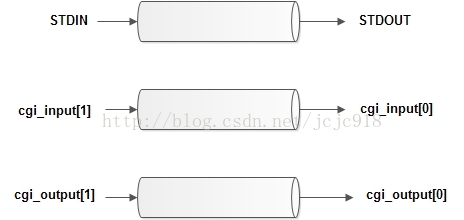
图 1 管道初始状态
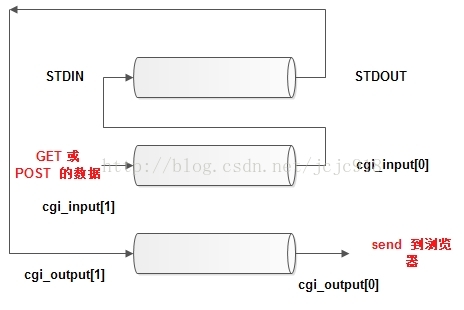
图 2 管道最终状态
(10) 关闭与浏览器的连接,完成了一次 HTTP 请求与回应,因为 HTTP 是无连接的。
注释版源码 /* J. David's webserver */
/* This is a simple webserver.
* Created November 1999 by J. David Blackstone.
* CSE 4344 (Network concepts), Prof. Zeigler
* University of Texas at Arlington
*/
/* This program compiles for Sparc Solaris 2.6.
* To compile for Linux:
* 1) Comment out the #include <pthread.h> line.
* 2) Comment out the line that defines the variable newthread.
* 3) Comment out the two lines that run pthread_create().
* 4) Uncomment the line that runs accept_request().
* 5) Remove -lsocket from the Makefile.
*/
#include <stdio.h>
#include <sys/socket.h>
#include <sys/types.h>
#include <netinet/in.h>
#include <arpa/inet.h>
#include <unistd.h>
#include <ctype.h>
#include <strings.h>
#include <string.h>
#include <sys/stat.h>
#include <pthread.h>
#include <sys/wait.h>
#include <stdlib.h>
#define ISspace(x) isspace((int)(x))
#define SERVER_STRING "Server: jdbhttpd/0.1.0\r\n"
    void accept_request(int);
    void bad_request(int);
    void cat(int, FILE *);
    void cannot_execute(int);
    void error_die(const char *);
    void execute_cgi(int, const char *, const char *, const char *);
    int get_line(int, char *, int);
    void headers(int, const char *);
    void not_found(int);
    void serve_file(int, const char *);
    int startup(u_short *);
    void unimplemented(int);
/**********************************************************************/
/* A request has caused a call to accept() on the server port to
* return. Process the request appropriately.
* Parameters: the socket connected to the client */
/**********************************************************************/
void accept_request(int client)
{
char buf[1024];
int numchars;
char method[255];
char url[255];
char path[512];
size_t i, j;
struct stat st;
int cgi = 0; /* becomes true if server decides this is a CGI program */
char *query_string = NULL;
/*得到请求的第一行*/
numchars = get_line(client, buf, sizeof(buf));
i = 0; j = 0;
/*把客户端的请求方法存到 method 数组*/
while (!ISspace(buf[j]) && (i < sizeof(method) - 1))
{
method[i] = buf[j];
i++; j++;
}
method[i] = '\0';
/*如果既不是 GET 又不是 POST 则无法处理 */
if (strcasecmp(method, "GET") && strcasecmp(method, "POST"))
{
unimplemented(client);
return;
}
/* POST 的时候开启 cgi */
if (strcasecmp(method, "POST") == 0)
cgi = 1;
/*读取 url 地址*/
i = 0;
while (ISspace(buf[j]) && (j < sizeof(buf)))
j++;
while (!ISspace(buf[j]) && (i < sizeof(url) - 1) && (j < sizeof(buf)))
{
/*存下 url */
url[i] = buf[j];
i++; j++;
}
url[i] = '\0';
/*处理 GET 方法*/
if (strcasecmp(method, "GET") == 0)
{
/* 待处理请求为 url */
query_string = url;
while ((*query_string != '?') && (*query_string != '\0'))
query_string++;
/* GET 方法特点,? 后面为参数*/
if (*query_string == '?')
{
/*开启 cgi */
cgi = 1;
*query_string = '\0';
query_string++;
}
}
/*格式化 url 到 path 数组,html 文件都在 htdocs 中*/
sprintf(path, "htdocs%s", url);
/*默认情况为 index.html */
if (path[strlen(path) - 1] == '/')
strcat(path, "index.html");
/*根据路径找到对应文件 */
if (stat(path, &st) == -1) {
/*把所有 headers 的信息都丢弃*/
while ((numchars > 0) && strcmp("\n", buf)) /* read & discard headers */
numchars = get_line(client, buf, sizeof(buf));
/*回应客户端找不到*/
not_found(client);
}
else
{
/*如果是个目录,则默认使用该目录下 index.html 文件*/
if ((st.st_mode & S_IFMT) == S_IFDIR)
strcat(path, "/index.html");
if ((st.st_mode & S_IXUSR) || (st.st_mode & S_IXGRP) || (st.st_mode & S_IXOTH) )
cgi = 1;
/*不是 cgi,直接把服务器文件返回,否则执行 cgi */
if (!cgi)
serve_file(client, path);
else
execute_cgi(client, path, method, query_string);
}
/*断开与客户端的连接(HTTP 特点:无连接)*/
close(client);
}
/**********************************************************************/
/* Inform the client that a request it has made has a problem.
* Parameters: client socket */
/**********************************************************************/
void bad_request(int client)
{
char buf[1024];
/*回应客户端错误的 HTTP 请求 */
sprintf(buf, "HTTP/1.0 400 BAD REQUEST\r\n");
send(client, buf, sizeof(buf), 0);
sprintf(buf, "Content-type: text/html\r\n");
send(client, buf, sizeof(buf), 0);
sprintf(buf, "\r\n");
send(client, buf, sizeof(buf), 0);
sprintf(buf, "<P>Your browser sent a bad request, ");
send(client, buf, sizeof(buf), 0);
sprintf(buf, "such as a POST without a Content-Length.\r\n");
send(client, buf, sizeof(buf), 0);
}
/**********************************************************************/
/* Put the entire contents of a file out on a socket. This function
* is named after the UNIX "cat" command, because it might have been
* easier just to do something like pipe, fork, and exec("cat").
* Parameters: the client socket descriptor
* FILE pointer for the file to cat */
/**********************************************************************/
void cat(int client, FILE *resource)
{
char buf[1024];
/*读取文件中的所有数据写到 socket */
fgets(buf, sizeof(buf), resource);
while (!feof(resource))
{
send(client, buf, strlen(buf), 0);
fgets(buf, sizeof(buf), resource);
}
}
/**********************************************************************/
/* Inform the client that a CGI script could not be executed.
* Parameter: the client socket descriptor. */
/**********************************************************************/
void cannot_execute(int client)
{
char buf[1024];
/* 回应客户端 cgi 无法执行*/
sprintf(buf, "HTTP/1.0 500 Internal Server Error\r\n");
send(client, buf, strlen(buf), 0);
sprintf(buf, "Content-type: text/html\r\n");
send(client, buf, strlen(buf), 0);
sprintf(buf, "\r\n");
send(client, buf, strlen(buf), 0);
sprintf(buf, "<P>Error prohibited CGI execution.\r\n");
send(client, buf, strlen(buf), 0);
}
/**********************************************************************/
/* Print out an error message with perror() (for system errors; based
* on value of errno, which indicates system call errors) and exit the
* program indicating an error. */
/**********************************************************************/
void error_die(const char *sc)
{
/*出错信息处理 */
perror(sc);
exit(1);
}
/**********************************************************************/
/* Execute a CGI script. Will need to set environment variables as
* appropriate.
* Parameters: client socket descriptor
* path to the CGI script */
/**********************************************************************/
void execute_cgi(int client, const char *path, const char *method, const char *query_string)
{
char buf[1024];
int cgi_output[2];
int cgi_input[2];
pid_t pid;
int status;
int i;
char c;
int numchars = 1;
int content_length = -1;
buf[0] = 'A'; buf[1] = '\0';
if (strcasecmp(method, "GET") == 0)
/*把所有的 HTTP header 读取并丢弃*/
while ((numchars > 0) && strcmp("\n", buf)) /* read & discard headers */
numchars = get_line(client, buf, sizeof(buf));
else /* POST */
{
/* 对 POST 的 HTTP 请求中找出 content_length */
numchars = get_line(client, buf, sizeof(buf));
while ((numchars > 0) && strcmp("\n", buf))
{
/*利用 \0 进行分隔 */
buf[15] = '\0';
/* HTTP 请求的特点*/
if (strcasecmp(buf, "Content-Length:") == 0)
content_length = atoi(&(buf[16]));
numchars = get_line(client, buf, sizeof(buf));
}
/*没有找到 content_length */
if (content_length == -1) {
/*错误请求*/
bad_request(client);
return;
}
}
/* 正确,HTTP 状态码 200 */
sprintf(buf, "HTTP/1.0 200 OK\r\n");
send(client, buf, strlen(buf), 0);
/* 建立管道*/
if (pipe(cgi_output) < 0) {
/*错误处理*/
cannot_execute(client);
return;
}
/*建立管道*/
if (pipe(cgi_input) < 0) {
/*错误处理*/
cannot_execute(client);
return;
}
if ((pid = fork()) < 0 ) {
/*错误处理*/
cannot_execute(client);
return;
}
if (pid == 0) /* child: CGI script */
{
char meth_env[255];
char query_env[255];
char length_env[255];
/* 把 STDOUT 重定向到 cgi_output 的写入端 */
dup2(cgi_output[1], 1);
/* 把 STDIN 重定向到 cgi_input 的读取端 */
dup2(cgi_input[0], 0);
/* 关闭 cgi_input 的写入端 和 cgi_output 的读取端 */
close(cgi_output[0]);
close(cgi_input[1]);
/*设置 request_method 的环境变量*/
sprintf(meth_env, "REQUEST_METHOD=%s", method);
putenv(meth_env);
if (strcasecmp(method, "GET") == 0) {
/*设置 query_string 的环境变量*/
sprintf(query_env, "QUERY_STRING=%s", query_string);
putenv(query_env);
}
else { /* POST */
/*设置 content_length 的环境变量*/
sprintf(length_env, "CONTENT_LENGTH=%d", content_length);
putenv(length_env);
}
/*用 execl 运行 cgi 程序*/
execl(path, path, NULL);
exit(0);
} else { /* parent */
/* 关闭 cgi_input 的读取端 和 cgi_output 的写入端 */
close(cgi_output[1]);
close(cgi_input[0]);
if (strcasecmp(method, "POST") == 0)
/*接收 POST 过来的数据*/
for (i = 0; i < content_length; i++) {
recv(client, &c, 1, 0);
/*把 POST 数据写入 cgi_input,现在重定向到 STDIN */
write(cgi_input[1], &c, 1);
}
/*读取 cgi_output 的管道输出到客户端,该管道输入是 STDOUT */
while (read(cgi_output[0], &c, 1) > 0)
send(client, &c, 1, 0);
/*关闭管道*/
close(cgi_output[0]);
close(cgi_input[1]);
/*等待子进程*/
waitpid(pid, &status, 0);
}
}
/**********************************************************************/
/* Get a line from a socket, whether the line ends in a newline,
* carriage return, or a CRLF combination. Terminates the string read
* with a null character. If no newline indicator is found before the
* end of the buffer, the string is terminated with a null. If any of
* the above three line terminators is read, the last character of the
* string will be a linefeed and the string will be terminated with a
* null character.
* Parameters: the socket descriptor
* the buffer to save the data in
* the size of the buffer
* Returns: the number of bytes stored (excluding null) */
/**********************************************************************/
int get_line(int sock, char *buf, int size)
{
int i = 0;
char c = '\0';
int n;
/*把终止条件统一为 \n 换行符,标准化 buf 数组*/
while ((i < size - 1) && (c != '\n'))
{
/*一次仅接收一个字节*/
n = recv(sock, &c, 1, 0);
/* DEBUG printf("%02X\n", c); */
if (n > 0)
{
/*收到 \r 则继续接收下个字节,因为换行符可能是 \r\n */
if (c == '\r')
{
/*使用 MSG_PEEK 标志使下一次读取依然可以得到这次读取的内容,可认为接收窗口不滑动*/
n = recv(sock, &c, 1, MSG_PEEK);
/* DEBUG printf("%02X\n", c); */
/*但如果是换行符则把它吸收掉*/
if ((n > 0) && (c == '\n'))
recv(sock, &c, 1, 0);
else
c = '\n';
}
/*存到缓冲区*/
buf[i] = c;
i++;
}
else
c = '\n';
}
buf[i] = '\0';
/*返回 buf 数组大小*/
return(i);
}
/**********************************************************************/
/* Return the informational HTTP headers about a file. */
/* Parameters: the socket to print the headers on
* the name of the file */
/**********************************************************************/
void headers(int client, const char *filename)
{
char buf[1024];
(void)filename; /* could use filename to determine file type */
/*正常的 HTTP header */
strcpy(buf, "HTTP/1.0 200 OK\r\n");
send(client, buf, strlen(buf), 0);
/*服务器信息*/
strcpy(buf, SERVER_STRING);
send(client, buf, strlen(buf), 0);
sprintf(buf, "Content-Type: text/html\r\n");
send(client, buf, strlen(buf), 0);
strcpy(buf, "\r\n");
send(client, buf, strlen(buf), 0);
}
/**********************************************************************/
/* Give a client a 404 not found status message. */
/**********************************************************************/
void not_found(int client)
{
char buf[1024];
/* 404 页面 */
sprintf(buf, "HTTP/1.0 404 NOT FOUND\r\n");
send(client, buf, strlen(buf), 0);
/*服务器信息*/
sprintf(buf, SERVER_STRING);
send(client, buf, strlen(buf), 0);
sprintf(buf, "Content-Type: text/html\r\n");
send(client, buf, strlen(buf), 0);
sprintf(buf, "\r\n");
send(client, buf, strlen(buf), 0);
sprintf(buf, "<HTML><TITLE>Not Found</TITLE>\r\n");
send(client, buf, strlen(buf), 0);
sprintf(buf, "<BODY><P>The server could not fulfill\r\n");
send(client, buf, strlen(buf), 0);
sprintf(buf, "your request because the resource specified\r\n");
send(client, buf, strlen(buf), 0);
sprintf(buf, "is unavailable or nonexistent.\r\n");
send(client, buf, strlen(buf), 0);
sprintf(buf, "</BODY></HTML>\r\n");
send(client, buf, strlen(buf), 0);
}
/**********************************************************************/
/* Send a regular file to the client. Use headers, and report
* errors to client if they occur.
* Parameters: a pointer to a file structure produced from the socket
* file descriptor
* the name of the file to serve */
/**********************************************************************/
void serve_file(int client, const char *filename)
{
FILE *resource = NULL;
int numchars = 1;
char buf[1024];
/*读取并丢弃 header */
buf[0] = 'A'; buf[1] = '\0';
while ((numchars > 0) && strcmp("\n", buf)) /* read & discard headers */
numchars = get_line(client, buf, sizeof(buf));
/*打开 sever 的文件*/
resource = fopen(filename, "r");
if (resource == NULL)
not_found(client);
else
{
/*写 HTTP header */
headers(client, filename);
/*复制文件*/
cat(client, resource);
}
fclose(resource);
}
/**********************************************************************/
/* This function starts the process of listening for web connections
* on a specified port. If the port is 0, then dynamically allocate a
* port and modify the original port variable to reflect the actual
* port.
* Parameters: pointer to variable containing the port to connect on
* Returns: the socket */
/**********************************************************************/
int startup(u_short *port)
{
int httpd = 0;
struct sockaddr_in name;
/*建立 socket */
httpd = socket(PF_INET, SOCK_STREAM, 0);
if (httpd == -1)
error_die("socket");
memset(&name, 0, sizeof(name));
name.sin_family = AF_INET;
name.sin_port = htons(*port);
name.sin_addr.s_addr = htonl(INADDR_ANY);
if (bind(httpd, (struct sockaddr *)&name, sizeof(name)) < 0)
error_die("bind");
/*如果当前指定端口是 0,则动态随机分配一个端口*/
if (*port == 0) /* if dynamically allocating a port */
{
int namelen = sizeof(name);
if (getsockname(httpd, (struct sockaddr *)&name, &namelen) == -1)
error_die("getsockname");
*port = ntohs(name.sin_port);
}
/*开始监听*/
if (listen(httpd, 5) < 0)
error_die("listen");
/*返回 socket id */
return(httpd);
}
/**********************************************************************/
/* Inform the client that the requested web method has not been
* implemented.
* Parameter: the client socket */
/**********************************************************************/
void unimplemented(int client)
{
char buf[1024];
/* HTTP method 不被支持*/
sprintf(buf, "HTTP/1.0 501 Method Not Implemented\r\n");
send(client, buf, strlen(buf), 0);
/*服务器信息*/
sprintf(buf, SERVER_STRING);
send(client, buf, strlen(buf), 0);
sprintf(buf, "Content-Type: text/html\r\n");
send(client, buf, strlen(buf), 0);
sprintf(buf, "\r\n");
send(client, buf, strlen(buf), 0);
sprintf(buf, "<HTML><HEAD><TITLE>Method Not Implemented\r\n");
send(client, buf, strlen(buf), 0);
sprintf(buf, "</TITLE></HEAD>\r\n");
send(client, buf, strlen(buf), 0);
sprintf(buf, "<BODY><P>HTTP request method not supported.\r\n");
send(client, buf, strlen(buf), 0);
sprintf(buf, "</BODY></HTML>\r\n");
send(client, buf, strlen(buf), 0);
}
/**********************************************************************/
int main(void)
{
int server_sock = -1;
u_short port = 0;
int client_sock = -1;
struct sockaddr_in client_name;
int client_name_len = sizeof(client_name);
pthread_t newthread;
/*在对应端口建立 httpd 服务*/
server_sock = startup(&port);
printf("httpd running on port %d\n", port);
while (1)
{
/*套接字收到客户端连接请求*/
client_sock = accept(server_sock,(struct sockaddr *)&client_name,&client_name_len);
if (client_sock == -1)
error_die("accept");
/*派生新线程用 accept_request 函数处理新请求*/
/* accept_request(client_sock); */
if (pthread_create(&newthread , NULL, accept_request, client_sock) != 0)
perror("pthread_create");
}
close(server_sock);
return(0);
}
    /* J. David's webserver */
    /* This is a simple webserver.
     * Created November 1999 by J. David Blackstone.
     * CSE 4344 (Network concepts), Prof. Zeigler
     * University of Texas at Arlington
     */
    /* This program compiles for Sparc Solaris 2.6.
     * To compile for Linux:
     *  1) Comment out the #include <pthread.h> line.
     *  2) Comment out the line that defines the variable newthread.
     *  3) Comment out the two lines that run pthread_create().
     *  4) Uncomment the line that runs accept_request().
     *  5) Remove -lsocket from the Makefile.
     */
    #include <stdio.h>
    #include <sys/socket.h>
    #include <sys/types.h>
    #include <netinet/in.h>
    #include <arpa/inet.h>
    #include <unistd.h>
    #include <ctype.h>
    #include <strings.h>
    #include <string.h>
    #include <sys/stat.h>
    #include <pthread.h>
    #include <sys/wait.h>
    #include <stdlib.h>

    #define ISspace(x) isspace((int)(x))

    #define SERVER_STRING "Server: jdbhttpd/0.1.0\r\n"

    void accept_request(int);
    void bad_request(int);
    void cat(int, FILE *);
    void cannot_execute(int);
    void error_die(const char *);
    void execute_cgi(int, const char *, const char *, const char *);
    int get_line(int, char *, int);
    void headers(int, const char *);
    void not_found(int);
    void serve_file(int, const char *);
    int startup(u_short *);
    void unimplemented(int);

    /**********************************************************************/
    /* A request has caused a call to accept() on the server port to
     * return.  Process the request appropriately.
     * Parameters: the socket connected to the client */
    /**********************************************************************/
    void accept_request(int client)
    {
        char buf[1024];
        int numchars;
        char method[255];
        char url[255];
        char path[512];
        size_t i, j;
        struct stat st;
        int cgi = 0;      /* becomes true if server decides this is a CGI program */
        char *query_string = NULL;

        /*得到请求的第一行*/
        numchars = get_line(client, buf, sizeof(buf));
        i = 0; j = 0;
        /*把客户端的请求方法存到 method 数组*/
        while (!ISspace(buf[j]) && (i < sizeof(method) - 1))
        {
            method[i] = buf[j];
            i++; j++;
        }
        method[i] = '\0';

        /*如果既不是 GET 又不是 POST 则无法处理 */
        if (strcasecmp(method, "GET") && strcasecmp(method, "POST"))
        {
            unimplemented(client);
            return;
        }

        /* POST 的时候开启 cgi */
        if (strcasecmp(method, "POST") == 0)
            cgi = 1;

        /*读取 url 地址*/
        i = 0;
        while (ISspace(buf[j]) && (j < sizeof(buf)))
            j++;
        while (!ISspace(buf[j]) && (i < sizeof(url) - 1) && (j < sizeof(buf)))
        {
            /*存下 url */
            url[i] = buf[j];
            i++; j++;
        }
        url[i] = '\0';

        /*处理 GET 方法*/
        if (strcasecmp(method, "GET") == 0)
        {
            /* 待处理请求为 url */
            query_string = url;
            while ((*query_string != '?') && (*query_string != '\0'))
                query_string++;
            /* GET 方法特点,? 后面为参数*/
            if (*query_string == '?')
            {
                /*开启 cgi */
                cgi = 1;
                *query_string = '\0';
                query_string++;
            }
        }

        /*格式化 url 到 path 数组,html 文件都在 htdocs 中*/
        sprintf(path, "htdocs%s", url);
        /*默认情况为 index.html */
        if (path[strlen(path) - 1] == '/')
            strcat(path, "index.html");
        /*根据路径找到对应文件 */
        if (stat(path, &st) == -1) {
            /*把所有 headers 的信息都丢弃*/
            while ((numchars > 0) && strcmp("\n", buf))  /* read & discard headers */
                numchars = get_line(client, buf, sizeof(buf));
            /*回应客户端找不到*/
            not_found(client);
        }
        else
        {
            /*如果是个目录,则默认使用该目录下 index.html 文件*/
            if ((st.st_mode & S_IFMT) == S_IFDIR)
                strcat(path, "/index.html");
          if ((st.st_mode & S_IXUSR) || (st.st_mode & S_IXGRP) || (st.st_mode & S_IXOTH)    )
              cgi = 1;
          /*不是 cgi,直接把服务器文件返回,否则执行 cgi */
          if (!cgi)
              serve_file(client, path);
          else
              execute_cgi(client, path, method, query_string);
        }

        /*断开与客户端的连接(HTTP 特点:无连接)*/
        close(client);
    }

    /**********************************************************************/
    /* Inform the client that a request it has made has a problem.
     * Parameters: client socket */
    /**********************************************************************/
    void bad_request(int client)
    {
        char buf[1024];

        /*回应客户端错误的 HTTP 请求 */
        sprintf(buf, "HTTP/1.0 400 BAD REQUEST\r\n");
        send(client, buf, sizeof(buf), 0);
        sprintf(buf, "Content-type: text/html\r\n");
        send(client, buf, sizeof(buf), 0);
        sprintf(buf, "\r\n");
        send(client, buf, sizeof(buf), 0);
        sprintf(buf, "<P>Your browser sent a bad request, ");
        send(client, buf, sizeof(buf), 0);
        sprintf(buf, "such as a POST without a Content-Length.\r\n");
        send(client, buf, sizeof(buf), 0);
    }

    /**********************************************************************/
    /* Put the entire contents of a file out on a socket.  This function
     * is named after the UNIX "cat" command, because it might have been
     * easier just to do something like pipe, fork, and exec("cat").
     * Parameters: the client socket descriptor
     *             FILE pointer for the file to cat */
    /**********************************************************************/
    void cat(int client, FILE *resource)
    {
        char buf[1024];

        /*读取文件中的所有数据写到 socket */
        fgets(buf, sizeof(buf), resource);
        while (!feof(resource))
        {
            send(client, buf, strlen(buf), 0);
            fgets(buf, sizeof(buf), resource);
        }
    }

    /**********************************************************************/
    /* Inform the client that a CGI script could not be executed.
     * Parameter: the client socket descriptor. */
    /**********************************************************************/
    void cannot_execute(int client)
    {
        char buf[1024];

        /* 回应客户端 cgi 无法执行*/
        sprintf(buf, "HTTP/1.0 500 Internal Server Error\r\n");
        send(client, buf, strlen(buf), 0);
        sprintf(buf, "Content-type: text/html\r\n");
        send(client, buf, strlen(buf), 0);
        sprintf(buf, "\r\n");
        send(client, buf, strlen(buf), 0);
        sprintf(buf, "<P>Error prohibited CGI execution.\r\n");
        send(client, buf, strlen(buf), 0);
    }

    /**********************************************************************/
    /* Print out an error message with perror() (for system errors; based
     * on value of errno, which indicates system call errors) and exit the
     * program indicating an error. */
    /**********************************************************************/
    void error_die(const char *sc)
    {
        /*出错信息处理 */
        perror(sc);
        exit(1);
    }

    /**********************************************************************/
    /* Execute a CGI script.  Will need to set environment variables as
     * appropriate.
     * Parameters: client socket descriptor
     *             path to the CGI script */
    /**********************************************************************/
    void execute_cgi(int client, const char *path, const char *method, const char *query_string)
    {
        char buf[1024];
        int cgi_output[2];
        int cgi_input[2];
        pid_t pid;
        int status;
        int i;
        char c;
        int numchars = 1;
        int content_length = -1;

        buf[0] = 'A'; buf[1] = '\0';
        if (strcasecmp(method, "GET") == 0)
            /*把所有的 HTTP header 读取并丢弃*/
            while ((numchars > 0) && strcmp("\n", buf))  /* read & discard headers */
                numchars = get_line(client, buf, sizeof(buf));
        else    /* POST */
        {
            /* 对 POST 的 HTTP 请求中找出 content_length */
            numchars = get_line(client, buf, sizeof(buf));
            while ((numchars > 0) && strcmp("\n", buf))
            {
                /*利用 \0 进行分隔 */
                buf[15] = '\0';
                /* HTTP 请求的特点*/
                if (strcasecmp(buf, "Content-Length:") == 0)
                    content_length = atoi(&(buf[16]));
                numchars = get_line(client, buf, sizeof(buf));
            }
            /*没有找到 content_length */
            if (content_length == -1) {
                /*错误请求*/
                bad_request(client);
                return;
            }
        }

        /* 正确,HTTP 状态码 200 */
        sprintf(buf, "HTTP/1.0 200 OK\r\n");
        send(client, buf, strlen(buf), 0);

        /* 建立管道*/
        if (pipe(cgi_output) < 0) {
            /*错误处理*/
            cannot_execute(client);
            return;
        }
        /*建立管道*/
        if (pipe(cgi_input) < 0) {
            /*错误处理*/
            cannot_execute(client);
            return;
        }

        if ((pid = fork()) < 0 ) {
            /*错误处理*/
            cannot_execute(client);
            return;
        }
        if (pid == 0)  /* child: CGI script */
        {
            char meth_env[255];
            char query_env[255];
            char length_env[255];

            /* 把 STDOUT 重定向到 cgi_output 的写入端 */
            dup2(cgi_output[1], 1);
            /* 把 STDIN 重定向到 cgi_input 的读取端 */
            dup2(cgi_input[0], 0);
            /* 关闭 cgi_input 的写入端 和 cgi_output 的读取端 */
            close(cgi_output[0]);
            close(cgi_input[1]);
            /*设置 request_method 的环境变量*/
            sprintf(meth_env, "REQUEST_METHOD=%s", method);
            putenv(meth_env);
            if (strcasecmp(method, "GET") == 0) {
                /*设置 query_string 的环境变量*/
                sprintf(query_env, "QUERY_STRING=%s", query_string);
                putenv(query_env);
            }
            else {   /* POST */
                /*设置 content_length 的环境变量*/
                sprintf(length_env, "CONTENT_LENGTH=%d", content_length);
                putenv(length_env);
            }
            /*用 execl 运行 cgi 程序*/
            execl(path, path, NULL);
            exit(0);
        } else {    /* parent */
            /* 关闭 cgi_input 的读取端 和 cgi_output 的写入端 */
            close(cgi_output[1]);
            close(cgi_input[0]);
            if (strcasecmp(method, "POST") == 0)
                /*接收 POST 过来的数据*/
                for (i = 0; i < content_length; i++) {
                    recv(client, &c, 1, 0);
                    /*把 POST 数据写入 cgi_input,现在重定向到 STDIN */
                    write(cgi_input[1], &c, 1);
                }
            /*读取 cgi_output 的管道输出到客户端,该管道输入是 STDOUT */
            while (read(cgi_output[0], &c, 1) > 0)
                send(client, &c, 1, 0);

            /*关闭管道*/
            close(cgi_output[0]);
            close(cgi_input[1]);
            /*等待子进程*/
            waitpid(pid, &status, 0);
        }
    }

    /**********************************************************************/
    /* Get a line from a socket, whether the line ends in a newline,
     * carriage return, or a CRLF combination.  Terminates the string read
     * with a null character.  If no newline indicator is found before the
     * end of the buffer, the string is terminated with a null.  If any of
     * the above three line terminators is read, the last character of the
     * string will be a linefeed and the string will be terminated with a
     * null character.
     * Parameters: the socket descriptor
     *             the buffer to save the data in
     *             the size of the buffer
     * Returns: the number of bytes stored (excluding null) */
    /**********************************************************************/
    int get_line(int sock, char *buf, int size)
    {
        int i = 0;
        char c = '\0';
        int n;

        /*把终止条件统一为 \n 换行符,标准化 buf 数组*/
        while ((i < size - 1) && (c != '\n'))
        {
            /*一次仅接收一个字节*/
            n = recv(sock, &c, 1, 0);
            /* DEBUG printf("%02X\n", c); */
            if (n > 0)
            {
                /*收到 \r 则继续接收下个字节,因为换行符可能是 \r\n */
                if (c == '\r')
                {
                    /*使用 MSG_PEEK 标志使下一次读取依然可以得到这次读取的内容,可认为接收窗口不滑动*/
                    n = recv(sock, &c, 1, MSG_PEEK);
                    /* DEBUG printf("%02X\n", c); */
                    /*但如果是换行符则把它吸收掉*/
                    if ((n > 0) && (c == '\n'))
                        recv(sock, &c, 1, 0);
                    else
                        c = '\n';
                }
                /*存到缓冲区*/
                buf[i] = c;
                i++;
            }
            else
                c = '\n';
        }
        buf[i] = '\0';

        /*返回 buf 数组大小*/
        return(i);
    }

    /**********************************************************************/
    /* Return the informational HTTP headers about a file. */
    /* Parameters: the socket to print the headers on
     *             the name of the file */
    /**********************************************************************/
    void headers(int client, const char *filename)
    {
        char buf[1024];
        (void)filename;  /* could use filename to determine file type */

        /*正常的 HTTP header */
        strcpy(buf, "HTTP/1.0 200 OK\r\n");
        send(client, buf, strlen(buf), 0);
        /*服务器信息*/
        strcpy(buf, SERVER_STRING);
        send(client, buf, strlen(buf), 0);
        sprintf(buf, "Content-Type: text/html\r\n");
        send(client, buf, strlen(buf), 0);
        strcpy(buf, "\r\n");
        send(client, buf, strlen(buf), 0);
    }

    /**********************************************************************/
    /* Give a client a 404 not found status message. */
    /**********************************************************************/
    void not_found(int client)
    {
        char buf[1024];

        /* 404 页面 */
        sprintf(buf, "HTTP/1.0 404 NOT FOUND\r\n");
        send(client, buf, strlen(buf), 0);
        /*服务器信息*/
        sprintf(buf, SERVER_STRING);
        send(client, buf, strlen(buf), 0);
        sprintf(buf, "Content-Type: text/html\r\n");
        send(client, buf, strlen(buf), 0);
        sprintf(buf, "\r\n");
        send(client, buf, strlen(buf), 0);
        sprintf(buf, "<HTML><TITLE>Not Found</TITLE>\r\n");
        send(client, buf, strlen(buf), 0);
        sprintf(buf, "<BODY><P>The server could not fulfill\r\n");
        send(client, buf, strlen(buf), 0);
        sprintf(buf, "your request because the resource specified\r\n");
        send(client, buf, strlen(buf), 0);
        sprintf(buf, "is unavailable or nonexistent.\r\n");
        send(client, buf, strlen(buf), 0);
        sprintf(buf, "</BODY></HTML>\r\n");
        send(client, buf, strlen(buf), 0);
    }

    /**********************************************************************/
    /* Send a regular file to the client.  Use headers, and report
     * errors to client if they occur.
     * Parameters: a pointer to a file structure produced from the socket
     *              file descriptor
     *             the name of the file to serve */
    /**********************************************************************/
    void serve_file(int client, const char *filename)
    {
        FILE *resource = NULL;
        int numchars = 1;
        char buf[1024];

        /*读取并丢弃 header */
        buf[0] = 'A'; buf[1] = '\0';
        while ((numchars > 0) && strcmp("\n", buf))  /* read & discard headers */
            numchars = get_line(client, buf, sizeof(buf));

        /*打开 sever 的文件*/
        resource = fopen(filename, "r");
        if (resource == NULL)
            not_found(client);
        else
        {
            /*写 HTTP header */
            headers(client, filename);
            /*复制文件*/
            cat(client, resource);
        }
        fclose(resource);
    }

    /**********************************************************************/
    /* This function starts the process of listening for web connections
     * on a specified port.  If the port is 0, then dynamically allocate a
     * port and modify the original port variable to reflect the actual
     * port.
     * Parameters: pointer to variable containing the port to connect on
     * Returns: the socket */
    /**********************************************************************/
    int startup(u_short *port)
    {
        int httpd = 0;
        struct sockaddr_in name;

        /*建立 socket */
        httpd = socket(PF_INET, SOCK_STREAM, 0);
        if (httpd == -1)
            error_die("socket");
        memset(&name, 0, sizeof(name));
        name.sin_family = AF_INET;
        name.sin_port = htons(*port);
        name.sin_addr.s_addr = htonl(INADDR_ANY);
        if (bind(httpd, (struct sockaddr *)&name, sizeof(name)) < 0)
            error_die("bind");
        /*如果当前指定端口是 0,则动态随机分配一个端口*/
        if (*port == 0)  /* if dynamically allocating a port */
        {
            int namelen = sizeof(name);
            if (getsockname(httpd, (struct sockaddr *)&name, &namelen) == -1)
                error_die("getsockname");
            *port = ntohs(name.sin_port);
        }
        /*开始监听*/
        if (listen(httpd, 5) < 0)
            error_die("listen");
        /*返回 socket id */
        return(httpd);
    }

    /**********************************************************************/
    /* Inform the client that the requested web method has not been
     * implemented.
     * Parameter: the client socket */
    /**********************************************************************/
    void unimplemented(int client)
    {
        char buf[1024];

        /* HTTP method 不被支持*/
        sprintf(buf, "HTTP/1.0 501 Method Not Implemented\r\n");
        send(client, buf, strlen(buf), 0);
        /*服务器信息*/
        sprintf(buf, SERVER_STRING);
        send(client, buf, strlen(buf), 0);
        sprintf(buf, "Content-Type: text/html\r\n");
        send(client, buf, strlen(buf), 0);
        sprintf(buf, "\r\n");
        send(client, buf, strlen(buf), 0);
        sprintf(buf, "<HTML><HEAD><TITLE>Method Not Implemented\r\n");
        send(client, buf, strlen(buf), 0);
        sprintf(buf, "</TITLE></HEAD>\r\n");
        send(client, buf, strlen(buf), 0);
        sprintf(buf, "<BODY><P>HTTP request method not supported.\r\n");
        send(client, buf, strlen(buf), 0);
        sprintf(buf, "</BODY></HTML>\r\n");
        send(client, buf, strlen(buf), 0);
    }

    /**********************************************************************/

    int main(void)
    {
        int server_sock = -1;
        u_short port = 0;
        int client_sock = -1;
        struct sockaddr_in client_name;
        int client_name_len = sizeof(client_name);
        pthread_t newthread;

        /*在对应端口建立 httpd 服务*/
        server_sock = startup(&port);
        printf("httpd running on port %d\n", port);

        while (1)
        {
            /*套接字收到客户端连接请求*/
            client_sock = accept(server_sock,(struct sockaddr *)&client_name,&client_name_len);
            if (client_sock == -1)
                error_die("accept");
            /*派生新线程用 accept_request 函数处理新请求*/
            /* accept_request(client_sock); */
            if (pthread_create(&newthread , NULL, accept_request, client_sock) != 0)
                perror("pthread_create");
        }

        close(server_sock);

        return(0);
    }
编译运行
这里我们如何让这个服务器跑起来呢?看评论区应该不少人遇到问题,这里我简单说下。
首先,需要修改 Makefile 文件,如果直接执行 make 的话,你会遇到这个错误:cannot find -lsocket。解决方法简单说就是在 Linux 系统中没有这样一个库,而且这个库在 linux 中的实现位于 libc 中,编译时被默认包含,所以可以直接在 Makefile 中去掉 -lsocket。详见:stackoverflow
另外,在 htdocs 文件下,有 cgi 的程序和 html 代码,cgi 是用 perl 写的,但文件中声明的 perl 执行程序位置在我这是错的,我这里 perl 脚本位于 /usr/bin 中(用 which perl 可以查看),所以把 cgi 文件中的第一行改为:
现在都没问题了。make 编译后,用 ./httpd 运行,在浏览器中输入 127.0.0.1:端口,就可以看到网页了:



 1297


 扫一扫


 被折叠的 条评论
为什么被折叠?
 到【灌水乐园】发言


