



 本文解释了眼镜处方单上的各项术语,包括验光师和眼科医生的区别、近视与远视等视力状况,以及SPH、CYL、AXIS、PRISM等专业术语的含义。了解这些信息有助于消费者更好地理解自己的视力状况并选择合适的眼镜。
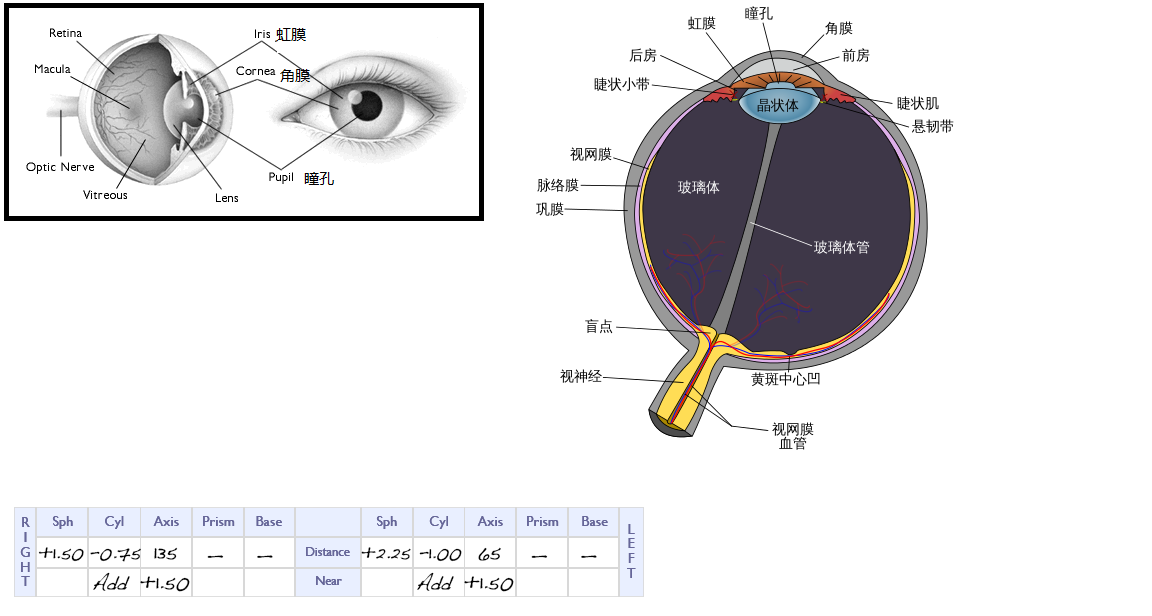
Optometrist –验光师
Ophthalmologist - 眼科医生
Myopia(near sighted)- 近视
Hyperopia (far sighted) - 远视
Emmetropia 正视眼; 屈光正常
SPH (sphere)
A + in the box indicates that you are long sighted which means you find it difficult to see things close to you. A – shows that you find it hard to see things that are far away without glasses. The number might be very small, like 0.25, or a large number, like 6.00. The higher the number, the stronger the prescription lenses required. This can influence your choice of frames. The higher the prescription, the greater the curve of the lens needed.
CYL (cylinder)
The amount of astigmatism (visual distortion) that is caused by an irregularly shaped cornea. If this box is empty, it means that there is no astigmatism and your eyes are perfectly spherical, like a football. If there is a low number, like 0.25, it means that your eyes are nearly round but not quite. A higher number, like 3.00 shows that your eyes are quite oval in shape.
AXIS
The direction of the astigmatism, measured in degrees. The number is not related to how well you can see but it helps the lab know what angle to position your lenses in the frame.
PRISM
This usually indicates that your eyes do not work well as a pair. If there is muscle imbalance between your eyes, prism lenses will provide the correction you need and help prevent double vision or headaches.
BASE
The base simply tells the lab where to put the prism in your glasses.
ADD
If you are over 45, there may be a number where it says ‘ADD’. This is your reading addition and relates to the amount of additional correction needed to focus at close distances. If a measurement is shown in this section, it means you have different prescriptions for distance and reading. Bifocal or varifocal lenses may be needed.





 扫一扫
扫一扫


 584
584

 被折叠的 条评论
为什么被折叠?
被折叠的 条评论
为什么被折叠?
 到【灌水乐园】发言





