


csapp datalab1实验记录
lab1试验记录
具体的实验思路已经写到每一个饰演的注释前面了,可以参考,已经通过测试。后续会整理细节的笔记发送出来
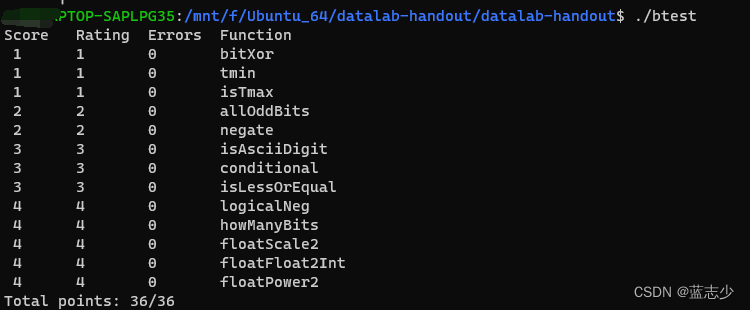
//1
/*
 * bitXor - x^y using only ~ and &
 *   Example: bitXor(4, 5) = 1
 *   Legal ops: ~ &
 *   Max ops: 14
 *   Rating: 1
 */
int bitXor(int x, int y) {
  return ~(~x&~y)&~(x&y);
}
/*
 * tmin - return minimum two's complement integer
 *   Legal ops: ! ~ & ^ | + << >>
 *   Max ops: 4
 *   Rating: 1
 * solution: 32bits : 0x 8000
 */
int tmin(void) {

  return 0x01<<31;

}
//2
/*
 * isTmax - returns 1 if x is the maximum, two's complement number,
 *     and 0 otherwise
 *   Legal ops: ! ~ & ^ | +
 *   Max ops: 10
 *   Rating: 1
 * solution: max 32bits : 7FFF
 */

int isTmax(int x) {
  int y = 0x7FFFFFFF;
  return !(x^y);
}
/*
 * allOddBits - return 1 if all odd-numbered bits in word set to 1
 *   where bits are numbered from 0 (least significant) to 31 (most significant)
 *   Examples allOddBits(0xFFFFFFFD) = 0, allOddBits(0xAAAAAAAA) = 1
 *   Legal ops: ! ~ & ^ | + << >>
 *   Max ops: 12
 *   Rating: 2
 * 0xAAAAAAAA相当于一个mask把奇数位都提取出来 再和mask异或,如果相同就是奇数位为1
 */
int allOddBits(int x) {
  return !((x & 0xAAAAAAAA )^0xAAAAAAAA) ;
}
/*
 * negate - return -x
 *   Example: negate(1) = -1.
 *   Legal ops: ! ~ & ^ | + << >>
 *   Max ops: 5
 *   Rating: 2
 */
int negate(int x) {
  return ~x+1;
}
//3
/*
 * isAsciiDigit - return 1 if 0x30 <= x <= 0x39 (ASCII codes for characters '0' to '9')
 *   Example: isAsciiDigit(0x35) = 1.
 *            isAsciiDigit(0x3a) = 0.
 *            isAsciiDigit(0x05) = 0.
 *   Legal ops: ! ~ & ^ | + << >>
 *   Max ops: 15
 *   Rating: 3
 * 移位运算,左移是逻辑移动,符号位会被舍弃。右移则对无符号数用0填充
 * 有符号数用1补充
 */
int isAsciiDigit(int x) {
  int a,b;
  a=x-0x30; //是Asic应该为sign=0
  b=0x39-x; //是Asic应该为sign=0

  return !((a>>31)|(b>>31)); //只把符号位提取出来,去或,有1则为1,表明超出了范围。
}
/*
 * conditional - same as x ? y : z
 *   Example: conditional(2,4,5) = 4
 *   Legal ops: ! ~ & ^ | + << >>
 *   Max ops: 16
 *   Rating: 3
 * 和数字电路不同 x≠0 -->y 否则 x=0 -->z
 * 先把x转化为bool逻辑值,如果x不为0,x的bool值就是1,然后还要把bool值转化为
 * 我理解的数值值,0---0,1---FFFFFFFF
 * ~ !的区别,~是按位取反,!是逻辑取反。
 * 我最开始的思路是int sign = x^0; 异或提取,但是这样是不对的,异或对每一位都进行了操作
 */
int conditional(int x, int y, int z) {
  x = !!x;
  x = ~x+1;
  return (x&y)|(~x&z);
  // int sign = x^0;//x=0 -->0 否则-->1
  // sign = ~sign+1;
  // return (~sign&z)|(sign&y);
}
/*
 * isLessOrEqual - if x <= y  then return 1, else return 0
 *   Example: isLessOrEqual(4,5) = 1.
 *   Legal ops: ! ~ & ^ | + << >>
 *   Max ops: 24
 *   Rating: 3
 *  最开始的思路只是用x-y判断符号位,这样是错误的,如果xy异号,那么很可能输出的值就会溢出
 *  所以这里通过判断xy符号的方法
 */
int isLessOrEqual(int x, int y) {
  int signx = (x >> 31) & 1;
  int signy = (y >> 31) & 1;
  int flag1 = signx & (!signy);
  int e = signx ^ signy; //同号
  int flag2 = ((!e) & ((x + ~y) >> 31) & 1);
  return flag1 | flag2;

}
//4
/*
 * logicalNeg - implement the ! operator, using all of
 *              the legal operators except !
 *   Examples: logicalNeg(3) = 0, logicalNeg(0) = 1
 *   Legal ops: ~ & ^ | + << >>
 *   Max ops: 12
 *   Rating: 4
 *  这道题需要求出逻辑反,我认为基本舍弃了,通过逻辑运算,异或等等来完成,因为这些都只能按位算
 *  没办法实现逻辑上的操作。
 *  对于逻辑为0的数而言,只有0本身。所以从0这个数找一些特点
 *  0的补码依然为0 ,不论是用10000,还是0000来表示,补码仍等于本身。
 *  用x -x+1符号就进行符号比较,符号位相同则为0,我最开始实现的是((x>>31)^((~x+1)>>31))+1
 *  但是这个是有问题的,右移过程,如果符号位是1,直接就补满1,这是算术右移的特性,
 *  所以需要想办法先把符号位提取出来
 */
int logicalNeg(int x) {
    return (((~ x + 1) | x) >> 31) + 1;

}
/* howManyBits - return the minimum number of bits required to represent x in
 *             two's complement
 *  Examples: howManyBits(12) = 5
 *            howManyBits(298) = 10
 *            howManyBits(-5) = 4
 *            howManyBits(0)  = 1
 *            howManyBits(-1) = 1
 *            howManyBits(0x80000000) = 32
 *  Legal ops: ! ~ & ^ | + << >>
 *  Max ops: 90
 *  Rating: 4
 * 这个题是二分法,当时没想出来,看的网友的答案
 */
int howManyBits(int x) {
    int b16, b8, b4, b2, b1;
    int sign = x >> 31;
    // 若为负数,则按位取反;若为正数,则不变
    x = (sign & ~x) | (~sign & x);

    // 1.若高16位有1,则至少需要16位
    b16 = (!!(x >> 16)) << 4;
    x >>= b16;

		// 2.若高8位有1,则还需要8位
    b8 = (!!(x >> 8)) << 3;
    x >>= b8;

  	// 3.若高4位有1,则还需要4位
    b4 = (!!(x >> 4)) << 2;
    x >>= b4;

  	// 4.若高2位有1,则还需要2位
    b2 = (!!(x >> 2)) << 1;
    x >>= b2;

  	// 5.若高1位有1,则还需要1位
    b1 = (!!(x >> 1));
    x >>= b1;

  	// 6.加上符号位
    return b16 + b8 + b4 + b2 + b1 + x + 1;
}
//float
/*
 * floatScale2 - Return bit-level equivalent of expression 2*f for
 *   floating point argument f.
 *   Both the argument and result are passed as unsigned int's, but
 *   they are to be interpreted as the bit-level representation of
 *   single-precision floating point values.
 *   When argument is NaN, return argument
 *   Legal ops: Any integer/unsigned operations incl. ||, &&. also if, while
 *   Max ops: 30
 *   Rating: 4
 *  单精度浮点数 4bytes 1符号位,8阶码,23尾数
 *  逻辑运算符&&”表示 与,意为同时都要满足  “||”表示 或,意为二者或多着只要满足其中一个
 * 先把指数,符号部分都提取出来
 */
unsigned floatScale2(unsigned uf) {
  int exp=(uf&0x7f800000)>>23;//相当于把指数的8位提取出来了
  int sign = uf&(1<<31);
  if(exp==0) return uf<<1|sign; //指数部分=0 原数乘2,再加上符号位,符号位目前是32bit是符号,其余的全都是1
  if(exp==255) return uf; //如果指数已经是255,乘以2后没有变化
  exp++;//指数+1
  if(exp==255) return 0x7f800000|sign;//如果指数满了,就返回无穷大
  return (exp<<23)|(uf&0x807fffff);

}
/*
 * floatFloat2Int - Return bit-level equivalent of expression (int) f
 *   for floating point argument f.
 *   Argument is passed as unsigned int, but
 *   it is to be interpreted as the bit-level representation of a
 *   single-precision floating point value.
 *   Anything out of range (including NaN and infinity) should return
 *   0x80000000u.
 *   Legal ops: Any integer/unsigned operations incl. ||, &&. also if, while
 *   Max ops: 30
 *   Rating: 4
 *   把浮点数转化为定点数,首先要把符号位,指数位,小数位全都单独表示出来
 *  单精度浮点数,存在一个偏移量,8位指数部分,偏移量127.8bit本来可以表示0-255,但是
 *  0  和 255被表示为无穷和0,非数。所以只能从1-254表示,减去偏移指数 -126到127。
 */
int floatFloat2Int(unsigned uf) {
   int exp=(uf&0x7f800000)>>23;//相当于把指数的8位提取出来了
   int  sign = uf >> 31;       //把符号位提取出来
   int frac = uf&0x007fffff;   //把frac提取出来了

   // 指数是0 就返回0
  if (exp == 0) return 0;

  // 指数都是1 返回无穷
  if (exp == 0xFF) return 0x80000000u;

  //单精度浮点数的偏移指数,减去

  exp -= 127;

  // If the exponent is negative, the float is less than one
  if (exp < 0) return 0;

  // If the exponent is greater than or equal to 31, the float is too large
  if (exp >= 31) return 0x80000000u;

  // Add the implicit leading one to the fraction
  frac |= (1 << 23);

  // Shift the fraction left or right according to the exponent
  if (exp > 23) {
    frac <<= (exp - 23);
  } else {
    frac >>= (23 - exp);
  }

  // If the sign is negative, negate the fraction
  if (sign) frac = -frac;
  return frac;
}
/*
 * floatPower2 - Return bit-level equivalent of the expression 2.0^x
 *   (2.0 raised to the power x) for any 32-bit integer x.
 *
 *   The unsigned value that is returned should have the identical bit
 *   representation as the single-precision floating-point number 2.0^x.
 *   If the result is too small to be represented as a denorm, return
 *   0. If too large, return +INF.
 *
 *   Legal ops: Any integer/unsigned operations incl. ||, &&. Also if, while
 *   Max ops: 30
 *   Rating: 4
 */
unsigned floatPower2(int x) {
    // 如果x小于-149,返回0
  if (x < -126) {
    return 0;
  }
  // 如果x大于127,返回正无穷
  if (x > 127) {
    return 0x7f800000;
  }
  // 计算指数部分,加上偏置指数127,左移23位
  unsigned exp = (x + 127) << 23;
  // 尾数部分为0
  unsigned frac = 0;
  // 返回指数部分和尾数部分的组合
  return exp | frac;
}
 1万+


 扫一扫


 被折叠的 条评论
为什么被折叠?
 到【灌水乐园】发言


