


Moving Tables
Time Limit : 2000/1000ms (Java/Other) Memory Limit : 65536/32768K (Java/Other)
Total Submission(s) : 22 Accepted Submission(s) : 7
Font: Times New Roman | Verdana | Georgia
Font Size: ← →
Problem Description
The famous ACM (Advanced Computer Maker) Company has rented a floor of a building whose shape is in the following figure.
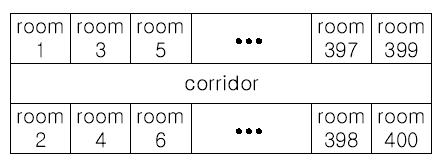
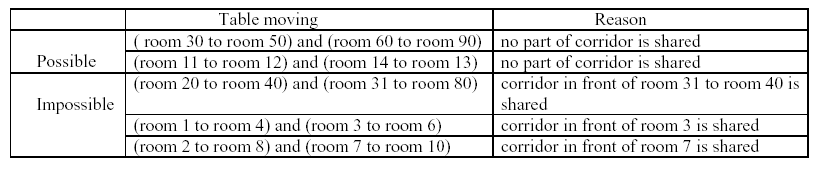
The floor has 200 rooms each on the north side and south side along the corridor. Recently the Company made a plan to reform its system. The reform includes moving a lot of tables between rooms. Because the corridor is narrow and all the tables are big, only one table can pass through the corridor. Some plan is needed to make the moving efficient. The manager figured out the following plan: Moving a table from a room to another room can be done within 10 minutes. When moving a table from room i to room j, the part of the corridor between the front of room i and the front of room j is used. So, during each 10 minutes, several moving between two rooms not sharing the same part of the corridor will be done simultaneously. To make it clear the manager illustrated the possible cases and impossible cases of simultaneous moving.
For each room, at most one table will be either moved in or moved out. Now, the manager seeks out a method to minimize the time to move all the tables. Your job is to write a program to solve the manager’s problem.
The floor has 200 rooms each on the north side and south side along the corridor. Recently the Company made a plan to reform its system. The reform includes moving a lot of tables between rooms. Because the corridor is narrow and all the tables are big, only one table can pass through the corridor. Some plan is needed to make the moving efficient. The manager figured out the following plan: Moving a table from a room to another room can be done within 10 minutes. When moving a table from room i to room j, the part of the corridor between the front of room i and the front of room j is used. So, during each 10 minutes, several moving between two rooms not sharing the same part of the corridor will be done simultaneously. To make it clear the manager illustrated the possible cases and impossible cases of simultaneous moving.
For each room, at most one table will be either moved in or moved out. Now, the manager seeks out a method to minimize the time to move all the tables. Your job is to write a program to solve the manager’s problem.
Input
The input consists of T test cases. The number of test cases ) (T is given in the first line of the input. Each test case begins with a line containing an integer N , 1<=N<=200 , that represents the number of tables to move. Each of the following
N lines contains two positive integers s and t, representing that a table is to move from room number s to room number t (each room number appears at most once in the N lines). From the N+3-rd line, the remaining test cases are listed in the same manner as
above.
Output
The output should contain the minimum time in minutes to complete the moving, one per line.
Sample Input
3
4
10 20
30 40
50 60
70 80
2
1 3
2 200
3
10 100
20 80
30 50
Sample Output
10
20
30
对房间号进行处理,然后对经过的房间进行标记,最后得到最大重复数。(大牛的思想就是牛。。。。)#include<iostream> using namespace std; struct node { int s,e; }a[210]; int c[210]; int main() { int test; int n,i,j,max,temp; scanf("%d",&test); while(test--) { memset(c,0,sizeof(c)); max=0; scanf("%d",&n); for(i=0;i<n;i++) { scanf("%d%d",&a[i].s,&a[i].e); a[i].s=(a[i].s+1)/2; a[i].e=(a[i].e+1)/2; } for(i=0;i<n;i++) { if(a[i].s>a[i].e) { temp=a[i].s; a[i].s=a[i].e; a[i].e=temp; } for(j=a[i].s;j<=a[i].e;j++) { c[j]++; if(c[j]>max) { max=c[j]; } } } printf("%d\n",max*10); } return 0; }

 1万+


 扫一扫


 被折叠的 条评论
为什么被折叠?
 到【灌水乐园】发言


