


目录
本文介绍交叉滞后模型相关知识,以及显变量模型与潜变量模型在Mplus中的语法。
如仅想了解操作方法,可直接跳转操作篇。
理论篇
交叉滞后面板模型(Cross-Lagged Panel Model, CLPM)是描述变量之间相互关系的一种纵向数据分析方法。
Cross-lagged panel analysis is an analytical strategy used to describe reciprocal relationships, or directional influences, between variables over time (Kearney, 2017).
The cross-lagged panel model (CLPM) has been extremely popular in behavioral and psychological science research (Usami et al., 2019).
最基本的CLPM如下图所示,对两个变量在两个时间点分别进行了测量,因此,该模型包括了两个X变量(x1,x2)和两个Y变量(y1,y2)。
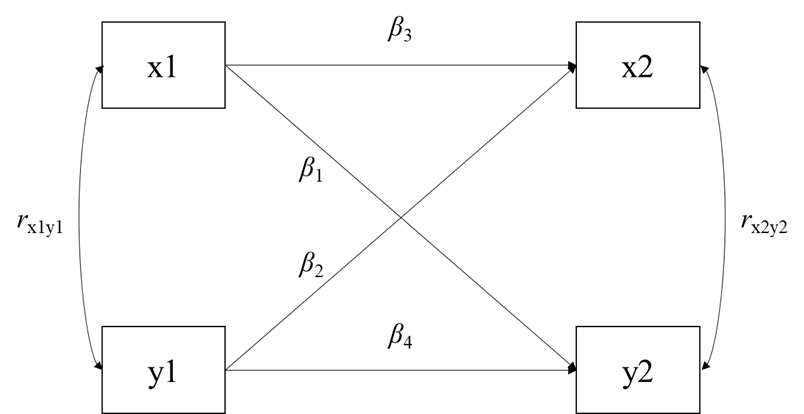
CLPM估计三种类型的关系
1. [Synchronous] Correlations:指同一时间点两个变量之间的关系。在上图中为x1与y1之间的相关(rx1y1),x2与y2之间的相关(rx2y2)。
2. Autoregressive effects:指不同时间点同一变量之间的关系。在上图中为x1到x2的效应(β3),y1到y2的效应(β4)。
Autoregressive effects describe the amount of stability in constructs over time. Smaller autoregressive coefficients (closer to zero) indicate more variance in the construct, meaning less stability or influence from the previous time point. Larger autoregressive coefficients indicate little variance over time, meaning more stability or influence from the previous time point (Kearney, 2017).
3. Cross-Lagged effects:指不同时间点不同变量之间的关系。在上图中为x1到y2的效应(β1),y1到x2的效应(β2)。
CLPM的优缺点
CLPM的优点为:在控制同一时间点内变量之间相关性和变量跨时间稳定性的情况下,探讨一个变量对另一个变量的预测效应。
CLPM的缺点是:纵向数据本身是一种多水平的数据,变量变异的来源可以天然分类到个体间水平和个体内水平。但CLPM混淆了个体间(Between-person)和个体内(Within-person)这两个截然不同水平的效应。
A major limitation of the CLPM is that it does not separate between-person effects from within-person effects. Depending on the between-person and within-person variance structures, CLPM results may reflect mostly between-person effects, mostly within-person effects, or an ambiguous mix of effects, leaving the researcher with an uninterpretable blend of effects (Masselink et al., 2018).
因此,传统交叉滞后模型的基础上,Hamaker等人(2015)提出了随机截距的交叉滞后模型(Random Intercepts Cross-Lagged Panel Model, RI-CLPM),详情可见下面这篇文章。
 https://blog.csdn.net/m0_54401011/article/details/129029691
操作篇—Mplus语法
显变量模型—两个变量两波数据
假设有两个变量X和Y,对每个变量进行了两次测量,得到四个变量x1,x2,y1,y2。对应CLPM的Mplus语句为:
TITLE: Cross-Lagged Panel Model, 2 variables, 2 waves;


 1万+


 扫一扫







&spm=1001.2101.3001.12003&articleId=131506546&d=1&t=3&u=c33f1d0edc4f4eb1865b6b561839efec)


 被折叠的 条评论
为什么被折叠?
 到【灌水乐园】发言


