


一、有效的括号
思路:
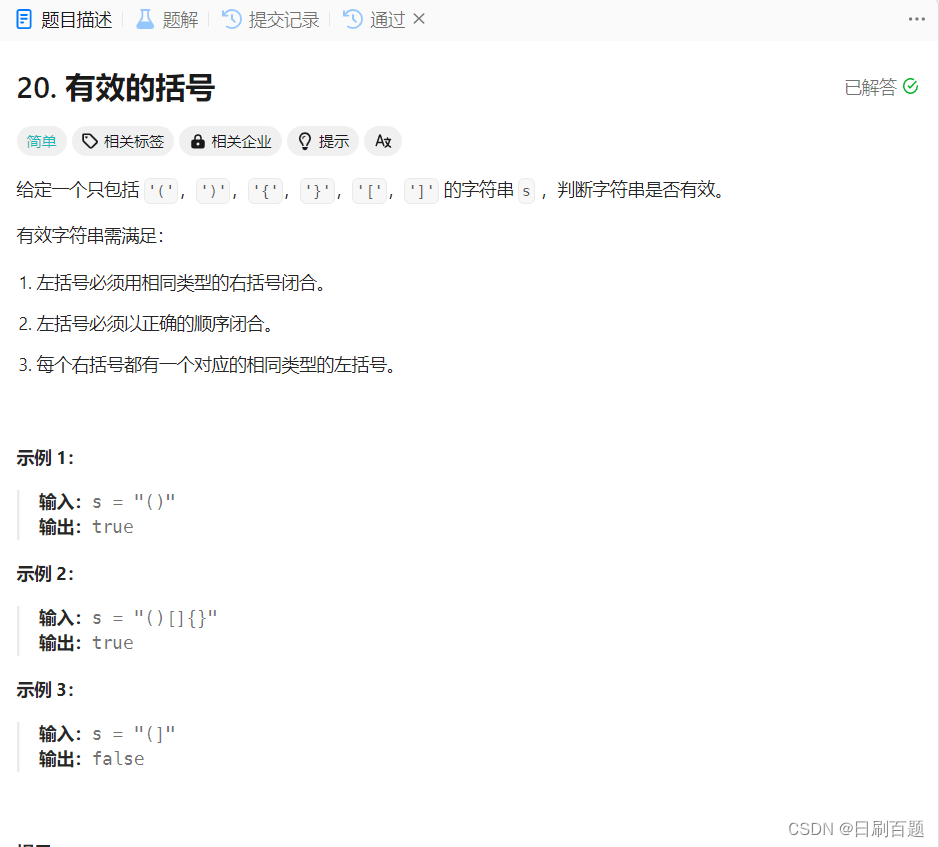
1)括号的顺序匹配:用栈实现,遇到左括号入,遇到右括号出(保证所出的左括号与右括号对应),否则顺序不匹配。
2)括号的数量匹配:
1>左括号大于右括号:用栈实现,遇到左括号入,遇到右括号出,遍历完字符数组,此时栈不为空,则说明左括号数量大于右括号;
2>右括号大于左括号:遇到右括号出时,判断栈是否为空,若此时栈为空,说明右括号数量大于左括号;
typedef char  SDateType;
typedef struct Stack
{
	SDateType* a;
	int top;
	int capacity;

}Stack;
//初始化栈和销毁栈
void InitStack(Stack* ps)
{
	assert(ps);
	ps->a = NULL;
	ps->capacity = ps->top = 0;
}
void DestoryStack(Stack* ps)
{
	assert(ps);
	free(ps->a);
	ps->a = NULL;
	ps->capacity = ps->top = 0;

}

//出栈和入栈
void StackPush(Stack* ps, SDateType x)
{
	assert(ps);
	//扩容
	if (ps->top == ps->capacity)
	{
		int newcapacity = ps->capacity == 0 ? 4 : ps->capacity * 2;
		SDateType* tmp = (SDateType*)realloc( ps->a,newcapacity * sizeof(SDateType));
		if (tmp == NULL)
		{
			perror("realloc fail:");
			return;
		}
		ps->a = tmp;
		ps->capacity = newcapacity;

	}
	//尾插
	ps->a[ps->top] = x;
	ps->top++;
}
void StackPop(Stack* ps)
{
	assert(ps);
	assert(ps->top > 0);//只少有一个元素,才能删除
	ps->top--;
}

//栈的有效个数和栈顶元素
int  StackSize(Stack* ps)
{
	assert(ps);
	return ps->top;
}
int   StackTop(Stack* ps)
{
	assert(ps);
	assert(ps->top > 0);
	return ps->a[ps->top - 1];
}

//栈是否为空
bool StackEmpty(Stack* ps)
{
	assert(ps);
	return ps->top == 0;
}
int isValid(char* s) {
	Stack ps;
	InitStack(&ps);

	while (*s)
	{
		if (*s == '[' || *s == '(' || *s == '{')
		{
			StackPush(&ps, *s);
			s++;
		}
		else

		{
			if (StackEmpty(&ps))
			{
				return false;
			}
			char tmp = StackTop(&ps);
			StackPop(&ps);
			if ((*s == ']' && tmp != '[') ||
				(*s == '}' && tmp != '{') ||
				(*s == ')' && tmp != '('))
			{
				return false;
			}

			s++;

		}
	}
	if (!StackEmpty(&ps))
	{
		return false;
	}
	else {
		return true;
	}
	DestoryStack(&ps);
}
二、用队列实现栈
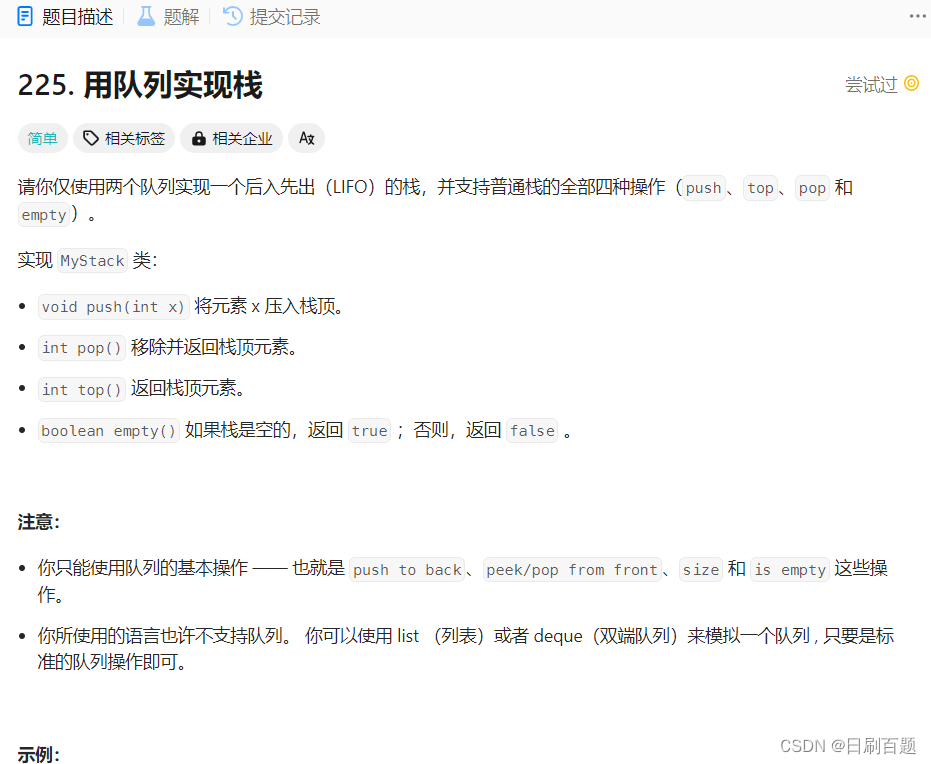
思路: 栈是后进先出,队列是先进先出。
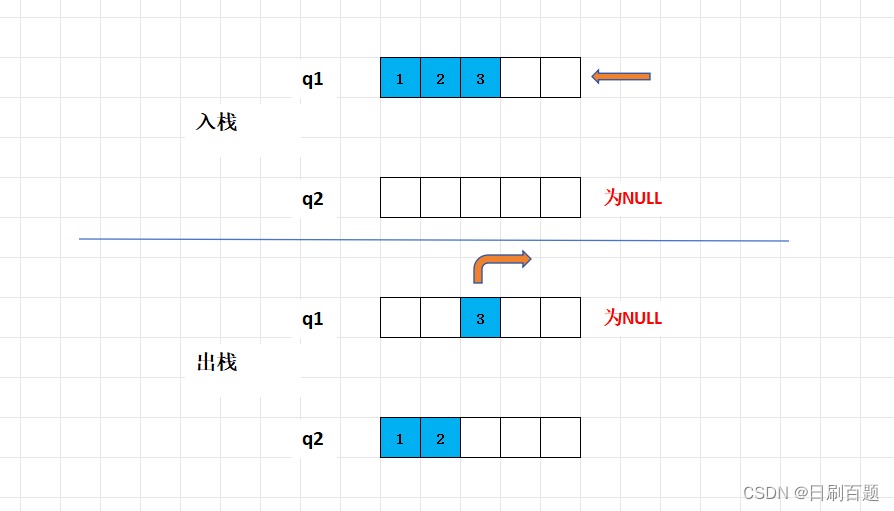
用俩队列实现栈
1)入栈时,选择有数据的队列入数据;
2)出栈时,将有数据队列中前k-1个数据出队列,并入到空队列中,返回并出有数据队列的最后一个数据
typedef int QDateType;
typedef struct QueueNode
{
	QDateType val;
	struct QueueNode * next;
}QueueNode;
typedef struct Queue
{
	QueueNode *head;
	QueueNode *tail;
	QDateType size;
}Queue;

// 初始化队列
void QueueInit(Queue* pq)
{
	assert(pq);
	pq->head = pq->tail = NULL;
	pq->size = 0;
}

void QueuePush(Queue* pq, QDateType x)
{
	assert(pq);
	QueueNode* node = (QueueNode*)malloc(sizeof(QueueNode));

	node->val = x;
	node->next = NULL;
	if (pq->tail == NULL)
	{
		pq->head = pq->tail = node;
		pq->size++;
	}
	else
	{
		pq->tail->next = node;
		pq->tail = node;
		pq->size++;
	}
}
void QueuePop(Queue* pq)
{
	assert(pq);
	assert(pq->head != NULL);//只少保证一个节点
	QueueNode* del = pq->head;
	pq->head = pq->head->next;
	free(del);
	del = NULL;
	pq->size--;
	if (pq->head == NULL)//只有一个节点处理
	{
		pq->tail = NULL;
	}
}

// 返回队头和队尾
QDateType QueueFront(Queue* pq)
{
	assert(pq);
	return pq->head->val;
}
QDateType QueueBack(Queue* pq)
{
	assert(pq);
	return pq->tail->val;
}

// 获取队列中有效元素个数
int QueueSize(Queue* pq)
{
	assert(pq);
	return pq->size;
}


bool QueueEmpty(Queue* pq)
{
	assert(pq);
	return pq->head==NULL;
}

void QueueDestroy(Queue* pq)
{
	assert(pq);
	QueueNode* cur = pq->head;
	while (cur)
	{
		QueueNode* next = cur->next;
		free(cur);
		cur = next;
	}
	pq->head = pq->tail = NULL;
	pq->size = 0;

}
typedef struct {
    Queue q1;
     Queue q2;

} MyStack;


MyStack* myStackCreate() {
    MyStack* obj=(MyStack*)malloc(sizeof(MyStack));
    QueueInit(&obj->q1);
    QueueInit(&obj->q2);
    return obj;

}

void myStackPush(MyStack* obj, int x) {
    if(!QueueEmpty(&obj->q1))
    {
        QueuePush(&obj->q1,x);
    }
    else{
        QueuePush(&obj->q2,x);
    }
}
bool myStackEmpty(MyStack* obj) {
    return QueueEmpty(&obj->q1)&&QueueEmpty(&obj->q2);
}

int myStackPop(MyStack* obj) {
    assert(!myStackEmpty(obj));
    Queue * empty=&obj->q1;
    Queue * nonempty=&obj->q2;
    if(!QueueEmpty(empty))
    {
        empty=&obj->q2;
        nonempty=&obj->q1;
    }
    while(QueueSize(nonempty)!=1)
    {
       int tmp= QueueFront(nonempty);
       QueuePush(empty,tmp);
        QueuePop(nonempty);
    }
     int tmp= QueueFront(nonempty);
      QueuePop(nonempty);
      return tmp;
}

int myStackTop(MyStack* obj) {
     assert(!myStackEmpty(obj));
    Queue * empty=&obj->q1;
    Queue * nonempty=&obj->q2;
    if(!QueueEmpty(empty))
    {
        empty=&obj->q2;
        nonempty=&obj->q1;
    }
    return QueueBack(nonempty);
}


void myStackFree(MyStack* obj) {
    QueueDestroy(&obj->q1);
    QueueDestroy(&obj->q2);
    free(obj);

}
三、用栈实现队列
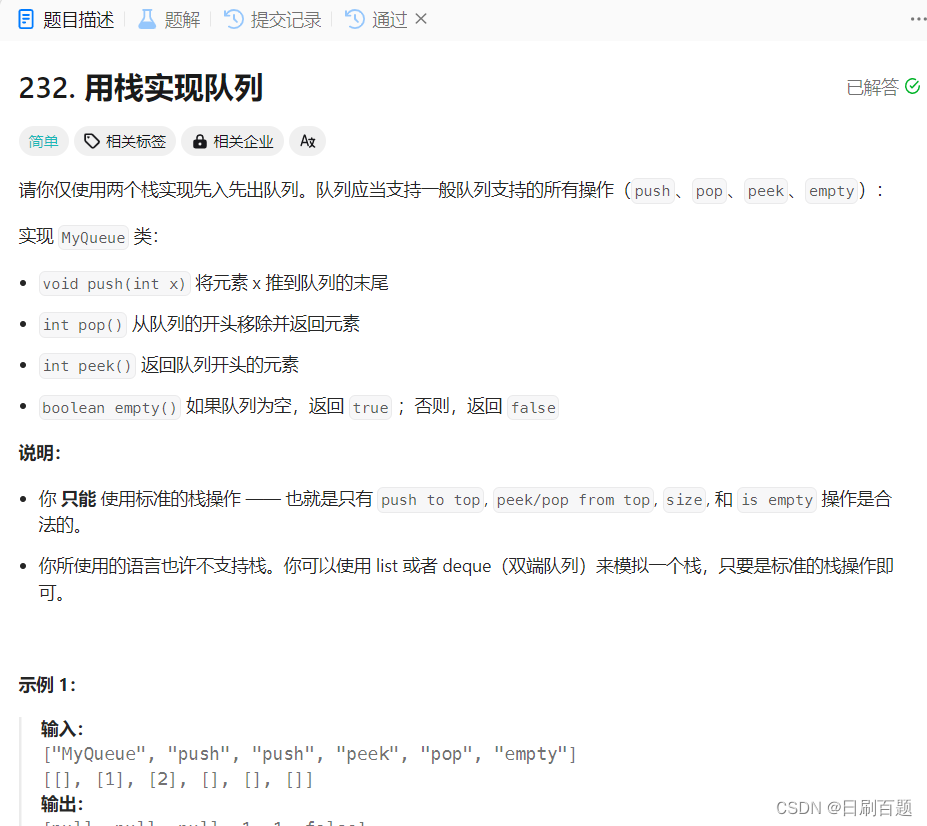
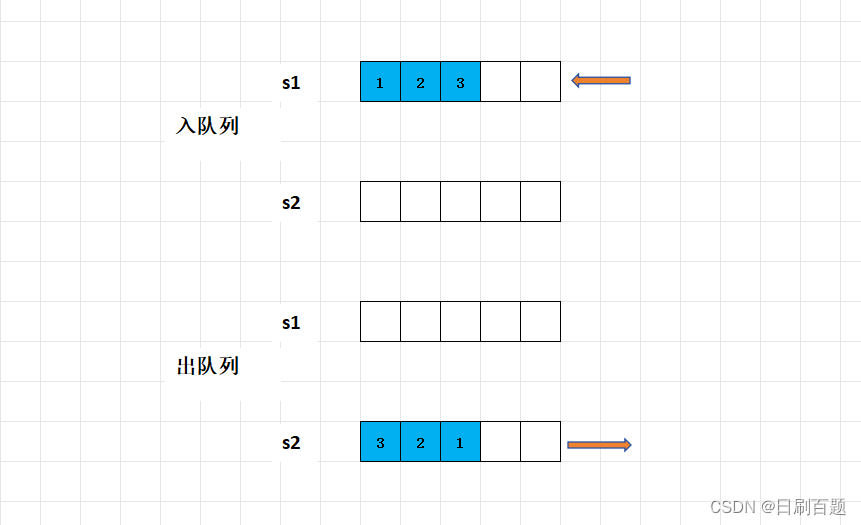
思路: 栈是后进先出,队列是先进先出。
1)入队列:s1栈用来在栈顶入数据;
2)出队列:s2栈用来出栈顶数据,如果s2为空,则从s1出数据入到s2中去(比如;s1中的数据为1,2,3,入到s2变为3,2,1),再出s2的栈顶数据,这样就满足队列的性质了
typedef int  SDateType;
typedef struct Stack
{
	SDateType* a;
	int top;
	int capacity;

}Stack;
//初始化栈和销毁栈
void InitStack(Stack* ps)
{
	assert(ps);
	ps->a = NULL;
	ps->capacity = ps->top = 0;
}
void DestoryStack(Stack* ps)
{
	assert(ps);
	free(ps->a);
	ps->a = NULL;
	ps->capacity = ps->top = 0;

}

//出栈和入栈
void StackPush(Stack* ps, SDateType x)
{
	assert(ps);
	//扩容
	if (ps->top == ps->capacity)
	{
		int newcapacity = ps->capacity == 0 ? 4 : ps->capacity * 2;
		SDateType* tmp = (SDateType*)realloc( ps->a,newcapacity * sizeof(SDateType));
		if (tmp == NULL)
		{
			perror("realloc fail:");
			return;
		}
		ps->a = tmp;
		ps->capacity = newcapacity;

	}
	//尾插
	ps->a[ps->top] = x;
	ps->top++;
}
void StackPop(Stack* ps)
{
	assert(ps);
	assert(ps->top > 0);//只少有一个元素,才能删除
	ps->top--;
}

//栈的有效个数和栈顶元素
int  StackSize(Stack* ps)
{
	assert(ps);
	return ps->top;
}
int   StackTop(Stack* ps)
{
	assert(ps);
	assert(ps->top > 0);
	return ps->a[ps->top - 1];
}

//栈是否为空
bool StackEmpty(Stack* ps)
{
	assert(ps);
	return ps->top == 0;
}


typedef struct {
    Stack s1;
    Stack s2;

} MyQueue;


MyQueue* myQueueCreate() {
    MyQueue* obj=(MyQueue* )malloc(sizeof(MyQueue));
    InitStack(&obj->s1);
    InitStack(&obj->s2);
    return obj;

}

void myQueuePush(MyQueue* obj, int x) {
    StackPush(&obj->s1,x);
}

bool myQueueEmpty(MyQueue* obj) {
    return StackEmpty(&obj->s1)&&StackEmpty(&obj->s2);
}

int myQueuePop(MyQueue* obj) {
    assert(!myQueueEmpty(obj));
    if(StackEmpty(&obj->s2))
    {
       while(!StackEmpty(&obj->s1))
       {
          int tmp= StackTop(&obj->s1);
          StackPush(&obj->s2,tmp);
          StackPop(&obj->s1);
       }

    }
     int tmp= StackTop(&obj->s2);
       StackPop(&obj->s2);
       return tmp;
}

int myQueuePeek(MyQueue* obj) {
     assert(!myQueueEmpty(obj));
    if(StackEmpty(&obj->s2))
    {
       while(!StackEmpty(&obj->s1))
       {
          int tmp= StackTop(&obj->s1);
          StackPush(&obj->s2,tmp);
          StackPop(&obj->s1);
       }

    }
    return StackTop(&obj->s2);
}


void myQueueFree(MyQueue* obj) {

   DestoryStack(&obj->s1);
   DestoryStack(&obj->s2);
   free(obj);


}
四、设计循环队列
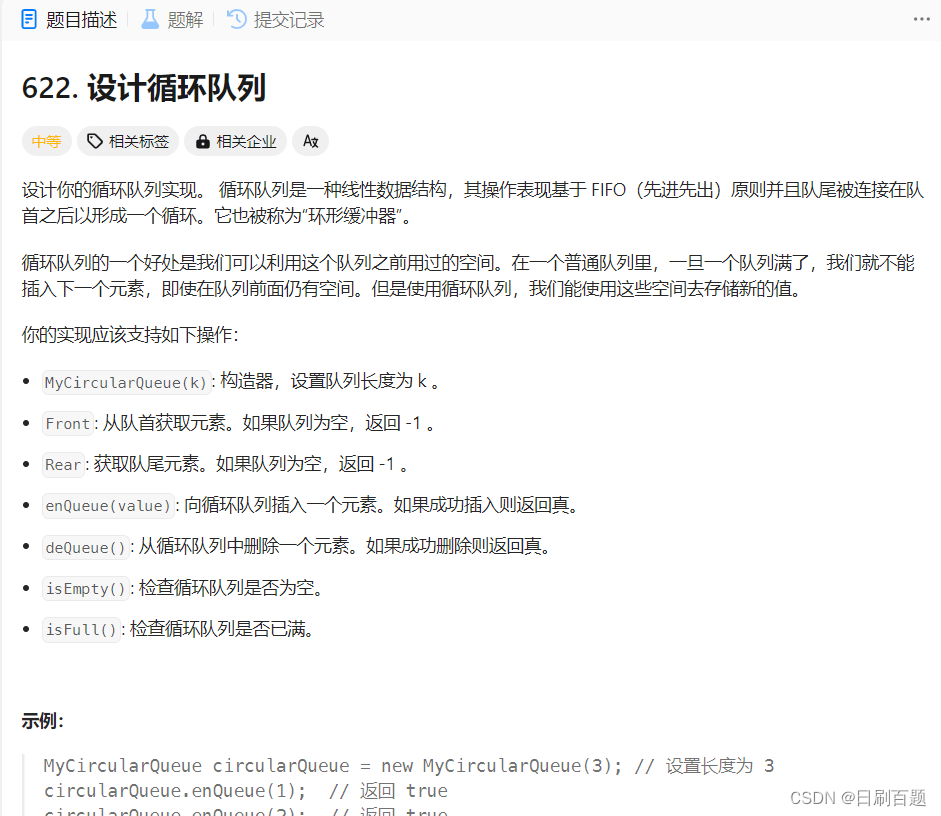
思路一:数组
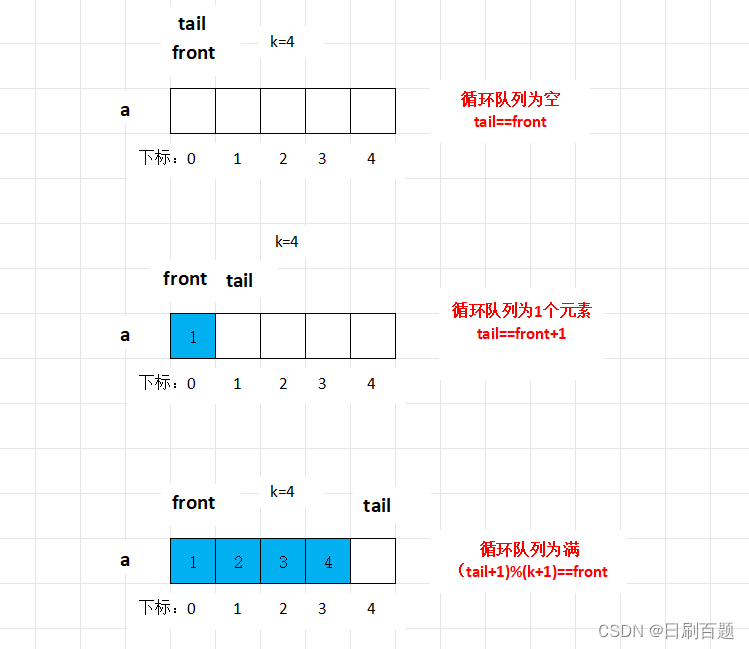
以front为队列头下标,tail为队列尾下一个元素下标,一共k个数据,开辟k+1个整型大小空间,方便区分队列为空、为满以及一个元素的情况
1)队列为空,front=tail
2)队列为1个元素,front+1=tail
3) 队列为满,(tail+1)%(k+1)==front
typedef struct {
    int *a;
    int front;
    int rear;
    int n;
} MyCircularQueue;


MyCircularQueue* myCircularQueueCreate(int k) {
    MyCircularQueue* obj=(MyCircularQueue*)malloc(sizeof(MyCircularQueue));
    int * tmp=(int *)malloc(sizeof(int)*(k+1));
    obj->a=tmp;
    obj->front=0;
    obj->rear=0;
    obj->n=k;
    return obj;
}

bool myCircularQueueIsFull(MyCircularQueue* obj) {
    if((obj->rear+1)%(obj->n+1)==obj->front)
    {
        return true;
    }
    return false;
}

bool myCircularQueueEnQueue(MyCircularQueue* obj, int value) {
    if(myCircularQueueIsFull( obj))
    {
        return false;
    }
    obj->a[obj->rear]=value;
    obj->rear++;
    obj->rear=obj->rear%(obj->n+1);
    return true;
}

bool myCircularQueueIsEmpty(MyCircularQueue* obj) {
    if(obj->front==obj->rear)
    {
        return true;
    }
    return false;
}
bool myCircularQueueDeQueue(MyCircularQueue* obj) {
    if(myCircularQueueIsEmpty( obj))
    {
        return false;
    }
    obj->front++;
    obj->front=obj->front%(obj->n+1);
    return true;
}

int myCircularQueueFront(MyCircularQueue* obj) {
    if(myCircularQueueIsEmpty( obj))
    {
        return -1;
    }
    return obj->a[obj->front];
}

int myCircularQueueRear(MyCircularQueue* obj) {
    if(myCircularQueueIsEmpty( obj))
    {
        return -1;
    }
    return  obj->a[(obj->rear-1+obj->n+1)%(obj->n+1)];
}


void myCircularQueueFree(MyCircularQueue* obj) {
    free(obj->a);
    free(obj);
}
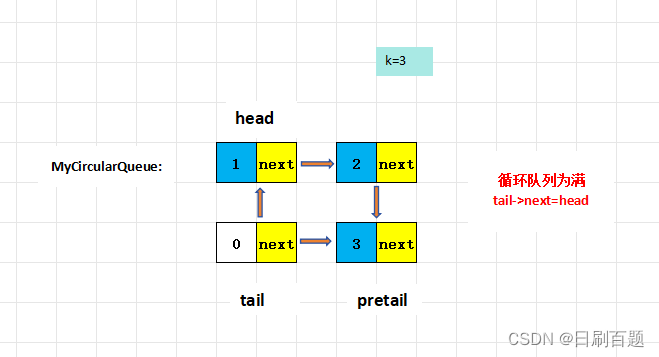
思路二:单向循环链表
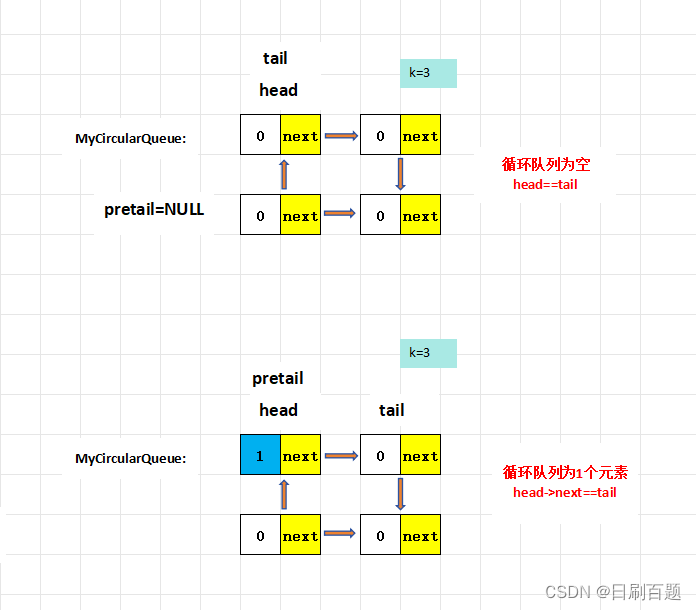
以head为队列头节点,tail为队列尾尾节点的下一个节点,一共k个数据,开辟k+1个节点的循环单向链表,方便区分队列为空、为满以及一个元素的情况
1)队列为空,head=tail
2)队列为1个元素,head->next=tail
3) 队列为满,tail->next=head
typedef struct QueueNode
{
	int val;
	struct QueueNode * next;
}QueueNode;

QueueNode* BuyNode(int x)
{
    QueueNode* node=(QueueNode*)malloc(sizeof(QueueNode));
    node->val=x;
    node->next=NULL;
    return node;
}
typedef struct MyCircularQueue{
   QueueNode *head;
	QueueNode *tail;
    QueueNode * pretail;
	int n;
} MyCircularQueue;


MyCircularQueue* myCircularQueueCreate(int k) {
    MyCircularQueue* obj=(MyCircularQueue*)malloc(sizeof(MyCircularQueue));
    QueueNode* node=BuyNode(0);
    obj->pretail=NULL;
    obj->head=obj->tail=node;
    obj->n=(k+1);
    QueueNode* cur=obj->tail;
    while(k--)
    {
       QueueNode* node=BuyNode(0);

      cur->next=node;
        cur= cur->next;
    }

   cur->next=obj->head;
    return obj;
}

bool myCircularQueueIsFull(MyCircularQueue* obj) {
    if(obj->tail->next==obj->head)
    {
        return true;
    }
    return false;
}

bool myCircularQueueEnQueue(MyCircularQueue* obj, int value) {
    if(myCircularQueueIsFull( obj))
    {
        return false;
    }
    obj->tail->val=value;
    obj->pretail=obj->tail;
    obj->tail=obj->tail->next;


    return true;
}

bool myCircularQueueIsEmpty(MyCircularQueue* obj) {
    if(obj->head==obj->tail)
    {
        return true;
    }
    return false;
}
bool myCircularQueueDeQueue(MyCircularQueue* obj) {
    if(myCircularQueueIsEmpty( obj))
    {
        return false;
    }
    obj->head=obj->head->next;

    return true;
}

int myCircularQueueFront(MyCircularQueue* obj) {
    if(myCircularQueueIsEmpty( obj))
    {
        return -1;
    }
    return obj->head->val;
}

int myCircularQueueRear(MyCircularQueue* obj) {
    if(myCircularQueueIsEmpty( obj))
    {
        return -1;
    }
    return  obj->pretail->val;
}


void myCircularQueueFree(MyCircularQueue* obj) {
   while(obj->n--)
   {
       QueueNode*next=obj->head->next;
       free(obj->head);
       obj->head=next;
   }
   obj->head=NULL;
    free(obj);
}
 4300


 扫一扫


&spm=1001.2101.3001.11974&articleId=134538488&d=1&t=3&u=1847cf66f5434fa38d93739f6600d6dc)


 被折叠的 条评论
为什么被折叠?
 到【灌水乐园】发言


