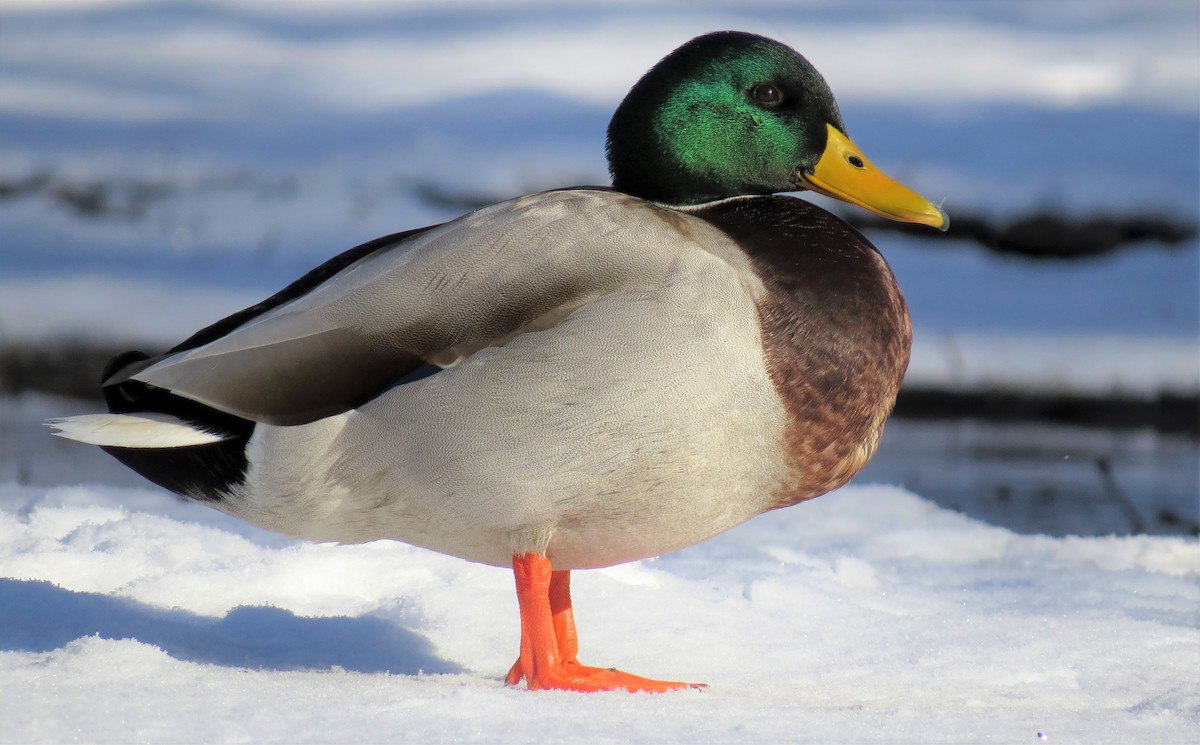

Mallard Anas platyrhynchos
Sign in to see your badges
Species names in eBird-supported languages
| Language | Common name |
|---|---|
| Afrikaans | Groenkop-/Meksikaanse Eend |
| Asturian | Coríu real/mexicanu |
| Azerbaijani | Yaşılbaş/Meksika ördəyi |
| Bulgarian | Зеленоглава / Мексиканска патица |
| Catalan | ànec collverd/mexicà |
| Czech | kachna divoká/mexická |
| Danish | Gråand/Mexicoand |
| Dutch | Wilde/Mexicaanse eend |
| English | Mallard/Mexican Duck |
| English (AVI) | Mallard/Mexican Duck |
| English (United States) | Mallard/Mexican Duck |
| Estonian | sinikael-part/mehhiko sinikael-part |
| French | Canard colvert ou C. du Mexique |
| Galician | Lavanco real/mexicano |
| German | Stock-/Mexikoente |
| Japanese | マガモ/メキシコガモ |
| Norwegian | stokkand/mexicoand |
| Polish | krzyżówka zwyczajna/meksykańska |
| Russian | Кряква/Мексиканская кряква |
| Serbian | Gluvara/meksička plovka |
| Slovak | kačica divá/mexická |
| Slovenian | Mlakarica/Mehiška mlakarica |
| Spanish | Ánade Azulón/Mexicano |
| Spanish (Chile) | Pato de collar/Mexicano |
| Spanish (Mexico) | Pato de Collar/Mexicano |
| Spanish (Paraguay) | Pato marrueco/mexicano |
| Spanish (Puerto Rico) | Pato Cabeciverde/Mexicano |
| Spanish (Spain) | Ánade azulón/mexicano |
| Spanish (Uruguay) | Pato Cabeza Verde/Mexicano |
| Swedish | gräsand/mexikansk and |
| Turkish | Yeşilbaş/Meksika Ördeği |
| Ukrainian | Крижень звичайний/мексиканський |
Full content is available exclusively to Birds of the World subscribers. Sign in Learn more
Introduction
The most familiar and widely distributed of the dabbling ducks, the Mallard is often the standard against which all other ducks are compared. The male's characteristic and conspicuous green head, gray flanks, and black tail-curl arguably make it the most easily identified duck. Once known as "the wild duck" in England, reflecting its status as a highly prized game bird, the Mallard has long been shot for sport and meat throughout the Northern Hemisphere. It is the source of all domestic ducks except the Muscovy. Feral populations of tame ducks, composed of mixtures of wild Mallards and domesticated breeds, live in urban areas through-out the world, where they habituate to humans who feed them.
In North America, the Mallard is the most abundant duck species. Its success in the wild reflects its adaptability to varied habitats, its hardiness in cold climates, its catholic food tastes, and its tolerance of human activities. The Mallard can be found wintering as far north as conditions permit as long as there is open water and access to food. As a breeder, it ranges from California to Alaska and across the central plains to the Atlantic Coast, nesting in marshes, farmlands, forests, and urban parks. The bulk of the Mallard's diet outside the breeding season consists of seeds of both natural wetland plants and agricultural crops. Although the Mallard is the most heavily hunted duck species in North America, its populations remain more or less steady, and the species is not considered in danger. Nevertheless, managers carefully monitor and manage Mallard populations and their habitats to ensure the continued prosperity of this extremely popular and successful duck.
The taxonomy of the Mallard and close relatives is complex with little agreement on how to treat some taxa. In this account, we follow the American Ornithologists' Union (American Ornithologists' Union 1998a), which includes the Mexican Duck (Anas platyrhynchos diazi) as a subspecies of the Mallard. Hereafter, Mallard refers to the platyrhynchos group, typical Mallards, and Mexican Duck refers to the diazi group (see Systematics).
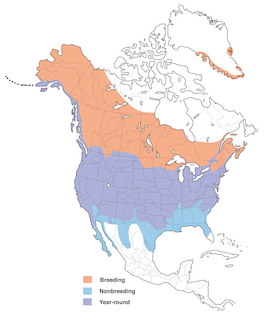
- Year-round
- Migration
- Breeding
- Non-Breeding
Distribution of the Mallard (Anas p. platyrhynchos) in North and Middle America. Additional (introduced) populations breed south to the dashed blue line. A. p. conboschas is largely resident in Greenland. Range of Mexican Mallard (A. p. diazi) indicated by solid gray line (year-round) and dashed gray line (winter). The Mallard also breeds in Europe, Asia, the Virgin Is., Hawaiian Is., Australia, and New Zealand. See text for details.