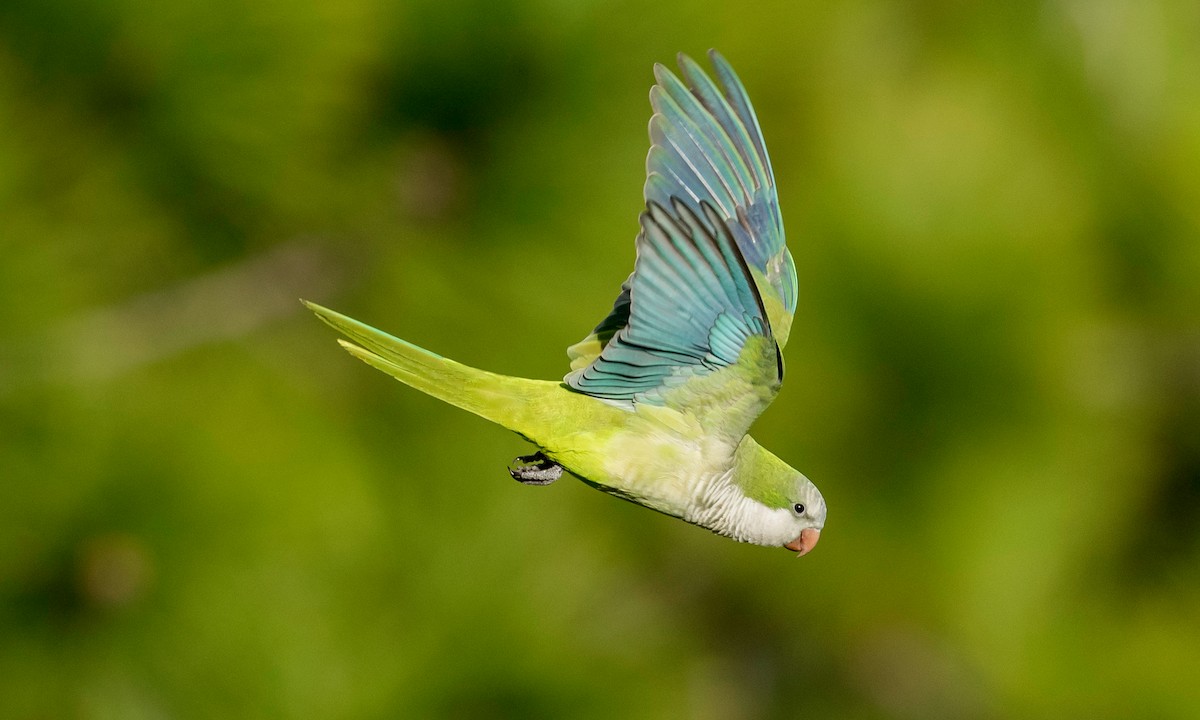

Monk Parakeet Myiopsitta monachus
Sign in to see your badges
Species names in eBird-supported languages
| Language | Common name |
|---|---|
| Afrikaans | Monniksparkiet |
| Arabic | دُرّةٌ نَاسِكَةٌ |
| Asturian | Cotorra monxa |
| Azerbaijani | Rahib tutuquşu |
| Basque | Papagai bulargrisa |
| Bulgarian | Папагал монах |
| Catalan | cotorreta pitgrisa |
| Chinese | 和尚鸚鵡 |
| Chinese (Hong Kong SAR China) | 灰胸鸚哥 |
| Chinese (SIM) | 灰胸鹦哥 (和尚鹦鹉) |
| Croatian | opatica |
| Czech | mníšek šedý |
| Danish | Munkeparakit |
| Dutch | Monniksparkiet |
| English | Monk Parakeet |
| English (AVI) | Monk Parakeet |
| English (United States) | Monk Parakeet |
| Estonian | munkpapagoi |
| Finnish | munkkiaratti |
| French | Perriche veuve |
| Galician | Catorra arxentina |
| German | Mönchssittich |
| Greek | Μυοψιττακός |
| Hebrew | תוכי נזירי |
| Hungarian | Barátpapagáj |
| Icelandic | Munkpáfi |
| Italian | Parrocchetto monaco |
| Japanese | オキナインコ |
| Latvian | Mūku papagailis |
| Lithuanian | Paprastoji kalita |
| Norwegian | munkeparakitt |
| Polish | mnicha |
| Portuguese (Brazil) | caturrita |
| Portuguese (Portugal) | Caturrita |
| Romanian | Papagal călugăr |
| Russian | Попугай-монах |
| Serbian | Papagaj kaluđerica |
| Slovak | mních zelený |
| Slovenian | Meniška papiga |
| Spanish | Cotorra Argentina |
| Spanish (Argentina) | Cotorra |
| Spanish (Bolivia) | Cotorra Pecho Plomo |
| Spanish (Chile) | Cotorra |
| Spanish (Cuba) | Cotorra monja |
| Spanish (Mexico) | Perico Monje Argentino |
| Spanish (Paraguay) | Cotorrita |
| Spanish (Peru) | Cotorra Argentina |
| Spanish (Puerto Rico) | Perico Monje |
| Spanish (Spain) | Cotorra argentina |
| Spanish (Uruguay) | Cotorra |
| Swedish | munkparakit |
| Turkish | Keşiş Papağanı |
| Ukrainian | Калита сіроволий |
Full content is available exclusively to Birds of the World subscribers. Sign in Learn more
Introduction
Native of South America from central Bolivia and southern Brazil south to central Argentina, the Monk Parakeet is popular as a pet bird in the United States. In North America, free-flying Monk Parakeets (escapees) date back to the 1960s. Early on, it was feared that this parakeet would thrive in its new home, ravaging crops as its range expanded. Over the years, however, this threat has not materialized and in many areas efforts to retrieve wild parakeets have been discontinued. It is worth noting that, in Argentina, agricultural losses attributed to the Monk Parakeet have never been measured accurately.
In the United States, the species has a variety of common names, including Gray-headed or Gray-breasted Parakeet, Quaker Conure, and Quaker Parakeet. The bird's cowl-like gray face and chest, reminiscent of religious attire, earned the species its Quaker and monk appellations.
The Monk Parakeet is the only species in the parrot family that does not nest in a cavity. Instead, it constructs a stick structure that can house a single nest or be a larger complex with a dozen or more separate chambers. Whereas most other parrot species suffer declines as a result of logging and the removal of suitable nest sites, Monk Parakeets easily adapt to the changing landscape, building nests and raising young. The species uses and maintains its stick compound year-round. This habit may explain this parakeet's ability to colonize areas with colder winters than in its region of origin.
The first review of this species' distribution in North America is found in Neidermyer and Hickey (Neidermyer and Hickey 1977). A few informative regional studies are also available (e.g., see Olivieri and Pearson 1992, Hyman and Pruett-Jones 1995). In general, however, there has been so little research on North American Monk Parakeets that much of the information in this life history is based on work done in Argentina (e.g., see Martella and Bucher 1990, Navarro et al. 1992a).
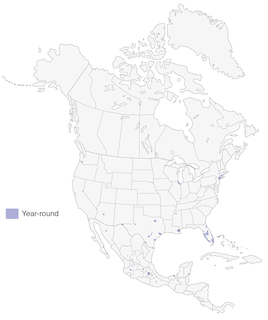
- Year-round
- Migration
- Breeding
- Non-Breeding
This species is native to the southern portion of South America. See text for details. Monk Parakeet populations in other parts of North America have not persisted.