


The best Gorgias alternative for most ecommerce brands is Re:amaze, which keeps a Gorgias-style inbox but charges $29 to $69 per seat instead of per ticket. Richpanel is the pick for maximum AI automation, at $0.20 per AI-handled conversation with a refund if it misses 50% automation in 30 days.
Gorgias is still the ecommerce helpdesk benchmark: it powers support for 40% of Shopify brands and holds 4.6/5 on G2. Teams leave because it bills every ticket ($360 a month for 2,000 on Pro), then charges again, $0.90 to $1.50 per automated interaction, when its AI Agent resolves one.
The full list: Re:amaze (closest Gorgias swap), Richpanel (AI-first with a guarantee), Shopify Inbox (free chat with an AI agent), Help Scout (email-first), Freshdesk (multichannel beyond Shopify), Zendesk (biggest app marketplace), Kustomer (customer-record model for large B2C teams), and eesel (keep Gorgias, add AI on top).
If the AI bill is your only complaint, you may not need to move at all. Question Beauty runs eesel inside Gorgias and Shopify: in one month it handled 990 Gorgias tickets, sent 960 replies and closed 280 tickets with no person involved. If you work with an AI coding agent, it can use the eesel CLI to upload approved macros and help articles or ask test questions before go-live, though connecting Gorgias still needs an admin's approval.
Short on time? Jump to the comparison table or how to choose.
Why do teams look for Gorgias alternatives?
Mostly price, and the price shape more than the number. Gorgias's ecommerce helpdesk is good at what it does: Shopify orders, customers and store data sit inside every ticket, and its pricing page says 12,400+ brands are on the Pro plan alone. From the support side, I'd say that order context is what agents miss most when they switch tools. But three friction points come up again and again.
1. Every ticket is billed. Gorgias pricing is by monthly ticket count, never by seat. That's kind to lean teams: $10 a month for 50 tickets is a bargain. It gets harder as you grow. Pro is $360 a month for 2,000 tickets and Advanced is $900 for 5,000, and every ticket past your plan costs $0.40 (Starter, Basic) or $0.36 (Pro, Advanced). A flash sale that doubles your volume for two weeks lands straight on the bill. The Gorgias ticket limit is a well-known pain point, and G2 reviewers say it in their own words:
"The main frustration with Gorgias is the pricing model, which is based on ticket volume rather than a flat monthly fee. As our order volume grows and customer inquiries increase, the cost scales up quickly in ways that can be difficult to predict and budget for."

2. AI is billed on top, and the ticket still counts. The Gorgias AI agent handles returns, order tracking and other actions, and it's an add-on sold in monthly bundles of "automated interactions". Gorgias's AI Agent pricing explainer puts most plans at $0.90 per automated interaction and Starter at $1.00, and the pricing page charges $1.50 for each interaction past your bundle. The detail most buyers miss is in Gorgias's own billing docs: when AI Agent resolves a ticket without a human, you pay the automation fee and the helpdesk ticket fee for that same ticket.
3. It's built for ecommerce, Shopify first. Gorgias does connect to WooCommerce on every plan, BigCommerce from Basic and Magento from Pro, plus 150+ other apps. But the product is shaped around stores: revenue attribution, shopping assistance, order actions. If a big share of your queue is B2B email, IT requests or anything without an order behind it, you're paying for features you won't use, and a general helpdesk like Freshdesk or Zendesk fits better.
None of this means Gorgias is bad. It means it's tuned for one kind of team. If you're outside that profile, or the AI bill is what hurts, the options below are better fits.
What does Gorgias cost today?
Here's what Gorgias charges at three common sizes, from its pricing page in November 2026, on monthly billing.
| Store size | Gorgias plan | Monthly cost | What's included |
|---|---|---|---|
| Small store, no AI | Basic | $60 | 300 tickets, then $0.40 per extra ticket |
| Growing brand with AI | Pro + AI Agent | $550 | 2,000 tickets and 190 automated interactions |
| High-volume brand with AI | Advanced + AI Agent | $1,430 | 5,000 tickets and 530 automated interactions |
Annual billing cuts those to $50, $471 and $1,227 a month. The number to watch is the AI line. If the Pro brand above has its AI resolve 400 conversations in a busy month instead of 190, the extra 210 cost $1.50 each, which is $315 on top of the $550. That's the bill most teams are trying to get away from.
How do the Gorgias alternatives compare? {#summary-table}
| Tool | Best for | Starting price | AI cost | Free trial | Shopify order actions | G2 rating |
|---|---|---|---|---|---|---|
| Re:amaze | Gorgias-like inbox, per-seat price | $29/seat/mo ($59 Starter, unlimited seats) | 5 to 20 AI resolutions per user included, then $0.85 each | 14 days | Refund, cancel, draft orders | 4.6/5 (140) |
| Richpanel | AI-first, high-volume brands | $69/agent/mo, yearly contract | $0.20 per AI-handled conversation | Free trial (under 30 agents) | AI resolves refunds, tracking, cancellations | 4.7/5 (94) |
| Shopify Inbox | Small Shopify stores, free chat with AI | Free | No AI fee listed | Free app | Order status lookups in chat | 4.5/5 on Shopify App Store (5,818) |
| Help Scout | Email-first, relationship-driven teams | $25/user/mo (free plan for 5 users) | $0.75 per resolution | 3 months of Envoy free | Refund, cancel, edit, duplicate | 4.4/5 (435) |
| Freshdesk | Multichannel teams beyond Shopify | $19/agent/mo, billed annually | 500 sessions included once, then $49 per 100 | 14 days | Refund, cancel | 4.4/5 (4,003) |
| Zendesk | Enterprise, biggest app marketplace | $55/agent/mo, billed annually | $1.50 to $2.00 per automated resolution past allowance | 14 days | Via Shopify apps | 4.3/5 (7,126) |
| Kustomer | Large B2C teams that need customer records | Talk to sales | $0.75 per engaged conversation | Not listed | Via integration | 4.4/5 (570) |
| eesel | Keep Gorgias, add AI on top | $299/mo for 500 credits | Included: 1 credit per ticket or chat | 7 days, 100 credits | Looks up Shopify orders | n/a |
A note on the AI column: those units aren't the same thing. Gorgias, Re:amaze, Help Scout and Zendesk charge only when the AI resolves a conversation alone. Richpanel and Kustomer charge per conversation the AI handles. Freshdesk charges per session, and eesel charges a credit for every ticket or chat it works on, resolved or drafted. Divide by your real resolution rate before comparing.
How I picked these
I looked for tools a Gorgias customer actually moves to, then checked each one's own pricing page, docs and Shopify integration in November 2026. The order follows how well each fits a typical Gorgias customer, a Shopify brand with a handful of agents. Lower picks suit narrower cases, and eesel sits last because it isn't a helpdesk replacement at all.
The 8 best Gorgias alternatives in 2026
Each pick has the same parts: who it suits, what it does, what it costs, and my verdict.
1. Re:amaze: best for Shopify teams wanting Gorgias-like depth at a lower cost
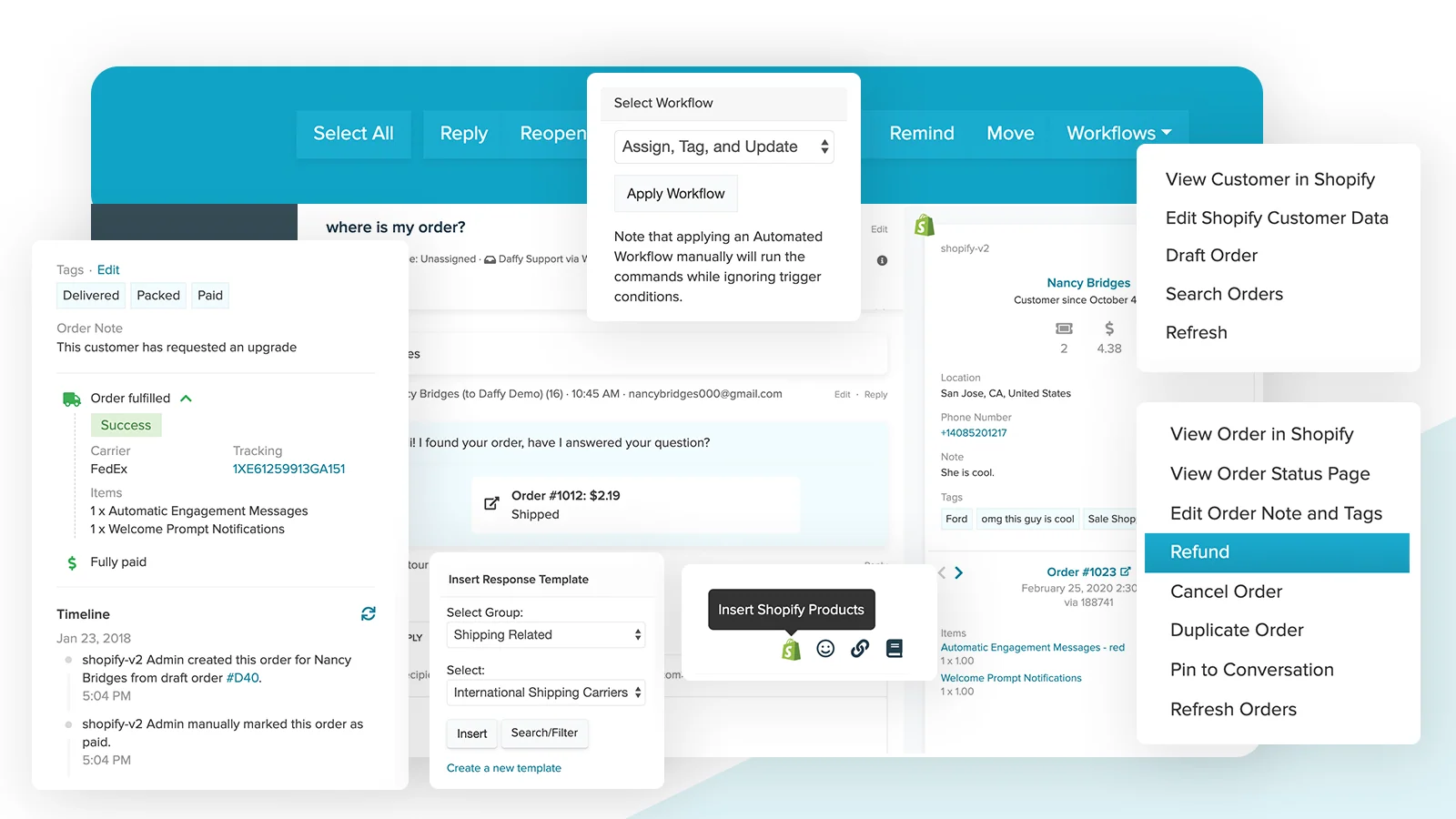
Re:amaze is the alternative that sits closest to Gorgias in its feature set: unified inbox, live chat, proactive Cues, a live view of site visitors, chatbots and live screen sharing (Peek), while charging per seat rather than per ticket. Owned by GoDaddy since 2021, it targets small and mid-size ecommerce and SaaS teams and covers email, chat, social, SMS, voice and push notifications from one workspace.
The pricing model flips Gorgias's logic: Re:amaze charges $29 to $69 per seat per month on its pricing page, not per ticket. That means a 3-agent team processing 5,000 tickets a month pays $87 to $207 against Gorgias Advanced at $900 for the same volume. The Starter plan is unusual: $59 flat a month for unlimited team members, capped at 500 responded conversations, with extra conversations at $15 per 100. For a small team it's one of the cheapest full setups on this list.
AI sits inside the platform: the Re:amaze AI Agent (still labelled beta) includes 5, 10 or 20 resolutions per user per month on Basic, Pro and Plus, then charges $0.85 per extra resolution. That's a little under Gorgias's $0.90, and the included allowance grows with your seat count.
On Shopify, the native integration shows every order inside the conversation, and agents can refund or cancel an order and create draft orders without leaving Re:amaze. SMS, voice, multiple brands and the live visitor view need Pro or higher, so price a multi-brand store on Pro from the start. Read the Re:amaze automation guide to see what its workflow engine can do before committing, and our Re:amaze pricing breakdown for the full plan table.
Pricing: Starter $59 flat/mo (500 conversations, unlimited seats), Basic $29/seat/mo, Pro $49/seat/mo, Plus $69/seat/mo (10% off annually). AI: 5 to 20 resolutions per user included, then $0.85 each. 14-day free trial, no credit card.
Verdict: Re:amaze is the best direct Gorgias swap if per-ticket pricing is your main objection and you want a comparable feature set at a lower, predictable cost. Skip it if your volume is low and your team is large, since per-seat pricing then costs more than Gorgias's per-ticket plans.
2. Richpanel: best for AI-first ecommerce brands with high ticket volume

Richpanel is the most AI-forward alternative on this list. Where Gorgias treats AI as an add-on to a helpdesk, Richpanel sells an AI team: a CX Manager AI that builds playbooks and monitors quality, a Customer Service Agent that resolves conversations, a Copilot AI that assists your human agents, and a QA AI that reviews every conversation. Its homepage pitches itself directly at "ecommerce teams that outgrew Gorgias or Zendesk".
Richpanel guarantees 50% automation within 30 days, or a full refund, even on an annual contract, according to its pricing page. It also promises a support bill at least 30% lower than Zendesk or Gorgias. The published results back the pitch: Ridge cut cost per ticket 70% while CSAT rose from 88% to 96%, and Jones Road Beauty went from 18 agents to 10 "with order volume flat or up", closing Black Friday with no backlog.
The pricing is now seat-based plus a cheap AI rate: Pro is $69 per agent per month and Pro Max $99, all on yearly contracts, and the Customer Service AI add-on is $0.20 per AI-handled conversation. The guarantee comes with the AI agents setup package, a $2,000 one-time fee that covers analysing your past conversations and building the self-service flows. For a team whose AI handles 2,000 conversations a month, that's $400 on Richpanel against about $1,800 on Gorgias at $0.90 an interaction, before Gorgias's ticket fee on the same tickets.
Richpanel also publishes the clearest migration plan of any alternative here: it moves conversations, macros, tags, routing and SLAs from Gorgias or Zendesk, keeps your old helpdesk serving customers until you approve the cutover, and can buy out the rest of your contract. Karta Ventures, which moved three brands, says on Richpanel's pricing page that "there were zero issues moving to Richpanel".
The catch is commitment: yearly contracts on every plan and a $2,000 setup fee for the guarantee. If you're a three-person store testing the waters, that's a lot to sign up for.
Pricing: Pro $69/agent/mo, Pro Max $99/agent/mo, Enterprise custom (yearly contracts). Customer Service AI $0.20 per AI-handled conversation. AI agents setup $2,000 one-time, with a full refund if 50% automation isn't reached in 30 days.
Verdict: The strongest option for ecommerce brands that want maximum AI automation and can commit to a yearly contract. Skip it if you want month-to-month flexibility.
3. Shopify Inbox: best for small Shopify stores that want free live chat with AI before paying for a helpdesk
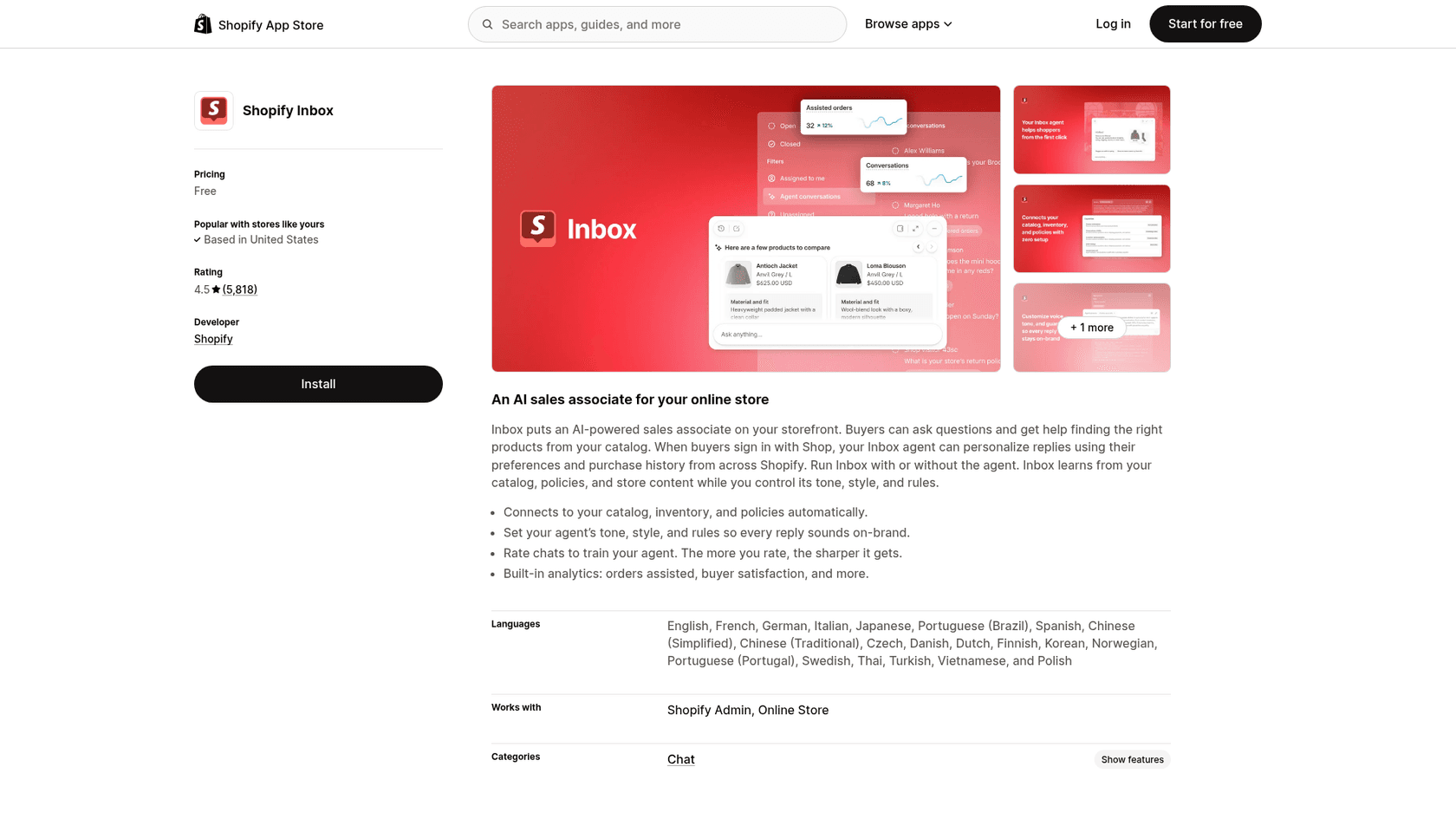
Shopify Inbox is the free option on this list. It's Shopify's own chat app, so it connects to your catalog, inventory and store policies with no setup. It holds 4.5/5 from 5,818 reviews on the Shopify App Store (November 2026), and the app itself costs nothing. The catch is that it only works for Shopify stores.
The AI part is called the Inbox agent, which Shopify describes as "An AI sales associate for your online store." According to Shopify's Help Center, it answers product questions, recommends products, looks up order status and adds items to the cart, using your catalog, policies, pages and Knowledge Base. It replies in the shopper's language (21 languages are supported). When a chat needs a person, it hands over to your staff with the AI's context, or gives the shopper your store email if no one is available. Shoppers see a notice that they're chatting with AI, and you can't remove it.
Staff get AI-suggested replies, and you set the agent's tone, style and rules. Rating chats trains it further. Built-in analytics track orders assisted and buyer satisfaction.
The trade-off against Gorgias is scope. Shopify Inbox is storefront chat, not a helpdesk. There's no ticketing, and the agent only operates in your store's chat widget, so it can't answer email for you. The Inbox agent needs new customer accounts (not legacy ones), and it is off by default for stores that installed Inbox before the agent launched. Recent merchant reviews on the App Store ask for exactly what's missing: an API, and a way to answer by email.
The short version: Gorgias wins on ticketing, order actions and multichannel support; Shopify Inbox wins on price, because it adds nothing to your Shopify bill.
Pricing: Free app for Shopify stores. No AI or per-conversation fee listed.
Verdict: The best starting point for small Shopify stores that want free live chat with an AI sales associate. Plan to move on once you need ticketing or email support.
4. Help Scout: best for relationship-driven DTC brands that live in email
Help Scout is built on a different philosophy from Gorgias. Where Gorgias treats support as a revenue channel with chat campaigns, product recommendations and sales attribution, Help Scout is built around the idea that support is a relationship, and it shows in how calm the inbox feels.
The product centres on a clean shared inbox that, per the Help Scout homepage, new agents learn in less than an hour, a Docs knowledge base and the Beacon widget, which together Help Scout's Shopify App Store listing says can reduce email volume by 30%. The AI agent is called Scout: it evolved from AI Answers, works in Beacon and email, and resolves 73% of the requests it receives on average. You'll see it billed as Envoy. Your team also gets an AI Inbox assistant on Standard and unlimited AI Drafts on Plus.
12,000+ companies use Help Scout, and 80% of them stay for four years or more, which says a lot about how sticky it is. Help Scout pricing: $25 per user per month (Standard), $45 (Plus) and $75 (Pro, minimum 10 users). Envoy is $0.75 per resolution, cheaper than Gorgias's $1.50 overage but above its $0.90 bundle rate, and it comes with a 3-month free trial.
One thing to know before you sign: Help Scout has changed pricing models before. It sold contact-based plans that billed by the number of customers you helped, and its pricing page is now back to per-user plans. The Gorgias vs Help Scout comparison covers what that means for a store weighing the two.
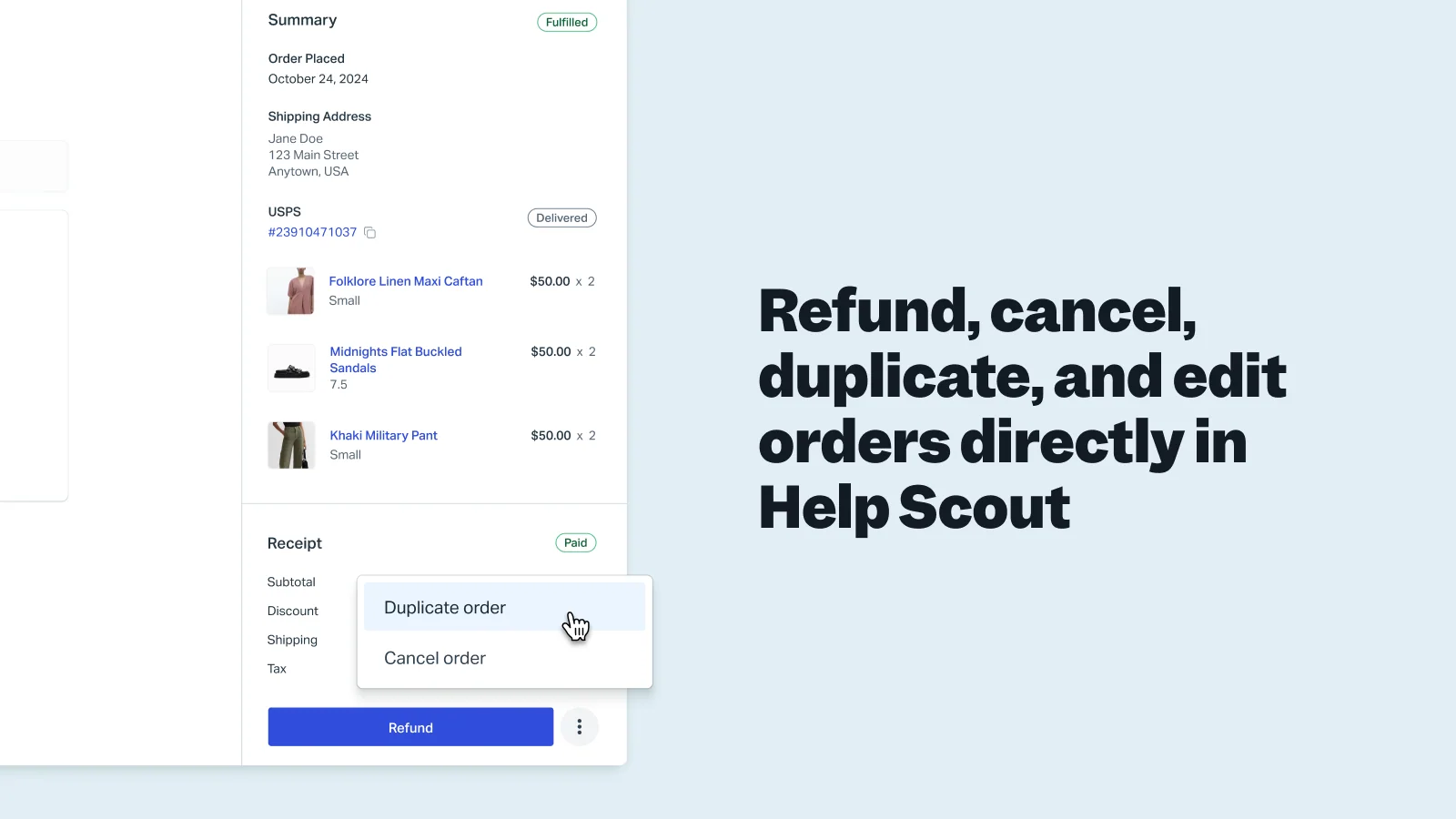
Shopify support is better than its reputation. Help Scout's free Shopify app shows lifetime value and full order details in the sidebar, and agents can refund, cancel, edit or duplicate a customer's recent orders without leaving the conversation.
Pricing: Free plan (5 users, 1 inbox); Standard $25/user/mo; Plus $45/user/mo; Pro $75/user/mo. Envoy AI: $0.75/resolution, 3-month free trial.
Verdict: Best for DTC brands that care more about warm, email-style support than sales chat. Skip it if chat-driven revenue is a big part of how you measure support.
5. Freshdesk: best for multichannel teams growing beyond Shopify
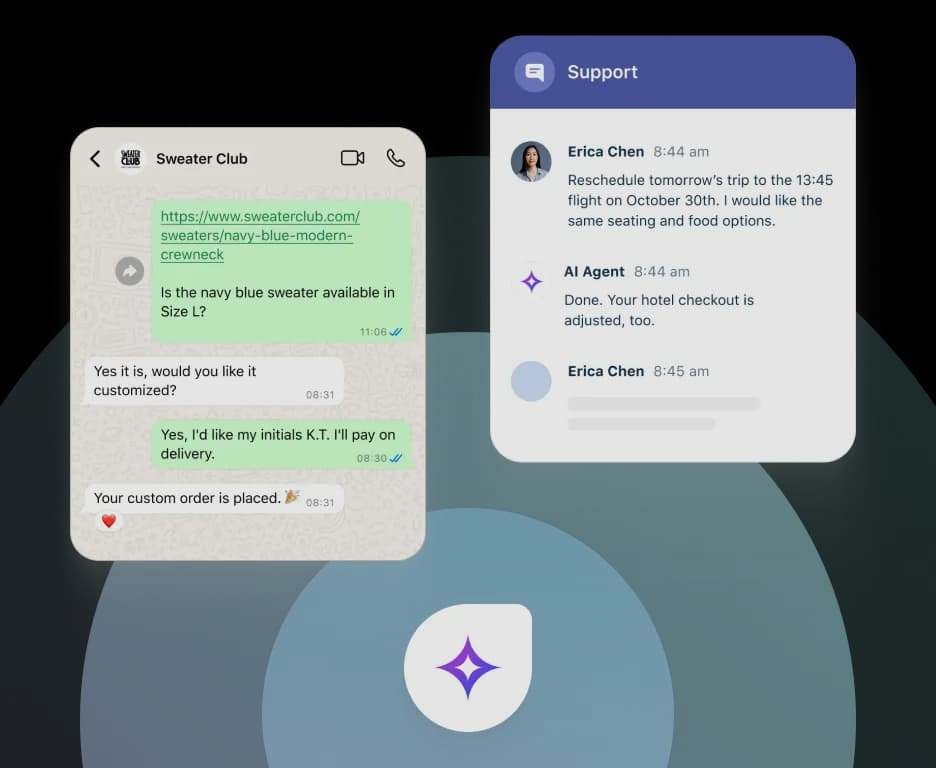
Freshdesk has the broadest reach on this list. 74,000+ businesses use it, according to its pricing page. Unlike Gorgias, Freshdesk wasn't built for ecommerce: it covers email, chat, phone, social, messaging apps and self-service in one place, for any industry.
Freddy AI is its main draw. Freshworks says Freddy AI agents can resolve up to 80% of queries, and they come with pre-built agentic workflows like cancel order, update subscription and check stock, built and launched from a no-code AI Agent Studio. The agent connects to apps including Shopify, FedEx, Wix and Stripe, and speaks 60+ languages. Freddy AI Copilot helps human agents with replies and summaries, and Freddy AI Insights is on the Enterprise plan.
The Freshdesk AI pricing: Growth $19 per agent per month, Pro $55 and Enterprise $89, all billed annually. Every plan includes 500 Freddy AI Agent sessions, once per account; after that you buy packs at $49 per 100 sessions. A session is one interaction between a customer and the AI agent, and for email a session is a 72-hour window from the customer's first email. Copilot is $29 per agent per month on Pro and Enterprise.
On Shopify: Freshdesk's Shopify app installs from the Freshdesk Marketplace, not the Shopify App Store. Per Freshdesk's docs, it shows current and past orders, order status and shipping inside the ticket, and agents can refund or cancel an order there (cancelling only works before the order ships). The Freshdesk vs Gorgias comparison goes deeper on where each one wins.
Pricing: Growth $19/agent/mo; Pro $55/agent/mo; Enterprise $89/agent/mo (billed annually). Freddy AI Agent: 500 sessions included once, then $49 per 100. 14-day free trial (on Enterprise).
Verdict: Best for multichannel teams that need helpdesk breadth beyond Shopify, especially teams that mix ecommerce with B2B or IT support.
6. Zendesk: best for enterprise ecommerce with the biggest integration catalog

Zendesk is the largest platform on this list: 4.3/5 from 7,126 reviews on G2, a marketplace listing 2,000 apps, and a Leader spot in the 2025 Gartner Magic Quadrant for the CRM Customer Engagement Center. If your team needs the widest integration catalog, battle-tested ticketing, or enterprise compliance, Zendesk is the benchmark.
The AI side has two parts. Zendesk's AI agents reason, take actions and follow your business processes, and Zendesk says they can resolve up to 80% or more of issues. Copilot helps human agents, and its admin side includes Admin Copilot and intelligent triage, which classifies every ticket.
The pricing needs reading closely: Suite Team is $55 and Suite Professional $115 per agent per month, billed annually, and Copilot adds $50 per agent per month on Professional and higher. Suite Team and Professional include 5 automated resolutions per agent per month. Since May 18, 2026, Zendesk sorts AI outcomes into tiers, and only a "verified resolution", one an LLM confirms actually solved the request, draws on that allowance. Past the allowance you pay $1.50 per resolution if you commit in advance, or $2.00 pay-as-you-go. For an AI-heavy team, seats plus Copilot plus resolutions can add up to two or three times the base subscription.
For Shopify, Zendesk relies on marketplace apps rather than a built-in order panel; our Zendesk Shopify plugin guide covers the options, and the Gorgias vs Zendesk post compares them head to head.
Pricing: Suite Team $55/agent/mo; Suite Professional $115/agent/mo (annual); Copilot $50/agent/mo add-on on Professional and up. AI overages $1.50 committed or $2.00 pay-as-you-go per automated resolution. 14-day trial.
Verdict: Best for enterprise ecommerce teams that need the widest integration catalog and have the budget for per-resolution billing. Overkill for most small DTC brands.
7. Kustomer: best for high-volume DTC and retail brands that need CRM-level customer context

Kustomer's core idea is that Gorgias and Zendesk are built around tickets, so every conversation starts fresh. Kustomer is built around the customer: every interaction hangs off one customer record, with order history, past conversations and custom data your team defines, all in one timeline.
The AI suite has four named products on Kustomer's homepage: Concierge (the customer-facing AI agent), Envoy (AI for human reps), Architect (the no-code builder) and Data Explorer (analytics), and its packages include an MCP server for connecting outside AI tools. The customer list skews toward big B2C names: Turo, Everlane, Rappi, Skims, Vuori, loveholidays and sweetgreen. Vuori's support manager says "70% of all conversations coming into chat are fully automated using Kustomer's AI."
Kustomer pricing is quote-only: the Enterprise and Ultimate plans both say "Talk to Sales". The AI rates are public on its pricing details page: Concierge is $0.75 per engaged conversation and Envoy is $50 per user per month. Without seat prices you can't model the bill until you've been through a sales call, and that alone rules it out for most small brands.
Kustomer reviews on G2 average 4.4/5 across 570 reviews. Users praise ease of use and automation, and the most-tagged downsides are slow performance, slow loading, the learning curve and complexity. For a Gorgias vs Kustomer decision, it usually comes down to this: Gorgias if you need native Shopify depth at small-team prices, Kustomer if you need one customer record across a large B2C operation.
Pricing: Quote-only (Enterprise and Ultimate). AI: Concierge $0.75 per engaged conversation, Envoy $50/user/mo.
Verdict: Best for high-volume DTC and retail brands with complex customer profiles that want a CRM and helpdesk in one. Not suitable for small or budget-sensitive teams.
8. eesel: best for teams that want to keep Gorgias and add AI on top
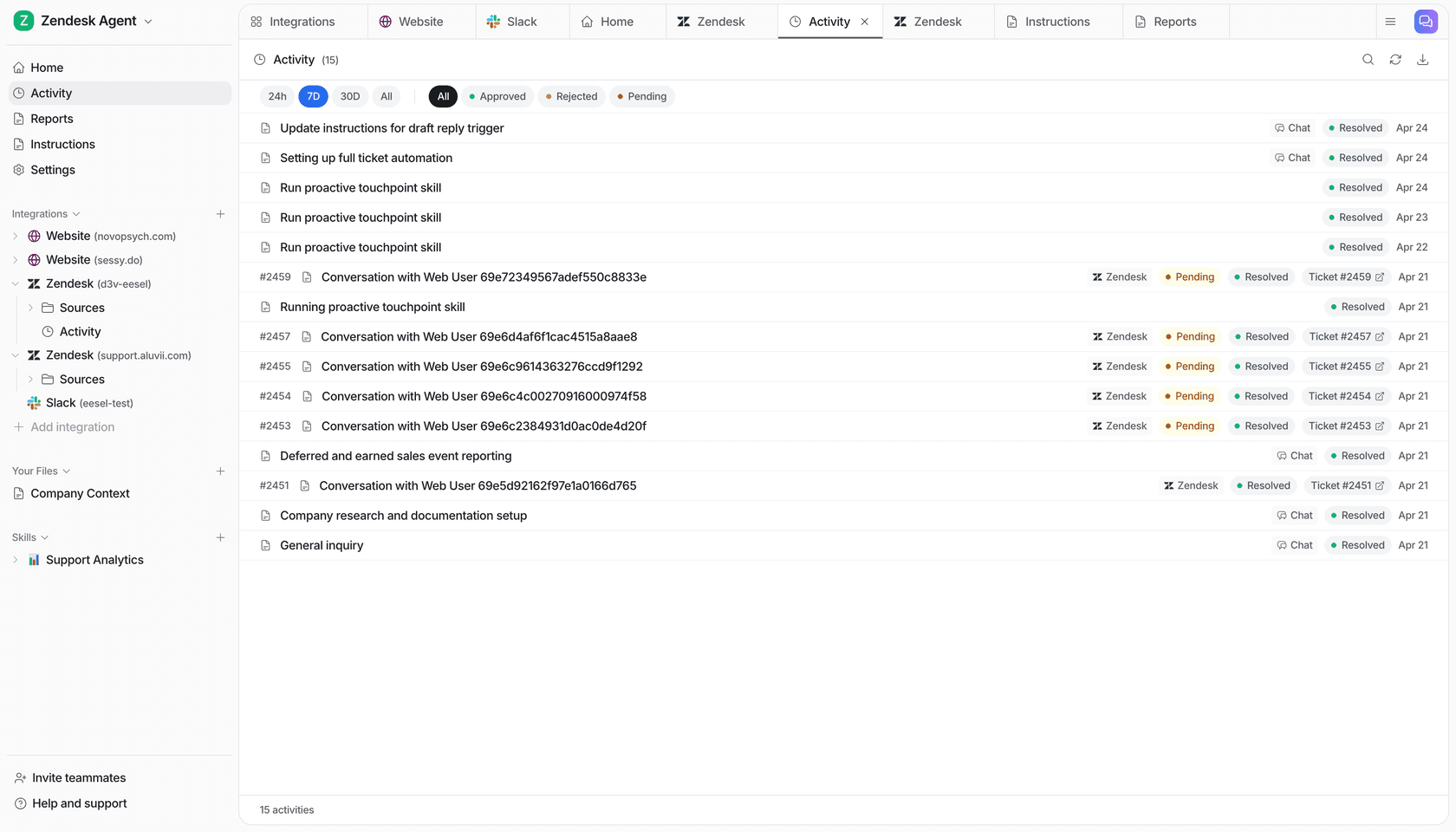
Every other option on this list means migrating your support stack. eesel starts from a different assumption: the helpdesk you already use is probably fine, and what's missing is an AI teammate that works inside it.
eesel's helpdesk teammate connects to Gorgias, Shopify, Slack and 3,000+ other tools, learns from your help center, macros and past tickets, and then works your queue: it tags tickets, looks up orders, and either replies or leaves a draft as an internal note, whichever you choose per topic. Two published examples show both modes. Question Beauty lets it reply directly in Gorgias: in one month it looked up 290 Shopify orders before answering and closed 280 tickets with no person involved. Rúngne runs three eesel agents on 2,100 Gorgias tickets a month: one tags every ticket, one leaves drafts for the team, and one answers plain questions from Shopify order and stock data.
eesel starts at $299 a month for 500 credits, where a ticket or chat is one credit however long it runs, with no seat fees and cancel-any-time terms on its pricing page. 1,000 credits is $499 and 3,000 is $1,149, and extra credits are $0.80 each up to a cap you set.
How that compares with Gorgias AI Agent depends on how you use it. Gorgias charges $0.90 only when the AI fully resolves a conversation. eesel spends a credit on every ticket it works, including the ones where it drafts for a person or tags and routes. If you only want hands-off resolutions, the per-resolution cost can come out similar. If you want AI on every ticket, triage and drafts included, eesel's flat monthly price covers work Gorgias doesn't bill as automation at all. Our eesel vs Gorgias AI post works through the numbers.
The trade-off is scope: eesel is the AI teammate, not the helpdesk. It doesn't replace Gorgias's inbox, ticket fees, reporting or routing. If those are where Gorgias is failing you, eesel alone won't fix it, and a platform switch makes more sense. But if the helpdesk works and the AI bill doesn't, eesel is the smaller change.
Pricing: From $299/mo for 500 credits (1 credit per ticket or chat), up to $1,749 for 5,000. Extra credits $0.80 each. No seat fees. Free 7-day trial with 100 credits, no card.
Verdict: Best for teams that are happy with Gorgias (or another helpdesk) and want AI on every ticket without migrating or paying per automated interaction.
How do you choose the right Gorgias alternative? {#how-to-choose}
If your pain point is Gorgias's ticket-volume pricing, go with Re:amaze. It's the closest feature match on a per-seat model. Run the maths: if your seat count times $29 to $69 comes out below your Gorgias plan plus overages, it's a clean swap.
If you want maximum AI automation with a guarantee, pick Richpanel. The yearly contract and $2,000 setup fee are real commitments, but $0.20 per AI conversation and the 50%-in-30-days refund make it easy to test against your Gorgias bill.
If budget is tight and you're a small Shopify store, start with Shopify Inbox. It's free, rated 4.5/5 on the Shopify App Store, and its Inbox agent answers product and order-status questions in chat. You'll need a real helpdesk once you want ticketing or email support.
If your brand leads with email relationships, not sales chat, choose Help Scout. The easy inbox, a working Shopify app and Scout's 73% average resolution rate make it the friendliest option for teams that find Gorgias's sales framing a poor fit.
If you're beyond Shopify-only support, look at Freshdesk or Zendesk. Freshdesk for broad channel coverage at a lower per-agent price; Zendesk for enterprise compliance, the 2,000-app marketplace and teams already deep in its ecosystem.
If you have complex customer data at B2C scale, Kustomer is the one. The customer-record model and Vuori's 70% chat automation are hard to match, but quote-only pricing means it's only worth a sales call for teams with the budget.
If you don't want to switch helpdesks at all, add eesel to Gorgias. You keep your tickets, macros and team habits, and pay one fixed monthly price from $299.
Try eesel on your Gorgias tickets before you migrate
If you're reading this because Gorgias's AI add-on costs more than you want to pay, test the cheaper move first. eesel connects to Gorgias and Shopify, learns from your past tickets and macros, and can run against real tickets in a simulation before it sends a single reply, so you see its answers on your own queue before deciding whether a full migration is worth the trouble.
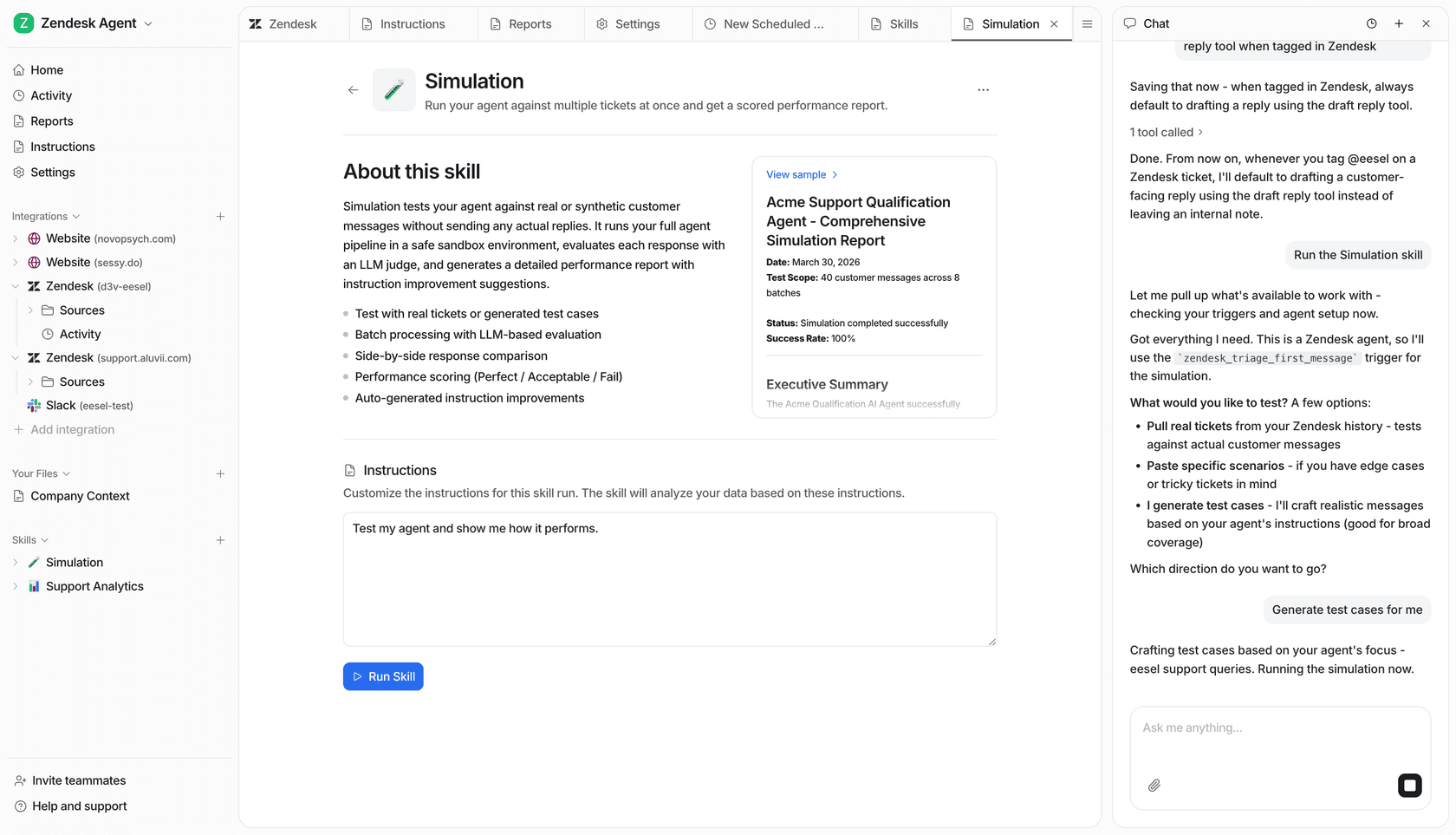
Try eesel free for 7 days with 100 credits, no credit card required.
