

The best AI chatbot for a Shopify store already on a helpdesk is eesel (from $299 a month); for a new store it's Gorgias, and Shopify Inbox's built-in AI agent covers on-site chat for free. I compared 9 apps on vendor prices I re-checked on 16 November 2026, and the deciding question is whether you're already on a helpdesk or starting fresh.
- Already on Zendesk, Freshdesk, Gorgias or Help Scout? Put eesel on top of it. You keep your helpdesk and your past tickets, and the AI agent looks up Shopify orders inside the tools you already use. Question Beauty runs it on Gorgias and Shopify: 990 tickets handled in a month, 960 replies sent by eesel itself.
- New Shopify store that wants a helpdesk and AI agent in one? Gorgias is the Shopify-native default, Help Scout is the simple shared inbox that charges $0.75 per AI resolution, and Richpanel bets the whole product on AI with a 50% automation guarantee.
- Want something free? Shopify Inbox now has a built-in AI agent that answers product and policy questions and looks up orders, at $0.
- Want a no-code chatbot you can paste onto your store? Chatling or SiteGPT are the lightest options.
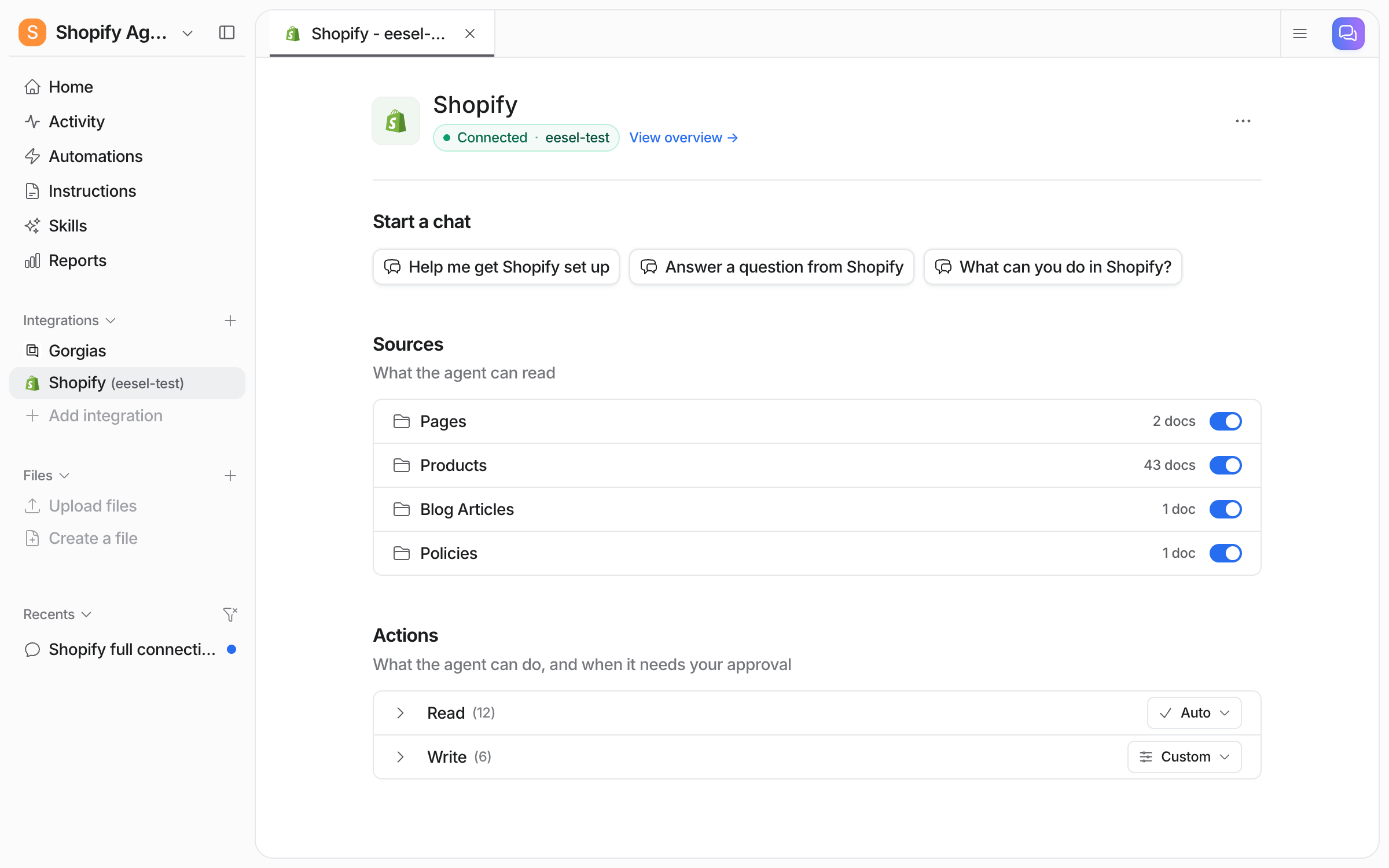
If you use an AI coding agent such as Claude Code or Cursor, it can connect your store, upload your help articles and ask test questions through the eesel CLI. The store owner still approves the Shopify connection in a browser.
How I picked these 9
I'm on eesel's support team, so I judge these tools by what helps on a real queue, not what demos well. I read each vendor's pricing page, help docs and Shopify App Store listing on 16 November 2026, then held every tool to the same questions a Shopify operator asks:
- Does the AI read live Shopify order data, or only your help articles?
- What does the AI do that a rule-based bot can't?
- What does a 1,000-ticket month cost, and what does a Black Friday month cost?
- Can it sit on your existing helpdesk, or does it force a migration?
I dropped tools with no real Shopify story (most generic chatbot builders) and tools that hide every price behind "contact us".
The 9 best Shopify chatbot apps at a glance
| App | Best for | AI type | Shopify order data | Starting price | Rating | Free option |
|---|---|---|---|---|---|---|
| eesel | Stores already on a helpdesk | Autonomous AI agent | Orders, tracking, returns, address changes | $299/mo (500 credits) | 5.0 on App Store (6) | 7-day trial, 100 credits |
| Gorgias | Shopify-native helpdesk | AI Agent + Shopping Assistant | Deepest, with order actions | $10/mo (50 tickets) | 4.6 on G2 (582) | Free trial |
| YourGPT | Ecommerce teams automating support, product discovery and order questions across channels | Autonomous, self-learning AI agents | Live catalog sync, product recommendations, inventory and pricing lookups, cart and checkout actions | $39/mo (billed annually) | Not listed | 7-day free trial |
| Help Scout | Small teams wanting a simple helpdesk | Envoy (Scout agent) | For agents via app; not used by the AI yet | $25/user/mo + $0.75/resolution | 3.7 on App Store (19) | Free plan (no AI) |
| Shopify Inbox | Free AI chat on Shopify | Inbox agent | Order lookups after sign-in | Free | 4.5 on App Store (5,818) | Always free |
| Re:amaze | Multichannel small teams | AI Agent (beta) + drafts | Create and edit orders in chat | $29/seat/mo | 4.5 on App Store (180) | 14-day trial |
| Richpanel | AI-first ecommerce teams | AI support team + QA | Shopify and Recharge actions | $69/agent/mo + $0.20/AI conversation | n/a | 30-day guarantee |
| Chatling | No-code AI chatbot on any store | AI agent, 46 models | Only through an HTTP request you build | $25/mo ($21 yearly) | 4.7 on G2 (83) | Free plan |
| SiteGPT | Website-trained AI on any store | GPT-4.1 / GPT-4.1-mini | Only through the API | $59/mo ($39 yearly) | 4.9 on G2 (12) | 7-day trial |
A bit of nuance up front. Shopify order depth matters more than headline AI claims, because a Shopify chatbot rarely fails by picking the wrong words. It fails by having no idea where the customer's order is. The tools that read orders, fulfillment status and subscriptions live (Gorgias, Richpanel, eesel, and now Shopify Inbox for signed-in shoppers) handle the questions that make up most of an ecommerce queue, and that's where real ticket deflection comes from. If "where is my order" (WISMO) is your biggest ticket type, read eesel's guide to chatbots for order status too.
1. eesel
Best for: Shopify stores already running a helpdesk (Zendesk, Freshdesk, Gorgias, Help Scout) that want an autonomous AI agent on top, without a migration.
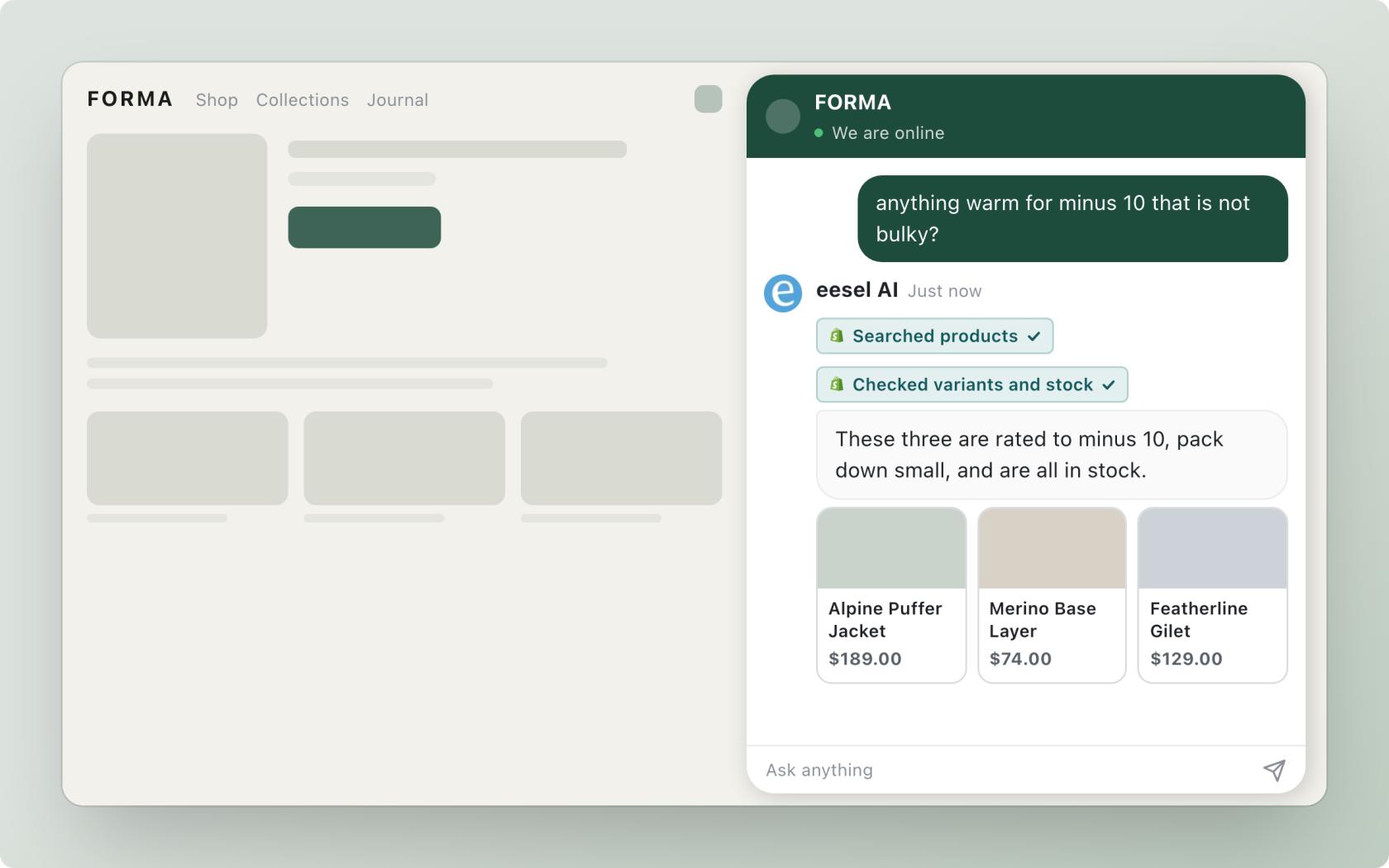
The pitch with eesel runs the other way from most of this list. Most tools here ask you to move your support into their helpdesk. eesel connects to the helpdesk you already have (Zendesk, Freshdesk, Gorgias, Help Scout, Front), your Shopify store, your knowledge base and 3,000+ other integrations, and runs an AI agent across all of them. Your chat widget and your helpdesk stay where they are, and the AI works inside them.
On Shopify, the eesel docs list what the agent does with a full connection: it looks up orders, tracking and stock live, shows products as cards a shopper can add to their cart, starts returns and fixes shipping addresses. Refunds and other changes follow the approval settings you choose. STIL Classics runs it on Gorgias, and eesel looked up 230 Shopify orders before drafting replies across 320 tickets in a month.
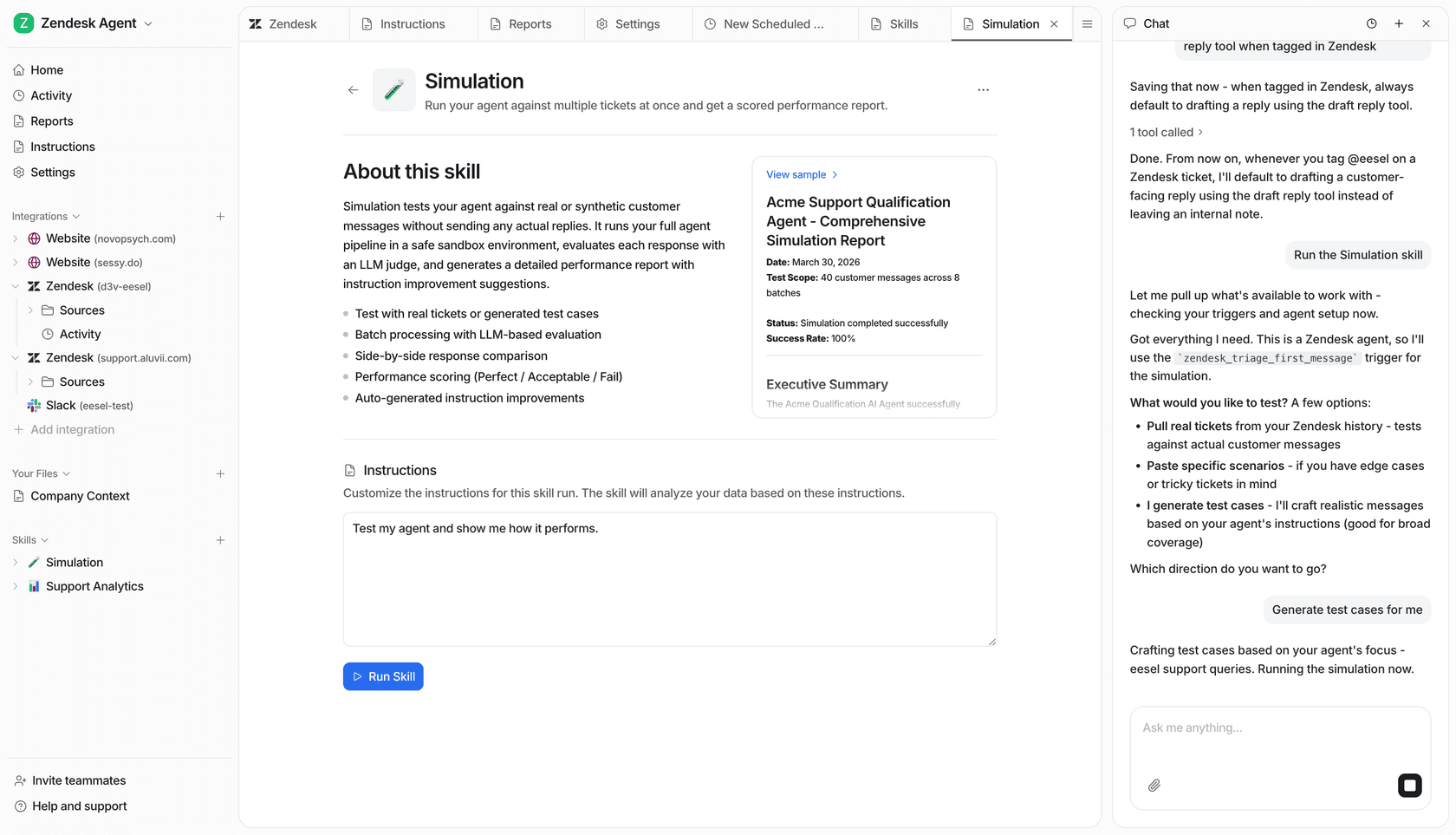
Before it touches a customer, eesel's simulation skill runs the agent against tickets your team already resolved. It drafts its own reply to each, puts it next to what your team actually sent, groups the results by topic and lists what to fix. It sends nothing to customers while it does this.
Pros:
- No helpdesk migration. Keep Zendesk, Gorgias, Freshdesk or Help Scout and add the AI on top.
- The simulation scores the agent's drafts against your team's real replies before launch.
- One fixed monthly price with every integration and channel included. No seat fees, no platform fee.
- Answers in 80+ languages and learns from your past tickets, help center and docs.
Cons:
- It's an AI teammate, not a helpdesk. If you don't run a helpdesk yet, a tool with its own inbox (Gorgias, Help Scout, Shopify Inbox) may be the simpler start.
- Its Shopify App Store listing has only 6 reviews so far, against 582 G2 reviews for Gorgias.
- It bills every ticket it works on, resolved or not. That keeps the bill flat, but a store with a low AI share can pay for tickets a person finishes.
Pricing: One fixed monthly price sized to your volume. A credit is one ticket or chat, however long. 500 credits is $299/mo, 1,000 is $499, 1,500 is $699, 2,000 is $849, 2,500 is $999, 3,000 is $1,149, up to 5,000 for $1,749. Extra credits are $0.80 each up to a cap you set, and paying yearly gives two months free. The free trial is 7 days with 100 credits and no card. Full breakdown on the eesel pricing page.
My take: If you've already invested in Zendesk, Gorgias or another helpdesk and don't want to throw it away, this is the shortest path to an AI agent that reads your Shopify orders. The simulation is what I'd use first: you see how the agent's answers compare with your team's on your own tickets before a customer sees one. If you don't have a helpdesk yet, look at Gorgias, Help Scout or Richpanel below first.
2. Gorgias
Best for: Shopify-native ecommerce teams who want ticketing, live chat and AI in one package.
Gorgias is the default answer to "what helpdesk should I run on Shopify?" Gorgias says it powers customer conversations for 40% of Shopify brands and 17,000+ ecommerce brands overall, and calls itself Shopify's only Premier Partner for CX on its Shopify integration page. The product combines a unified inbox (email, chat, social, SMS, voice) with an AI Agent that does two jobs: a Shopping Assistant for pre-purchase questions, and support work like order tracking, returns, refunds, cancellations, order edits and subscription changes.
The depth of the Shopify integration is the biggest reason people pick it. Order history, product catalog, customer profile and fulfillment status show up inside the ticket, you can connect several stores, and Gorgias reports revenue from conversations. Chat in checkout reaches shoppers while they enter shipping details, to stop cart abandonment.

Pros:
- The deepest Shopify integration here: several stores, order actions, revenue reporting.
- The AI Agent tracks orders, starts returns, issues refunds, cancels and edits orders, and applies discounts.
- Pricing is by ticket volume, with 500 seats on Basic and above, so adding agents for peak season costs nothing extra.
- 4.6 out of 5 from 582 reviews on G2 is a well-tested baseline.
Cons:
- The $10/mo Starter covers 50 tickets and 3 seats. At 1,000 tickets a month you're realistically on Pro, which is $360/mo for the helpdesk alone.
- AI Agent is billed per automated interaction on top of the helpdesk: $1.50 each past the bundle in your plan.
- Both meters grow with volume, so a Black Friday month costs a lot more than a quiet one (worked numbers below).
Pricing: Four public plans by ticket volume, billed monthly: Starter $10 (50 tickets), Basic $60 (300), Pro $360 (2,000), Advanced $900 (5,000), then custom above 5,000. Adding AI Agent bundles automated interactions: $30 for 30 on Starter and Basic, $190 for 190 on Pro, $530 for 530 on Advanced, then $1.50 per automated interaction past that. Paying yearly drops Pro's helpdesk to $300/mo. Full detail on the Gorgias pricing page, and eesel's Gorgias AI Agent pricing breakdown works through more bills.
My take: If your store is Shopify-only and you want one tool to run support, chat and AI on top of native order data, Gorgias is the obvious pick. Skip it if your volume is under 300 tickets a month, or if you're on another helpdesk you don't want to leave. For cheaper options, see eesel's Gorgias alternatives roundup.
3. YourGPT
Best for: Shopify and ecommerce teams that want one AI agent handling support, sales and operations across every channel.
YourGPT is a no-code AI agent platform for customer support, sales and operations. You train agents on your store data, website, PDFs, Notion or Google Drive, then deploy one agent across website chat, WhatsApp, Instagram, Telegram, Slack, email and phone, in 100+ languages. YourGPT says its agents reach a 90% resolution rate across industries.
The Shopify integration is what makes it useful for stores. Agents check order status, process refunds, recommend products and update CRM records inside the conversation, then hand off to your team with full context when a chat needs a person. The integration is available on every YourGPT plan.
Reviewers praise how easy it is to build and scale agents without code. Source: YourGPT reviews on G2.
Pros:
- No-code setup that's quick to launch, with the flexibility to go deep and fully customize your agents.
- Omnichannel deployment across web, WhatsApp, Instagram, Slack, email, Discord and phone.
- Self-learning agents that improve from unresolved conversations.
- Action-oriented agents that resolve up to 90% of customer queries and run business workflows.
Cons:
- Deeper workflow logic in AI Studio takes hands-on time to master.
- Credit-based pricing, with no per-resolution plan available.
- Advanced use cases come with a bit of a learning curve.
- Only a 7-day free trial, no free tier.
Pricing: Credit-based, with no per-resolution fee. Essential is $39/mo, Professional $79/mo and Advanced $349/mo, all billed annually. Monthly billing is $59, $129 and $499. Enterprise is custom. Full detail on the YourGPT pricing page.
My take: If you want one agent covering support, sales and operations across more than one channel, YourGPT is a strong fit. Skip it if you need a permanent free tier or only want a basic chat widget on one channel.
4. Help Scout
Best for: Small Shopify teams that want a simple helpdesk and an AI chatbot in one package, paying for the AI only when it resolves a chat.
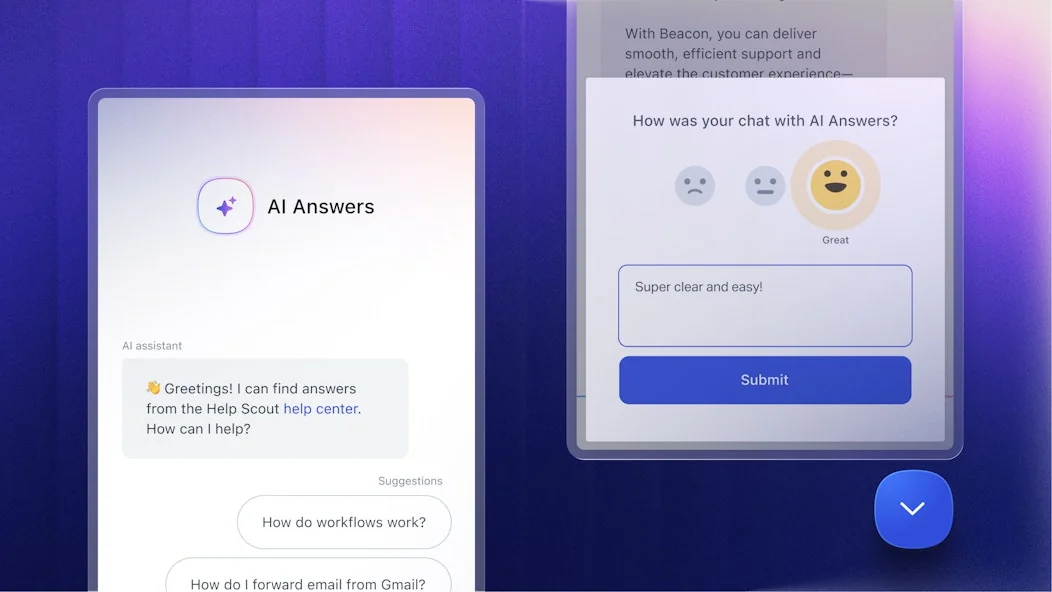
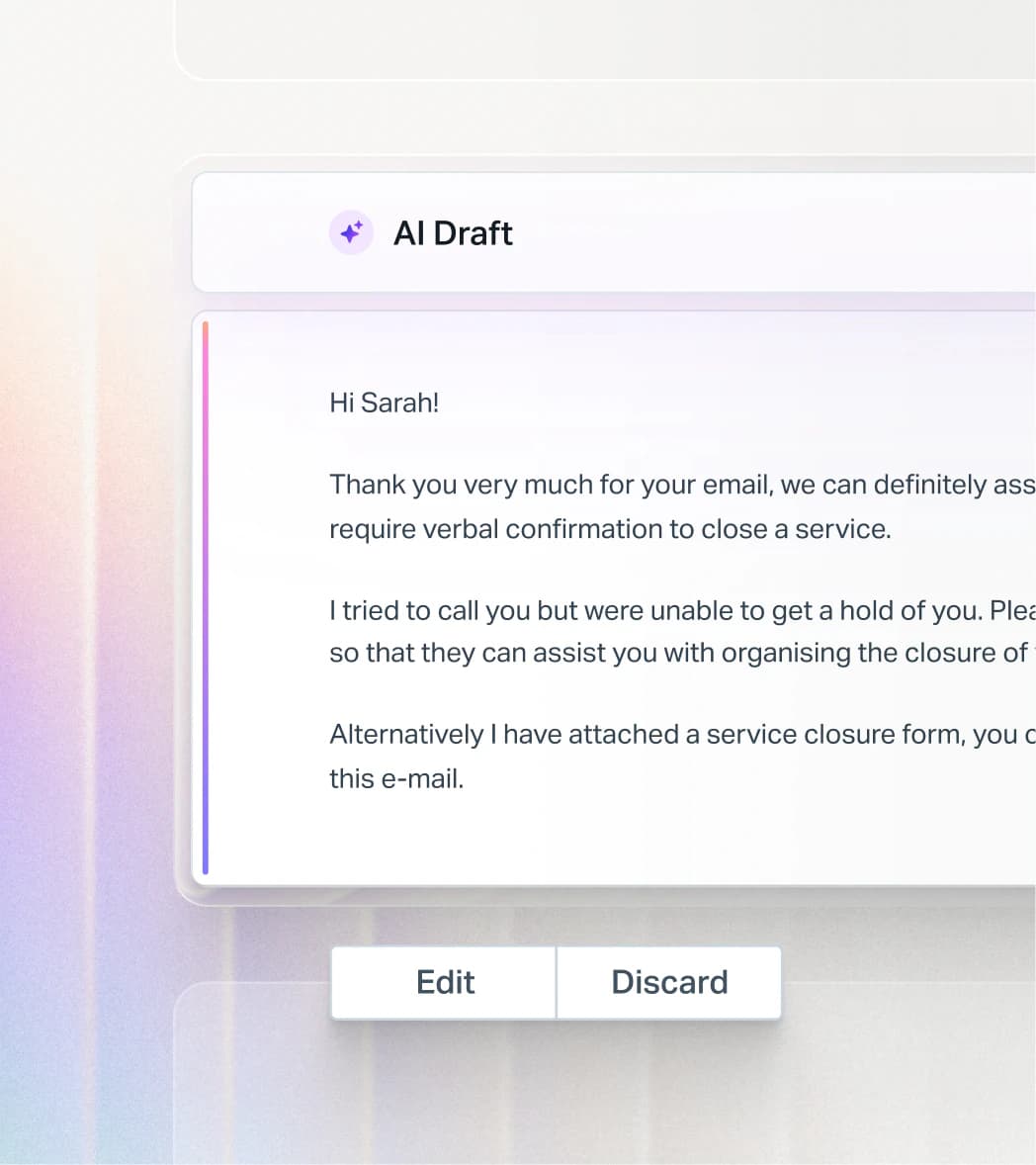
Help Scout is a shared inbox with an AI chatbot built in. The chatbot is Envoy (formerly AI Answers), and its built-in agent, Scout, lives in the Beacon chat widget on your storefront or inside your app. It answers from your help center, your website and custom sources like a Google Doc, and hands the chat to your team with context when it can't help. Help Scout says Scout resolves 73% of requests on average. If you'd rather run your own agent, Help Scout also lets you connect Claude, ChatGPT or an in-house agent through its MCP server or API.
On Shopify, the free Help Scout app shows order details and history next to each conversation and lets agents edit, duplicate, cancel and refund orders from Help Scout. The catch is that the AI can't use that order data yet: Help Scout lists app connections for Scout as "Coming Soon". So Envoy answers policy and product questions, not "where is my order #1234".
Pros:
- You pay only when the AI resolves a chat: $0.75 per resolution, counted once per conversation, and only when the customer doesn't escalate or ask more.
- A real free plan (5 users, 1 inbox, 1 Docs site, no AI), plus a 3-month free trial of Envoy.
- A clean shared inbox that small teams learn quickly, with AI Assist on every paid plan.
- Useful controls: choose topics Scout must not answer, test it privately before launch, and see which sources it used for each answer.
Cons:
- The AI can't read Shopify order data yet, so WISMO tickets still land with a person.
- Two meters: per-user seats plus per-resolution AI. AI Drafts and AI Summarize need Plus or higher.
- The Shopify app has only 19 reviews (3.7 out of 5), and the AI's name has changed more than once (AI Answers, Envoy, Scout), which makes older docs harder to follow.
Pricing: Free $0 for up to 5 users (no AI). Standard $25/user/mo yearly ($30 monthly), up to 25 users. Plus $45/user/mo yearly ($54 monthly), which adds AI Drafts and AI Summarize. Pro $75/user/mo yearly ($90 monthly), 10-user minimum, through a demo. Envoy is $0.75 per resolution on any paid plan, with prepaid discounts. 15-day free trial. Full breakdown on the Help Scout pricing page and in eesel's Help Scout pricing guide.
My take: If you want a simple helpdesk for a small store and an AI chatbot you only pay for when it works, Help Scout is an easy place to start. The order-data gap is the real watchout: until Scout can read Shopify orders, it handles policy and product questions while your team keeps the "where is my order" tickets. For more context, see eesel's Help Scout AI guide.
5. Shopify Inbox
Best for: Stores on a tight budget that want a working AI chat widget today, with no new tool to learn.
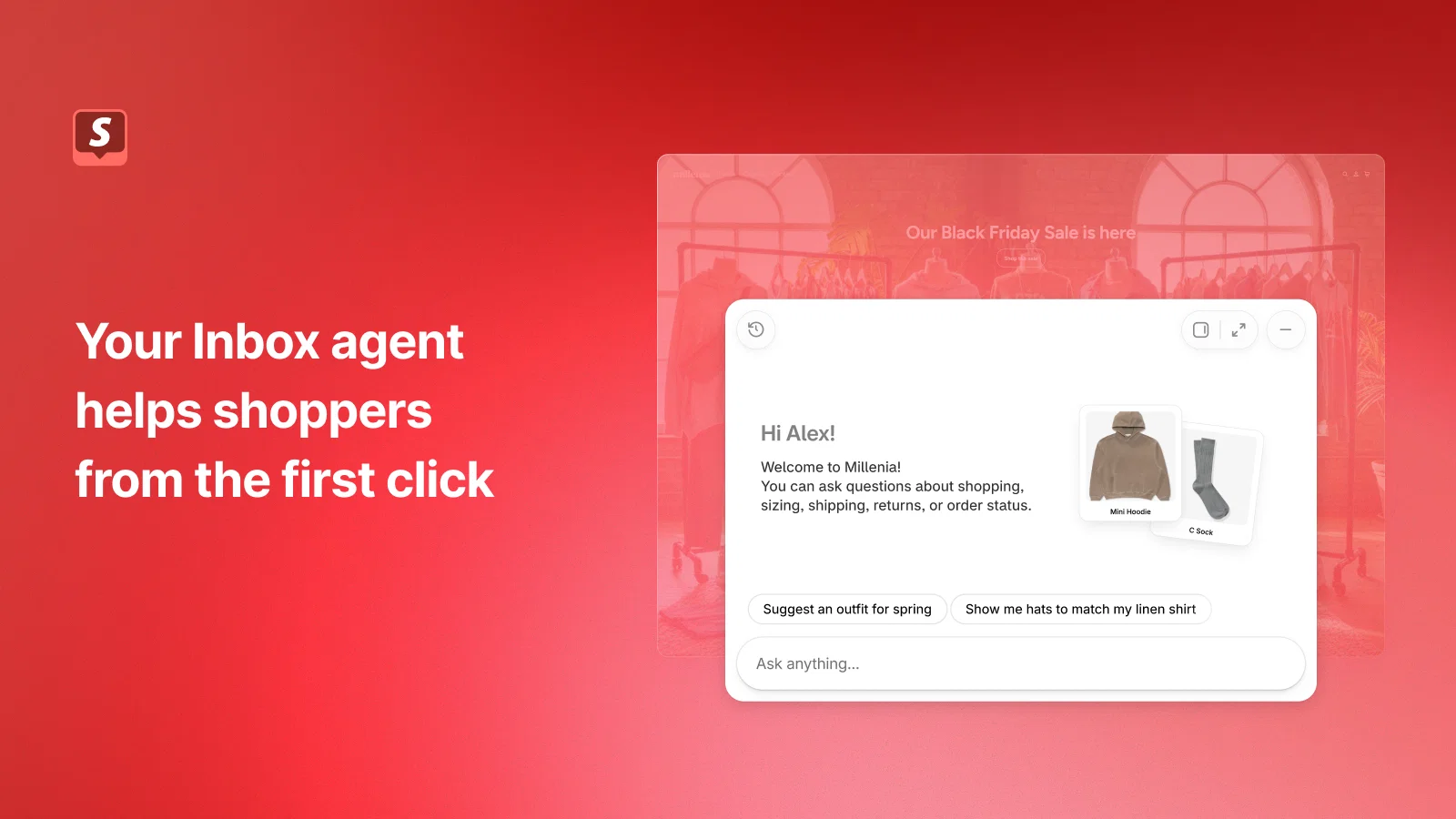
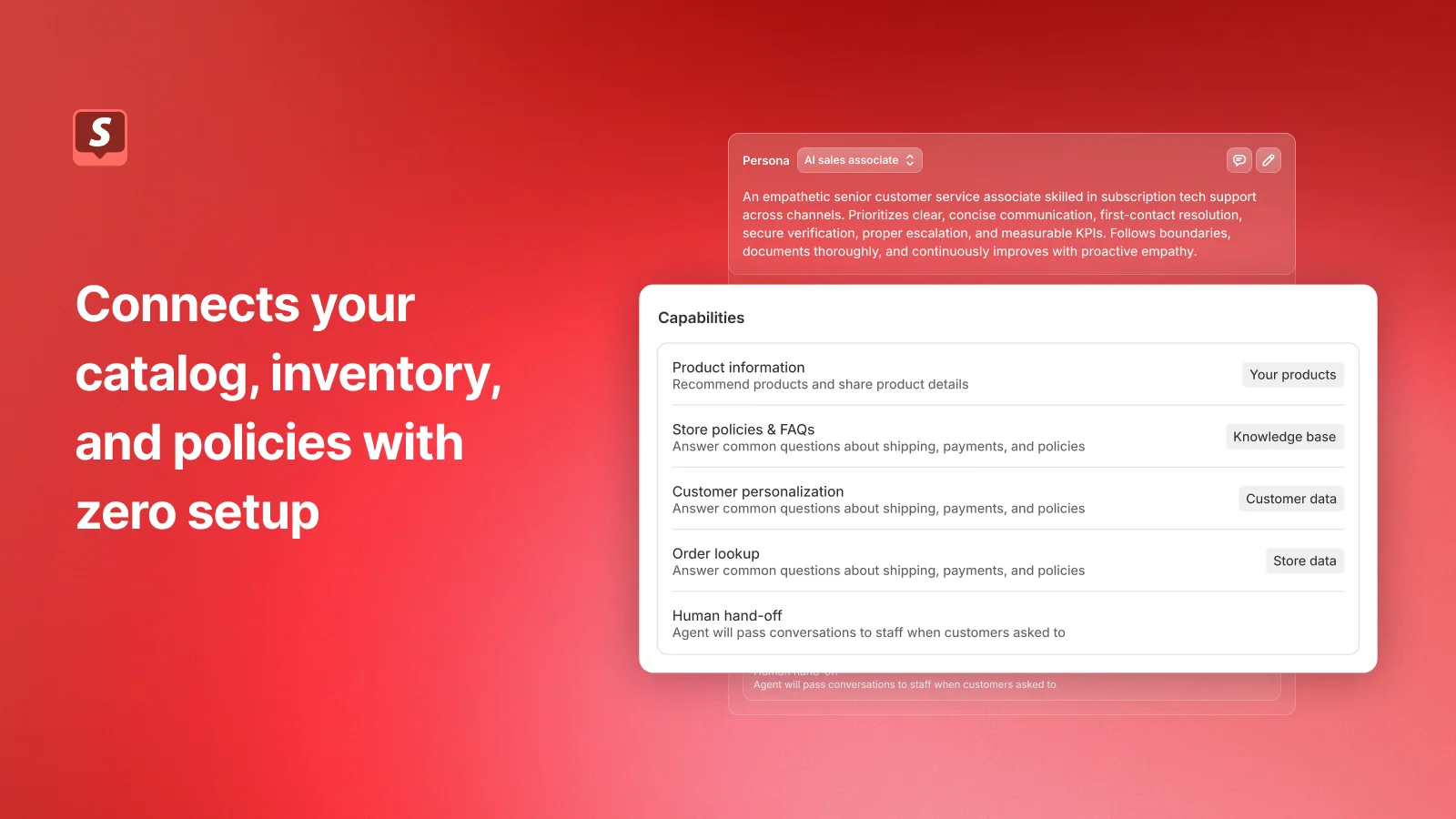
Shopify Inbox is Shopify's own free chat app, and it's no longer just a chat box. It now ships an Inbox agent you can switch on to answer shoppers automatically. Shopify's docs say it answers questions about products, shipping, returns, sizing and policies from your catalog, policies, Knowledge Base and storefront pages. It recommends products, adds them to the cart, and helps customers check an existing order once they sign in. It replies in the customer's language, and you choose whether it takes every chat, only chats outside your staff's hours, or none.
You shape its voice by rating its answers in practice scenarios or real chats, and Shopify suggests persona changes you approve before they go live. When a shopper asks for a person, the chat moves to your staff with the AI's context, or the shopper gets your store's email if nobody is available.
It holds 4.5 out of 5 from 5,818 App Store reviews, with 80% of them five stars.
Pros:
- Free at every scale. No paid tier, no per-conversation fee.
- First-party: it reads your catalog, inventory, policies and orders with no setup.
- Mobile apps for iOS and Android, plus a desktop app.
- 21 languages listed on the App Store.
Cons:
- It works only in your online store's chat widget. Email, WhatsApp and social messages need another tool.
- Your store must use new customer accounts. On legacy accounts, chats stay with your staff.
- Shoppers always see a notice that the chat is powered by Shopify and that they're talking to AI. You can't remove or change it.
Pricing: Free. It needs a Shopify plan, but Inbox adds nothing to the bill. See eesel's Shopify Inbox guide for setup and limits.
My take: If your store lives mostly on on-site chat and you've never run a helpdesk, start with Shopify Inbox and its agent. It costs nothing and now handles the basic order and product questions itself. You'll outgrow it once email, social and returns work pile up in places the chat widget can't reach; that's when Gorgias, or eesel on the helpdesk you pick, makes sense.
6. Re:amaze
Best for: Small ecommerce or SaaS teams that want one inbox for chat, email, SMS, voice and social without buying four separate tools.
Re:amaze, owned by GoDaddy since 2021, is a multichannel inbox that bundles its chat widget and bots into every plan. You get live chat, email, social, SMS, voice, video calls, push notifications, an AI Agent (still labelled beta), AI reply drafting, conversation summaries and a screen-sharing feature called Peek.
On Shopify, the Re:amaze app lets agents manage, modify and create Shopify orders from inside a conversation, and it holds 4.5 out of 5 from 180 reviews. It's a generalist helpdesk that does ecommerce well, rather than a Shopify-only build like Gorgias.
Pros:
- Built-in chatbots (Welcome Bot, Order Bot, custom bots) ship as part of every plan, not as paid add-ons.
- The $59/mo Starter plan covers unlimited team members at up to 500 conversations a month, which suits a big team with a light load.
- Peek screen sharing and in-chat video calls on the Plus plan are rare at this price.
- Every plan includes some AI Agent resolutions: 5, 10 or 20 per user a month on Basic, Pro and Plus.
Cons:
- The AI Agent is still in beta, and resolutions past your allowance are $0.85 each on every plan.
- Per-seat pricing plus per-resolution AI means two meters, like Help Scout.
- The flat Starter plan stops at 500 conversations a month; past that you're on per-seat pricing.
Pricing: Starter $59/mo flat for unlimited seats, up to 500 conversations a month. Basic $29/seat/mo ($26.10 yearly). Pro $49/seat/mo ($44.10 yearly). Plus $69/seat/mo ($62.10 yearly). AI Agent resolutions past the included amount are $0.85 each. 14-day free trial, no card. See the Re:amaze pricing page or eesel's Re:amaze pricing guide.
My take: Re:amaze is the right pick when customers really do reach you across five or more channels (email, chat, Instagram, SMS, voice) and you want them in one inbox without enterprise pricing. If your support is mostly Shopify chat and email, you'll get more order depth from Gorgias. eesel's Re:amaze review goes deeper.
7. Richpanel
Best for: AI-first ecommerce teams ready to commit to autonomous resolution, on a yearly contract.
Richpanel is the boldest reframe of the helpdesk in this list. It sells an AI support team of four roles: a CX Manager AI that builds playbooks and monitors quality, a Customer Service Agent that resolves conversations end to end, a Copilot AI that assists your human agents, and a QA AI that reviews every conversation. Its pitch is aimed at teams that "outgrew Gorgias or Zendesk", and it says 3,000+ brands use it.
The headline guarantee is the commercial hook: 50% automation within 30 days, or a full refund, even on an annual contract. That guarantee comes with Richpanel's AI agents setup, a $2,000 one-time fee. The case studies on its homepage show 63% of tickets resolved end to end by AI at one wellness brand and 72% closed by AI at Plateful, and named customers include The Ridge, Jones Road Beauty and Pela.

Pros:
- A money-back guarantee on AI performance is rare in this category.
- The AI resolves refunds, order tracking, cancellations and subscription changes, and Richpanel shows it updating Recharge subscriptions.
- QA AI reviews every conversation, a real answer to the "what if it says something wrong" worry.
- You can test the AI on your past tickets before launch and start in copilot mode before switching to full auto.
- Richpanel says it's checked against SOC 2 Type II, HIPAA and GDPR standards.
Cons:
- All subscriptions are yearly contracts, so there's no month-to-month way out.
- The guarantee needs the $2,000 one-time AI agents setup on top of seats.
- WhatsApp, phone and SMS are on Pro Max ($99/agent), not Pro.
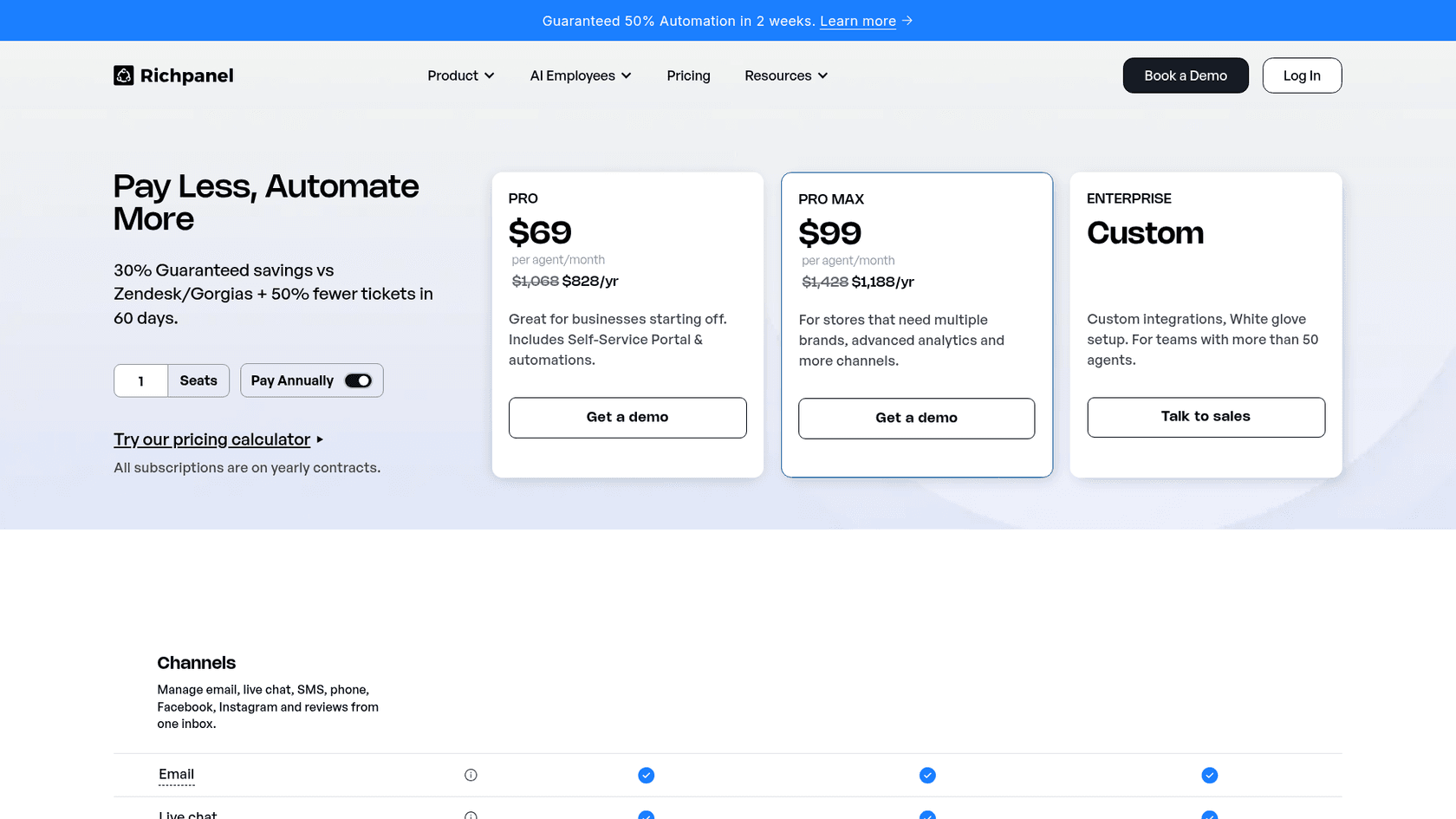
Pricing: Pro $69/agent/mo ($828 a year) and Pro Max $99/agent/mo ($1,188 a year), both on yearly contracts; Enterprise is custom for teams over 50 agents. The Customer Service AI is $0.20 per AI-handled conversation, and the guaranteed AI agents setup is $2,000 one time. Full detail on the Richpanel pricing page and in eesel's Richpanel pricing guide.
My take: If you're ready to sign for a year and bet on autonomous AI, with people handling the exceptions, Richpanel is the cleanest product on that bet, and at $0.20 per AI conversation its per-unit price is the lowest here. If you want to stay month to month or keep your current helpdesk, eesel or Gorgias fit better. See eesel's Richpanel alternatives for more.
8. Chatling
Best for: Stores that want a no-code AI chatbot on Shopify without moving off their current helpdesk.
Chatling is the lightweight option in this list. You point it at your website, docs, FAQs or files, it trains an AI agent on that content, and you embed it on your store. It runs on the web widget, WhatsApp, Instagram, Messenger and Telegram from one inbox, and lets you pick from 46 models across OpenAI, Anthropic, Google, Mistral, xAI, DeepSeek and Z.ai.
Chatling holds 4.7 out of 5 from 83 reviews on G2, with 78% five-star ratings, and reviewers keep coming back to how easy setup is. The thing to watch is the credit system: credits per reply run from 0.5 on Gemini 2.5 Flash to 25 on Claude Opus 5 or GPT-6 Astra, so the same plan buys 50 times more replies on the cheapest model than on the dearest.
Pros:
- Truly no-code; Shopify install is pasting the widget code into your theme.
- A free plan with 200 AI credits, 1 AI agent and 1 seat.
- Many model choices, so you can run a cheap model for FAQs and a stronger one for harder replies.
- WhatsApp, Instagram and Messenger start on the $25/mo Starter plan.
Cons:
- Not Shopify-native. To answer order questions, you build an HTTP Request action that calls Shopify's API yourself.
- Premium models burn credits fast, so budgeting takes some care.
- Zendesk, Zoho and HubSpot integrations start on the $75/mo Growth plan.
Pricing: Free $0/mo (200 AI credits, 1 agent, 1 seat). Starter $25/mo or $21/mo yearly (1,750 credits, 2 agents, 2 seats). Growth $75/mo or $63/mo yearly (6,000 credits, 5 agents, 5 seats). Scale $295/mo or $246/mo yearly (35,000 credits). 7-day money-back guarantee on first purchases. See the Chatling pricing page, or eesel's Chatling review.
My take: A good fit if you want an AI chatbot on your Shopify store without changing your helpdesk, and someone on your team is comfortable wiring an API call to fetch order data. Skip it if you need order context in every conversation without building it.
9. SiteGPT
Best for: Stores that already write good help docs and want a website-trained AI bot to answer from them, on a small budget.
SiteGPT is the most narrowly scoped tool in this list. You point it at a URL, sitemap, YouTube channel or files, it trains a chatbot on your content, and you embed it on your site. Its positioning is "like having ChatGPT specifically for your product." It supports 95+ languages, escalates to a human when needed, and on Scale and above can run as the AI agent inside Zendesk Messaging.
It has a small but very positive review base: 4.9 out of 5 from 12 reviews on G2.
Pros:
- A cheap paid entry for an AI bot: Starter is $39/mo on yearly billing.
- SOC 2 Type II audited, and SiteGPT says your data is never used to train AI models. HIPAA with a signed BAA is on Enterprise.
- Two model tiers: up to 4,000 GPT-4.1-mini messages or 400 GPT-4.1 messages a month on Starter, in any mix.
- Auto-refresh keeps the bot in sync with your help docs (monthly on Growth, weekly on Scale, daily on Enterprise).
Cons:
- Not Shopify-native. You embed it on your storefront and train it on your docs; order context needs the API.
- The 7-day trial needs a credit card.
- Page limits are per plan (1,000 / 10,000 / 50,000), and a page is 2,500 cleaned characters, so a big help center uses the quota faster than you'd expect.
- Starter has no auto-refresh and 1 seat.
Pricing: Starter $59/mo monthly or $39/mo yearly (1 chatbot, 4k messages, 1,000 pages, manual refresh). Growth $129/mo or $79/mo yearly (2 chatbots, 10k messages, 10,000 pages, integrations, API, monthly auto-refresh). Scale $429/mo or $259/mo yearly (3 chatbots, 40k messages, 50,000 pages, weekly auto-refresh, daily auto-scan). Enterprise custom. Yearly billing saves up to 40%. Add-ons on yearly billing: remove branding $39/mo, extra 5k messages $39/mo, WhatsApp $39/mo per number. See the SiteGPT pricing page or eesel's SiteGPT pricing guide.
My take: A clean, focused tool when your volume is small and your help docs are good. It gets thinner as soon as you need Shopify order context inside conversations; for that, look at eesel or Gorgias.
What does a Shopify chatbot really cost per month?
For a store with 3 support agents, 1,000 tickets a month and the AI resolving half of them, the monthly bill runs from $0 on Shopify Inbox to about $1,015 on Gorgias. Here's the maths from each vendor's public prices, plus a Black Friday month with 4,000 tickets and the same 50% AI share. Chatling and SiteGPT are left out because they bill AI credits or messages, not tickets.
| App | Normal month (1,000 tickets, 500 by AI) | Black Friday (4,000 tickets, 2,000 by AI) |
|---|---|---|
| eesel | $499 (1,000 credits) | $1,449 (move up to 4,000 credits) |
| Gorgias | $1,015 (Pro with AI $550, plus 310 × $1.50) | $3,635 (Advanced with AI $1,430, plus 1,470 × $1.50) |
| Help Scout | $450 (3 × $25 yearly, plus 500 × $0.75) | $1,575 (3 × $25, plus 2,000 × $0.75) |
| Re:amaze | $499 (3 × $29, plus 485 × $0.85) | $1,687 (3 × $29, plus 1,985 × $0.85) |
| Richpanel | $307 (3 × $69, plus 500 × $0.20) | $607 (3 × $69, plus 2,000 × $0.20) |
| Shopify Inbox | $0 | $0 |
A few things the table can't show. eesel counts every ticket it works on, resolved or not, while the others charge only when the AI resolves one; in return eesel's figure doesn't move with your AI share. Richpanel's lines need a yearly contract, and its guarantee adds $2,000 once. Help Scout's AI can't answer order questions yet, so a 50% share is generous for a WISMO-heavy store. Shopify Inbox only covers chats on your storefront.
The takeaway: model your bill for your quietest month and your Black Friday month before you sign. The cheapest sticker price in this list is rarely the cheapest year, and per-resolution AI is cheap per unit but grows with exactly the busy months you bought it for. eesel's deflection vs resolution rate guide explains which number each vendor is counting.
How do you pick the right Shopify chatbot in 60 seconds?
Answer three questions: how big is your support volume, do you already have a helpdesk, and do you want a full AI agent or just a chat widget.
- Under 200 tickets a month, mostly on-site chat: Shopify Inbox (free).
- Under 200 tickets a month, want an AI bot trained on your docs: Chatling or SiteGPT.
- 200 to 5,000+ tickets a month, already on a helpdesk: eesel on top of it.
- 200 to 5,000+ tickets a month, starting fresh: Gorgias, Help Scout, Re:amaze or Richpanel.
What should you check before you commit?
- Does the AI read Shopify order data live? Not "integrates with Shopify" on a marketing page, but "the AI can answer where is my order #1234 without an agent." Test it in the trial.
- Can it sit on your existing helpdesk, or does it force a migration? Migration costs real time and carries real risk. If you've invested in Zendesk or Gorgias, adding AI like eesel on top usually beats re-platforming.
- What does a 1,000-ticket month cost? A 4,000-ticket month? Get a worked bill for both, like the table above.
- How does it hand off to a person? A clean handoff with the conversation context kept is the difference between an AI that helps and one that buries your team in cleanup.
- What does it do when it's not sure? Look for confidence settings, topics it must not touch, and a mode where it drafts an internal note instead of replying.
- Is your data used to train models? SiteGPT and Help Scout both say they never train AI on your data. Read the data processing agreement of whichever tool you pick before signing.
Try eesel next to your Shopify store
If your store already runs on a helpdesk and the cost of switching is what's holding you back, eesel is the quickest path to an AI agent that knows your Shopify orders. It connects to Zendesk, Freshdesk, Gorgias, Help Scout and Front, your Shopify store and your knowledge base, and works inside all of them. Run the simulation on your own resolved tickets first, and you'll see how its answers compare with your team's before a customer ever reads one.
Pricing starts at $299/mo for 500 credits, with no seat fees, and the 7-day free trial gives you 100 credits with no card. Try eesel or read the Shopify integration page for setup detail.
Frequently asked questions
What is the best Shopify chatbot app for small stores?
For a small store whose chats happen on its own site, Shopify Inbox is the sensible start: it's free and its built-in AI agent answers product and policy questions and looks up orders for signed-in shoppers. If you want a bot trained on your help docs for other channels, Chatling starts at $25/mo. For more picks, see eesel's AI chatbots for Shopify roundup.
How much does a Shopify chatbot app cost?
Shopify chatbots run from free (Shopify Inbox) to eesel at $1,749/mo for 5,000 credits. For 3 agents, 1,000 tickets a month and the AI resolving half, my worked bills run from $307 on Richpanel to $1,015 on Gorgias Pro. See eesel's Shopify AI pricing guide for more.
Do I need a chatbot app if I already have Shopify Inbox?
Not if your support happens mostly in your storefront chat: Inbox's free AI agent now handles product questions and order lookups there. Once email, social and returns pile up outside the chat widget, an AI agent on your helpdesk like eesel covers those channels too. eesel's Shopify Inbox guide covers its limits.
What does a Shopify chatbot actually do?
A Shopify chatbot is a chat widget on your storefront that answers shoppers' pre-purchase questions and post-purchase support questions automatically. The good ones pull live order data, show product cards, add items to the cart and hand off to a person when they can't help. See eesel's Shopify chatbot guide for the full picture.
Can a Shopify chatbot replace my support agents?
Not entirely, and the honest tools don't claim it. Richpanel guarantees 50% automation within 30 days or a full refund, and Help Scout says its Scout agent resolves 73% of requests on average; your team keeps the rest. eesel's WISMO automation guide shows where the AI share usually comes from.
Which Shopify chatbot has the best AI?
It depends on where you start. If you're already on a helpdesk (Zendesk, Freshdesk, Gorgias), eesel adds an autonomous agent that reads Shopify orders without a migration. If you're starting fresh and want a Shopify-native helpdesk with AI built in, Gorgias and Richpanel are the strongest picks; see eesel's eesel vs Gorgias AI comparison.
Is there a free AI chatbot for Shopify?
Yes. Shopify Inbox is free and includes an Inbox agent that answers product, shipping, returns and policy questions and helps signed-in shoppers check orders. Chatling also has a free plan with 200 AI credits, and eesel offers a 7-day free trial with 100 credits. eesel's Shopify chat app roundup lists more.
How long does it take to set up a Shopify chatbot?
Turning on Shopify Inbox's agent takes minutes. eesel says connecting a Shopify store and going live takes 30 minutes or less, and its simulation skill tests the agent on your past resolved tickets before it talks to a customer. See the eesel Shopify integration for the steps.
