


FIVB Senior World Rankings
The FIVB Senior World Rankings is a ranking system for men's and women's national teams in volleyball. The teams of the member nations of Fédération Internationale de Volleyball (FIVB), volleyball's world governing body, are ranked based on their game results with the most successful teams being ranked highest. A points system is used, with points being awarded based on the results of all FIVB-recognised full international matches. The rankings are used in international competitions to define the seeded teams and arrange them in pools. Specific procedures for seeding and pooling are established by the FIVB in each competition's formula, but the method usually employed is the serpentine system.
The ranking system has been revamped in 2020, responding to criticism that the preceding calculation method did not effectively reflect the relative strengths of the national teams. The old version of the ranking system was finally used on 31 January 2020.
As of 28 July 2026, the highest ranked team in the men's category is Poland, while in the women's category is Italy.
Previous calculation method
[edit]The system of point attribution for the selected FIVB World and Official Competitions below is as follows:[1]
- Olympic Games and qualifying tournaments: included for 4 years and points are also granted for the qualification matches, to the best non-qualified teams.
- World Championship and qualifying tournaments: included for 4 years and points are also granted for the qualification matches, to the best non-qualified teams.
- World Cup: included for 4 years
- World Grand Prix: included for 1 year
- World League: included for 1 year
Current calculation method
[edit]In 2019, FIVB collaborated with Hypercube Business Innovation of the Netherlands to design a new world ranking platform. The previous calculation method had a problem of circularity in the international volleyball calendar: only countries who participated in the major volleyball events could earn ranking points, whilst the number of ranking points of countries also determined the seeding and access to major events. This unfair principle did not contribute to the sporting and commercial quality of volleyball.[2]
On 1 February 2020, the new ranking system was implemented and took into account all results from 1 January 2019 and later.[3] The system is consistently updated to reflect the latest results and performances. The ranking considers the match results from:
- Olympic Games and qualifying tournaments
- FIVB World Championship[A]
- FIVB World Cup[B]
- FIVB Nations League and Challenger Cup
- Confederations' Championship and qualifying tournaments
- Annual Official Continental Confederations' Events
- Annual Official Zonal Associations' Events
- Olympic qualifying tournaments, FIVB World Cup[B] and FIVB Challenger Cup are discontinued tournaments (as of 2025).
- Official competitions must feature a minimum of four senior national teams to be eligible for world ranking points.
- Matches played in multi-sport events, friendly matches or unofficial competitions are not eligible for world ranking points.
- From 2023: Matches from Annual Continental and Zonal Events are not considered for the world ranking if they involve teams that are also participating in the FIVB Volleyball Nations League (VNL) in the same year.
- From 2025: Each Continental Confederation may include up to two Annual Continental Events in the world ranking.
- From 2025: Each Zonal Association may include one Annual Zonal Event in the world ranking.
The rankings outcome of each match depends on two main factors:
- The playing strength of the teams competing.
- The actual match performance or final result of the match.
Ranking Procedure
[edit]It is based on the zero-sum system, like CONCACAF Ranking Index or FIFA World ranking, where, after each game, points will be added to or subtracted from a team's rating according to the formula:[8]
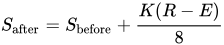
where:
- – the team's number of World Ranking scores after the game
- – the team's number of World Ranking scores before the game
- – the match weight factor; see below
- – the result of the game depended on match and sets won (3–0, 3–1, 3–2, 2–3, 1–3 or 0–3); see below
- – the expected result of the game has the value between -2 and +2. If the match is completely balanced, the expected result is 0. The bigger the surprise, the more points are transferred; see below for calculation details.


A key principle of the world ranking is that a team winning a match cannot lose ranking points and a team losing a match cannot gain ranking points.[9] Hence, if a team wins a match but the result is lower than expected, with , the team will be rewarded with the minimum ranking points (0.01), i.e.


The team that lost the match will instead lose the minimum ranking points (0.01), i.e.

Match weight factor
[edit]The match weight factor is set to reflect the prestige of the tournament. In 2025, FIVB changed the match weight factors for some events and introduced ranking points for events organized by zonal associations.[10] In 2026, the match weight factor for zonal events was reduced.[11]
| Event | Match weight factor | ||
|---|---|---|---|
| 2019–2024[6] | 2025[7] | 2026–[12] | |
| Annual Official Zonal Events | – | 30.0 | 20.0 |
| Annual Official Continental Events | 10.0 | 30.0 | 30.0 |
| Continental Championship qualifying | 17.5 | – | – |
| FIVB Challenger Cup | 20.0 | – | – |
| Olympic Games qualifying / FIVB World Cup[B] | 35.0 | – | – |
| Continental Championship | 35.0 | 40.0 | 40.0 |
| FIVB Nations League | 40.0 | 40.0 | 40.0 |
| FIVB World Championship/Cup[A] | 45.0 | 50.0 | 50.0 |
| Olympic Games | 50.0 | 50.0 | 50.0 |

Match result
[edit]|
We set the result , where is the index of the actual result (set score)
|
|


Expected match result
[edit]The expected results is then calculated as where is the probability of the outcome obtained using the following model (known as Ordered probit):

- Team A win 3–0
- Team A win 3–1
- Team A win 3–2
- Team A lose 2–3
- Team A lose 1–3
- Team A lose 0–3


where is the Cumulative distribution function of the Normal distribution, and are the cut-points


set so that is the probability of the outcome between two equal strength opponents (that is when ), which is derived from the actual match results of the past decade.

 |

|

The parameter represents the scaled difference of the teams rankings

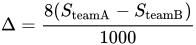
where:
- – the team A's number of World Ranking scores before the game
- – the team B's number of World Ranking scores before the game


Examples
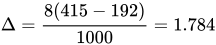
[edit]Before the match at the FIVB Volleyball World Championship (K = 50), Brazil (Team A) is ranked number 1 with a 415 WR score and Japan (Team B) is ranked number 11 with a 192 WR score.[9]
- Strength difference between Brazil and Japan
- Expected match result


Expected match result for Brazil:

Expected match result for Japan:

World Ranking scores for Brazil: World Ranking scores for Japan:
World Ranking scores for Brazil:
World Ranking scores for Japan:
World Ranking scores for Brazil:
World Ranking scores for Japan:
|
World Ranking scores for Brazil: World Ranking scores for Japan:
World Ranking scores for Brazil: World Ranking scores for Japan:
World Ranking scores for Brazil: World Ranking scores for Japan:
|


Inactive teams
[edit]Previously, inactive teams would lose 50 ranking points, but the inactivity sanction was removed in February 2026.[11] Until 2025, teams were considered inactive after one year without participating in competitions eligible for ranking points. In April 2025, this was extended to two years.[10]
Between 2020 and 2025, new teams with no match history entered the official ranking list with 50 ranking points when they played their first match eligible for ranking points (the original 100 points all teams received in 2019 minus the 50 points inactivity penalty).[7] From 2026, new teams with no match history enter the ranking list with 0 ranking points.[12]
World and Continental Rankings
[edit]The five Continental Rankings filter the World Ranking points won and lost in matches played between teams from the same Continental Confederation.
- Intercontinental Tournaments – calculated in World Rankings, but some matches can be calculated in Continental Rankings
- Olympic Games final and intercontinental qualification tournaments
- FIVB World Championship final and intercontinental qualification tournaments
- FIVB World Cup
- FIVB Volleyball Nations League and Challenger Cup
- some Continental Cups: Pan-America
- some FIVB recognised international events, e.g. Pan American Games, Montreux Volley Masters
- Continental Tournaments – calculated in World and Continental Rankings
- Olympic Games continental qualification tournaments
- FIVB World Championship continental qualification tournaments
- FIVB Challenger Cup qualification tournaments
- Continental Championships: Asia (AVC), Africa (CAVB), Europe (CEV), North America (NORCECA), and South America (CSV)
- some Continental Cups: Asia (both AVC Cup and Challenge Cup)
- Zonal Championships, e.g. Eastern Asia, ASEAN, Central America
- some FIVB recognised international events, e.g. African Games, Asian Games, European Games
- Examples
Japan (Asian Volleyball Confederation) vs Italy (Confédération Européenne de Volleyball)
The points calculated in FIVB World Rankings.
Japan (Asian Volleyball Confederation) vs South Korea (Asian Volleyball Confederation)
The points calculated in FIVB World Rankings, and AVC Continental Rankings.
FIVB World Rankings
[edit]Current men's top teams
[edit]| Top 30 rankings as of 3 August 2026[13] | |||
| Rank | Change | Team | Points |
|---|---|---|---|
| 1 |  |
 Poland Poland | 407.56 |
| 2 | |
 Italy Italy | 355.84 |
| 3 | |
 Russia Russia | 352.1 |
| 4 | |
 Slovenia Slovenia | 344.53 |
| 5 | |
 United States United States | 344.41 |
| 6 | |
 Japan Japan | 333.33 |
| 7 | |
 Brazil Brazil | 312.13 |
| 8 | |
 France France | 302.59 |
| 9 | |
 Bulgaria Bulgaria | 272.25 |
| 10 | |
 Turkey Turkey | 268.49 |
| 11 | |
 Ukraine Ukraine | 247.16 |
| 12 | |
 Germany Germany | 241.87 |
| 13 | |
 Serbia Serbia | 234.98 |
| 14 | |
 Argentina Argentina | 232.41 |
| 15 | |
 Cuba Cuba | 224.23 |
| 16 | |
 Finland Finland | 218.01 |
| 17 | |
 Belgium Belgium | 211.6 |
| 18 | |
 Canada Canada | 209.21 |
| 19 | |
 Iran Iran | 205.6 |
| 20 | |
 Czech Republic Czech Republic | 203.22 |
| 21 | |
 Netherlands Netherlands | 194.97 |
| 22 | |
 Puerto Rico Puerto Rico | 168.59 |
| 23 | |
 Greece Greece | 148.96 |
| 24 | |
 Qatar Qatar | 147.82 |
| 25 | |
 Portugal Portugal | 138.86 |
| 26 | |
 South Korea South Korea | 137.22 |
| 27 | |
 Egypt Egypt | 136.56 |
| 28 | |
 Switzerland Switzerland | 134.76 |
| 29 | |
 Israel Israel | 133.53 |
| 30 | |
 Estonia Estonia | 133.14 |
| 27 | |
 Bangladesh Bangladesh | 50.1 |
| *Change from 5 October 2025 | |||
Current women's top teams
[edit]| Top 30 rankings as of 24 May 2026[14] | |||
| Rank | Change | Team | Points |
|---|---|---|---|
| 1 | |
Italy | 484.15 |
| 2 | |
Brazil | 428 |
| 3 | |
Turkey | 368.09 |
| 4 | |
Poland | 359.85 |
| 5 | |
Japan | 346.26 |
| 6 | |
 China China | 337.02 |
| 7 | |
United States | 335.03 |
| 8 | |
Netherlands | 270.58 |
| 9 | |
Serbia | 261.31 |
| 10 | |
Germany | 254.86 |
| 11 | |
 Dominican Republic Dominican Republic | 254.68 |
| 12 | |
Canada | 230.99 |
| 13 | |
France | 222.91 |
| 14 | |
Belgium | 211.23 |
| 15 | |
Czech Republic | 194.3 |
| 16 | |
Ukraine | 190.2 |
| 17 | |
Argentina | 182.42 |
| 18 | |
 Thailand Thailand | 171.66 |
| 19 | |
 Mexico Mexico | 166.82 |
| 20 | |
Slovenia | 161.08 |
| 21 | |
 Kenya Kenya | 158.49 |
| 22 | |
 Colombia Colombia | 157.31 |
| 23 | |
Puerto Rico | 149.24 |
| 24 | |
 Romania Romania | 148.02 |
| 25 | |
Bulgaria | 144.25 |
| 26 | |
 Sweden Sweden | 141.12 |
| 27 | |
Cuba | 139.83 |
| 28 | |
 Vietnam Vietnam | 136.75 |
| 29 |  2 2 |
 Hungary Hungary | 131.98 |
| 30 |  1 1 |
Greece | 131.02 |
| *Change from 1 May 2026 | |||

Historic women's leaders
[edit]For historical women's FIVB rankings from September 2005 to present.[16]

List of men's number one ranked nations
[edit]| No. | Team | Start date | End date | Days | Total |
|---|---|---|---|---|---|
| 1 | Brazil |
October 31, 2005 | July 12, 2022 | 6098 | 6098 |
| 2 | Poland |
July 12, 2022 | July 20, 2025 | 1104 | 1104 |
| 3 | Italy |
July 20, 2025 | July 20, 2025 | 1 | 1 |
| Poland (2) |
July 20, 2025 | June 12, 2026 | 327 | 1431 | |
| Italy (2) |
June 12, 2026 | June 24, 2026 | 12 | 13 | |
| Poland (3) |
June 24, 2026 | November 30, 2026 | 159 | 1590 |
Last update: 30 November 2026
List of women's number one ranked nations
[edit]| No. | Team | Start date | End date | Days | Total |
|---|---|---|---|---|---|
| 1 | China |
October 30, 2005 | December 1, 2006 | 397 | 397 |
| 2 | Russia |
December 1, 2006 | November 30, 2007 | 364 | 364 |
| 3 | Brazil |
November 30, 2007 | November 30, 2011 | 1461 | 1461 |
| 4 | United States |
November 30, 2011 | September 30, 2013 | 670 | 670 |
| Brazil (2) |
September 30, 2013 | October 31, 2014 | 396 | 1857 | |
| United States (2) |
October 31, 2014 | August 31, 2016 | 670 | 1340 | |
| China (2) |
August 31, 2016 | October 31, 2018 | 791 | 1188 | |
| 5 | Serbia |
October 31, 2018 | September 30, 2019 | 334 | 334 |
| China (3) |
September 30, 2019 | May 27, 2021 | 605 | 1793 | |
| United States (3) |
May 27, 2021 | October 5, 2022 | 496 | 1836 | |
| Brazil (3) |
October 5, 2022 | October 9, 2022 | 4 | 1861 | |
| 6 | Italy |
October 9, 2022 | October 13, 2022 | 4 | 4 |
| Brazil (4) |
October 13, 2022 | October 15, 2022 | 2 | 1863 | |
| Serbia (2) |
October 15, 2022 | July 17, 2023 | 275 | 609 | |
| 7 | Turkey |
July 17, 2023 | June 21, 2024 | 340 | 340 |
| Italy (2) |
June 21, 2024 | August 31, 2026 | 801 | 805 |
Last update: 31 August 2026
See also
[edit]
Notes
[edit]References
[edit]- ↑ "FIVB World Ranking system". FIVB. Retrieved 21 December 2019.
- ↑ "Ranking FIVB (2019)". Hypercube. Retrieved 1 February 2020.
- ↑ "FIVB to introduce new World Ranking system for 2020". FIVB. Retrieved 21 December 2019.
- ↑ "The FIVB Volleyball World Cup Takes the Sport Into a New Era". FIVB. 5 March 2026. Archived from the original on 9 March 2026. Retrieved 9 March 2026.
- ↑ "FIVB Competitions". FIVB. Retrieved 9 March 2026.
- 1 2 "Frequently Asked Questions (FAQ, 2023)" (PDF). Volleyball World. 8 February 2023. Archived (PDF) from the original on 1 June 2023. Retrieved 13 June 2025.
- 1 2 3 "Frequently Asked Questions (FAQ, 2025)" (PDF). Volleyball World. 15 April 2025. Archived (PDF) from the original on 13 June 2025. Retrieved 13 June 2025.
- ↑ "How it works" (PDF). Volleyball World. Retrieved 9 March 2026.
- 1 2 "Volleyball World Ranking Examples" (PDF). Volleyball World. Retrieved 13 June 2025.
- 1 2 "FIVB Board of Administration approves key proposals from FIVB Commissions and Councils". FIVB. 13 April 2025. Archived from the original on 20 May 2025. Retrieved 13 June 2025.
- 1 2 "FIVB Board of Administration advances Strategic Vision 2032 and global volleyball growth roadmap". FIVB. 27 February 2026. Archived from the original on 27 February 2026. Retrieved 9 March 2026.
- 1 2 "Frequently Asked Questions (FAQ, 2026)" (PDF). Volleyball World. 2 March 2026. Archived (PDF) from the original on 9 March 2026. Retrieved 9 March 2026.
- ↑ "The FIVB World Ranking". FIVB. 3 August 2026. Retrieved 3 August 2026.
- ↑ "The FIVB Women's World Ranking". FIVB. 24 May 2026. Retrieved 24 May 2026.
- ↑ "Tableau Public". public.tableau.com.
- ↑ "Tableau Public". public.tableau.com.
