


Kirchhoff's diffraction formula
Kirchhoff's diffraction formula[1][2] (also called Fresnel–Kirchhoff diffraction formula) approximates light intensity and phase in optical diffraction: light fields in the boundary regions of shadows. The approximation can be used to model light propagation in a wide range of configurations, either analytically or using numerical modelling. It gives an expression for the wave disturbance when a monochromatic spherical wave is the incoming wave of a situation under consideration. This formula is derived by applying the Kirchhoff integral theorem, which uses the Green's second identity to derive the solution to the homogeneous scalar wave equation, to a spherical wave with some approximations.
The Huygens–Fresnel principle can be derived by the Fresnel–Kirchhoff diffraction formula.
Derivation of Kirchhoff's diffraction formula
[edit]Kirchhoff's integral theorem, sometimes referred to as the Fresnel–Kirchhoff integral theorem,[3] uses Green's second identity to derive the solution of the homogeneous monochromatic scalar wave equation at an arbitrary spatial position P in terms of the solution of the wave equation and its first order derivative at all points on an arbitrary closed surface as the boundary of some volume including P.

The solution provided by the integral theorem for a monochromatic source is[1] where is the spatial part of the solution of the homogeneous scalar wave equation (i.e., as the homogeneous scalar wave equation solution), k is the wavenumber, and s is the distance from P to an (infinitesimally small) integral surface element, and is a normal derivative, that is a derivative of the function along the unit normal vector of an integral surface element . The surface normal unit vector is toward the inside of the enclosed volume in this integral.
![{\displaystyle U({\textbf {P}})={\frac {1}{4\pi }}\int _{S}\left[U{\frac {\partial }{\partial {\textbf {n}}}}\left({\frac {e^{iks}}{s}}\right)-{\frac {e^{iks}}{s}}{\frac {\partial U}{\partial {\textbf {n}}}}\right]dS,}](https://wikimedia.org/api/rest_v1/media/math/render/svg/ef39cb0a1dcc041fe7b095fd67dec8e193fed12a)




For the below sections, following assumptions are made.
- The distance between a point source P0 of waves and an integral area and the distance between the integral area and an observation point P are much greater than the wave wavelength .
- Waves on the aperture is same to waves that would be present if there was no obstacle (e.g., a screen having the aperture) for the waves.[note 1]
- and are zero at the obstacle (that leads to a physically incorrectly condition that they are discontinuous at the boundaries of the aperture).


The 2nd and 3rd conditions are called Kirchhoff's boundary conditions.
Point source
[edit]
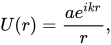
Consider a monochromatic spherical wave point source at P0, which illuminates an aperture A1 in a screen as shown in the right figure. The intensity of the wave emitted by a point source falls off as the inverse square of the distance traveled, so the amplitude falls off as the inverse of the distance. The complex amplitude of the disturbance at a distance is given by

where represents the magnitude of the disturbance at the point source.

The disturbance at a spatial position P can be found by applying the Kirchhoff's integral theorem to the closed surface formed by the screen, consisted of A1 and A2, and a unblocked part of a sphere of radius R centered at C, A3. The integration is performed over the areas A1, A2 and A3, giving
![{\displaystyle U(P)={\frac {1}{4\pi }}\left[\int _{A_{1}}+\int _{A_{2}}+\int _{A_{3}}\right]\left(U{\frac {\partial }{\partial n}}\left({\frac {e^{iks}}{s}}\right)-{\frac {e^{iks}}{s}}{\frac {\partial U}{\partial n}}\right)dS.}](https://wikimedia.org/api/rest_v1/media/math/render/svg/6e868b7b6c02e67b3a9de389ca74c35dea29c5c2)
To solve the equation, it is assumed that the values of and in the aperture area A1 are the same as when the screen is not present (1st assumption of the Kirchhoff's diffraction formula, one of two Kirchhoff's boundary conditions), so at the position Q on the aperture, [note 2]where is the length of the straight line P0Q, and is the angle between a straightly extended version of P0Q (the extension is directed from P0 to Q) and the (inward) unit normal vector to the aperture. Note that so is a positive real number on A1.

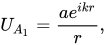
![{\displaystyle {\frac {\partial U_{A_{1}}}{\partial n}}=\nabla U_{A_{1}}\cdot n={\frac {ae^{ikr}}{r}}\left[ik-{\frac {1}{r}}\right]\cos(n,r),}](https://wikimedia.org/api/rest_v1/media/math/render/svg/4fdcc1e15b5647baa0f617c5cda95513dafe7aff)


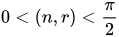

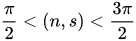
At Q, we also have where is the length of the straight line PQ, and is the angle between a straightly extended version of PQ (the extension is directed from P to Q) and the (inward) normal to the aperture. Note that so is a negative real number on A1.
![{\displaystyle {\frac {\partial }{\partial n}}\left({\frac {e^{iks}}{s}}\right)={\frac {e^{iks}}{s}}\left[ik-{\frac {1}{s}}\right]\cos(n,s),}](https://wikimedia.org/api/rest_v1/media/math/render/svg/ac2234b4549e2fc131bfcc05b03762a9b058fe76)



Two more following assumptions are made.
- (2nd assumption of the Kirchhoff's diffraction formula) In the above normal derivatives, the terms and in both square brackets are assumed to be negligible compared with the wavenumber , means and are much greater than the wavelength . Thus,
- (3rd assumption of the Kirchhoff's diffraction formula, one of the two Kirchhoff's boundary conditions) Kirchhoff assumes that the values of and on the opaque areas marked by A2 are zero. This implies that and are discontinuous at the edge of the aperture A1. Of course this is generally not the case.[4][5]


The contribution from A3 to the integral is expected to be zero, and it can be justified by one of the following reasons. (The 2nd one is preferred as the 1st one has a physical flaw.)
- Make the assumption that the source starts to radiate at a particular time, and make R large enough, so that when the disturbance at P is being considered, no contributions from A3 will have arrived there.[1] Such a wave is no longer monochromatic, since a monochromatic wave must exist at all times, while the monochromaticity is assumed in the Kirchoff's diffraction formula. This physically flawed assumption is not necessary, and a more formal argument avoiding it has been derived.[6]
- A wave emanated from the aperture A1 is expected to evolve toward a spherical wave as it propagates.[note 3] So, if R is large enough, then the wave on A3 is with being the distance from the center of the aperture A1, thus the integral on A3 becomeswhere is the distance from the center of the aperture A1 to an integral surface element.


![{\displaystyle {\begin{array}{lcl}U(P)&=&{\frac {1}{4\pi }}\int \left[U{\frac {\partial }{\partial n}}\left({\frac {e^{iks}}{s}}\right)-{\frac {e^{iks}}{s}}{\frac {\partial U}{\partial n}}\right]dA_{3}\\&\sim &{\frac {1}{4\pi }}\int \left[{\frac {be^{ikr'}}{r'}}ik{\frac {e^{iks}}{s}}\cos(n,s)-{\frac {e^{iks}}{s}}ik{\frac {be^{ikr'}}{r'}}\cos(n,r')\right]dA_{3}\\&=&{\frac {ik}{4\pi }}{\frac {be^{ik(r'+s)}}{r's}}\int \left[\cos(n,s)-\cos(n,r')\right]dA_{3}\\&\sim &{\frac {ib}{2\lambda }}{\frac {e^{ik(r'+s)}}{r'^{2}}}\int \left[\cos(n,r')-\cos(n,r')\right]dA_{3}\\&=&0\end{array}}}](https://wikimedia.org/api/rest_v1/media/math/render/svg/353594cdffe11c0c95a29e253425c46cb81fddd1)
As a result, finally, the integral above, which represents the complex amplitude at P, becomes
![{\displaystyle U(P)=-{\frac {ia}{2\lambda }}\int _{A_{1}}{\frac {e^{ik(r+s)}}{rs}}[\cos(n,r)-\cos(n,s)]d{A_{1}}.}](https://wikimedia.org/api/rest_v1/media/math/render/svg/42ce3b7f0d59de9a19276492b784aede55faaa2b)
This is the Kirchhoff or Fresnel–Kirchhoff diffraction formula.
This formula can also be derived by using a different geometry in which non-physical (no so wave blocking) arbitrary closed surface, that is apart from the point wave source P0 and surrounds the observation point P, is the integral surface to which the Kirchhoff's integral theorem is applied.[7] In this geometry, among three assumptions made above, only the 2nd assumption - (The distance between P0 and an element of the integral surface) and (The distance between the integral surface element and P) are much greater than the wavelength - is required. The result is the same integral form of the Fresnel–Kirchhoff diffraction formula above, except that the integral surface is the chosen closed surface.
Equivalence to Huygens–Fresnel principle
[edit]
The Huygens–Fresnel principle can be derived by integrating over a different closed surface (the boundary of some volume having an observation point P). In the right diagram, the aperture area A1 in the diagram of the above section is replaced by (1) a part of a wavefront (emitted from a P0) at r0, which is the closest to the aperture, and (2) a portion of a cone with a vertex at P0, labelled A4, that is straight lines perpendicular to the wavefront and between the wavefront and the edges of the aperture. If the wavefront is positioned such that the wavefront is very close to the edges of the aperture, then the contribution from A4 can be neglected (an additional assumption on the top of three assumptions used to derive the Kirchhoff's diffraction formula for a spherical wave point source above). On this new A1, the inward (toward the volume enclosed by the closed integral surface, so toward the right side in the diagram) normal to A1 is along the radial direction from P0, i.e., the direction perpendicular to the wavefront. As a result, the angle and the angle is related with the angle (the angle as defined in Huygens–Fresnel principle) as



The complex amplitude of the wavefront at r0 is given by

So, the diffraction formula in the above section becomes where the integral is done over the part of the wavefront at r0 which is the closest to the aperture in the diagram. This integral leads to the Huygens–Fresnel principle (with the obliquity factor ).


In the derivation of this integral, instead of the geometry depicted in the diagram of this section, two closed surfaces (no physical surfaces so they do not block waves), one is a sphere of radius r0 centered at the point wave source P0, and the other is an arbitrary closed surface that contains this inner sphere and is infinitely far from it (e.g., another sphere of infinite radius), can be used.[7] In this geometry, the observation point P is located in the volume enclosed by these closed surfaces, so the Fresnel-Kirchhoff diffraction formula is applied on the two spheres. (The surface normal on these integral surfaces are, say again, toward the enclosed volume.) In the formula application to this geometry, the additional assumption of neglecting the integral on A4, used in the above diagram of this section, is not required. The integral on the outer surface is zero as long as it is infinitely far from P, so as a result, the Huygens–Fresnel principle in the same integral from above is derived, except that the integral surface is the inner sphere.
Extended source
[edit]Assume that an aperture is illuminated by waves from an extended monochromatic wave source.[8] The complex amplitude at the aperture is given by .[note 4]

It is assumed, as before, that the values of and in the area A1 are the same as when a screen having the aperture is not present, that the values of and in A2 are zero (Kirchhoff's boundary conditions), and that 1/s is negligible compared with a wavenumber k (s is much greater than the wavelength )[note 5]. By the same logic as before, the integral over A3 is zero. By applying the Kirchhoff's integral theorem to A1, we then have
![{\displaystyle U(P)={\frac {1}{4\pi }}\int _{A_{1}}{\frac {e^{iks}}{s}}\left[ikU_{0}(r)\cos(n,s)-{\frac {\partial U_{0}(r)}{\partial n}}\right]\,dS.}](https://wikimedia.org/api/rest_v1/media/math/render/svg/50cee27eecc2def77bea0687a8b224c1cc60a307)
This is the most general form of the Kirchhoff diffraction formula.
To solve this equation for an extended wave source, an additional integration would be required to sum contributions from individual points in the source. If, however, we assume that the distance between the source and the aperture is significantly greater than the wavelength[note 6], then we may approximately write a wave in the aperture like a spherical wave (It may be an additional assumption on the top of three assumptions used to derive the Kirchhoff's diffraction formula for a point wave source above.) where is the magnitude of the disturbance at the point in the aperture. We then have where a slowly varying wave magnitude ([note 7]), as expected from the assumption of the source far from the aperture, is used, and is a unit radial vector. Thus, where ( is an angle between the surface normal and the line PQ at Q in the diagram here.) is used.



![{\displaystyle U(P)=-{\frac {i}{2\lambda }}\int _{S}a(r){\frac {e^{ik(s+r)}}{s}}[\cos \chi +\cos(n,r)]\,dS}](https://wikimedia.org/api/rest_v1/media/math/render/svg/08d7b1b192e54a1307aa657baea31da0666d576e)

Fraunhofer and Fresnel diffraction equations
[edit]In spite of the various approximations that were made in arriving at the Kirchoff's diffraction formula,[note 8] the formula is adequate to describe the majority of problems in instrumental optics. This is mainly because the wavelength of light is much smaller than the dimensions of any obstacles encountered by the light in many problems under consideration. Analytical solutions are not possible for most configurations, but the Fresnel diffraction equation and Fraunhofer diffraction equation, which are approximations of the Kirchhoff's formula for the near field and far field, respectively, can be applied to a very wide range of optical systems.
One of the important assumptions made in arriving at the Kirchhoff diffraction formula is that r (the distance between a point wave source P0 and a point on an aperture Q) and s (the distance between Q and an observation point P) are significantly greater than the wavelength λ. Here, another approximation can be made, which significantly simplifies the equation further: this is that the line P0P is great such the lines P0P, P0Q, and QP are approximately parallel to each other, and the distances are much greater than the dimension of the aperture. This allows one to make two further approximations:
- cos(n, r) − cos(n, s) is approximately replaced with 2cos β, where β is the angle between P0P and the normal to the aperture.[9] The factor 1/rs is approximately replaced with 1/r's', where r' and s' are the distances from P0 and P to the origin, which is located in the aperture. Then, given the aperture (denoted by from now on), P0, and P, the Kirchhoff's diffraction formula becomes:
- Assume that the aperture lies in the xy plane, and the coordinates of P0, P and Q (a general point in the aperture)[note 9] are (x0, y0, z0), (x, y, z) and (x', y', 0) respectively. We then have (r and s being the distances of P0 and P to Q respectively):
![{\displaystyle U(P)=-{\frac {ia}{2\lambda }}\int _{S}{\frac {e^{ik(r+s)}}{rs}}[\cos(n,r)-\cos(n,s)]d{S}\approx -{\frac {ia\cos \beta }{\lambda r's'}}\int _{S}e^{ik(r+s)}\,dS.}](https://wikimedia.org/api/rest_v1/media/math/render/svg/993a7d64c3790f47f9df0df809588c937dce9d57)




We can express r and s as follows:
![{\displaystyle r=r'\left[1-{\frac {2(x_{0}x'+y_{0}y')}{r'^{2}}}+{\frac {x'^{2}+y'^{2}}{r'^{2}}}\right]^{1/2},}](https://wikimedia.org/api/rest_v1/media/math/render/svg/536f08fb63f055b7a8fdb568e0c3668fef791ef3)
![{\displaystyle s=s'\left[1-{\frac {2(xx'+yy')}{s'^{2}}}+{\frac {x'^{2}+y'^{2}}{s'^{2}}}\right]^{1/2}.}](https://wikimedia.org/api/rest_v1/media/math/render/svg/f475903d11bb8b04579db861d401f0e464b3701d)
These can be expanded as power series:
![{\displaystyle r=r'\left[1-{\frac {1}{2r'^{2}}}\left[2(x_{0}x'+y_{0}y')-(x'^{2}+y'^{2})\right]+{\frac {1}{8r'^{4}}}\left[2(x_{0}x'+y_{0}y')-(x'^{2}+y'^{2})\right]^{2}+\cdots \right],}](https://wikimedia.org/api/rest_v1/media/math/render/svg/d56d72208823ecdf4259d206dbce7868bfb6c0c4)
![{\displaystyle s=s'\left[1-{\frac {1}{2s'^{2}}}\left[2(xx'+yy')-(x'^{2}+y'^{2})\right]+{\frac {1}{8s'^{4}}}\left[2(xx'+yy')-(x'^{2}+y'^{2})\right]^{2}+\cdots \right].}](https://wikimedia.org/api/rest_v1/media/math/render/svg/d0fa1630df2f86f825e8fb09b438c42446d86096)
The complex amplitude at P can now be expressed as where f(x', y') includes all the terms in the expressions above for s and r apart from the first term in each expression and can be written in the form where the ci are constants.


Fraunhofer diffraction
[edit]If all the terms in f(x', y') can be neglected except for the terms in x' and y', we have the Fraunhofer diffraction equation. If the direction cosines of P0Q and PQ are
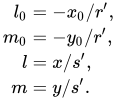
The Fraunhofer diffraction equation is then where C is a constant. This can also be written in the form where k0 and k are the wave vectors of the waves traveling from P0 to the aperture and from the aperture to P respectively, and r' is a point in the aperture.
![{\displaystyle U(P)=C\int _{S}e^{ik[(l_{0}-l)x'+(m_{0}-m)y']}\,dx'dy',}](https://wikimedia.org/api/rest_v1/media/math/render/svg/e8efe3239b2d3dc8ca3858ac0b64de6be496b82f)
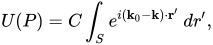
If the point source is replaced by an extended source whose complex amplitude at the aperture is given by U0(r' ), then the Fraunhofer diffraction equation is: where a0(r') is, as before, the magnitude of the disturbance at the aperture.

In addition to the approximations made in deriving the Kirchhoff equation, it is assumed that
- r and s are significantly greater than the size of the aperture,
- second- and higher-order terms in the expression f(x', y') can be neglected.
Fresnel diffraction
[edit]When the quadratic terms cannot be neglected but all higher order terms can, the equation becomes the Fresnel diffraction equation. The approximations for the Kirchhoff equation are used, and additional assumptions are:
- r and s are significantly greater than the size of the aperture,
- third- and higher-order terms in the expression f(x', y') can be neglected.
Note
[edit]- ↑ This assumption may be expressed differently: the dimension of opening (aperture) is much greater than the wave wavelength .
- ↑ The del operator is in terms of independent variables of the functions and . Here .
- ↑ Water wave examples of this can be found in many pictures showing that a water wave passes through a relatively narrow opening and then the wave evolves to a spherical wave as it propagates away from the opening.
- ↑ In a point wave source case above, it is .
- ↑ This is a part of the 2nd assumption used to derive the Kirchhoff's diffraction formula for a spherical wave point source.
- ↑ This is the remaining part of the 2nd assumption used to derive the Kirchhoff's diffraction formula for a spherical wave point source.
- ↑ To compare with , is interpreted as a derivative, as the ratio of an increase by to a displacement by (multiplied by ). It means the wave magnitude significantly varies over a scale of the wavelength , which is an extremely rapid change. Since the discussion is restricted to monochromatic waves, such a case may not be possible.
- ↑ A high-level overview of how to drive the Kirchhoff's diffraction formula is the following. (1) An infinitely long opaque screen with an aperture (through which light can pass) is placed, a monochromatic spherical wave point source P0 is located in one of its sides (e.g., the left to the screen), and an observation point P is located in the other side (e.g., the right to the screen). (2) A closed surface is defined such that it is made of the screen and a part of a very large sphere (the part not blocked by the screen) surrounding P. (3) The Kirchhoff integral theorem is applied on this closed surface. In applying the theorem, the Kirchhoff's boundary conditions (The wave on the aperture is not disturbed by the screen, and the wave and its directional derivative along the surface unit normal vectors to the opaque part of the screen are zero.) and an assumption that the distances of P0 and P to the aperture is much larger than the wavelength .
- ↑ The origin of the coordinate system is on the aperture S. (The natural choice is the origin being at the aperture center.)


References
[edit]- 1 2 3 Born, Max; Wolf, Emil (2005). "8.3 Kirchhoff's diffraction theory". Principles of optics: electromagnetic theory of propagation, interference and diffraction of light (7th (extended) ed.). Cambridge: Cambridge University Press. ISBN 9780521642224.
- ↑ Longhurst, Richard Samuel (1986). Geometrical And Physical Optics. Orient BlackSwan. p. 651. ISBN 8125016236.
- ↑ Kirchhoff, G. (1883). "Zur Theorie der Lichtstrahlen". Annalen der Physik (in German). 254 (4). Wiley: 663–695. Bibcode:1882AnP...254..663K. doi:10.1002/andp.18832540409.
- ↑ J.Z. Buchwald & C.-P. Yeang, "Kirchhoff's theory for optical diffraction, its predecessor and subsequent development: the resilience of an inconsistent theory" Archived 2021-06-24 at the Wayback Machine, Archive for History of Exact Sciences, vol. 70, no. 5 (Sep. 2016), pp. 463–511; doi:10.1007/s00407-016-0176-1.
- ↑ J. Saatsi & P. Vickers, "Miraculous success? Inconsistency and untruth in Kirchhoff’s diffraction theory", British J. for the Philosophy of Science, vol. 62, no. 1 (March 2011), pp. 29–46; jstor.org/stable/41241806. (Pre-publication version, with different pagination: dro.dur.ac.uk/10523/1/10523.pdf.)
- ↑ M. Born, Optik: ein Lehrbuch der elektromagnetischen Lichttheorie. Berlin, Springer, 1933, reprinted 1965, p. 149.
- 1 2 Hecht, Eugene (2017). "10.4 Kirchhoff's Scalar Diffraction Theory". Optics (5th (Global) ed.). Pearson. pp. 532–535. ISBN 978-1-292-09693-3.
- ↑ M. V. Klein & T. E. Furtak, 1986, Optics; 2nd ed. John Wiley & Sons, New York ISBN 0-471-87297-0.
- ↑ In this approximation, , , and ., so .


Further reading
[edit]- Baker, B.B.; Copson, E.T. (1939, 1950). The Mathematical Theory of Huygens' Principle. Oxford.
- Woan, Graham (2000). The Cambridge Handbook of Physics Formulas. Cambridge University Press. ISBN 9780521575072.
- J. Goodman (2005). Introduction to Fourier Optics (3rd ed.). Roberts & Co Publishers. ISBN 978-0-9747077-2-3.
- Griffiths, David J. (2012). Introduction to Electrodynamics. Pearson Education, Limited. ISBN 978-0-321-85656-2.
- Band, Yehuda B. (2006). Light and Matter: Electromagnetism, Optics, Spectroscopy and Lasers. John Wiley & Sons. ISBN 978-0-471-89931-0.
- Kenyon, Ian (2008). The Light Fantastic: A Modern Introduction to Classical and Quantum Optics. Oxford University Press. ISBN 978-0-19-856646-5.
- Lerner, Rita G.; George L., Trigg (1991). Encyclopedia of physics. VCH. ISBN 978-0-89573-752-6.
- Sybil P., Parker (1993). MacGraw-Hill Encyclopedia of Physics. McGraw-Hill Ryerson, Limited. ISBN 978-0-07-051400-3.
