


Reciprocal polynomial
 | This article needs more citations. (April 2021) |
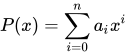
In algebra, given a polynomial with coefficients from an arbitrary field, its reciprocal polynomial or reflected polynomial,[1][2] denoted by p∗ or pR,[2][1] is the polynomial with the same coefficients in the reverse order,[3]


That is, the coefficients of are the coefficients of in reverse order. Reciprocal polynomials arise naturally in linear algebra as the characteristic polynomial of the inverse of a matrix.


In the special case where the field is the complex numbers, when

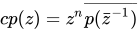
the conjugate reciprocal polynomial, denoted , is defined by,


where denotes the complex conjugate of , and is also called the reciprocal polynomial when no confusion can arise.


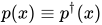
A polynomial is called self-reciprocal or palindromic if . The coefficients of a self-reciprocal polynomial satisfy for all i.


Properties
[edit]Reciprocal polynomials have several connections with their original polynomials, including:
- if is not 0.
- .[2]
- is a root of a polynomial if and only if is a root of or if and is of lower degree than .[4]
- If then is irreducible if and only if is irreducible.[5]
- is primitive if and only if is primitive.[4]


Other properties of reciprocal polynomials may be obtained, for instance:
- A self-reciprocal polynomial of odd degree is divisible by , hence is not irreducible if its degree is .


Palindromic and antipalindromic polynomials
[edit]A self-reciprocal polynomial is also called palindromic because its coefficients, when the polynomial is written in the order of ascending or descending powers, form a palindrome. That is, if is a polynomial of degree , then is palindromic if for , or equivalently if .




Similarly, a polynomial of degree is called antipalindromic if for . That is, a polynomial is antipalindromic if .


Examples
[edit]From the properties of the binomial coefficients, it follows that the polynomials are palindromic for all positive integers , while the polynomials are palindromic when is even and antipalindromic when is odd.


Other examples of palindromic polynomials include cyclotomic polynomials and Eulerian polynomials.
Properties
[edit]- If is a root of a polynomial that is either palindromic or antipalindromic, then is also a root and has the same multiplicity.[6]
- The converse is true: If for each root of polynomial, the value is also a root of the same multiplicity, then the polynomial is either palindromic or antipalindromic.
- For any polynomial , the polynomial is palindromic and the polynomial is antipalindromic.
- It follows that any polynomial can be written as the sum of a palindromic and an antipalindromic polynomial, since[7]


- The product of two palindromic or antipalindromic polynomials is palindromic.
- The product of a palindromic polynomial and an antipalindromic polynomial is antipalindromic.
- A palindromic polynomial of odd degree is a multiple of (it has as a root) and its quotient by is also palindromic.
- An antipalindromic polynomial over a field with odd characteristic is a multiple of (it has as a root) and its quotient by is palindromic.
- An antipalindromic polynomial of even degree is a multiple of (it has and as roots) and its quotient by is palindromic.
- If is a palindromic polynomial of even degree , then there is a polynomial of degree such that .[8]
- If is a monic antipalindromic polynomial of even degree over a field of odd characteristic, then it can be written uniquely as , where is a monic polynomial of degree with no constant term.[9]
- If an antipalindromic polynomial has even degree over a field of odd characteristic, then its "middle" coefficient (of power is since .


Real coefficients
[edit]A polynomial with real coefficients all of whose complex roots lie on the unit circle in the complex plane (that is, all the roots have modulus 1) is either palindromic or antipalindromic.[10]
Conjugate reciprocal polynomials
[edit]A polynomial is conjugate reciprocal if and self-inversive if for a scale factor on the unit circle.[11]
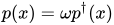

If is the minimal polynomial of with , , and has real coefficients, then is conjugate-reciprocal. This follows because



So is a root of the polynomial which has degree . But, the minimal polynomial is unique, hence for some constant , i.e. . Sum from to and note that is not a root of . We conclude that .





A consequence is that the cyclotomic polynomials are conjugate-reciprocal for . This is used in the special number field sieve to allow numbers of the form , , and to be factored taking advantage of the algebraic factors by using polynomials of degree 5, 6, 4 and 6 respectively – note that (Euler's totient function) of the exponents are 10, 12, 8 and 12.[citation needed]


Per Cohn's theorem, a self-inversive polynomial has as many roots in the unit disk as the reciprocal polynomial of its derivative.[12][13]

Application in coding theory
[edit]The reciprocal polynomial finds a use in the theory of cyclic error correcting codes. Suppose can be factored into the product of two polynomials, say . When generates a cyclic code , then the reciprocal polynomial generates , the orthogonal complement of .[14] Also, is self-orthogonal (that is, ), if and only if divides .[15]


See also
[edit]Notes
[edit]- 1 2
- Graham, Ronald; Knuth, Donald E.; Patashnik, Oren (1994). Concrete mathematics : a foundation for computer science (Second ed.). Reading, Mass: Addison-Wesley. p. 340. ISBN 978-0201558029.
- 1 2 3 Aigner, Martin (2007). A course in enumeration. Berlin New York: Springer. p. 94. ISBN 978-3540390329.
- ↑ Roman 1995, pg.37
- 1 2 Pless 1990, pg. 57
- ↑ Roman 1995, pg. 37
- ↑ Pless 1990, pg. 57 for the palindromic case only
- ↑ Stein, Jonathan Y. (2000), Digital Signal Processing: A Computer Science Perspective, Wiley Interscience, p. 384, ISBN 9780471295464
- ↑ Durand 1961
- ↑ Katz, Nicholas M. (2012), Convolution and Equidistribution : Sato-Tate Theorems for Finite Field Mellin Transformations, Princeton University Press, p. 146, ISBN 9780691153315
- ↑ Markovsky, Ivan; Rao, Shodhan (2008). "Palindromic polynomials, time-reversible systems, and conserved quantities". 2008 16th Mediterranean Conference on Control and Automation (PDF). IEEE. pp. 125–130. doi:10.1109/MED.2008.4602018. ISBN 978-1-4244-2504-4. S2CID 14122451.
- ↑ Sinclair, Christopher D.; Vaaler, Jeffrey D. (2008). "Self-inversive polynomials with all zeros on the unit circle". In McKee, James; Smyth, C. J. (eds.). Number theory and polynomials. Proceedings of the workshop, Bristol, UK, April 3–7, 2006. London Mathematical Society Lecture Note Series. Vol. 352. Cambridge: Cambridge University Press. pp. 312–321. ISBN 978-0-521-71467-9. Zbl 1334.11017.
- ↑ Ancochea, Germán (1953). "Zeros of self-inversive polynomials". Proceedings of the American Mathematical Society. 4 (6): 900–902. doi:10.1090/S0002-9939-1953-0058748-8. ISSN 0002-9939.
- ↑ Bonsall, F. F.; Marden, Morris (1952). "Zeros of self-inversive polynomials". Proceedings of the American Mathematical Society. 3 (3): 471–475. doi:10.1090/S0002-9939-1952-0047828-8. ISSN 0002-9939.
- ↑ Pless 1990, pg. 75, Theorem 48
- ↑ Pless 1990, pg. 77, Theorem 51
References
[edit]- Pless, Vera (1990), Introduction to the Theory of Error Correcting Codes (2nd ed.), New York: Wiley-Interscience, ISBN 0-471-61884-5
- Roman, Steven (1995), Field Theory, New York: Springer-Verlag, ISBN 0-387-94408-7
- Durand, Émile (1961), "Masson et Cie: XV - polynômes dont les coefficients sont symétriques ou antisymétriques", Solutions numériques des équations algrébriques, vol. I, pp. 140–141
