by Skip Daly.
 |
| Kurt Neumann. Photo by Morgan Hemphill. |
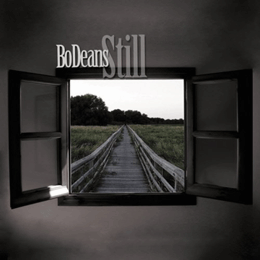
The determination and resilience expressed in the lyrics from “Round Here Somewhere” on the BoDeans’ new record, Still (2008, He and He Records), makes for an appropriate anthem for a band that has seen its share of highs and lows over the past 25 years.
“Looking for a potential that got left behind…
Looking for the reasons we try…
Where can they be?
I know I left them ‘round here somewhere…”
(“Round Here Somewhere” from Still by the BoDeans)
Line-up changes, manager difficulties – you name it, the BoDeans have dealt with it. Of course, they have also done extraordinary things, including supporting U2 on the Joshua Tree tour, and scoring a breakthrough mainstream hit with the ubiquitous “Closer To Free” in the mid 1990s. In the process, they managed to largely define quality American roots rock in the eyes of many a music fan.
It was sometime around 1990 when my cousin first turned me on to this great little band from Milwaukee. I was at his house when he said, “Check this out. I think you’ll like this band,” then played the BoDeans’ first album, Love & Hope & Sex & Dreams (1986, Slash/Warner Records; reissued 1990, Reprise/WEA). By the time “Still The Night” came on, I was hooked. The track called “Angels” clinched it.
I went on to see the band four times on their 1991-1992 Black And White tour and then I made a point of seeing them on all their tours that followed. Their spirited live sets have always been up there among the best live rock ‘n’ roll performances I’ve ever seen. The BoDeans are in that small personal pantheon of bands where I feel I have to own everything they put out. Even with the records that might not qualify as their best work, I’ve always respected what they’re reaching for. What more can one expect of an artist? I like the philosophy reflected in that quote, “Only a mediocre man is always at his best.”
So, it was quite a pleasure for this long-time fan to spend time speaking with Kurt Neumann about the group’s latest release, the current tour and the present state of the BoDeans. It’s a cliché, but my sense is that this is truly a band in the middle of a rebirth, or at least a rediscovery of “the reasons we try.”
The new record, produced by T-Bone Burnett, somehow manages to strike that magical and elusive balance between being both a return to roots and a bold step forward. After a few years of limited number of live performances, the band’s new tour is an extensive one, promising fresh treats for hardcore BoDeans fans via their web site, including the forthcoming web-only release of some special live acoustic performances.
The full conversation with Kurt Neumann follows and I hope you Modern Guitars readers enjoy the interview as much as I enjoyed the conversation.
Skip Daly: Kurt, it’s a thrill to speak with you. I’ve been a big fan for over 15 years now, and I appreciate you calling in. I’ve seen you guys a bunch of times when you passed through the Washington, D.C. area. It really looks like the band is ramping things up again with the current list of tour dates. How does it feel to have this new record out and be back out on the road?
 |
| Kurt Neumann. Photo © 2008, Shou-ping Yu. |
Kurt Neumann: Cool, D.C.’s always a fun town to play in! It feels great every time you get another record out. We like that a lot, and I think for a band like us the live part of it is really important. It’s kind of essential to us because we never made tons of money from our record sales but we’ve always managed to build a big following from our live shows.
So, it’s a good way to get back out there and do the shows and have new material for our fans, which is kind of how we’ve always looked at it. It’s a little bit more exhausting at our age compared to the earlier years!
Skip: I guess it’s more a “balancing your whole life” thing at this point?
Kurt: Yeah, as far as getting the records out and it taking more time between releases. We were really kind of stuck under the thumb of a manager that really made it kind of impossible for us from around 1998 through to 2003, when we finally fired him and just decided to put a record together ourselves and get it out, because it had been so long.
We’d been trying to get a record out for so long and it seemed like everything we tried we couldn’t get around this manager in getting the record out. So, we finally fell into firing him and then we had this big lawsuit with him. All this stuff that just sidetracks you. We never intended to not be releasing records. It’s just that life kind of got in the way there. Once we got past all that stuff, we wanted to start getting records out at least every two years.
This record was just about all the way done when we ran into T-Bone and decided to go back in and rip it apart and build it back up. And that took an extra year-and-a-half to do it with him.
 |
| Still |
Skip: I was going to ask you about that. That’s pretty cool to see you guys working with T-Bone again. I’m wondering: what were the goals, both for the band and for you personally, with respect to the new Still record? Do you feel these goals were achieved? And how much of a role did producer T-Bone Burnett play in the process, going back to work with him for the first time in…what, 20 years? Had you guys worked with him since Love & Hope & Sex & Dreams?
Kurt: Yeah, we worked with him about 1995. I think on the Go Slow Down record.
Skip: Oh, that’s right. I forgot he came back into the fold for that one. I was thinking all the way back to the debut album.
Kurt: That’s kind of how we did this record with him too, more as an executive producer role because we had recorded so much stuff. We had about 23 songs recorded. Because so much of it was already recorded and because we really probably couldn’t afford to just hire him as a straight up producer, we had him come in and help us decide what were the good songs and what were the bad songs, and how to make them a little bit better and what should be done in the mixing process with them, and things like that.
It wasn’t like we got to build this record from the ground up with him, which I think we’d love to do. Unfortunately, we ran into him kind of late in the process. And then I never even thought he’d be able to fit us in. But, because he cared about the relationship we’ve had all these years, he said if we came out there to him, to L.A., and worked on his schedule, he’d fit it in. So, that’s what we did.
Skip: Yeah, he’s a little busy these days with Robert Plant and Alison Krauss I guess, right?
Kurt: Yeah, well with everybody. You know, with all the movie soundtracks he’s dealing with. And yeah, the Robert Plant stuff. And then he was flying off to work with B.B. King and people like that at the same time, and Mellancamp. He was going in many directions at once, which I think he likes doing. For a band like us that can’t command his total attention, we have to work on his schedule.
Skip: The new record sounds great. I’ve been really enjoying it. Songs like “Round Here Somewhere,” to me, that strikes a great balance between old classic BoDeans and also having a freshness to it that sounds like you guys are still growing and going in new directions as a band.
Kurt: Yeah, well that was kind of the feeling too. The record starts out with kind of a bizarre song, “Pretty Ghost,” and I thought everybody would hear that and think “Wow, they’ve really gotten weird, and they’ve really changed!” But, as soon as “Round Here Somewhere” comes on, you just sit back and go, “Oh, I know this sound, I remember this band.” That’s what I liked about putting “Round Here Somewhere” second. It just made a lot of sense.
I agree with you. I mean, we really tried to just stick with what we do. When we go into a studio, we’re not really from the younger generation of using all of the computer samples and loops and all of that stuff. We just do what we do, which is play a drum part and a guitar part and then we sing and then that’s it. That’s what you’ve got. There’s no real tricks about it. It’s just our sound. And then you try to do it in a way that’s still fresh to people. I mean, so it’s still an interesting song.
Skip: Well, it’s kind of funny how some of that stuff seems to be cyclical anyway, like everybody embraces the new technological fads, but then at some point people go back to the raw analog…warm natural sounds. A lot of times it ends up being “less is more.”
Kurt: Oh, exactly. I mean, that was the first big lesson we learned from T-Bone: “less is more,” from the first record on. It was kind of tough on the first record because you go out to L.A. for your first record and there’s so much you want to do. You want to just spend a year out there making some great classic record. But, literally, we had about four weeks to do it and then get out of there. It all happened so fast for us!. Then it was just like, “What happened?” So, it was tough at that age to realize it, but after eight records you look back and you realize that that simplicity is really the key, to keep it super simple, but, try to get a great performance out of that simplicity. That’s really what seems to make the best recordings and the best records.
Skip: Yeah, to say nothing of having great songs at the core of it.
Kurt: Right, right, that’s kind of what I’m saying. You want to really concentrate on that, on what’s important, which is the soul of the song, and try to get the best performance you can of that. But, after that, to a band like us, it’s really not all the different layering. I hear stories about producers who have 20 or 30 guitar tracks and stuff. In fact, we went with T-Bone one day to Capitol when he was working on the Across The Universe soundtrack, and they had like 120 tracks that they were dealing with. I just can’t imagine what you put on that many tracks.
Skip: Yeah right, and then having to go back through it all at some point and make sense of it!
Kurt: Right. But, that’s different because lots of producers were sending tracks back and forth and everybody was adding ideas. I guess that’s how you end up with that type of situation. But, certainly for us, it’s not like that.
Skip:So, with respect to the live show, are there any particular surprises in the new live show? Are you revisiting any old songs that you haven’t touched in a while?
Kurt: Well, we’re trying to play about half of the new record. We try to play at least five or six of the new ones every night. And then there are a bunch of the favorites, what we call “sing along songs,” that we’ve played for years that people seem to really identify with.
Then we leave two or three holes in the set every night where we can just call something out, or if a fan is calling something out in front of us. Things like that, where it can just be real spontaneous and do whatever people want to hear, whatever old song or favorite song or something like that that they have, or whatever we feel like. Sometimes the crowd feels more mellow, or more up, so we can just do whatever we want in the set at that point.
Skip: That’s cool, kind of building in that slot each night. That reminds me of a quote I once heard that I think applies really well to music, and that’s: “Don’t leave spontaneity to chance.” You know, have a plan, but build into the plan the chance to be spontaneous.
Kurt: Yeah, because you know we can pretty much play most anything and, yet, you want it to be a song that everybody can kind of identify. Sometimes, there are fans who will have a specific song that they really want to hear, but it’s not really going to make sense to the whole house of people that night. So, you’ve really got to be able to feel what everybody collectively can identify with. Or, if you just get yourself in a certain mood, you can play something. Still, you have all the new stuff to play for people and some of the old favorites. It makes for a really nice balanced show, I think, and people have really been digging it.
Skip: What guitars are you using now? What do you consider to be your main axe, and why?
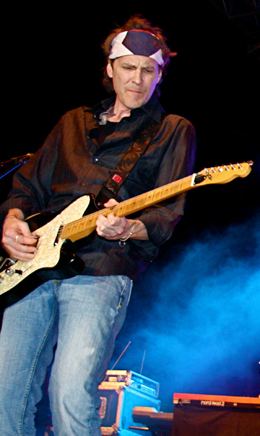
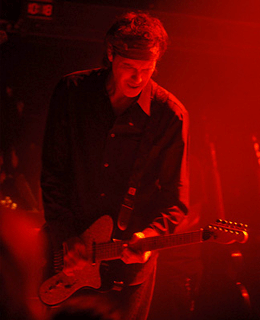
Kurt: I’m not sure of the exact year, but I think it’s about a ’72 Tele custom I’ve been using, which I’ve altered a little bit. I put in an Alnico humbucker. I split the coils in the back and the bridge. I have a lipstick tube type up on the neck pickup that has its own pre-amp in it to match with the humbucker. Sam had bought me that guitar about 1983 or 1984, before we got signed. It’s a heavier guitar. I think it’s made out of maple or something like that. I’ve just always been used to that guitar, the neck always feels good in my hands. It gives me lots of options. By splitting the back coil like that, you can get it very thin and clean sound. Then, you can thicken it up again with the humbucker.
I have a Wilkinson tremolo bridge on there that I use a lot because I use a stereo rig when I play. A lot of times I’ll have long delays going so the tremolo bridge kind of coarsens everything out, and thickens up the sound a lot. So, between all of that, it gives me a lot of options because Sam is just playing the acoustic all night, and he’s just strumming that same sound. So, any changes in the music really stem from where I’m at, whether it’s going to be like a “Closer To Free” song where you need a really big, thick, distorted humbucker sound or where it’s more like “Everyday,” on the new record, where it’s a very clean, picking and chorus-y kind of guitar going on. It’s nice that I can do all of that with the same guitar without having to do a lot of switches.
Skip: It seems like you’ve always been the electric guitarist in the band, with Sammy tending to handle more of the acoustic playing. How did those roles come about? Did that evolve naturally or was it a deliberate decision?
Kurt: I think it was deliberate. Neither Sam nor I really had been guitar players for long when we started the band. I had grown up playing drums. So, I come from that kind of background. Even when I play the guitar, it’s always approached from a real rhythm-esque kind of angle.
Sam had played electric guitar and one time he had hit it so hard that he broke about four of the strings in one swipe. He didn’t have a technique for playing electric guitar. He preferred the acoustic guitar. But, because in the early days it was just Sam and I with two guitars and our two voices, we would just try to expand as much as we could with two guys. Having the electric/acoustic mix made for different instruments, instead of just two acoustics.
So, that was our decision, and the reason for the decision. We were making what we had at the time as big as we could, which was the same idea with the two voices. Originally, Sam was just singing and I was playing guitar. He suggested I sing too, to have a bigger sound. We could have more stuff going on with just the two guys.
Skip: At home are you more likely to pick up an acoustic or plug in an electric?
Kurt: I play acoustic a lot at home. In fact, on almost all of our records, I tend to be the one who records the acoustic. A lot of times, I just have real good timing when I play. Sam tends to get ahead of the music sometimes. So, on most of our records, I’ll end up playing acoustics and electrics. I love playing the acoustic.
Last year, we recorded a couple shows we did where it was just the two acoustic guitars and our accordion player. We’re going to release that later on this fall, a live recording of an acoustic show, and it’s really nice.
Skip: Oh cool, I remember seeing you guys do some of those kinds of shows about 15 years ago. I saw that at Wolf Trap in Virginia.
Kurt: Yeah, the record sounds really nice. We’re just going to sell it off our website to kind of hard core fans, because they really like that stuff, and it gives them something special. But, it’s a very cool record, and I think more and more we like to try and do that stuff.
In fact, it’s the most popular thing in the show. When we come up for our encore, Sam and I come out with two acoustics. But, we do it without the PA. So, we just go to the front of the stage and we sing “Only Love,” with just the acoustics and our voices, no amplification at all. And it’s always hands-down the favorite thing of the night. It’s an amazing thing to have that kind of power in just two acoustics and no PA.
Skip: You just led right into one of my questions.I saw you guys six or seven years ago at the 9:30 Club in D.C., and you did the coolest thing I have ever seen a band do. You came out for the encore, and this was in a 1,200 capacity sold-out room that was going bonkers. You got the crowd to become totally silent, and then you played a song. I think it was “It’s Only Love” without any amplification, just acoustic guitars and no microphones. It was like you turned the place, with a thousand people in there, into a living room for those three minutes. I thought that was absolutely amazing. Where did you get the idea to try that? Did that work so well everywhere? Or did I just happen to catch a particularly magical performance?
Kurt: No, I don’t know where we got it exactly. I can’t remember. I remember seeing some people play that way in theaters. George Winston, he always plays the piano like that and I was amazed he never had a PA system. He was just on the stage playing piano. That struck me that these theaters are really set up for that, to have that kind of sound. But it’s like that every time we do it. Every time we just play it, it’s such an amazing contrast.
To us, we just want to show people that this is for real. This is what we really do. We just sing these songs and the sound of our voices together is just naturally that way. It doesn’t have to do with sound and lights and all the special effects that you can have live, and it’s such a stark contrast to all that stuff. I think that’s why people really love it. It’s so intimate.
Skip: Yeah, like I said, I’ve seen a lot of shows over the years – arena shows to club shows – and that was one moment that just sticks out up there among the best. That was one that I still remember clearly to this day.
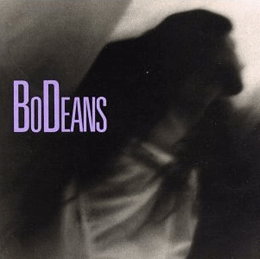 |
| Love & Hope & Sex & Dreams |
Kurt: It’s a favorite thing of ours to do now, just because we know how much people like it. The hard thing is getting everyone to shut up! That’s why particularly we do it in just the theaters. People are glad to sit down and shut up there. When people are out drinking in a rock club, it’s a little bit harder to do it. So, we don’t tend to do it so much in those situations. But, if you can get everyone to just be quiet for four minutes like that, it works great.
Skip: On the subject of longevity, you and Sammy have had an enduring musical partnership for, what, 25 years now? How do you guys work out differences and how do you decide which songs end up on a record or in a set list? Are you guys close? Do you hang out at all in the band’s downtime, or do you give each other some space when the band isn’t working? I always find it really impressive when a band has maintained a lineup for some time. Somehow, that makes the music more “real” to me. It makes it like, “Ok, these guys aren’t just together running a business. There’s a real bond there.” Sort of like sports teams or something, you know?
Kurt: Sure sure, I understand exactly. It’s a great thing when you can keep that whole core together. I think it makes for the whole sound, and that’s great. I think, though, that Sam and I always kind of saw ourselves as the core, even though I think Guy Hoffman [drums] had a lot to do with our original sound. Bob [Griffin, bass] didn’t really come into the scene until after we were getting signed, and going out to make the first record. So, he wasn’t as instrumental into the initial sound of the band. But, he certainly was with us for a long time playing. It’s a great thing.
I think Sam and I always felt like we, being the singers and the songwriters and the sound of our voices and stuff like that, were really at the core of what we did. And, I think how we get along now is based on our respect for that. Certainly, we’ve learned to give each other lots of space, especially when you’re out doing shows and stuff like that. You just have to give each other space. But, it’s funny, on this run. What we’ve done since February between the promotion and the tour shows, it’s been the most at ease that I’ve ever felt touring and doing shows. We’re just respecting each other and doing whatever feels right to us and just getting along and stuff like that.
We’ve certainly had our share of arguments. But, I think we’ve learned that that doesn’t get you anywhere. The music is what’s really important. If you can learn to let your ego go and just try to play the best you can, whether it’s one of my songs or one of his songs or whatever it is that we’re playing, we try to just concentrate on making it good.
As far as picking songs to go on the record, that’s where people like T-Bone come in as essential, because you really need that person in between it all to kind of say, “I like this song.” Or what T-Bone had said on the Still record was, because we had 23 songs, he said, “You know, all these songs are ‘good’, but I think this group of 12 work really well together.”
When we first found him, there were three songs that we thought were the strongest songs on the record that he threw out immediately, and now they’re just sitting there! And we thought “Boy, these are, like, the radio singles!” And he was like “No, no, these other songs work better together.” So, that’s great when it’s someone you respect and you’re just willing to take their word for it. That’s what we did. We weren’t going to try to question him or anything like that on it. We thought, “Okay, that’s what we’ll do then.” As far as Sam and I trying to pick them, I don’t know if we would have picked as good of a record or not.
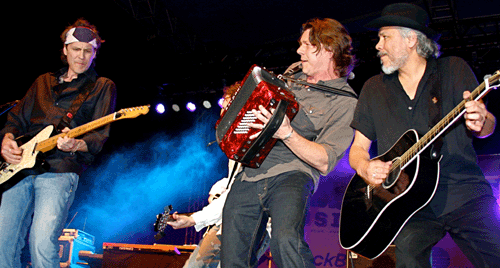 |
| (L-R) Kurt Neumann, Bukka Allen and Sam Llanas. Photo by Morgan Hemphill. |
Skip: It sounds like you really have to make the commitment to surrender yourself to that objective ear?
Kurt: Yeah, anytime I think you’re working with a good producer, you’ve got to do that. You’ve got to trust them. I mean, that’s what you hired them to do! It never makes any sense when I hear stories about people fighting with producers. It’s like, “You hired this guy to do this job and now you’re questioning everything he does or everything he tells you to do?”
It doesn’t make any sense that way. Unless, we’ve worked with people where the process felt so backwards to us that we just had to put a stop to it. But, I can’t imagine people who complete a whole record like that, because that would go nowhere. I mean, I would think. I might be wrong.
Skip: Back in 1987, the BoDeans opened for U2 on The Joshua Tree tour. I have to ask, what was that like? What did you take away from that experience? Did the two bands get along well, and do you still keep in touch with any of the U2 guys?
Kurt: Sometimes, and yeah, they were great people. They were fantastic to us, really nice people. I loved it! The experience was a great experience. It taught us a lot about real big time music.
It’s kind of at a whole different level. When you’re like that, it’s like a big machine. It was nice to sit back and just watch it all happen and see what goes on with it. I think it taught us a lot about the industry and about selling your music at that level and stuff like that. I don’t know that we were ever that interested to be that.
I think BoDeans always wanted to be something where you put records out on your own and you really identified with the music you were doing. I think, when it gets to the level of U2, there’s almost a whole different pressure around you of what you kind of have to do or what’s expected. And, maybe, not so much where they’re at now, but certainly around the time of the Joshua Tree years there was.
Skip: That was when they were just breaking I guess. So, I imagine everybody had an opinion they wanted to throw in.
Kurt: And I think U2 wanted that. I think they wanted to be a huge, huge band that ruled the world and that’s what they strived for and worked for, and I can respect that. But, I don’t think Sam and I ever had that mindset.
We were never going to be the next pop sensation. I don’t think we ever tried to be. When “Closer To Free” hit, it just was a freak thing. It just happened on its own. It was nothing that we had pushed or tried to make happen. Certainly, you want your records to sell and people to like them. But, becoming a huge pop sensation is very different than just having your records sell, you know?
Skip:Speaking of “Closer To Free,” I’m curious, in retrospect, how you feel about that whole thing? I mean, I presume it opened a lot of doors for you guys and was great from a business perspective, but, I’m wondering if the fact that you get one kind of huge hit single like that, do you view that as a positive thing? Do you harbor any feelings of regret that perhaps all those people who heard that one song were maybe not getting a full and accurate taste of what the band is about? If you had to pick one BoDeans song to have been “the hit,” would it have been that one?
Kurt: Well, I don’t know. There were songs that did real good on their own without ever being a single. Songs like “Good Things” were Top 5 radio songs in Chicago and the record company never even released them as singles. And they’ve become favorites in concert. So, it’s hard to say.
I think what people pick out as their favorites and the songs that have lasted for years are what I’ve always kind of seen as our singles, because the audience kind of chose them as songs they really want to hear or songs they react to.
The thing with “Closer To Free,” you know it’s weird. By then we’d already kind of built up a following, so we had an audience that would come out and see us. When “Closer To Free” hit, we had to go and do all these Top 40 kind of radio shows. Those were very strange because we were used to an audience that knew all of our songs and all of our material.
To go and play a show for an audience that just sits there and doesn’t recognize any song until you play “Closer To Free” and then they all jump on their feet and clap, was not my thing. I didn’t enjoy that kind of show. We want an audience that relates to what you’re doing and is familiar with your stuff and knows your stuff. So, it was kind of a weird era for shows. But, it came back around to our normal audience in a year or so.
The bad thing about “Closer To Free” is that it started all the trouble with our old manager and all the problems. Everybody starts to see that the money situation is different and then all the negativity starts. If you ever watched the series Behind The Music, we went through the exact thing that every other band goes through at that point. So, Sam and I would just try to concentrate on the music. All the negative stuff that happened was a total drag.
But I think, I just prefer these kind of audiences. I refer to it as “under the radar,” where you don’t have to do anything for radio necessarily and you get to put out the records you want in the way that you want. And yet, you still have an audience there when you come to a town and play. I really think as a musician, that’s just the best place to be. Granted, you don’t have houses all over the world and a bank account stuffed full of money. But, you really get to have a good musical life. So, that’s what we’ve kind of preferred and that’s why we don’t try to follow up “Closer To Free” with other pop-sounding records, or anything like that.
Skip: Awhile a go, guitar tablature websites were told to “cease and desist” offering free guitar tabs or were threatened with lawsuits because publishers or owners of the songs weren’t getting any compensation. Have any thoughts on that?
Kurt: I’m not offended if somebody wants to learn my song. I don’t understand why there’s a problem, I mean, why you’d need to be paid for that. I understand why record companies would make that argument, I guess. But, I’ve always considered your publishing to be about your radio play and stuff like that. So, I was really even unaware that that was happening. It’s never offended me that someone could go and learn one of my songs or get the chords to one of my songs. I feel more flattered by that than offended by it.
I am certainly offended by the fact that music in general seems to be devalued so much compared to how it was in the ’80s and ’90s when we were coming through. Music always had an important place in people’s lives. You had to pay 15 bucks for a CD, but it didn’t seem like a big price to pay. The problem was that the record companies were taking all of the money from it. But, now because of all the problems, everybody wants music just to be free again. I think musicians struggle with how to make a living after that. But, I certainly never thought that argument went all the way into tablature and chords.
Skip:What are your thoughts on the future of CDs versus digital music? And what do you think of the current state of the business, with file sharing and the RIAA trying to combat that? Most recently, even going so far as to try to claim that it’s illegal to buy a CD and then put it on your computer or iPod?
Kurt: Well, I don’t think there’s any way that they can stop people from pirating a CD, if that’s what somebody wants to do. It’s got to be a society’s ethical decision that music has some value. I’m all for it going just to what someone wants, as far as digital download or a CD. I personally prefer vinyl. I see some of the artists are releasing stuff on vinyl again.
I think you should have that choice. Consumers should have whatever they want as far as how they get the music. I’m just not sure it should be totally free. I’m not sure they should be gouged by record companies either. I wish the artist was making the money off their music.
The middleman has ruined it for so many years, to where they had to be making, you know, 50 million dollars off every CD and the artist is making 50 thousand dollars a year. It didn’t translate well. It didn’t make any sense that way. I think that was what ruined it and now nobody wants to pay.
I think when music gets important in people’s lives again they’ll be glad to pay for it, when music comes back around to where you can’t just construct it on the computer and have everything fixed, all the timing fixed and the all pitch fixed, and everybody thinking it’s this perfect-sounding thing. I think it has to get past that and back to real performances again.
That’s what recordings were about. They were about recording a performance of somebody doing something, playing an instrument or singing a song. They weren’t just about the illusion of it, you know? I think the consumer maybe thought it was valueless because of that, because anybody could do it. Anybody could sing a song in a computer and have it fixed to sound perfect. What’s special about that?
I think when it comes back around to, “This is a real performance this person is doing. This is not something that anyone can do,” I find some value in that. I would be willing to pay for that. I think that’s what needs to happen with music. And I don’t know when it will come back around. But, I really think it will eventually, when some of the “computer music” is weeded out and people get tired of it because once everybody can do something, then nothing is special about it.
There are some things, like when Sam and I sing, our voices make a certain sound, and there’s no computer plug-in that can make that happen. It’s just the way we sound singing together. That’s the way it is when you hear somebody do what they do, that’s interesting and unique, and when you record that process, then I think you have something that people feel like, “Yeah, I like this…I’m willing to pay for this.”
Skip: What are you listening to now? Who are your current musical and guitar heroes?
Kurt: Well, I think my guitar heroes have always kind of stayed the same. When I grew up, when I first started playing guitar, I couldn’t play anything too fancy, so I always was listening to Stones records, Keith Richards’ playing.
Later on, because I had really been into using rockabilly slap delay on my guitars, I started listening to The Edge a lot because of the stuff he was doing with delays. I really thought he came up with a unique style of playing that I love. And then I’ve always been mesmerized by Jimmy Page. What he did with Zeppelin, I don’t know, what he was doing there with rock ‘n’ roll music was just so special and so interesting. I was a drummer back when that was going on, so, I was a big John Bonham fan. But, as a guitar player, when I listen to what Page was doing, I’m just mesmerized! I’m just knocked out by it! It just seems like such an interesting take on it.
So, those are the people I’ve really always identified with as far as guitar players. When I come off the road, I don’t tend to put on a lot of hard music because my ears and my head have been drilled with it for weeks and weeks on end. I like to listen to stuff like John Coltrane or stuff that is totally different. Stuff that I could never really play because I can just sit back and appreciate it.
Skip: What about your own catalog? How often to you listen back to old BoDeans records and which are your favorites?
Kurt: Well, I like that Go Slow Down record a lot. It’s a really warm record that we kind of just put together ourselves. I don’t listen a lot to the Black And White record, which is strange, because it’s got most of the favorites of ours on it, as far as the audience goes, like “Naked” and “Paradise” and “Good Things,” and a lot of these songs that people love to hear.
But, what I end up listening to are live recordings of us because I’m mixing them here in my studio for release. So, I’ll listen back to that stuff a lot. We released a record off our website that was recorded in Boulder, Colorado. And the reason we recorded it is because we had hired two drummers for this show. We had Noah Levy and Kenny Aronoff and we just wanted to document that show. So, I’m mixing that stuff and mixing the new live acoustic stuff. That’s really my favorite stuff, even doing back to the Joe Dirt Car stuff. I love the live stuff a lot.
Skip:Yeah, that’s possibly my favorite BoDeans record. I’ve been waiting for “Volume 2.”
Kurt: Yeah, I know! I’m also working on that! We’re going to have the first record remastered because the transformation from analog to digital back in the early ’80s was really poorly done. Now the technology has gotten so much better that we’re going to go and remaster the first record to re-release it. But, when it’s released we’re going to re-release it with a DVD of this film they just found in the basement of First Avenue. It’s a concert of ours that we played at First Avenue right around 1985. We’re like young, little kids playing on stage there, and they just found this film and just fixed it all up and got the audio all mastered. So, we’re going to release those two things together. That’s a pretty interesting thing to watch because it’s got Guy Hoffman and Bob Griffin, you know, the original band. And Sam’s voice back then just was an amazing thing to hear. So, I’m looking forward to getting that out. But, again, I think it’s the live stuff that really gets me off the most.
Skip: In terms of outside interests, what kind of stuff do you do in your downtime?
Kurt: Well, I’ve got a lot of kids, so the kids are pretty much…I’m never giving them enough time. So, I have to drive them to soccer and do the dad thing. And you know, when you spend 10 or 11 weeks on the road on a bus playing shows every night, it’s kind of nice to come home and just do something simple like go in the backyard and kick a soccer ball with the kids and do that kind of stuff. We just try to chill and hang out.
Because I live outside of town, we’re a little bit in the country, and it’s more relaxed and more sedate to just do that kind of stuff. It’s really nice. Little kids are so smart and it’s such an amazing experience. They’re so addictive and you just want to do everything with them and hang out with them. For me, that’s really my pastime, you know, just doing stuff with them.
Skip: What goals remain to be achieved with the band? What would you like to see happen that hasn’t happened yet? Is there anyone in particular you still really want the chance to work with? What are your plans for the future, if you have any at this point?
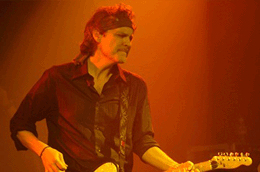 |
| Kurt Neumann. Photo © 2008, Shou-ping Yu. |
Kurt: Well, Sam and I have already talked about starting some recordings for another record. Like I said, we’d like to get one out in the next 18 months to two year type period, as soon as possible. I mean, I want to let this record [Still] go out through the summer and play all the shows for it. But, I want to be starting some work on another record and I think it’s going to be real Sam-and-me-based, and maybe find some real interesting people to play with us and maybe try to do a smaller, more broken-down record than this one. You know, not so full of electric guitars and stuff. We’ll see how that goes. You never know.
Sometimes you have ideas about a record and it just doesn’t pan out. But, we’re kind of talking about that stuff. I think the one thing we haven’t ever achieved, that would be nice in some ways, is that we’ve never been nominated for a Grammy. I think BoDeans have always been kind of a smaller band. I think people know our music a lot, but they don’t really know our name. I think it would be nice just to be recognized on a national or international level like that with one of our records.
About Skip Daly – Skip Daly has several years experience in artist management, promotion, and public relations work. As a business partner at BOS Music, he has been instrumental in managing record releases and national press relations, as well as A&R responsibilities.
Related Links
BoDeans
Shou-ping Yu Photography & Graphic Design