In this issue: love notes, violins, Google Earth, blocked texts, Precious Moments, a teacup Maltese, gamers, bad wiring, wifi passwords, a lost stone, failing at grad school, and Shelley.
Fiction
Hema Padhu | Signs of Happiness
Trent Kay Maverick | Down East
Eirene Gentle| The Rock Counter
Josie Tolin | The Prettiest Girl at the Funeral
Raj Desai | The Mustang
Michael Powers | Helga the Merciful
Sara Duff | Unmarried Woman
Kristen Steenbeeke | Incoherent Condition
Nonfiction
Jacques Servin | The Past Is Alive | My Mother Wants to Know | Remembering
Madeline Cash | You Pink and Precious Angels
John Bresland | Once More to the Lake
Patrick Clement Jones | Sean and Susan
Marilyn Abildskov | Offering
Jacquelyn Ardam| Eudorawelty34
Jim Kelly | The Bump Shop
Poetry
Chrissy Stegman | I Conceal Carry My Joy
Sarah Edwards | The Reading | Daylight Saving
Brian Blanchfield | The Interim
Amanda Quaid | I Know for Sure My Actor Father
Lucy Silbaugh | Coexistence
Trey Moody | This Ending
Chloe Bliss Snyder | A Marian Against Again
John Tracy | The Literal Mariner
Lotte Brown | Pentecost
Delilah Silberman | Fever Shed | Cul-de-Sac
G.C. Waldrep | Mist over a Field near Mercersburg, Sunrise
Julian Talamantez Brolaski | on not being a super passy transsexual | cloudcraft
John Latta | The Ten Thousand Things (11) | The Ten Thousand Things (12)
grace (ge) gilbert | [Symbols of rivers or rivers. Plucking]
William Virgil Davis | Shelley on His Way Out
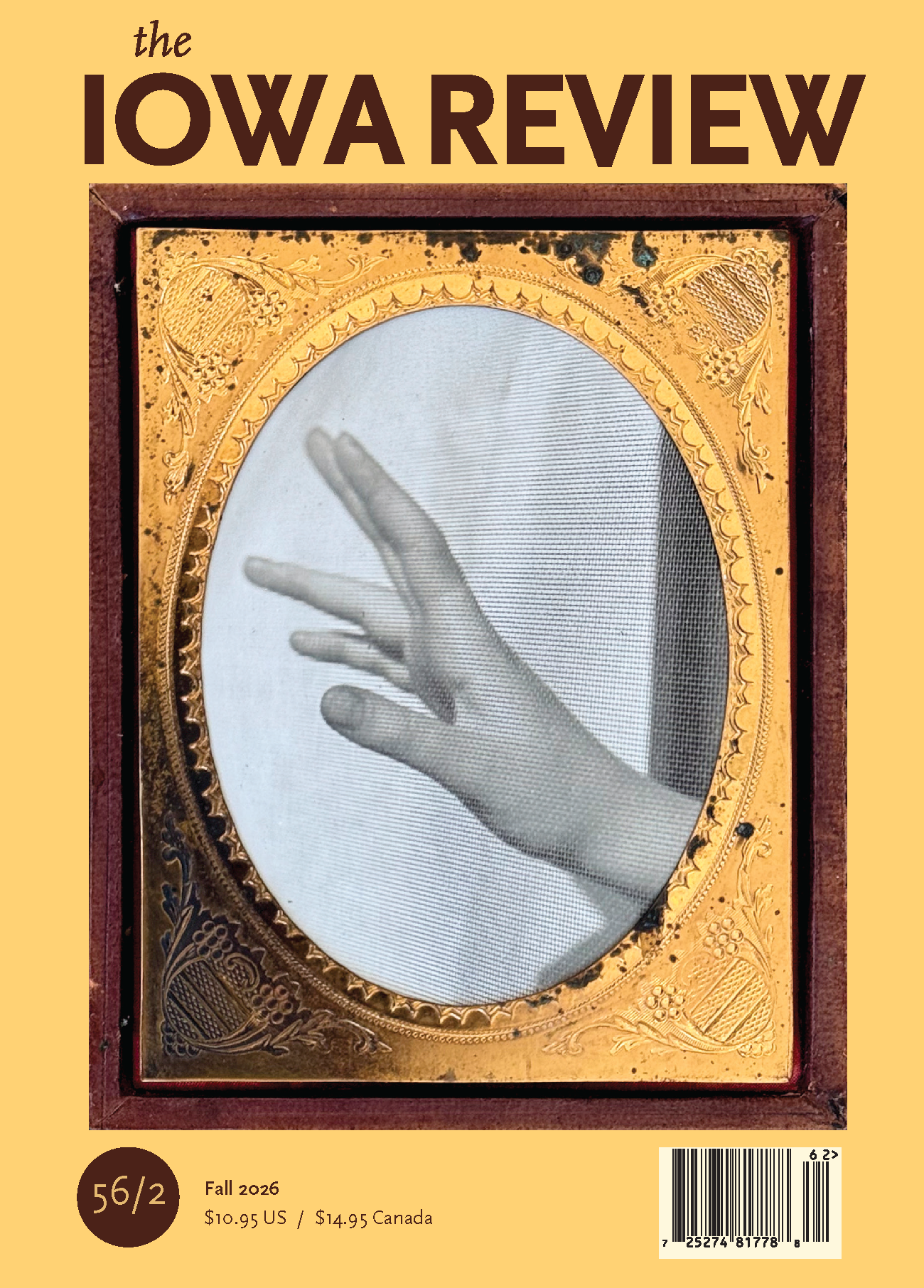
On our cover
A Calling by Sal Taylor Kidd. Assemblage, 3.25 x 4.25 inches.
Editor’s Note
Contact
As a novelist, I may perhaps be forgiven for taking literature as a reflection, indirect but profoundly true, of our national consciousness. And our literature, as perhaps you are aware, is sick, embittered, losing its mind, losing its faith.
—Wallace Stegner, “The Wilderness Letter,” 1960
Some short stories can be categorized as man (sic) vs. nature, I was taught in high school, whereas others are man vs. man, or man vs. society, or man vs. himself. In Trent Kay Maverick’s story in this issue, “Down East,” it’s man vs. cell phone. Visiting his hometown and the lingering rumors of a scandal of his own creation, the unnamed main character keeps trying to text people in his life, but over and over again he receives an automated message informing him that he’s been blocked. Could so many of his contacts have independently decided to block him? Or is a technological glitch to blame?
I noticed the same theme of disconnection throughout the issue, to the point that the most appropriate cover art was Sal Taylor Kydd’s lonely outstretched hand. In an essay, Jacquelyn Ardam struggles to find common ground with her boyfriend’s bitter, distant mother. In another essay, Marilyn Abildskov has to imagine the mental landscape of her partner when he can’t communicate after a stroke. The speaker of “Interim,” a poem by Brian Blanchfield, lets pins fall randomly in Google Earth to connect with somewhere, anywhere, to escape his feelings of alienation from his own country.
And that’s just the first three authors in the issue, according to the alphabetical list we work from before we create our table of contents. “Sick, embittered, losing its mind, losing its faith,” as Wallace Stegner wrote of American literature more than sixty years ago, may not be too far off the mark for our literature today. But there’s another way to read the situation, just as there’s another way of looking at Taylor Kydd’s empty hand: as the prerequisite for any connection—the attempt, the reaching out. The unexpected connections that result from showing up can be seen in this issue just as often as the attempts that fail. In his short story “Mustang,” Raj Desai’s narrator cherishes a moment of intimacy in a closeted life. In his essay “Once More to the Lake,” John Bresland finds himself in a tender moment with the white supremacist father he had gone no-contact with and who is now dying of Alzheimer’s.
Even in my personal life, I—who tell my kids to get off their screens and then later doomscroll into the night, unsure of what’s real and what’s AI-generated slop—can be redeemed by unexpected moments of human connection. Trudging through the backyard from my driveway to the kitchen door after work, I noticed my teenage son Alasdair chatting with our next-door neighbor, Jim Walters. Alasdair appeared inside later with a copy of “The Wilderness Letter,” a little staple-bound volume issued by Route 3 Press in rural Iowa. Jim had lent Alasdair the booklet as an example of letterpress printing—which is what they had been discussing—but I’m sure Jim, a retired university groundskeeper who, ninja-like, plants native trees around the neighborhood, hoped to keep Stegner’s concerns for the natural world in circulation.
Wallace Stegner (born in Iowa!) addressed “The Wilderness Letter” to the California Outdoor Recreation Resource Review Commission in 1960, hoping to impress upon the commissioners the importance of “the wilderness idea.” At a time of great environmental destruction (which hasn’t ended), he argues that the existence of wild places reminds us of where we come from, as a species, and where we still belong. Quoting a previous letter, one written by Sherwood Anderson, Stegner reminds us that the wilderness teaches us “the trick of quiet.”
Stegner reaching out to the Commission, writing his letter; Route 3 Press printing up copies; Jim handing one over the picket fence to Alasdair; me putting my phone down to read it. The writers in this issue poised at their laptops, writing their poems, essays, and stories, each a letter to you. Even writing about the most profound examples of disconnection, they are doing so in the hope of connecting.
It made me vow to write more letters, talk to more neighbors, and hand-deliver more reading recommendations. Do me a favor: if you find yourself connecting to something in this issue, hand it over to someone you think would enjoy it and report back to me at TIReditor@uiowa.edu. I’ll send you something in return. —Lynne Nugent