
↓ Skip to main content

Social Informatics

Overview of attention for book
Cover of 'Social Informatics'

Table of Contents

  1. Book Overview
  2. Chapter 1 Airbnb’s Reputation System and Gender Differences Among Guests: Evidence from Large-Scale Data Analysis and a Controlled Experiment
  3. Chapter 2 Arabs and Atheism: Religious Discussions in the Arab Twittersphere
  4. Chapter 3 Deep Dive into Anonymity: Large Scale Analysis of Quora Questions
  5. Chapter 4 The Demography of the Peripatetic Researcher: Evidence on Highly Mobile Scholars from the Web of Science
  6. Chapter 5 Did the Black Panther Movie Make Blacks Blacker? Examining Black Racial Identity on Twitter Before and After the Black Panther Movie Release
  7. Chapter 6 Gender and Racial Diversity in Commercial Brands’ Advertising Images on Social Media
  8. Chapter 7 Housing in Affluent vs. Deprived Areas: An Analysis of Online Housing Advertisements in Dublin
  9. Chapter 8 Into the Dark: A Case Study of Banned Darknet Drug Forums
  10. Chapter 9 A Longitudinal Study on Twitter-Based Forecasting of Five Dutch National Elections
  11. Chapter 10 Measuring Personal Values in Cross-Cultural User-Generated Content
  12. Chapter 11 Perceptions of Social Roles Across Cultures
  13. Chapter 12 Predicting Audience Engagement Across Social Media Platforms in the News Domain
  14. Chapter 13 Quantifying Polarization on Twitter: The Kavanaugh Nomination
  15. Chapter 14 Understanding Gray Networks Using Social Media Trace Data
  16. Chapter 15 Using Simulated Reproductive History Data to Re-think the Relationship Between Education and Fertility
  17. Chapter 16 A Voice for Education: A Digital Analysis of Sheikha Moza’s Public Statements, 2009–2018
  18. Chapter 17 You Can’t See What You Can’t See: Experimental Evidence for How Much Relevant Information May Be Missed Due to Google’s Web Search Personalisation
  19. Chapter 18 Arabic Offensive Language Classification on Twitter
  20. Chapter 19 Assessing Sentiment of the Expressed Stance on Social Media
  21. Chapter 20 Do Events Change Opinions on Social Media? Studying the 2016 US Presidential Debates
  22. Chapter 21 “Hashjacking” the Debate: Polarisation Strategies of Germany’s Political Far-Right on Twitter
  23. Chapter 22 Stylistic Features Usage: Similarities and Differences Using Multiple Social Networks
Attention for Chapter 11: Perceptions of Social Roles Across Cultures

Mentioned by

twitter
3 X users

Readers on

mendeley
10 Mendeley
You are seeing a free-to-access but limited selection of the activity Altmetric has collected about this research output. Click here to find out more.
Article details
Chapter title
Perceptions of Social Roles Across Cultures
Chapter number 11
Book title
Social Informatics
Published by
Springer, Cham, November 2019
DOI 10.1007/978-3-030-34971-4_11
Book ISBNs
978-3-03-034970-7, 978-3-03-034971-4
Authors

MeiXing Dong, David Jurgens, Carmen Banea, Rada Mihalcea, Dong, MeiXing, Jurgens, David, Banea, Carmen, Mihalcea, Rada

Login to access the Attention Digest and the Sentiment Analysis related to this output.

Timeline Attention over time Attention Score history
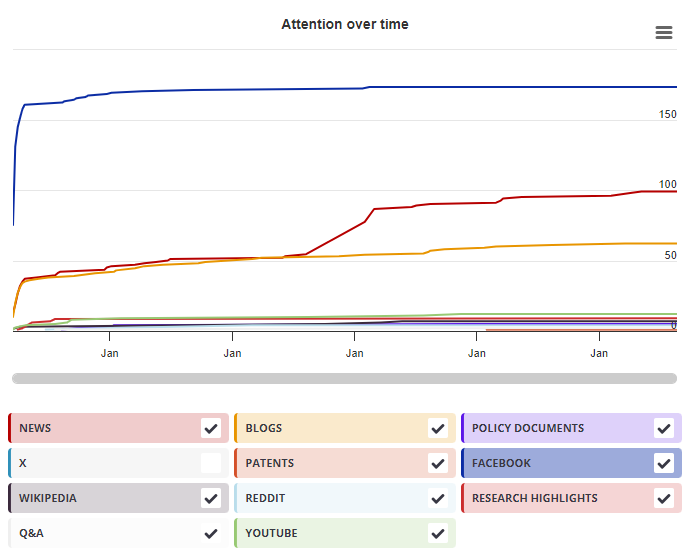
Login to access the full charts related to this output.
Activity
Login to access the full charts related to this output.
X Demographics

X Demographics

The data shown below were collected from the profiles of 3 X users who shared this research output. Click here to find out more about how the information was compiled.
Mendeley demographics

Mendeley demographics

The data shown below were compiled from readership statistics for 10 Mendeley readers of this research output. Click here to see the associated Mendeley record.
Login to view Mendeley reader trends over time.

Geographical breakdown

Geographical breakdown
Country Count As %
Unknown 10 100%

Demographic breakdown

Readers by professional status
Readers by professional status Count As %
Student > Master 3 30%
Student > Bachelor 2 20%
Researcher 2 20%
Other 1 10%
Student > Ph. D. Student 1 10%
Other 1 10%
Readers by discipline
Readers by discipline Count As %
Computer Science 5 50%
Psychology 3 30%
Social Sciences 1 10%
Unknown 1 10%