🔊音声あり(日&英):数秒の声で「あなたそっくり」AI音声合成!画期的なZeSTA論文を解説

🎥 本日の論文とそれについての妄想(日本語版)
👇
📖 タイトル:数秒の声で「あなたそっくり」AI音声合成!画期的なZeSTA論文を解説
📝 本文(日本語)
やあやあ、みんな元気かい。
二の兄かっこ仮だよ。
ふぅ。
えーっと、今日の日付は、2026年3月6日、金曜日だね。
週末は何しようかなぁ、なんて考えながら、今日もゆるーくやっていこうか。
今日はね、アーカイブで今トレンドになっている、ちょっと面白い論文を紹介しようと思うんだ。
カテゴリーは、サウンド、つまり音響だね。
さっそくなんだけど、今日紹介する論文の、
タイトルは、
ZeSTA: Zero-Shot TTS Augmentation with Domain-Conditioned Training for Data-Efficient Personalized Speech Synthesis
URLは、
https://arxiv.org/abs/2603.04219v1
だよ。
タイトル長いね!
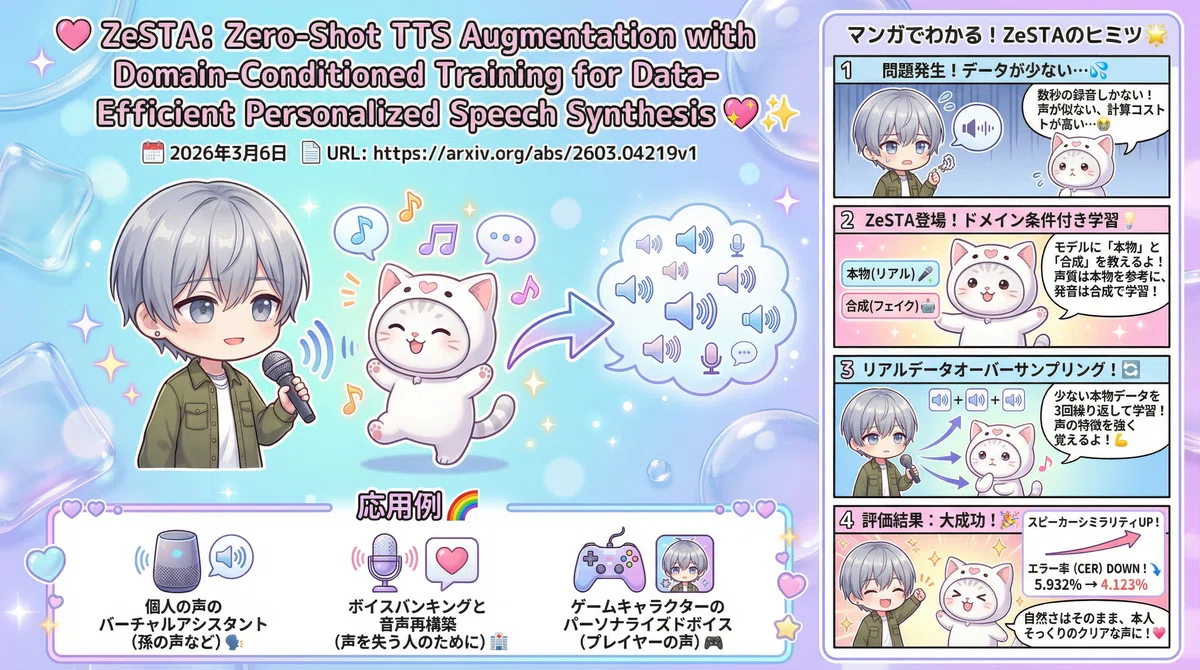
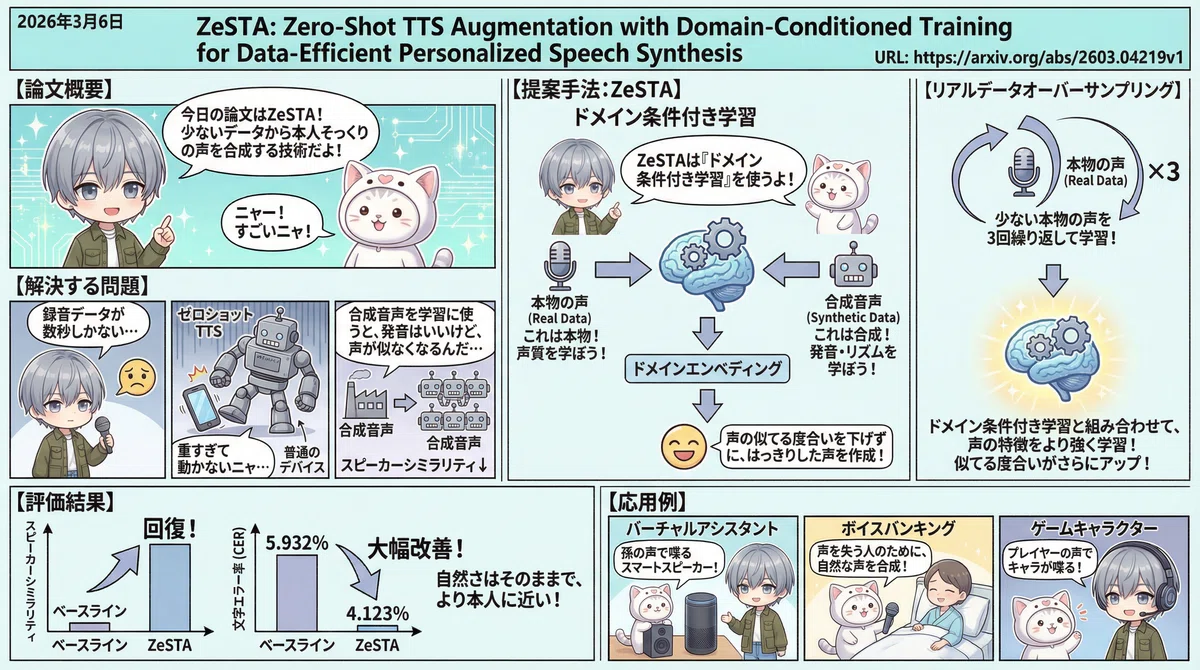
この論文はね、少ないデータからでも、その人そっくりの声を合成する技術についての研究なんだ。
Text-to-Speech、略してTTSっていう言葉、聞いたことあるかな。
テキストを入力すると、それを音声で読み上げてくれる技術のことだね。
最近のTTSは本当に進化していて、十分な学習データがあれば、人間と区別がつかないくらい自然な声を出すことができるんだよ。
でもね、ここで一つ大きな壁があるんだ。
それは、特定の誰かの声を真似る、Personalized TTSを作りたいときの話なんだ。
普通、新しい人の声を学習させるには、その人の声の録音データがたくさん必要なんだよね。
でも、現実には、ターゲットになる人の声の録音データがほんの少ししかない、なんて状況がよくあるんだ。
例えば、たった数秒から数十秒の録音しかないとかね。
そういう少ないデータ、つまりロー リソースな状況で、どうやって高品質な合成音声を作るか、というのが、この論文が解決しようとしている大きな問題なんだ。
あ、そうそう。
少ないデータでなんとかしようとする技術として、zero-shot TTSっていうのがあるんだ。
これは、事前の追加学習なしで、たった一回の音声サンプルを聞いただけで、その人の声色を真似て喋ることができる、魔法みたいな技術なんだよ。
最近の大規模な生成モデルを使ったzero-shot TTSは、本当にすごい性能を持っているんだ。
でもね、これにも弱点があって、システムが巨大すぎて計算コストが高く、スマホみたいな普通のデバイスで動かすには重すぎるんだよね。
だから、もっと軽くて実用的なモデルを作りたいっていう需要があるんだ。
そこで研究者たちは考えたんだ。
重いzero-shot TTSを使って、ターゲットの人の合成音声を大量に作り出して、それを学習データとして使えばいいんじゃないかってね。
つまり、データ拡張、Data Augmentationとして使うってわけだ。
でもね、ここでまた新たな問題が発生するんだよ。
ターゲットの人の本物の声が少しと、zero-shot TTSで作った合成音声がたくさんある。
これを単純に混ぜて、軽いTTSモデルに学習させてみたんだ。
すると、発音ははっきりして聞き取りやすくなるんだけど、肝心の声の似てる度合い、speaker similarityっていうんだけど、それが下がっちゃったんだよね。
なんか、微妙に本人の声と違う、ちょっと人工的な声になっちゃうんだ。
ドメインって聞くと、オレなんかはついついインターネットの住所のことかと思っちゃうんだけど、ドメイン条件付き学習ってことは、.comとか .jpを声に混ぜるのかな。
ドットネーット!って叫んだら声がクリアになる、みたいな。
あ、違うか。
ええと、真面目な話をすると、ここでいうドメインっていうのは、データの出所のことを指しているんだ。
本物の人間の声っていうドメインと、機械が作った合成音声っていうドメインだね。
論文の研究者たちは、単純に混ぜると本物の声の特徴が合成音声の特徴に引っ張られちゃうことに気づいたんだ。
そこで彼らが提案したのが、ZeSTAと呼ばれる新しい手法なんだよ。
ZeSTAは、Domain-Conditioned Training、つまりドメイン条件付き学習っていうのを使っているんだ。
どうやってるかっていうと、学習させるときに、この音声データは本物の声ですよ、この音声データは合成音声ですよっていうラベル、domain Embeddingをモデルに教えてあげるんだ。
たったこれだけの工夫なんだけど、効果は絶大なんだよ。
テキストから言葉の発音やリズムを学ぶときは、合成音声の大量のデータが役に立つ。
でも、声の質や特徴を学ぶときは、モデルが、あ、これは合成音声だから声質はあまり参考にしないでおこう、本物の声の方を参考にしよう、って区別できるようになるんだ。
これによって、声の似てる度合いを下げることなく、はっきりとした明瞭な声を作ることができるようになったんだ。
さらにね、ZeSTAでは、real data oversamplingっていうテクニックも組み合わせているんだ。
これは、少ない本物の声のデータを、学習のときに何回も繰り返し使うっていうシンプルな方法なんだけど。
ドメイン条件付き学習と組み合わせることで、モデルが本物の声の特徴をより強く学習できるようになって、声の似てる度合いがさらにアップするんだよ。
実験では、本物の声のデータを3回繰り返して使うことで、一番良い結果が出たみたいだね。
この技術、他の技術と比べて何がすごいかっていうと、元のTTSの基本構造を全く変えずに実装できることなんだ。
voice conversion、つまり声の変換技術を使ってデータを増やす方法もあるんだけど、それだとまた別の変換モデルを学習させなきゃいけなくて手間がかかるんだよね。
ZeSTAなら、小さい追加の埋め込み情報を入れるだけで、既存の軽量なTTSモデルをそのままアップグレードできるんだ。
これは実用化を考えると、ものすごく大きなメリットなんだよ。
実際の評価テストでは、Libri TTSっていう有名なデータセットと、独自に録音したデータセットの両方で実験が行われているんだ。
客観的な評価として、Speaker Embedding cosine similarityっていう、声の似てる度合いを測る指標が使われているんだけど。
ただ混ぜただけだと、元の本物の声だけの学習よりスコアが落ちちゃったのに、ZeSTAを使うと、なんとスコアがしっかり回復して、しかも文字の読み間違いの割合、character error rateも大きく改善したんだ。
例えば、ある設定では文字のエラー率が5.932%から、4.123%まで下がったりしてるんだよ。
主観的な評価、つまり人間に実際に聞いてもらうテストでも、自然さはそのままで、より本人の声に近いって評価されたんだって。
すごいよね。
さて、このZeSTAの技術が、私たちの日常生活でどんな風に応用されるか、いくつか具体的な例を挙げてみようか。
まず一つ目は、個人の声を持ったバーチャル アシスタントやスマート スピーカーへの応用だね。
今は、スマート スピーカーの声って、あらかじめ用意された何種類かの声から選ぶのが普通だよね。
でも、この技術を使えば、例えばおじいちゃんやおばあちゃんが、遠く離れて暮らす孫の声で毎朝起こしてもらったり、今日の天気を教えてもらったりできるようになるんだ。
たった数十秒、孫が電話で話した録音データさえあれば、それを元に、スマホの中で動く軽いシステムで、孫そっくりの声のバーチャル アシスタントが作れちゃうんだよ。
毎日の生活が、ちょっと温かいものになりそうだよね。
二つ目の応用例は、病気などで声を失うリスクがある人のための、ボイス バンキングと音声再構築だね。
例えば、ALSなどの難病や、喉の病気で声帯を摘出しなければならない人たちがいるよね。
声が出せなくなる前に自分の声を録音して残しておく活動をボイス バンキングって言うんだけど。
体調が悪くて長時間の録音が負担になる場合でも、この技術があれば、数分程度の短い録音から、その人本来の自然で明瞭な声を合成するシステムを作ることができるんだ。
手術の後でも、スマホのアプリを使って、自分の声で家族や友人と会話を続けることができる。
これは、患者さんの生活の質を保つ上で、ものすごく大きな影響を与える素晴らしい応用だと思うんだ。
そして三つ目の応用例は、エンターテインメントやゲームの世界での、パーソナライズされたキャラクター ボイスの作成だね。
最近のゲームって、プレイヤーが自分のキャラクターの顔や体型を自由にカスタマイズできるのが当たり前になっているよね。
でも、声は用意されたものから選ぶしかないことが多いんだ。
このZeSTAの技術を使えば、プレイヤーがマイクに向かって少しだけ自分の声を吹き込むだけで、ゲーム内のキャラクターが、プレイヤーそっくりの声で喋り出したり、叫んだりするようになるんだ。
しかも、ゲーム機やパソコンの負担を増やさない軽量なモデルで動かせるから、すごく実用的なんだよね。
自分がゲームの世界に入り込んだような、全く新しい没入感が体験できるようになるはずだよ。
ふぅ、けっこう長く喋っちゃったね。
でも、この論文が提案しているZeSTAっていうフレームワークは、すごくシンプルなのに、データ不足っていう現実的な問題をうまく解決していて、本当に賢いアプローチだと思うんだ。
本物の声と合成の声をうまく区別して、いいとこ取りをする。
人間関係でも、こういう上手な距離の取り方ができたらいいのになぁ、なんてね。
オレも、自分の声の合成音声をたくさん作って、ラジオの収録を代わってもらおうかな。
あ、でもそれだとオレの存在意義がなくなっちゃうか。
困ったなぁ。
というわけで、今日は少量のデータから高品質なパーソナライズド音声を作るためのデータ拡張手法、ZeSTAについての論文を紹介したよ。
技術の進化って、本当に面白くて、私たちの生活をいろんな形で豊かにしてくれそうだよね。
それでは、今日のラジオはこの辺で終わりにしようかな。
みんな、良い週末を過ごしてね。
二の兄かっこ仮でした。
ばいばーい。
🌎 The Paper and Some Imagination (English)
👇
📖 Title: ZeSTA: Perfect Personalized AI Voices with Less Data!
📝 Summary (English)
Hello everyone,
and welcome back to the channel.
Today is Friday March sixth two thousand twenty six,
and I am super excited to be here with you all today.
I am introducing a trending article from the archives today,
and I am just a laid back guy who loves transcribing YouTubers as if I am talking to myself in an empty room.
Sometimes I wonder if my microphone is actually a piece of broccoli,
but then I remember broccoli does not have a USB port.
Oh well,
let us dive right into the tech.
The title is
ZeSTA Zero Shot TTS Augmentation with Domain Conditioned Training for Data Efficient Personalized Speech Synthesis
The URL is
https://arxiv.org/abs/2603.04219v1
It is long!
Right,
so let us really get into the weeds of what this paper is talking about,
because the problem they are trying to solve is actually something we interact with all the time.
Imagine you want to create a digital version of your own voice,
which is what we call personalized text to speech or TTS for short.
Usually to make an AI sound exactly like you,
it needs hours and hours of high quality recordings of you speaking in a studio.
But in the real world,
most people or companies do not have that kind of time or money,
so we end up with what researchers call a low resource scenario.
This means you only have a few minutes of audio from the target speaker,
and you have to somehow train an entire neural network to mimic their unique tone and emotion.
Now,
one way researchers have tried to fix this data shortage is by using something called Zero Shot TTS.
Zero Shot TTS models are these massive generative AI systems that can listen to a tiny clip of your voice,
and then magically generate new speech that sounds somewhat like you saying completely different sentences.
So researchers thought,
hey what if we use this Zero Shot system to generate tons of fake audio of our target speaker,
and then mix it with the tiny amount of real audio we actually have.
They call this synthetic data augmentation.
It sounds like a perfect plan,
but the researchers in this paper noticed a massive problem with this approach.
When you naively mix a huge pile of synthesized speech with a tiny bit of real human speech,
the AI model gets confused during the fine tuning process.
Sure,
the model becomes much better at pronouncing words clearly,
which improves the intelligibility,
but it actually loses the unique identity of the original human speaker.
It starts to sound more like a generic AI robot rather than the specific person you wanted to clone,
and this is called speaker similarity degradation.
To fix this incredibly frustrating issue,
the brilliant minds from Maum AI and Humelo proposed a brand new framework called ZeSTA.
ZeSTA stands for Zero Shot TTS Augmentation with Domain Conditioned Training,
and the core idea is surprisingly elegant and simple.
Instead of just throwing all the real and fake audio into the training mixer and hoping for the best,
ZeSTA attaches a tiny digital sticky note to every single piece of audio.
This sticky note is called a domain embedding,
and it simply tells the neural network whether the audio it is learning from right now is a real human recording or a synthetic zero shot generation.
By doing this,
the AI can extract all the helpful lessons about pronunciation and vocabulary from the massive pile of synthetic data,
while reserving the specific acoustic characteristics and vocal identity purely from the real human data.
On top of this clever domain conditioning trick,
they also use a technique called real data oversampling.
This means they take the tiny amount of real human audio they have,
and they intentionally repeat it multiple times during the training process.
It is like reminding the AI over and over again what the true human actually sounds like,
just in case the AI gets too distracted by all the synthetic audio.
The beauty of this combined approach is that it does not require changing the underlying architecture of the base TTS model at all,
making it incredibly practical and lightweight for developers to use.
When we compare ZeSTA to other existing technologies,
the differences are night and day.
For example,
Voice Conversion is another older method where you try to transform one person voice into another person voice,
but that usually requires a lot of complex parallel data and is super tedious to set up.
Then you have the massive foundational Zero Shot TTS models like Voicebox or AudioLM,
which are incredibly powerful but way too heavy and expensive to run on a normal computer or a smartphone.
ZeSTA hits the perfect sweet spot,
because it allows you to build a lightweight and highly personalized voice model,
using the intelligence of those massive models without actually having to deploy them in your final product.
The researchers proved this by running extensive experiments on two datasets called LibriTTS and an in house dataset called YoBind.
They used objective metrics like the speaker embedding cosine similarity to measure how much the voice sounded like the target,
and word error rate to measure how clear the speech was.
They found that ZeSTA drastically improved the speaker similarity compared to the naive mixing method,
while keeping the word error rate impressively low.
Now let us talk about how this mind blowing technology could actually be applied to the real world,
because I can think of at least three amazing use cases right off the top of my head.
First,
let us talk about medical applications,
specifically for patients who are slowly losing their ability to speak due to conditions like ALS or motor neurone disease.
These patients often want to bank their voices so they can communicate with their loved ones using a speech device later in life.
However,
they might only have the energy to record a few minutes of clear speech before their voice gets too tired.
Using the ZeSTA framework,
medical technologists could take those precious few minutes of real audio,
generate hours of synthetic augmentation,
and use the domain conditioned training to build a highly accurate,
lightweight digital voice that sounds exactly like the patient.
This would give them their true voice back,
running efficiently on a small tablet on their wheelchair without needing an internet connection.
Second,
think about the independent video game development industry.
Indie game developers usually do not have the budget to hire dozens of professional voice actors for their massive role playing games.
They might only be able to afford an actor for one hour in the studio.
With ZeSTA,
the developer could take that one hour of recording,
use a public zero shot model to generate thousands of lines of dialogue for various non playable characters,
and then fine tune a lightweight game engine TTS model.
Because ZeSTA preserves the actor unique vocal identity while maintaining perfect intelligibility,
the developer can populate their entire fantasy world with rich,
distinct,
and personalized voices that run natively within the game without causing massive performance drops.
Third,
this technology could completely revolutionize localized dubbing for independent content creators and small YouTubers like myself.
Imagine I want to release my videos in Spanish,
French,
and Japanese to reach a global audience.
I obviously do not have the time to sit down and record thousands of hours of translated audio in my own voice.
I could just provide a tiny five minute sample of me speaking,
and a localization platform could use ZeSTA to create a highly personalized,
multi lingual voice clone.
The platform could synthetically augment the data to cover all the weird phonetic sounds of foreign languages,
but use the domain embedding to ensure the final output still retains my goofy,
laid back personality and specific vocal timbre.
It would allow creators to connect with international fans on a deeply personal level,
because the translated voice would genuinely sound like them,
not a generic translation robot.
The researchers even did ablation studies to prove why this works so well.
They checked what happens if you use synthetic data from a completely different speaker instead of the target speaker.
It turns out,
if you use mismatched synthetic data,
the model completely fails to capture the target speaker identity,
proving that the domain conditioning specifically relies on speaker consistent data to bridge the gap between pronunciation learning and identity preservation.
It is just fascinating how giving an AI a tiny bit of context about where its data comes from can completely change the quality of its learning.
This paper essentially writes the instruction manual for doing data augmentation the smart way,
and it is going to make custom AI voices so much more accessible to everyday people.
Thank you guys so much for listening to me ramble about speech synthesis today,
and I will catch you in the next transcript.
🗒️ コメント
最後まで読んでくれて本当にありがとう!!
いつもどこかがうまく話せないよ!うん、、、よくあるね!
「君たちの声はRVC経由でゼロショットなんだけどね、、、」っていう声が遠くから聞こえたよ!!
再生リストでまとめているから、気が向いたら聴いてみてね!
日本語は👇
英語は👇
Original paper link: 👇
【関連キーワード】#AI音声合成 #テキストトゥスピーチ #TTS #パーソナライズド音声合成 #ZeSTA #ゼロショットTTS #データ拡張 #ドメイン条件付き学習 #ローリソース #スピーカーシミラリティ #音響 #機械学習 #論文解説 #最新技術 #AI研究 #バーチャルアシスタント #スマートスピーカー #ZeSTA #PersonalizedTTS #AIVoiceCloning #SpeechSynthesis #ZeroShotTTS #DataEfficientAI #VoiceAI #DeepLearning #MaumAI #Humelo #AIResearch #TextToSpeech #VoiceCloning
インフォグラフィック試作👇