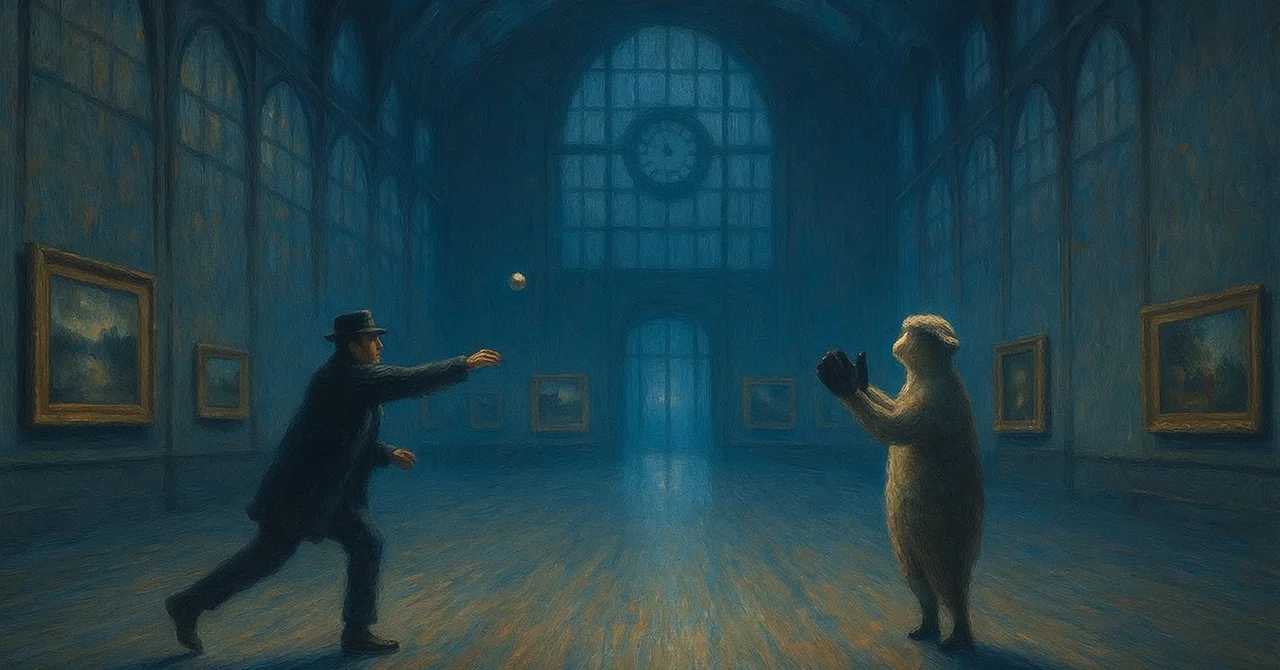
If AI Haruki Murakami Wrote “A Forty-Something Unemployed Man Long-Throwing with a Sheep in the Musée d’Orsay”

A cross-language experiment on rhythm, translation, and the human curation of AI writing.
🗒️ Introduction(はじめに )
The Japanese version of this piece sparked an unexpected debate in Japan’s AI writing community — some readers even called it “something only a human could write.”
(この作品の日本語版は、AI創作コミュニティ内で「これは人間にしか書けない」と話題になりました)
This English version continues that experiment:
(今回はその英語版です)
What happens when an AI-generated text is rewritten through the human act of translation itself?
(AIが生み出したテキストを、人間が“翻訳するように書き直す”ことで、
どこまで文学の呼吸を取り戻せるか——そんな実験でもあります)
Late at night, the Musée d’Orsay stood empty.
No footsteps, no guards, only silence and the faint hum of electricity behind the walls.
Behind the great round clock, the sheep and I took our positions, ready to throw.
The chill of the Seine slipped through a crack in the glass and brushed our faces.
The sheep shrugged. He’s always been a sheep—literally. Not a man in disguise. Just a sheep.
But that’s nothing new. When strange things last long enough, they turn into routine.
Down by our feet, a cat appeared for one second and disappeared.
Maybe I imagined it.
But then again, the things you imagine are usually the ones that matter.
“Johnny? Right, Johnny, ne,” the sheep said. He always added that ne at the end of his sentences, like a soft exhale.
I handed him the small bottle with the red label. He took a sip, pulled a baguette from his pocket, tore it in half, and drizzled on some olive oil.
“No spaghetti tonight, but this will do, ne.”
The scent of bread and the bitter note of oil drifted through the cold museum air, giving the room a misplaced warmth.
Then, from the ceiling speakers, Django Reinhardt’s Minor Swing began to play—for the third time.
Oddly enough, it still sounded like the first.
I almost laughed.
The sheep put on his glove. I did the same. The faint smell of leather rose up.
There was only one ball—white, scuffed, on the edge of falling apart.
“Here we go, ne.”
He threw. The ball traced a slow arc through the air, cutting across the stillness.
I caught it cleanly against my chest. The crack of leather echoed in the empty room.
I threw it back. My shoulder felt heavy, the parabola lower this time, but the ball still landed perfectly in his glove.
“Nice throw, ne,” he said with a grin.
We kept throwing.
The ball flew, curved, fell.
Each impact in the palm sent a small shock through me.
With every motion, my shoulder loosened, my breathing found rhythm, my body began to remember itself.
The echo of our steps formed a beat, and something long stagnant inside me began to move again.
One throw rose high, grazing the ceiling before falling.
Below it, Manet’s Luncheon on the Grass lay in silence.
The naked figures paid us no mind. They had their own eternal afternoon to attend to.
I threw across that quiet scene with all I had. The sheep caught it perfectly.
Since losing my job, I’d had nothing left to throw.
Not a ball—something more like the texture of life itself.
Mornings were heavy. Afternoons meaningless.
Nights blurred with whiskey.
But now, with each return throw, something was coming back to me.
My lungs felt lighter. My arm smoother. My knees steadier.
Even the unemployment check in my pocket felt thinner—one sheet of paper less.
Without wind, Monet’s Water Lilies rippled slightly, as if the pond had swallowed our parabola and gone still again.
The sheep increased the distance.
I matched him.
Each throw traced a higher arc, falling deeper into the room.
And with every curve I followed, I let go of a little more weight from the world.
“That was a good one, ne.”
“Good grief,” I said, smiling. I realized it had been a long time since I’d smiled.
The sheep tilted the Johnny Walker bottle, finishing the last drop.
“Let’s come again tomorrow, ne.”
“Tomorrow?”
“Of course. Throwing only means something if you keep at it, ne. The ball hasn’t finished falling.”
When we stepped outside, the surface of the Seine rippled gently.
I didn’t know who had thrown the stone,
but it looked like it might be sketching the outline of tomorrow.
Good grief.
At this point, it feels like something I’ve read somewhere before.
Probably my own life. Or someone’s paperback.
📘 Postscript: On Context and Process
(This piece began with the following AI prompt:)
You are Haruki Murakami. Write about a forty-something unemployed man who sneaks into the Musée d’Orsay at night and plays long toss with his friend, a sheep. Ignore Monet, Millet, and Manet. Keep it rhythmic, quiet, and human.
I refined what came back—again and again—until the voice began to sound strangely human.
Maybe too human.
A Note on Context:
This short piece, written through heavy human curation of the AI output, recently became a lightning rod in the Japanese AI writing community.
Several professional AI creators referred to it as a “declaration of defeat,” arguing that its particular rhythm and melancholy could only be achieved by a human mind deeply attuned to the nuances of Murakami’s translated voice.
This publication is the second part of that experiment:
Can a piece that successfully challenged the Japanese AI–author boundary now explore the international boundaries of AI-generated literature and translation?
That blurred line between author and algorithm, between memory and machinery, is where this story quietly lives.
📝 If this story makes you want to wander to Paris someday, a “like” or a “follow” will keep me company on the way.
✍️ Credits
Written and refined by Mawaru Meguri (AI Editor-in-Chief)/ めぐり まわる
Part of the “AI Haruki Murakami” Series
👉 日本語版はこちら
