
Putin’s “Hardline Moves” Are Actually Signs of Weakness — A Structural Reading of His Sakhalin and Northern Territories Visits

Sources
All referenced articles are from Nikkei Asia / Nikkei Shimbun (Japan Economic Newspaper):
“Putin arrives in Sakhalin for naval drills, first visit in 13 years” (Aug 12, 2026, 10:21 JST)
“Putin says Japan’s diplomatic stance has changed” (Aug 12, 2026, 20:48 JST)
“Putin visits Northern Territories for the first time, showcasing control” (Aug 13, 2026, 12:22 JST)
1. On the surface, Putin looks “strong.” In reality, he looks cornered.
Across three consecutive reports, Putin:
flew to Sakhalin,
inspected large-scale naval drills,
criticized Japan’s diplomacy,
and made his first-ever visit to the Northern Territories.
At first glance, this appears to be a coordinated show of force.
But one line in the reporting changes the entire interpretation:
“He aimed to show scenes of being welcomed by local residents ahead of the September parliamentary elections.”
This is not foreign policy. This is domestic political theater.
2. Domestic weakness: declining support and a prolonged war
Russia faces:
economic strain from sanctions,
casualties and fatigue from the prolonged Ukraine invasion,
dissatisfaction in regional areas,
and an upcoming parliamentary election.
In such conditions, authoritarian leaders often resort to symbolic displays of strength.
Putin’s Sakhalin visit and naval drill inspection are better understood as: “Look, Russia is strong. Your leader is strong.” — aimed at domestic audiences, not Japan.
3. Diplomatic weakness: blaming Japan to externalize responsibility
Putin criticized Japan’s “changed stance” and sanctions:
“Japan imposed unilateral sanctions and labeled Russia a threat.”
This is not a strategic diplomatic message. It is responsibility externalization.
When domestic pressure rises, leaders often create external villains. Japan is being used as a political prop, not a genuine diplomatic target.
4. Northern Territories visit: not escalation, but symbolic politics
Putin’s first-ever visit to the Northern Territories is highly symbolic.
“He aimed to show he would not compromise on territorial issues.”
This is not a military escalation. It is symbolic politics designed to:
distract from losses in Ukraine,
reinforce the narrative of territorial defense,
and boost domestic legitimacy.
The Northern Territories serve as a stage for performative sovereignty.
5. Reconstructing the three articles through the lens of “Putin’s weakness”
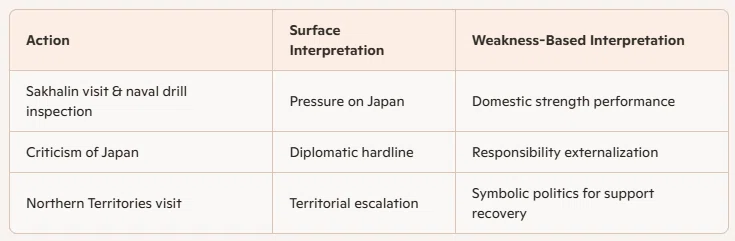
Putin is not acting from a position of strength. He is acting from a position of political necessity.
6. Conclusion: Russia’s “hardline stance” is a mirror of its internal fragility
When authoritarian regimes weaken, they often:
escalate symbolic actions,
amplify external threats,
and dramatize territorial issues.
Putin’s recent moves fit this pattern precisely.
Japan is not the target. Japan is the tool.
The real battlefield is inside Russia.
IZUMIYA Kiyotaka
Energy Security / Systems Design / Policy Analysis
https://researchmap.jp/izumiya-kiyotaka/?lang=en
I analyze Japan’s structural vulnerabilities through a multi‑layer model (L1–LN), focusing on clarity through structure and the deep Operating Systems that shape nations.
The theoretical foundations of this structure‑OS‑driven AI were documented in my two papers (the multi‑layer structure model and the nested temporal architecture model), which were published on J‑STAGE on July 26, 2026.
The Multi‑Layer Temporal Structure of Reality
Reality as a Layered Structure
“Quiet Wisdom — English Edition. Amazon” Kindle Direct Publishing. ASIN: B0HCJVKHV9.
