P035 | AI Future Vision III | Chapter 2 — How Will Data Centers Coexist with Society?

AI often appears to grow inside a digital world.
A user enters a prompt. A model processes it. Text, images, audio, or video appears on a screen.
Yet behind this seemingly weightless experience stands a large physical system.
Servers must be installed in buildings. Electricity must reach them continuously. Heat must be removed. Data must travel through networks. Equipment must be maintained, protected, and eventually replaced.
As AI services expand, the infrastructure supporting them may become more visible in the places where people live.
Chapter 2 looks at this relationship.
How might data centers continue to grow while sharing electricity, water, land, and other resources with the communities around them?
Computing has a physical address
Cloud computing can feel as if it exists everywhere and nowhere.
In reality, every calculation takes place somewhere.
A data center occupies land within a particular region. It connects to a local or regional power system. It operates under specific climate conditions and depends on roads, networks, equipment, and skilled workers.
This physical location shapes what the facility can do.
A site that appears suitable on a map may face limits in available electricity, cooling conditions, network access, construction capacity, or disaster resilience.
Digital capacity can expand rapidly, but the places supporting it cannot always change at the same speed.
Electricity becomes part of the design
AI processors require electricity, and additional energy is needed to cool and operate the surrounding facility.
Chips may become more efficient over time. However, if the total volume of AI computation grows even faster, the overall demand placed on data-center infrastructure could continue to rise.
This connects AI development with power generation, transmission, grid access, and storage.
The challenge is not only to secure more electricity.
It is also to consider when that power is available, how reliably it can be supplied, and how new demand fits alongside homes, public services, and existing industries.
The future of AI infrastructure may therefore depend partly on cooperation with utilities and regional energy planning.
Cooling connects computing with water
High-density computing produces heat.
That heat must be carried away so that processors and supporting equipment can operate reliably.
Some cooling systems use water directly or indirectly. Others may reduce water use but require different equipment or energy inputs.
There may be no single cooling method that works best everywhere.
Climate, facility design, available resources, workload density, and local environmental conditions can all influence the appropriate choice.
Water is also shared by households, agriculture, industry, and ecosystems. As a result, cooling design may increasingly become a question of regional fit rather than technical performance alone.
Land is more than empty space
A data center requires land, but an available plot is only the beginning.
The location must connect to electricity and communications networks. It must support construction and maintenance. It may also need to address flooding, earthquakes, heat, water availability, transportation, and the distance between facilities and users.
Land that satisfies all these conditions is not equally available in every region.
AI services may cross national and regional boundaries almost instantly.
Their physical foundations remain tied to particular places.
Local communities become part of AI infrastructure
A new data center may bring investment, employment, tax revenue, or improvements to surrounding infrastructure.
At the same time, residents may be concerned about electricity and water use, construction activity, noise, landscape changes, or whether the benefits are shared fairly.
These perspectives do not automatically make data-center development impossible.
They suggest that technical planning alone may not be enough.
Utilities, local governments, construction companies, equipment providers, and residents may need to become involved earlier in the process. Clear information about resource use, expected benefits, and long-term operations could help build a more stable relationship.
The ability to communicate may become almost as important as the ability to construct.
Growth must fit the world around it
Coexistence does not necessarily mean stopping the growth of AI.
It may mean designing that growth with greater awareness of physical limits and shared resources.
Computing capacity, electricity, water, land, and local communities are not separate topics. They form one connected system.
If the connections are designed well, data centers could become long-term infrastructure that supports both digital services and regional development.
If they are ignored, resistance or resource constraints may slow expansion regardless of how advanced the chips inside the building become.
Chapter 2 follows AI beyond the screen and into the physical world that sustains it.
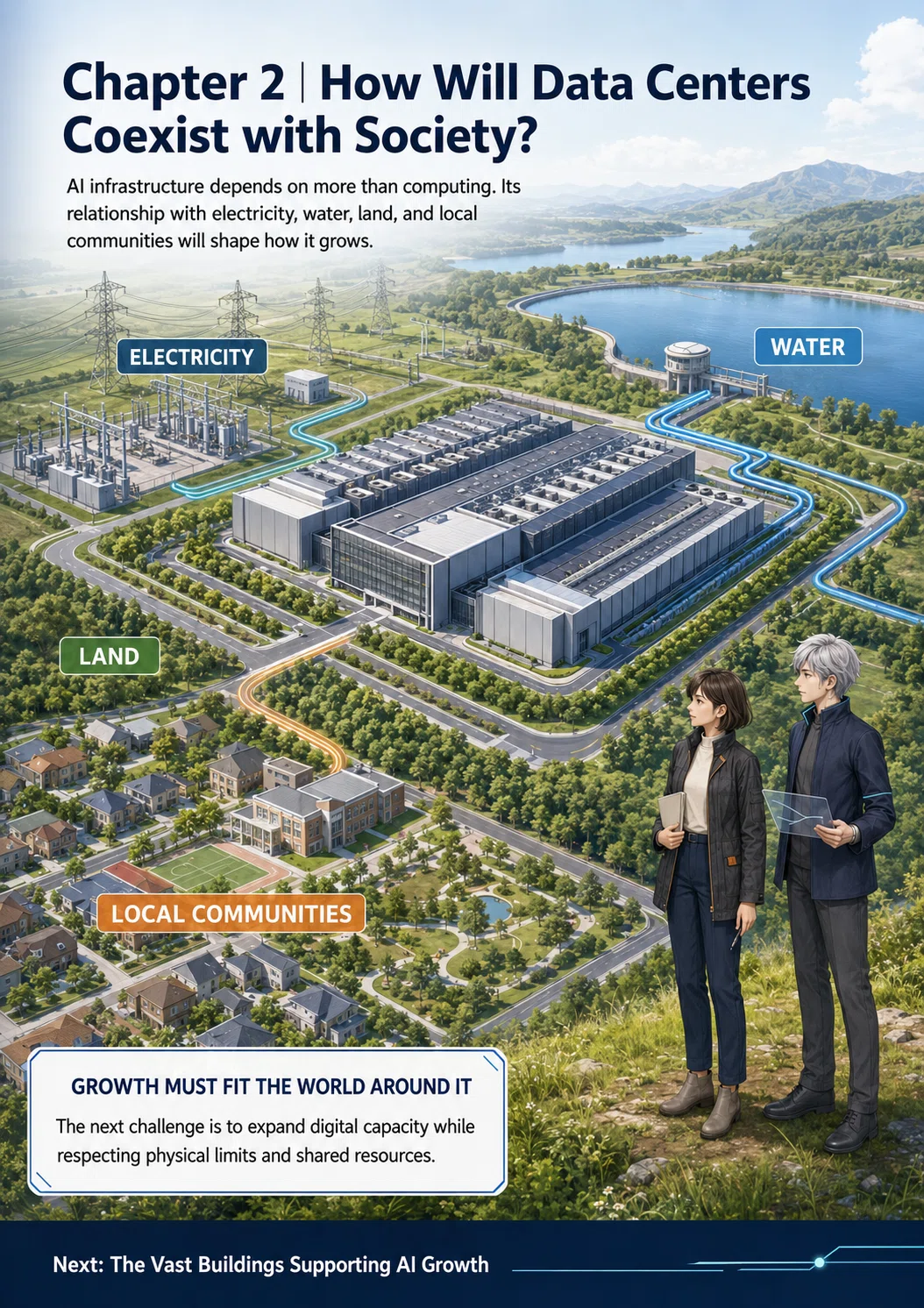
The next stage begins with the building itself.
Next: The Vast Buildings Supporting AI Growth
#AIFutureVisionIII #DataCenters #AIInfrastructure #Electricity #Cooling #WaterResources #LandUse #LocalCommunities #SustainableGrowth #PhysicalAI
いいなと思ったら応援しよう!
この記事は noteマネー にピックアップされました

