P020 | NVIDIA Empire and the Next Computing Civilization | Origins of the GPU – From Graphics Processing

The GPU was not born for AI.
Today, GPUs are widely associated with generative AI, scientific computing, and massive data centers. Their original purpose, however, was far more visual.
They were developed to draw increasingly complex graphics on a screen.
The origin of the GPU lies in the demand for fast, real-time 3D rendering.
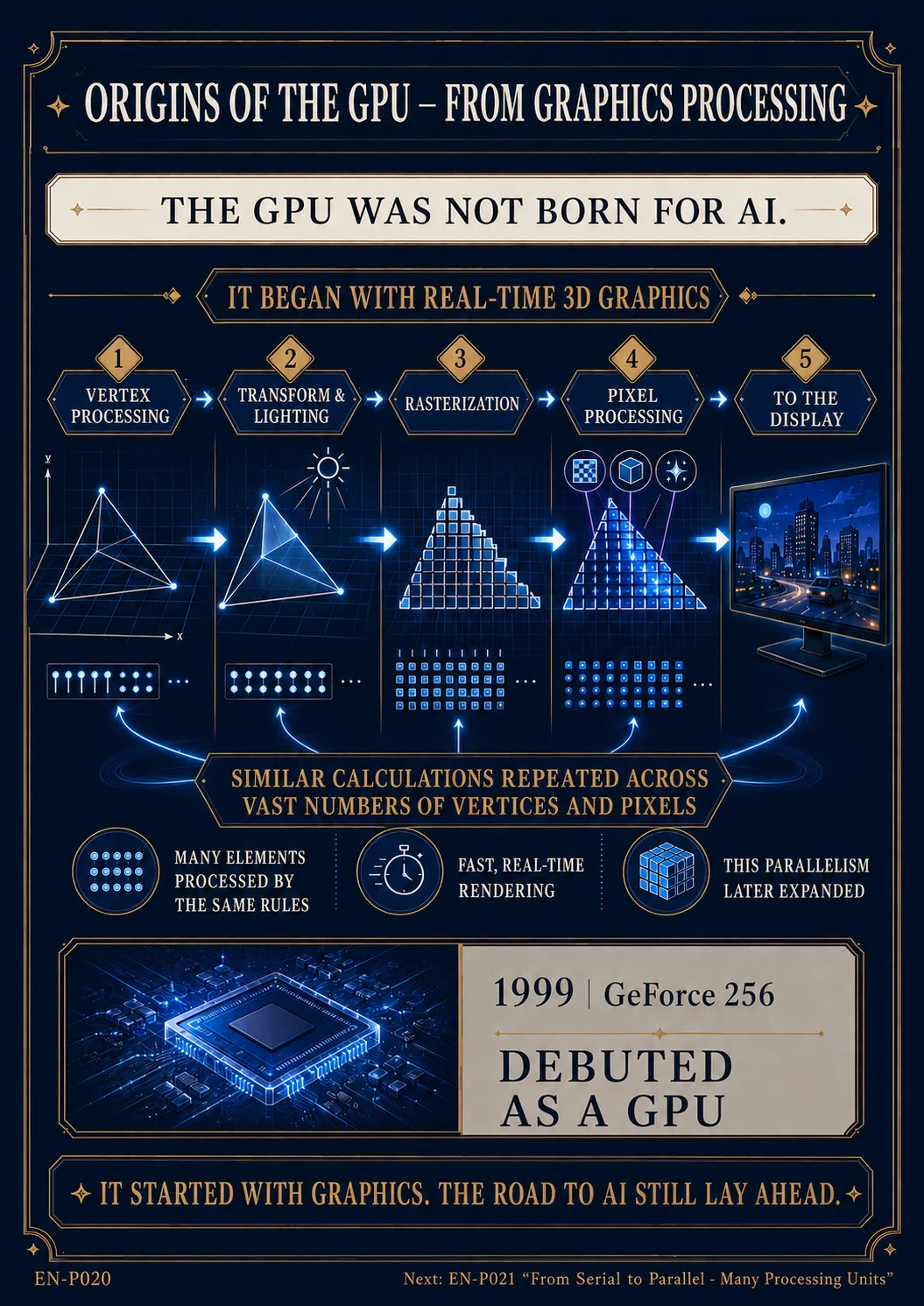
A 3D image is built through a sequence of calculations
A computer does not receive a complete three-dimensional scene and place it directly on a display.
The scene must pass through several stages of processing.
First comes vertex processing.
A three-dimensional object is represented by points called vertices. Their positions help define the object’s shape and geometry.
Next comes transformation and lighting.
Objects may need to be moved, rotated, or viewed from another angle. The system also calculates how light affects the visible surfaces.
Rasterization then converts geometric information into the smaller elements that can be represented on a screen.
Pixel processing determines details such as color, brightness, and texture.
Finally, the completed result is sent to the display.
The flow can be summarized as:
Vertex processing → transform and lighting → rasterization → pixel processing → display.
What looks like a single image to the viewer is actually the result of an enormous number of coordinated calculations.
Similar calculations are repeated across vast numbers of elements
Three-dimensional graphics contain many vertices and pixels.
A useful image cannot be created by calculating only one of them.
The system must apply related operations across large collections of elements. Many vertices require similar geometric transformations. Many pixels require similar calculations for color, lighting, and visual effects.
Real-time graphics add another challenge.
The calculations must be repeated quickly enough to create continuous motion. A game or interactive 3D environment cannot wait several minutes for each frame.
This requirement encouraged a particular kind of processor design.
Instead of relying only on a small number of units to work through every operation one after another, graphics processing could benefit from handling many similar tasks at the same time.
The goal was simple: render the scene faster.
Yet the method created something much more important.
It established the foundation for large-scale parallel processing.
Parallelism emerged from the needs of graphics
The early GPU was not designed with neural networks in mind.
Its structure developed because graphics contained an unusually large number of similar calculations that needed to be completed under strict time constraints.
Many elements could be processed according to the same rules.
Many operations could proceed together.
This architectural direction was highly effective for graphics. It allowed increasingly detailed scenes to be rendered more quickly and made real-time 3D experiences practical.
The significance of this parallelism would become clearer later.
Scientific simulations, numerical analysis, and AI also involve workloads in which large amounts of data pass through repeated mathematical operations.
The GPU did not begin in those fields.
But graphics had already trained the architecture to process many pieces of work simultaneously.
A solution created for drawing pixels was quietly developing into a broader computing engine.
GeForce 256 appeared in 1999
In 1999, GeForce 256 debuted as a GPU.
At that stage, the main story was still graphics.
The challenge was to handle the growing complexity of 3D scenes and deliver images to users in real time.
AI was not yet the destination.
Nevertheless, several elements of the future were already present:
Large numbers of visual elements.
Repeated calculations.
Many operations following similar rules.
A processor architecture designed to move that work forward quickly.
The hardware was built to draw virtual worlds, but its underlying method would eventually prove useful far beyond the display.
Technologies can outgrow their original purpose
The history of the GPU shows how a technology developed for one problem can later find a much larger role.
Graphics created the demand.
Real-time rendering shaped the architecture.
Repeated calculations encouraged parallelism.
Parallelism later opened a path toward scientific computing and AI.
This transformation did not happen all at once.
Hardware had to evolve. Programming environments had to change. Developers needed ways to use GPU resources outside traditional graphics pipelines.
Those developments still lay ahead.
At the beginning, there was simply a need to draw more complex images faster.
The GPU empire did not begin with AI.
It began with vertices, pixels, and the effort to create a convincing world on a screen.
Next: From Serial to Parallel - Many Processing Units
#NVIDIAEmpire #GPU #GeForce256 #GraphicsProcessing #3DGraphics #RealTimeRendering #ParallelComputing #AIAccelerators #Semiconductors #ComputingCivilization
