P022 | NVIDIA Empire and the Next Computing Civilization | Parallel Architecture Meets AI

The rise of AI and the rise of the GPU did not happen together by coincidence.
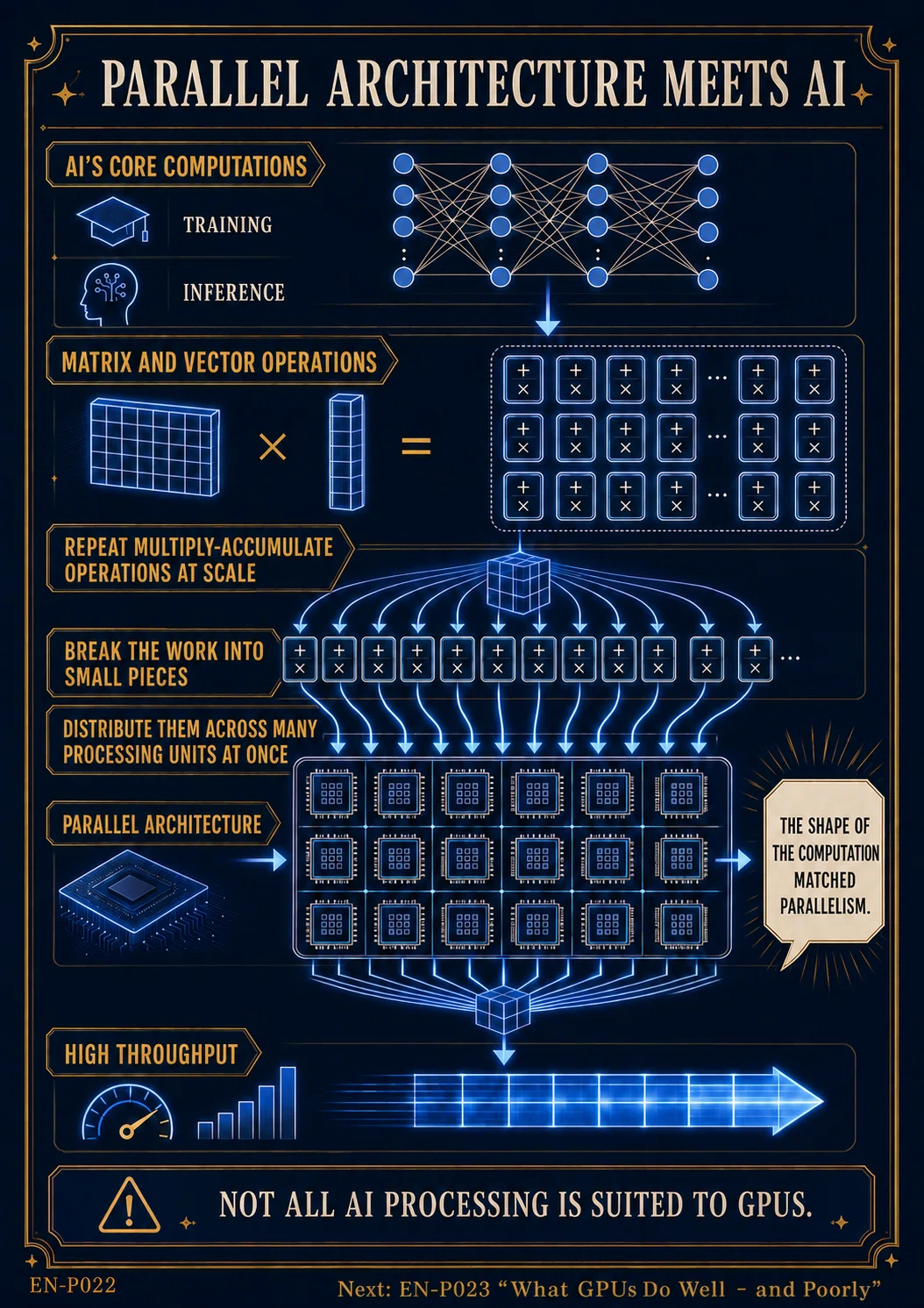
Neural networks require a style of computation that closely matches the parallel architecture GPUs had already developed.
Apply similar operations to enormous collections of numbers.
Divide a large problem into many smaller calculations.
Distribute those calculations across many processing units.
Increase the total amount of work completed at once.
The GPU was originally designed to create images. But when its architecture encountered the computational structure of AI, it began evolving into a machine for building and operating artificial intelligence.
AI represents information as arrays of numbers
Inside a neural network, text, images, audio, and other forms of information are converted into numerical representations.
The relationships learned by the model are also stored as vast collections of numbers known as weights.
Input values are multiplied by weights. The results are added together, transformed, and passed into the next layer.
By repeating these operations, a model can extract patterns, make predictions, classify information, or generate new content.
To a user, an AI system may appear to understand a sentence or recognize an object.
To the computer, much of this activity consists of continuously transforming enormous arrays of numbers.
These arrays are often organized as matrices and higher-dimensional structures called tensors.
The repeated multiplication and addition of these values created the architectural match between AI and the GPU.
Similar calculations can be repeated across large datasets
The central calculations inside AI are not necessarily difficult because each individual operation is unusually complex.
They are difficult because relatively simple operations must be repeated an enormous number of times.
A matrix contains many rows, columns, and individual values.
Much of the work required to multiply matrices can be divided into smaller calculations. Different processing units can work on different sections at the same time.
One processor does not need to handle every value sequentially.
In computer vision, similar operations may be applied across many pixels and extracted features.
In a language model, mathematical transformations are applied across token representations, attention calculations, and large collections of learned weights.
Not every part of these workloads is independent. However, many of their largest calculations contain enough regularity and parallelism to occupy a large number of processing units.
The more uniform work that can be performed simultaneously, the more effectively a GPU can be used.
The GPU moves many calculations at once
A GPU is designed to achieve high throughput by keeping many processing units active.
A large workload is divided into threads, and groups of threads execute instructions across different pieces of data.
When threads within a group follow similar instruction paths, the GPU can use its execution resources efficiently.
Matrix operations inside neural networks frequently contain this kind of regular structure.
Large numbers of values require the same sequence of multiplication, addition, and transformation. The data changes, but the basic operation remains similar.
This is favorable for parallel execution.
The system can distribute the calculations instead of forcing them through only a few powerful execution paths.
But the arrangement has limits.
If one thread follows one branch of a program while another follows a different branch, some execution resources may remain inactive while the alternative paths are processed.
Highly irregular control logic can therefore reduce utilization.
The GPU’s advantage depends not only on the number of processing units it contains, but also on whether the workload gives those units enough similar work to perform together.
Many important AI calculations satisfy that condition.
Tensor Cores accelerate matrix operations
Matrix multiplication and accumulation are among the most common operations in modern AI.
NVIDIA introduced Tensor Cores to accelerate this computational pattern directly in hardware.
A Tensor Core can multiply small matrices and accumulate the result into another matrix.
Instead of treating every multiplication and addition as an unrelated instruction, the processor handles a structured matrix operation designed around the needs of AI and other numerical workloads.
This changed the GPU from a highly parallel general-purpose processor into a processor increasingly specialized for neural-network computation.
Numerical precision also became part of the design.
Some AI workloads do not require every value to be represented with the same high precision during every stage of computation.
When lower-precision formats can be used without unacceptable loss of model quality, more values can be processed with less memory and potentially higher throughput.
Training and inference systems may therefore combine different numerical formats, using higher precision where stability requires it and lower precision where efficiency matters more.
AI performance is not determined only by how many calculations a processor can perform.
It is also determined by which numerical formats it supports and how effectively the software can use them.
Training repeats enormous calculations
Training a neural network involves several connected stages.
First, input data passes through the model to produce a prediction.
The prediction is compared with the desired result.
The system then calculates how the model’s weights contributed to the error.
Those weights are adjusted, and the process begins again with more data.
Forward computation.
Loss calculation.
Backpropagation.
Gradient calculation.
Weight updates.
These stages repeatedly generate large matrix and tensor operations.
Training data can be divided across multiple GPUs.
A model too large for one GPU can also be divided across several processors. Different layers, tensors, or sections of the model may be assigned to different devices.
At a still larger scale, GPUs distributed across many servers can participate in the same training run.
The problem therefore expands beyond parallelism inside a single chip.
It becomes parallelism across GPUs, servers, memory systems, and networks.
Large-scale AI training is not simply the work of one exceptionally fast processor.
It is the coordinated operation of an entire computing system.
Inference also benefits from parallelism
After training, a model uses its learned weights to process new input. This is inference.
Inference still requires large numbers of matrix operations.
When multiple requests are grouped into a batch, a GPU can process more calculations simultaneously. Services involving image generation, speech recognition, search, recommendation, or document analysis may benefit from high throughput across many requests.
But inference has different constraints from training.
An interactive service must return an answer quickly. The system must consider the latency experienced by one user as well as the total number of requests processed.
Autoregressive language models also generate text sequentially.
The model uses the previous tokens to determine the next token. This creates a dependency that prevents the entire response from being generated in one completely parallel operation.
The calculations within each generation step may be highly parallel, but the sequence of steps still matters.
Performance may also be limited by how quickly the model’s weights can be moved from memory into the processing units.
A GPU can possess enormous theoretical computing power and still spend time waiting for data.
Inference performance therefore depends on the balance among computation, memory bandwidth, communication, batching, and latency.
Processing units need a continuous supply of data
Adding more processing units does not help if the system cannot deliver data to them.
Model weights must be read from memory.
Input data must be prepared and transferred.
Intermediate results must be stored and retrieved.
During training, gradients must be exchanged and combined.
As models grow, data movement can become as important as arithmetic.
If computing capacity increases faster than memory bandwidth, the processing units may wait for values to arrive.
If a model is divided across several GPUs, communication between those GPUs may become a bottleneck.
If the processors are spread across many servers, network performance becomes part of the AI system.
This is why modern AI infrastructure includes more than the GPU chip.
High-bandwidth memory, cache architecture, GPU interconnects, networking, storage, and software scheduling all influence how much of the available computing capacity can actually be used.
The performance of an AI accelerator can no longer be understood through a single operations-per-second figure.
The entire path followed by the data matters.
CUDA connected the architecture with developers
A hardware architecture can match a workload and still fail to become a platform.
Developers need programming tools, libraries, compilers, debuggers, and methods for moving applications from experiments into production.
CUDA allowed developers to use NVIDIA GPUs for general-purpose parallel computing beyond graphics.
Programs could divide work into threads, manage memory, launch calculations on the GPU, and coordinate results with the CPU.
Around this programming model, NVIDIA and the broader developer community built libraries for matrix computation, neural networks, communication, inference, and other important workloads.
Researchers and companies no longer needed to create every low-level operation from the beginning.
AI frameworks could connect to established GPU libraries and make parallel hardware accessible through higher-level software.
The match between AI and the GPU was therefore not created by silicon alone.
The hardware supplied parallel capacity.
CUDA and its surrounding software ecosystem made that capacity usable.
This combination helped turn the GPU from a component into a computing platform.
CPU and GPU divide the work
The rise of GPU computing does not eliminate the CPU.
A CPU continues to run the operating system and application, receive input, manage control flow, prepare data, coordinate resources, and assign work to accelerators.
It is well suited to complex logic, irregular tasks, input and output, and decisions that must be completed with low latency.
The GPU takes responsibility for large calculations that can be divided into many similar operations.
The CPU organizes the work.
The GPU processes the large parallel sections.
Data and instructions move between them as the application advances.
AI systems are therefore heterogeneous computing systems.
They combine processors with different strengths instead of expecting one architecture to perform every task equally well.
The GPU did not simply replace the CPU.
It took over a class of computation that had become too large and too parallel for the CPU to handle efficiently on its own.
Not every AI workload fits a GPU
The words “AI workload” do not automatically mean that a GPU is the best choice.
A small task may not contain enough parallel work to occupy the hardware.
A calculation with strong sequential dependencies may have to wait for previous results.
Frequent branching may cause groups of threads to follow different execution paths.
Data transfer may take longer than the calculation itself.
Some applications may require extremely low latency for a single request rather than high throughput across many requests.
In these situations, a CPU or another specialized processor may be more efficient.
The correct question is not simply whether an application uses AI.
The question is which parts of the application can be divided, repeated, and executed in parallel—and which computing architecture best matches those parts.
The GPU became central to the AI era not because it was universal.
It became central because the dominant calculations inside neural networks aligned with its strengths.
Large datasets.
Repeated operations.
Matrix multiplication.
High parallelism.
The architecture developed for computer graphics found a second purpose in artificial intelligence.
AI needed a machine capable of processing enormous volumes of structured computation.
The GPU needed a workload capable of revealing the full value of parallel architecture.
Each transformed the importance of the other.
But an architecture defined by strengths will also have weaknesses.
The next step is to identify the workloads that allow GPUs to perform well—and those that prevent their many processing units from being used effectively.
Next: What GPUs Do Well—and Poorly
#NVIDIAEmpire #GPU #AI #ParallelComputing #NeuralNetworks #MatrixMultiplication #TensorCores #CUDA #AIAccelerators #ComputingCivilization
