P025 | NVIDIA Empire and the Next Computing Civilization | The Arrival of CUDA — Opening Up Compute Resources

GPUs possessed enormous parallel-computing potential long before most developers could use it conveniently.
Early general-purpose GPU computing proved that graphics processors could run scientific calculations, simulations, and other non-graphics workloads. The problem was access. To make the GPU perform general computation, developers often had to express data and operations through graphics concepts.
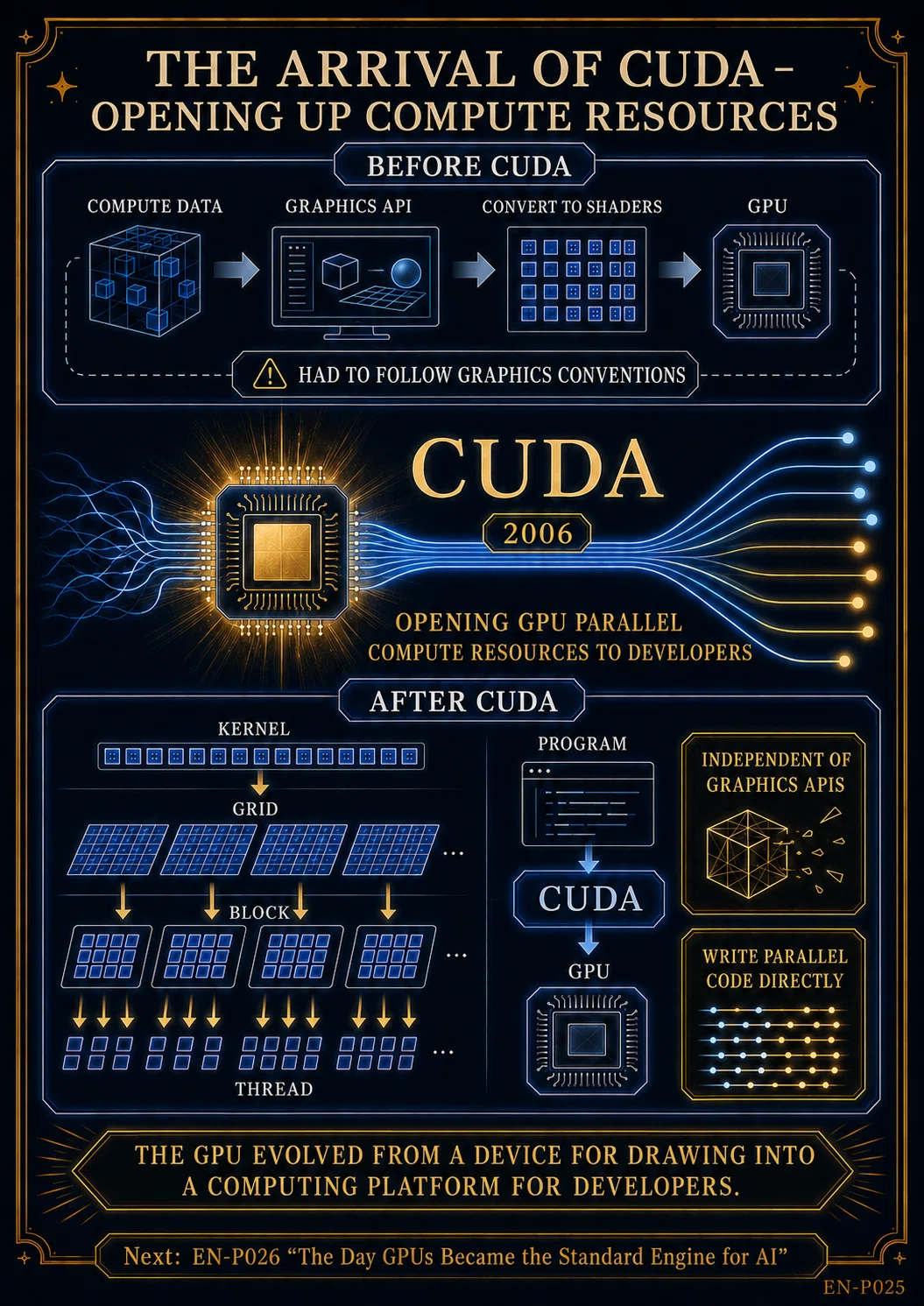
Compute data was encoded as images or textures, passed through a graphics API, converted into shader operations, and then executed by the GPU.
The hardware could compute, but the programmer had to follow the conventions of drawing.
CUDA changed that relationship.
The Barrier Before CUDA
A GPU contains many processing elements designed to perform similar operations across large quantities of data. That architecture evolved because graphics workloads require millions of vertices and pixels to be processed in parallel.
Researchers recognized that the same structure could be useful beyond graphics. If a scientific problem could be mapped onto the graphics pipeline, the GPU could accelerate it.
But this method demanded an awkward translation.
The developer’s real objective might have been matrix processing, physical simulation, or numerical analysis. Yet the program still had to be described using graphics-oriented data structures, APIs, and shaders. Results then had to be read back from a system originally designed to produce images.
GPGPU demonstrated the value of the hardware, but it did not yet provide a natural computing platform for a broad developer community.
A Direct Programming Model
The page identifies 2006 as the CUDA turning point.
CUDA opened GPU parallel-computing resources to developers through a programming model that was independent of the traditional graphics API route. Instead of disguising a calculation as a drawing operation, programmers could write code intended for parallel execution on the GPU.
At the center of this model is the kernel—a function executed across many GPU threads.
Threads are grouped into blocks, and blocks form a grid. This grid-block-thread hierarchy gives developers a way to divide a large workload and map it onto the GPU’s parallel structure.
Before CUDA, the path was:
compute data → graphics API → shaders → GPU.
After CUDA, the path became more direct:
program → CUDA kernel → GPU.
This did not remove the need to understand parallel computing, but it removed much of the graphics-specific barrier that had limited access.
From a Chip to a Platform
CUDA’s importance goes beyond programming convenience.
A powerful processor has limited influence if only a small group of specialists can use it. A computing platform becomes much more valuable when it includes a programming model, development tools, libraries, documentation, training resources, and a growing body of software.
CUDA helped transform the GPU from a component sold for graphics into a platform around which developers could build applications.
Scientific computing, image processing, simulation, data analysis, and later AI workloads could share a common development environment. As more developers adopted CUDA, more software and libraries became available. That software encouraged additional adoption, creating a reinforcing ecosystem around NVIDIA hardware.
The competitive advantage was therefore not only the number of processing cores inside a GPU. It was the connection between hardware capability and developer access.
NVIDIA was building both the engine and the road leading to it.
Parallel Does Not Automatically Mean Faster
CUDA did not turn every program into a high-performance application.
A workload must contain enough parallel work to justify using the GPU. Developers must consider how tasks are divided across threads, how blocks are organized, and how memory is accessed. Data transfer between the CPU and GPU can reduce or eliminate the expected performance gain.
Synchronization, control-flow divergence, and inefficient memory movement can also limit results. Some algorithms fit the GPU’s structure naturally; others remain better suited to a CPU or a mixed computing approach.
CUDA is not a promise that every calculation will become faster. It is a framework that allows developers to design software around GPU parallelism.
That distinction matters. Hardware potential becomes useful only when the algorithm, data movement, and execution model work together.
The Doorway to AI Computing
CUDA moved the GPU from a device for drawing into a computing platform for developers.
That transition became especially important when modern AI workloads demanded vast numbers of similar mathematical operations. Neural-network training and inference could benefit from the same parallel structure that had evolved for graphics.
The GPU did not become central to AI because of hardware alone. Developers also needed a practical way to program it, optimize it, and reuse an expanding collection of software.
CUDA provided that doorway.
The next stage is the moment when GPUs moved beyond being one possible accelerator and became a standard engine for AI. The foundation was already in place: parallel hardware, a direct programming model, and a developer ecosystem capable of turning computing resources into applications.
#NVIDIAEmpire #NVIDIA #CUDA #GPU #ParallelComputing #GPGPU #AIComputing
