P019 | NVIDIA Empire and the Next Computing Civilization | Chapter 2 Opener - Why the GPU Became an Empire

At what point did the GPU stop being merely a component?
It began as a processor designed to draw images on a screen.
By handling large numbers of similar calculations in parallel, the GPU supported the rapidly expanding demands of computer graphics.
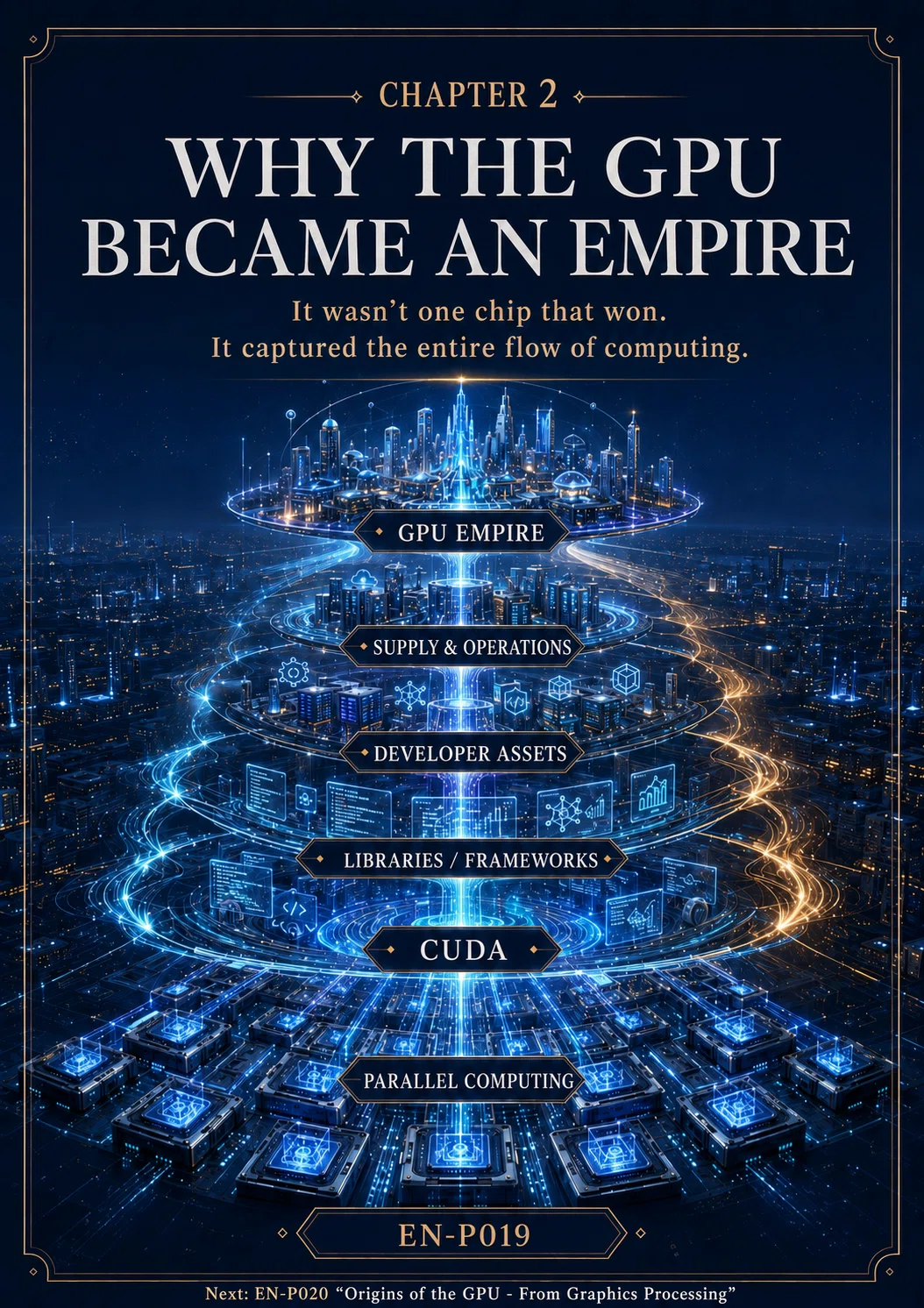
But the GPU empire of today is not built on chip performance alone.
Parallel computing.
CUDA.
Libraries and frameworks.
Software assets accumulated by developers.
The supply and operational foundation required to deploy GPUs at scale.
When these layers began reinforcing one another, the GPU evolved from a single type of processor into an entire computing platform.
Parallel computing created the foundation
A CPU is designed to handle general-purpose control, operating-system interaction, conditional logic, and many different kinds of work.
A GPU follows a different architectural direction.
It uses large numbers of processing units to perform similar operations across many pieces of data at the same time.
Graphics workloads provided a natural starting point. A screen contains an enormous number of pixels, and many of those pixels require similar mathematical operations.
The same underlying approach later proved useful in scientific computing, simulation, and AI workloads involving large-scale matrix operations.
This does not mean that every task becomes faster when moved to a GPU.
The workload must fit the architecture. Data movement, latency, control flow, and available software all affect the result.
But when AI entered an era of massive parallel computation, the GPU already possessed an architectural foundation suited to much of that work.
CUDA opened the GPU to developers
Powerful hardware has limited value if developers cannot use it effectively.
Using GPUs for work beyond graphics once required highly specialized knowledge and complex development methods.
CUDA created a more accessible connection between software and GPU computing.
It is not simply one programming language or one library.
CUDA functions as a parallel-computing platform, a programming model, and a development environment.
It helped developers treat the GPU not only as a device for drawing graphics, but as a general computing resource.
At this point, the GPU began to change.
It was no longer defined only by the physical chip.
It became hardware connected to a growing software platform.
Libraries and frameworks expanded access
Not every developer needs to understand every detail of a GPU’s internal architecture.
Optimized libraries can place complex low-level operations behind interfaces that applications can call more easily.
Connections with widely used AI frameworks can reduce the amount of specialized work required to use GPU acceleration.
This creates a powerful cycle.
Easier access attracts more users.
More users encourage the creation of additional tools and software.
Better software brings in more developers.
More developers discover new workloads for the hardware.
The strength of the GPU therefore extends beyond the processor itself.
It spreads through the surrounding software ecosystem.
Developer assets accumulate over time
An ecosystem contains assets that cannot be measured through transistor counts or benchmark results alone.
Existing code.
Tested models.
Development tools.
Technical documentation.
Known solutions to recurring problems.
Operational knowledge.
And the experience of engineers who already know how to build and maintain GPU-based systems.
These assets cannot be reproduced overnight simply by manufacturing a new accelerator.
They are accumulated through years of development, experimentation, failure, reuse, and improvement.
When an organization considers moving to another computing platform, it must evaluate more than the performance of the new chip.
Existing code may need to be rewritten. Workloads must be validated again. Engineers may require new training. Deployment and monitoring systems may need to be rebuilt.
The GPU empire is supported not only by silicon.
It is also supported by accumulated time.
Supply and operations turn computing into a service
An AI system is not completed by purchasing one GPU.
Large deployments combine accelerators, memory, networking, servers, power systems, cooling equipment, data centers, cloud environments, and operational software.
The equipment must be available where it is needed.
The processors must be connected into a usable system.
Failures, updates, scheduling, security, and capacity must be managed continuously.
This supply and operational foundation turns theoretical computing performance into an AI service that people and organizations can actually use.
Competition in GPUs has therefore moved beyond comparisons between individual chips.
It now includes the ability to supply, integrate, operate, and support complete computing systems.
It was not one chip that won
No single invention fully explains why the GPU became an empire.
Parallel computing created the foundation.
CUDA connected the hardware with developers.
Libraries and frameworks expanded access.
Developer assets accumulated over time.
Supply and operational systems brought the platform into data centers and real services.
As these layers began to reinforce one another, the GPU captured a larger portion of the computing flow.
This is why a new accelerator does not automatically replace the GPU simply by delivering a better result on one benchmark.
The competitor is not facing one chip.
It is facing a layered computing foundation built from hardware, software, developers, accumulated assets, supply, and operations.
Chapter 2 follows this structure back to its beginning.
Where did the GPU come from?
Why did a processor created for graphics begin moving toward general-purpose parallel computation?
The origin of the empire lies in a period when AI was not yet the central story.
Next: Origins of the GPU - From Graphics Processing
#NVIDIAEmpire #GPU #CUDA #ParallelComputing #AIAccelerators #SoftwareEcosystem #DeveloperAssets #AIInfrastructure #Semiconductors #ComputingCivilization
