
Does Vitamin D Preserve Telomeres and Slow Aging? How Should We Read the Latest Research Paper, and How Can We Apply It in Real Life?

Have you ever heard the word “telomere”?
A helpful way to picture it is as the plastic cap at the end of a shoelace. Each time a cell divides, that cap gets worn down a little and becomes shorter.
Once the cap is completely gone, the shoelace itself—that is, the DNA—starts to fray badly, and the cell ultimately dies. In that sense, telomeres are like a limited-use ticket book for a cell’s lifespan.

What this randomized controlled trial (RCT) by Haidong Zhu and colleagues at the Medical College of Georgia showed is that vitamin D appeared to slow down, to some extent, the wearing away of that “shoelace cap.”
▼ Original paper:
The American Journal of Clinical Nutrition, 2025; 122: 39–47
Bottom line first
The specific conditions used in this study were: 2,000 IU of vitamin D3 per day, taken daily for 4 years. As a result, the rate of shortening in white blood cell telomeres was suppressed, and telomeres were about 140 base pairs longer on average than in the placebo group.
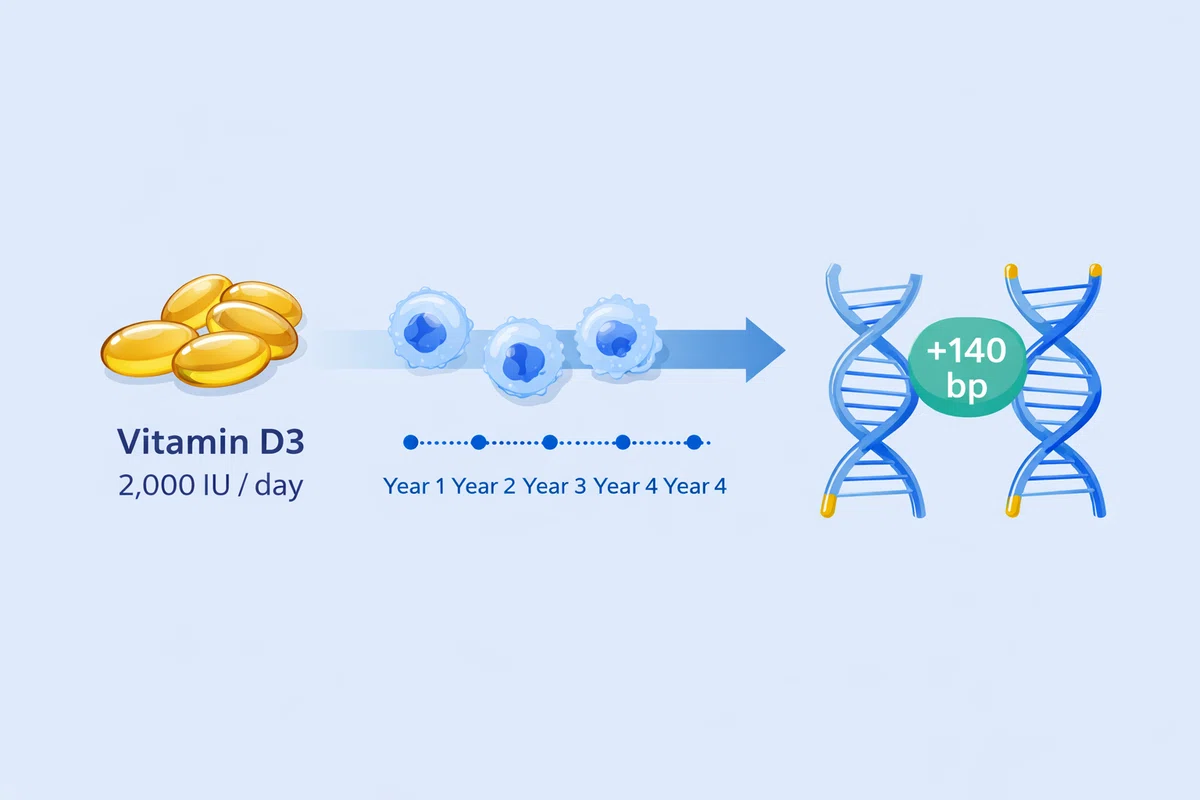
In plain terms, this suggests that taking an appropriate amount of vitamin D3 every day may help slow aging—at least in white blood cells.
That said...
Being told that telomeres were 140 base pairs longer on average does not immediately feel intuitive, right?
By the way, vitamin D3, also known as cholecalciferol, is not yet in its fully active form when it enters the body. It is metabolized in the liver and kidneys and converted into the active form, calcitriol, which then exerts its effects. The active form binds to the vitamin D receptor and works by regulating gene expression.
Estimating how many “years of aging” this might correspond to, based on papers on annual telomere shortening
This is not a strict calculation, but it seemed possible to make a rough estimate based on the paper below. Here, let’s use a simple approximation of −30 base pairs per year.
For TL measured in base pairs, the median change rate of TL was −23 bp/year in cross-sectional samples and −38 bp/year in longitudinal samples.
140 ÷ 30 = 4...!?
Does that mean the difference in telomere length over 4 years was roughly equivalent to about 4 years’ worth?
Does that imply that white blood cell aging barely progressed at all?
Can that really happen...?
Telomere length is not the same thing as aging
Telomeres do reflect one aspect of aging, but they do not by themselves define aging as a whole.
In reality, there is cellular aging and whole-body aging, and whole-body aging involves many factors, including DNA methylation, chronic inflammation, mitochondrial function, muscle strength, and cognitive function.
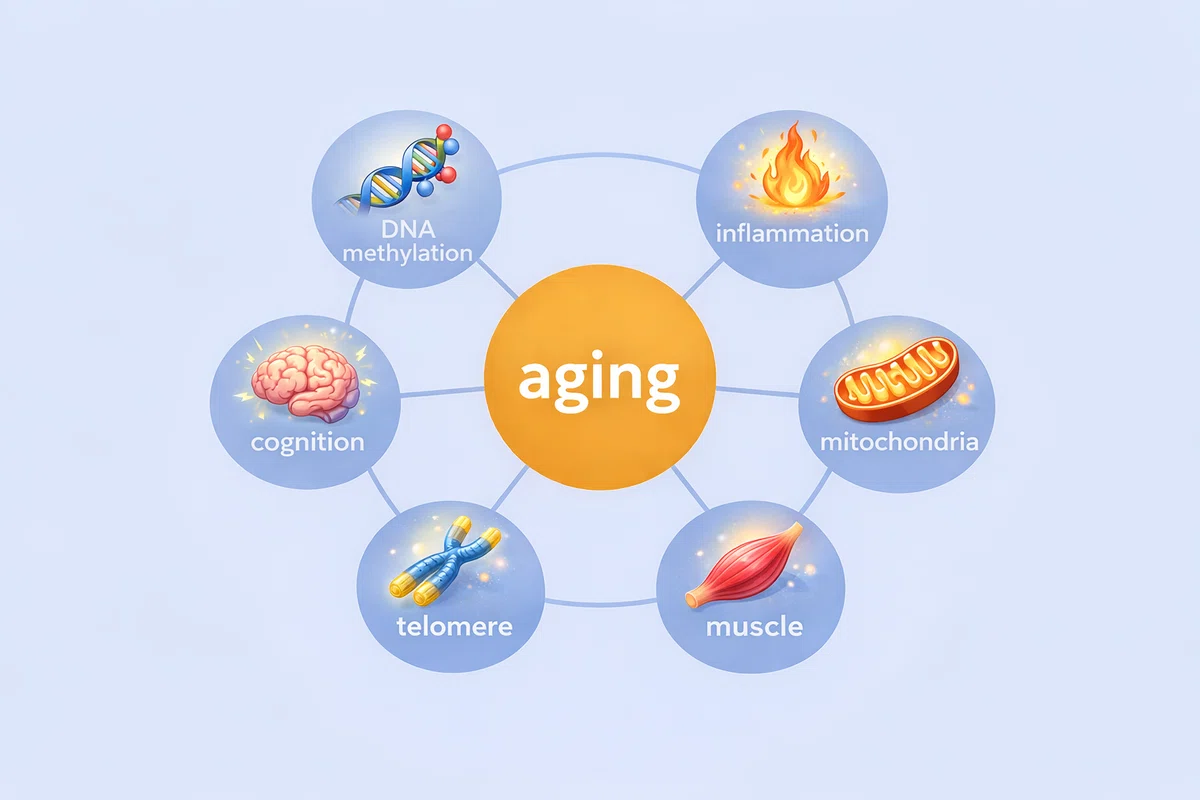
So even if a cell’s telomere length is maintained, that does not immediately mean that “aging has stopped.”
Also, these results apply only to white blood cells, so we should keep in mind that this alone is not enough to explain aging in its entirety.
Most likely, analyzing telomeres in cells from other tissues or organs would have been far more invasive—because it would require collecting actual cells from those organs—and that probably was not feasible in a trial of this scale.
So what does it actually mean if telomeres are maintained?
As explained at the beginning, telomeres serve as a kind of protective cap at the ends of chromosomes. When they are sufficiently preserved, cells can keep dividing without severely damaging their genetic information.
On the other hand, when telomeres become critically short, cells judge that they can no longer divide safely, and they either stop proliferating or enter a senescent state.
In other words, telomere length is one clue to how many times a cell has divided and how much wear and tear it has accumulated.
It does not represent aging in its entirety, but it is still an important indicator for understanding the degree of cellular wear.
Why this study is still impressive
This study was part of a randomized, double-blind, placebo-controlled trial.
The parent trial, VITAL, enrolled 25,871 participants in the United States—women aged 55 and older and men aged 50 and older. In this telomere analysis, 1,054 participants were included, and white blood cell telomere length was measured at baseline, year 2, and year 4.
So this was not the kind of study often used in supplement marketing where:
“We gave it to a few dozen people for a few weeks.”
It is fair to say that the evidence linking vitamin D3 intake with white blood cell telomere length is highly reliable.
Can I expect the same effect ourselves?
Given the context of the paper and the lifestyle patterns of modern people, this evidence is especially relevant to people like:
Desk workers who spend little time in sunlight
(many modern adults are chronically low in vitamin D)People who want to fix the basics cost-effectively before spending money on expensive anti-aging supplements
The people to whom these findings most directly apply are generally healthy middle-aged to older adults.
The VITAL participants were mostly community-dwelling adults with no prior history of cancer or cardiovascular disease at the time of enrollment. In addition, personal vitamin D intake outside the trial was limited to 800 IU/day or less.
Important cautions
Of course, there are individual differences, so you cannot assume that you personally would see the exact same effect. For people who are concerned, it may be reasonable to make that decision in consultation with a physician.
This is an ordinary supplement, so taking it as directed is generally not harmful.
That said, people with certain medical histories do need to be careful.
In fact, for safety reasons, the VITAL study excluded people with conditions such as hypercalcemia, kidney failure/dialysis, and cirrhosis.
Also, vitamin D is a fat-soluble vitamin, so more is not automatically better.
Some fat-soluble substances have a high affinity for lipids in cells and tend to repel water, which makes them harder to dissolve in the bloodstream and allows them to remain in the body relatively longer.
Vitamin D3 also regulates gene expression, so excessive intake can actually be quite dangerous.
If you were going to take it, how much would make sense?
The dose used in this study was 2,000 IU/day of vitamin D3.
So if you are thinking in terms of reproducibility, the first condition to mimic would be 2,000 IU of D3 every day.
However, there is an important caveat here.
The general recommended intake for adults is about 600–800 IU/day.
By contrast, the tolerable upper intake level for adults is considered to be 4,000 IU/day.
So 2,000 IU/day is higher than the usual recommended intake, but still below the upper limit of 4,000 IU/day for adults.
Vitamin D can be obtained from foods such as fatty fish, cod liver oil, egg yolks, fortified milk, and fortified cereals, but for some people it is difficult to get enough from natural foods alone.
It is also synthesized through sunlight exposure, but the amount of sun needed varies greatly depending on season, time of day, cloud cover, skin color, age, and sunscreen use, so it is difficult to say mechanically that “X minutes of sunlight is enough.” On top of that, ultraviolet exposure carries a skin cancer risk.
So in real life, paying attention to vitamin D makes more sense for people who:
may not be getting enough from diet alone
get little sun exposure
are getting older
How to apply this in real life
First, think about whether your lifestyle is one in which vitamin D is likely to be insufficient.
Next, if needed, estimate how much vitamin D3 supplementation would make sense for you.
This will vary depending on age and lifestyle, so it is a good idea to calculate in advance how much you would be getting from supplements relative to the recommended intake.
In this study, the dose was 2,000 IU/day.
If you are already taking other multivitamins or calcium products, you should check the total amount.
Excess vitamin D can contribute to hypercalcemia, increased urinary calcium, kidney damage, and arrhythmias, and when combined with calcium supplements, it may also increase the risk of kidney stones.
Summary
The condition that produced the effect in this study was vitamin D3 at 2,000 IU/day, taken daily for 4 years.
The outcome was an effect on white blood cell telomere length. It did not directly prove life extension or full-body rejuvenation.
The study population consisted mainly of middle-aged and older adults from the general population, so it is difficult to generalize these findings directly to younger people or those with chronic illnesses.
The general recommended intake is 600–800 IU/day, and the adult upper limit is 4,000 IU/day. So 2,000 IU/day can be described as a practical dose used in a clinical study, but not necessarily a dose that should be recommended to absolutely everyone without qualification.
Omega-3 showed no significant effect in this study. At the very least, there is no basis for expecting it to be equally effective for telomere maintenance.
Final thoughts
What this paper made me think is that, before trying all kinds of supplements with vague or shaky evidence, it may be worth taking a more serious look at the basic nutrition that forms the foundation of health.
I look forward to seeing more detailed research in the future.
P.S.
One point that personally made me grin a little—both amusing and a bit cruel—was this:
The study also looked at the effect of omega-3 fatty acid supplements, which are often treated like the king of anti-aging supplements. And yet, omega-3 did not show an effect on preserving telomere length.
In the results of a large, carefully conducted trial, at least from the perspective of maintaining white blood cell telomere length, it was not the expensive omega-3 products that have been heavily advertised for years that came out on top.
It was the plain, unglamorous vitamin D you can buy at a drugstore that turned out to be the winner.
いいなと思ったら応援しよう!
 お気持ちは大切に使わせていただきます✨