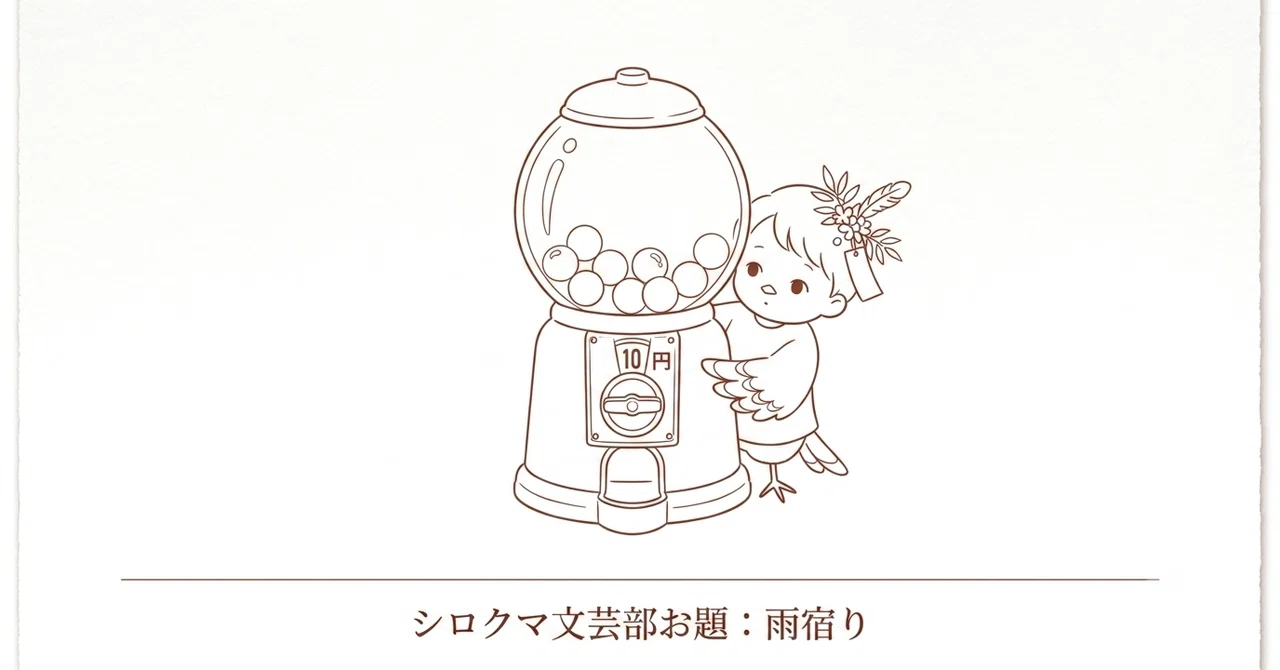
【シロクマ文芸部お題】『雨宿り』/ショートショート創作童話(英訳付)

※本作のプロット構成や表現の推敲において、一部AI(Geminiなど)のサポートを受けています。
※画像:Geminiにて生成
かささぎの恩返し
「雨宿りしてっちゃどうかね、坊ちゃん、嬢ちゃんたち」
『だがし屋かささぎ堂』のおばあちゃんは引戸を開けた。
小さな子供たちが五人ほど、突然の雨に往生しているように見えたからだ。
店先の笹竹に吊るしてある七夕飾りはすっかり濡れてしまっている。
「ありがとうございます」
わらわらと子供たちが入ってくる。
見ない顔だから、ここらの子じゃないんだろう。
髪が少し濡れている子もいたから、タオルを渡してやった。服の方は大丈夫そうだ。
「好きな駄菓子をひとつ選んでいいよ。あたしのおごりだ」
「わー!」と子供たちが歓声を上げて、陳列棚から菓子を選んでいる間に、冷たい麦茶を用意する。
振り返れば、十円ガムマシーンを興味深げに見ている子が一人。
昔からある十円玉を入れて、レバーをひねれば色とりどりの丸いガムボールがでてくるマシーンが、今の子には珍しいのかもしれない。
「やってみるかい?」と十円玉を一枚入れたが、あら、出てこない。
「ごめんね、壊れちゃったかな。
じいさんがいた頃は修理してくれたんだがね。
あたしゃ、こういうことは苦手でね……」
とうとう壊れてしまったか。
このマシーンもそうだが、この駄菓子屋も客も減ったし、くたびれた。
そろそろ店をたたむことも考えた方がいいのかもしれない。
心配そうに見上げてくる子供に気づいて、しめっぽいことを考えてしまったと、笑顔を作った。
「それにしても、今日は七夕だっていうのに、こんな雨じゃあ織姫と彦星も難儀してるんじゃないかね。
天の川に橋を架けてくれるっていうかささぎも大変だ」
子供はニコッと笑った。どうやら、安心してくれたようだ。
「いえいえ、このくらいならば、我らかささぎには問題ありません。
おいしいお菓子もいただきましたので、元気いっぱいです。
たいへん困っているところを助けてくださり、ありがとうございました」
パタパタと鳥の羽音がして――気が付けば、子供たちの姿はなく、食べ終わった駄菓子の袋と、空のグラスがあった。
まるでたぬきかきつねに化かされたような気分だった。
そんなとき、店の引戸がガラガラと開けられた。
「こんにちはー、ばあちゃん、久しぶり!」
「元気ー?」
かつて店の常連だった中学生の子たちが何人も入ってくる。
「ん? ばあちゃん、どうしたの?」
「ああ、この十円ガムマシーン壊れちゃったみたいで……」
「ちょっと見せて。うん、これ、オレがなおせるよ」
「そうかい? 助かるねえ」
雨はすっかり上がっていた。
その夜の天の川はくっきりと、とても輝いて見えた。
(終)
[あとがき]
『七夕伝説』からのインスパイアのつもりです。
中国の星の物語、中国の宮廷儀礼、日本古来の神事、そして地域ごとの民話が重なったためか、色々なパターンの話があります。
かささぎが天の川に橋を架けるというだけでも、三パターンくらいありました。
晴天でもかささぎが橋を架ける。
雨の日だけかささぎが橋を架けて渡れるように助ける。
雨の日は天の川が増水し、かささぎでも橋が架けられない。
人間の伝言ゲームはすごいですね。
ちなみに、わたしの地元北海道では七夕は「七月七日」ではなく、「八月七日」の「月遅れ七夕」です。
そして、「竹」ではなく「柳」に短冊を飾ります。
理由は北海道は竹が育たない地域で、柳は手に入りやすいから。
小さい頃からなじんでいるというのもありますが、葉の形が笹に似ているため、地元民には違和感がありません。
地域によっては、ハロウィンのように子供がお菓子をもらい歩く文化もあるようです。
玄関先で「ろうそく出せ」「ろうそくもらい」という歌をうたうのだとか。
ただ、この風習はわたしにはなじみがないです。
けれど、父母が言うには、幼い頃住んでいたところにはあったそうです。
わたしがまわれるような年齢になる前に引っ越してしまったのだとか。
シロクマ文芸部のnote企画に参加しています。
※本文のあとに英訳を載せています↓
※AI support (such as Gemini) was used for refining the plot structure and expressions in this work.
※Image generated by Gemini.
The Magpies’ Gratitude
“Why don’t you step inside and shelter from the rain, little ones?”
The old woman of ‘The Magpie Sweetshop’ slid open the wooden door. Before her, five young children stood stranded, caught in the sudden downpour. On the bamboo branch at the storefront, the colourful Tanabata wishing papers hung drenched, heavy with water.
“Thank you so much,” they chimed, tumbling into the shop in a small, rustling flurry.
Their faces were unfamiliar; they were likely from another town. Noticing that some had damp hair, the old woman gently handed them towels. Their clothes, at least, seemed dry enough.
“You may each choose any treat you like. It is my treat today.”
As the children raised a joyful cheer and began scouring the shelves for sweets, she turned around to prepare some cold barley tea. When she looked back, she noticed one child gazing intently at the ten-yen gumball machine. It was a relic of days gone by—a machine where you inserted a shiny copper coin, twisted the metal lever, and watched a kaleidoscope of vibrant, round gumballs tumble down. To a child of the modern world, it must have seemed like a curious treasure.
“Would you like to give it a whirl?” she asked, slipping a ten-yen coin into the slot. But alas, the lever turned stiffly, and nothing came out.
“Oh dear, I’m terribly sorry. It seems to be broken. When my husband was still with me, he would always fix it right up. But I have never been any good with these mechanical things…”
So, it had finally given up the ghost. It wasn’t just this machine; the shop itself had seen fewer customers of late, and she, too, felt worn and weary. Perhaps it was time to consider closing the shutters for good. Catching sight of the child looking up at her with worried eyes, she realised she had let her gloomy thoughts show and quickly forced a warm, reassuring smile.
“And to think, today of all days is Tanabata. With rain like this, Princess Orihime and Prince Hikoboshi must be having a dreadful time. Even the magpies, who fly up to form a bridge across the Milky Way, must be exhausted.”
The child grinned softly. It seemed her words had brought comfort.
“Oh, not at all. A little rain like this is no trouble for us magpies. And now that we have received these delicious sweets, we are bursting with energy. Thank you for rescuing us from our plight.”
A sudden, soft rustle of beating wings filled the air—and in the blink of an eye, the children were gone. In their stead lay only the empty wrappers of the sweets they had eaten and a cluster of hollow glasses. For a moment, she wondered if she had been bewitched by a mischievous fox or a tanuki.
Just then, the shop’s sliding door rattled open once more.
“Hello! Grandma, it’s been ages!”
“How have you been?”
Several junior high school students, who used to frequent the shop when they were small, came bursting through the door.
“Hmm? Grandma, what’s wrong?”
“Ah, well, it seems this old ten-yen gumball machine has finally broken down…”
“Let me take a look. Oh, yeah, I can fix this easily!”
“Truly? Oh, what a blessing you are.”
Outside, the rain had completely cleared away.
That night, the Milky Way spanned the heavens, casting a brilliant, crystal-clear radiance down upon the world.
(The End)
[Afterword]
This piece was inspired by the Tanabata legend. Over the centuries, this tradition has woven together Chinese astral mythology, ancient imperial court rituals, indigenous Japanese Shinto ceremonies, and localised folklore, resulting in a rich tapestry of variations. Even the simple motif of magpies forming a bridge across the Heavenly River contains at least three distinct interpretations. In one version, the magpies build the bridge even under clear skies. In another, they only construct it on rainy days to aid the star-crossed lovers. In yet another, the rain causes the Heavenly River to swell so fiercely that even the magpies cannot bridge the torrent. The way human stories evolve through centuries of retelling is truly remarkable.
As a side note, in my home prefecture of Hokkaido, Tanabata is celebrated not on July 7th, but on August 7th, following the traditional lunar-delayed calendar. Furthermore, we decorate willow branches rather than bamboo. This is because bamboo does not naturally thrive in Hokkaido’s climate, whereas willow is abundant and easily gathered. Since we have been accustomed to this since childhood, and because the shape of willow leaves closely resembles that of bamboo, it feels entirely natural to the locals.
In certain regions of Hokkaido, there is also a charming tradition akin to Halloween, where children go from house to house collecting sweets. They stand at front doors singing a traditional chant that goes, “Bring out the candles, give us some candles.” Personally, I did not grow up with this custom of trick-or-treating for sweets. However, my parents tell me that it did exist in the town where we lived when I was an infant. Sadly, we relocated to another region before I was old enough to participate.
※Written in Japanese, translated with the help of AI. I hope the heart of this story reaches you, regardless of the language barrier.
いいなと思ったら応援しよう!
 物語を気に入っていただけたら、活動を応援いただけると励みになります。