#067 How Practical Is It for Camping? An Honest Review of Multi-Function Fire Tongs That Look Like Traditional Craftwork

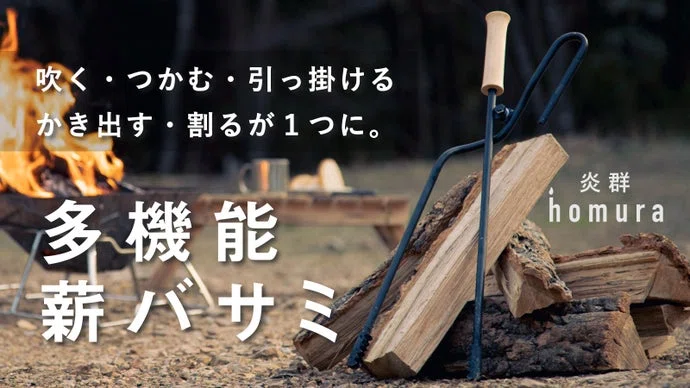
[Hidenori Kimura's Tech Magic #067 ] This time I'm introducing a set of multi-function fire tongs called "炎群 homura." Its eye-catching look was achieved by a metalworking craftsman teaming up with a kijishi (a woodturning craftsman). What stands out is that the tongs have a variety of other functions, such as a fire blower and an ash rake. The idea of the tongs doubling as a blow pipe in particular seemed handy. I actually used them on a camping trip, so I'll review them without holding anything back.

The multi-function fire tongs "炎群 homura," which look solid and substantial.
I tested how practical they are on an actual camping trip.
A Handmade Presence That's Deeply Satisfying
homura is made entirely by hand, aiming to be a tool people see as something to keep for life. When I actually held it, it was crafted with more attention to detail than it looks in photos, and I was very satisfied. The handle was made by a woodworker called a kijishi, and it's smooth and comfortable to hold. Kijishi, also called rokuro-shi, are craftsmen who turn and make wooden goods such as bowls and trays on a lathe. In Japan, it's said that about 1,200 years ago Prince Koretaka came up with the lathe from the principle of a rotating scroll rod, and passed the technique on to clans of his retainers such as the Ogura and Okura. I also liked that it uses a technique with such history behind it, in the sense that it lets you touch traditional culture.

The handle comes in standard hinoki cypress
or with a lacquer finish. There are two lacquers: regular lacquer and red lacquer.
The grip is made from Tono hinoki cypress from Gifu Prefecture. It's a high-quality material also used for building Ise Grand Shrine, and is said to be light and resistant to water and humidity, with excellent strength and durability. Its thermal conductivity is also low at 0.095, so it doesn't feel cold even when you use it barehanded in winter.
The welding and baked-on paint of the metal parts are also high quality, and I liked that it seems unlikely to break or chip even when used hard while camping. Its total length is 540mm, slightly long for fire tongs, so you can tend the fire from a distance. The joint between the two arms is fixed with a fairly thick screw, so it's unlikely to warp, and it looks capable of putting heavy, thick logs on the fire without any trouble. The tips have serrated parts, so even thin pieces of firewood can be gripped without slipping.

The tips are serrated so the wood doesn't slip easily.
If they meshed together perfectly, you'd need extra force to open them,
so they're designed to be slightly offset.

The body, bent by hand by a craftsman, is sturdy.
Despite being iron with a delicate form, it's strong enough not to warp.
The Body Alone Is Well Balanced, but the Options Raise Concerns
As mentioned above, the handmade body is very reliable, but in terms of practicality I found a few concerns. One is that the body is somewhat heavy. At 492g, I think it does well for such a long body, but it doesn't fit small fire pits well. It's best matched with a fire pit where you add several large logs.

This time I used it for cooking, so it wasn't a good fit.

The crowdfunding website shows images of it used with a smaller fire pit,
but considering the weight and maneuverability, it was hard to use.

It may be best to assume you'll use it with a fire pit at least this big.
Another concern is the weight when an optional part is attached. homura lets you attach two parts to the tip: a hook and an ash rake. I chose the ash rake, which seemed to have more uses, but it's surprisingly heavy. The part itself weighs 139g, but because it attaches at the tip, combined with the length it feels quite heavy. It's attached by tightening screws in four places, so it can't be easily put on and taken off, which means if you use it, you have to accept that weight from the start. It may be difficult because of the heat, but if it were at least magnetic, it would have been easier to attach and remove and easier to use. Changing the material, such as making only the optional parts from titanium, would also have solved the weight problem. I felt there was room for improvement in these areas.

With the ash rake option attached.
A lot of weight ends up at the tip, which makes it harder to use for regular purposes.
The other thing that bothered me was the grip, which can also be used as a blow pipe. This was exactly what attracted me to buy it, but I felt the air didn't flow through it efficiently. The one I'd been using was VARGO's Ultimate Fire Starter, and by comparison it seemed to deliver oxygen more efficiently without as much effort. It's also very light at 53g, so in practical use, it came out ahead.

VARGO's blow pipe packs down compactly and is easy to use in terms of weight too.
However, its spark-making mechanism has issues.
A Great Concept: I Have High Hopes for the Second Generation
homura's concept of combining a blow pipe and fire tongs was very good, but I caught glimpses of practical areas where I wish it had gone a little further. The shape and length of the body were fine, so if they refine the weight and the resistance when blowing air through it, I felt it would become a "product you can use for life," as the maker proposes. I'm looking forward to further evolution in the next version, including the weight of the optional parts.
Subscribe to my YouTube channel to see the good points, bad points, and real-world use
of the latest gadgets that I don't post on note.
👇👇👇👇👇
(Hidenori Kimura, tech journalist)
If you enjoyed this article, come visit the official RE.KIMURAS site. I'm adding more reviews that show how products actually work in real life.
This article was originally published in Japanese on BCN+R in September 2021. Prices and product details are as of that time.
This article contains Amazon affiliate links. As an Amazon Associate, Hidenori Kimura earns from qualifying purchases.