AI Visibility vs. AI Referenceability: Showing Up in AI Answers Is Only Half the Problem

Most companies are now asking a version of the same question: does ChatGPT know us? When a customer, an investor, a journalist, or a candidate asks an AI about our market, do we appear in the answer?
That question is real, and it has a name — AI Visibility. But there is a second question that arrives about ten seconds later, and it is the harder one.
Suppose the AI does know your company. It mentions your brand. It even cites your website. Then someone asks it what your current pricing policy is, and it finds five plausible answers: a 2024 policy, a 2025 revision, the 2026 policy, a customer-specific exception, and an unapproved proposal that was never withdrawn from the shared drive.
Nothing is missing. Nothing is hidden. The AI can retrieve all five. The problem is that all five look correct.
At that point the question is no longer can AI see us? It is can AI reach the right thing? I call that second property AI Referenceability.
Definition
AI Referenceability: the degree to which an AI system can reach the correct reference point for a given question.
Two clarifications, because both matter in English.
First, this is not the B2B sales and IT procurement sense of "referenceability" — the ability to produce reference customers. Different word, different field.
Second, it is not a rebranding of retrievability, the established information-retrieval measure proposed by Azzopardi and Vinay (CIKM 2008) for how easily a document can be reached by a retrieval system under a given query set.
The distinction I am drawing is this. Retrievability evaluates how a retrieval system makes documents accessible under a query set. AI Referenceability looks at how the knowledge resource itself is designed so that the correct reference point can be reached. Retrievability is an established measure; the second half of that sentence is my proposal, and I would rather say so than imply the boundary is settled in the literature.
I am not trying to improve search engines. I am concerned with the design of what is handed to them.
Visibility and referenceability are not competitors
They fail differently.
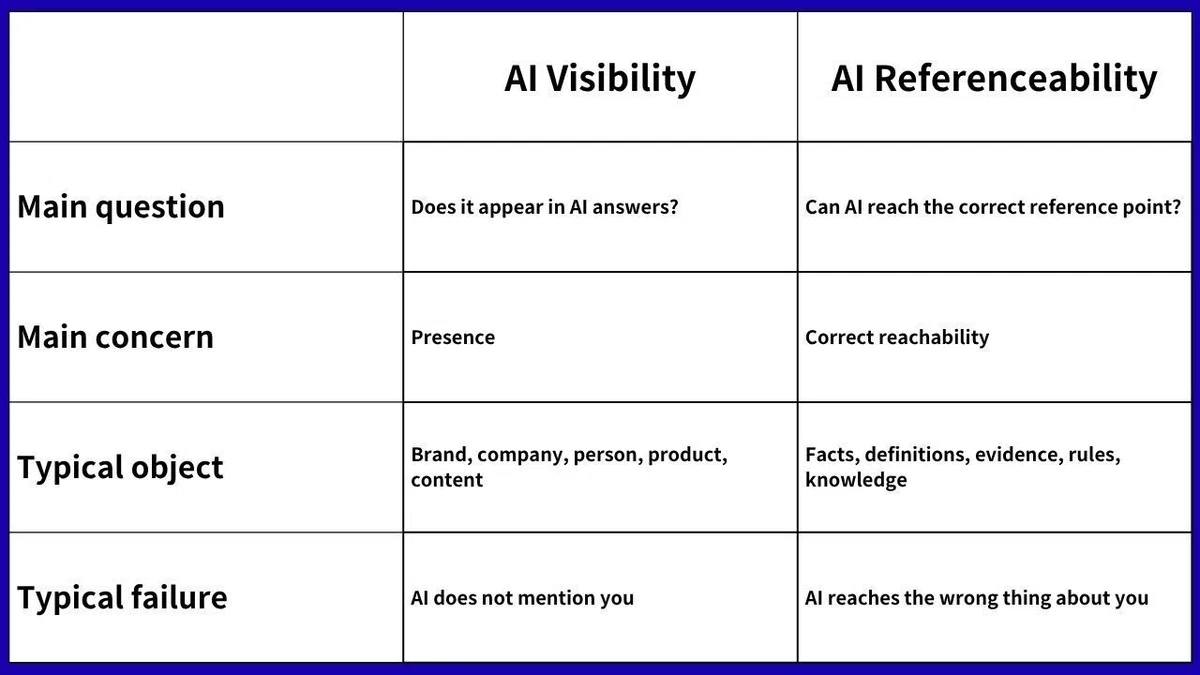
Which produces three states worth naming. Low visibility, high referenceability: your knowledge is well built, but AI rarely surfaces you. High visibility, low referenceability: the correct canonical reference point exists, but AI still reaches an outdated number, a superseded rule, or the wrong section. High visibility, high referenceability: AI can find you and reach the correct thing about you. Only the third state is worth investing in, and most AI-search programmes are currently buying only the first half of it.
A citation does not close the gap either. If your site contains three versions of the same rule, an AI can cite your domain accurately while reaching the wrong paragraph. There is a chain before an answer appears — information exists, the system retrieves it, selects it, interprets it, uses it, and only then does something become visible or cited. Visibility is measured near the end of that chain. Referenceability is decided near the beginning.
What 2026 made measurable — and what it did not
This stopped being abstract in June.
On June 3, 2026, Google announced dedicated Generative AI performance reports for Search Console, isolating impressions earned inside generative AI features in Search — AI Overviews and AI Mode — and, in a separate report, in Discover. Google currently documents the report as impression-based, with pages, countries, devices, and dates available as dimensions. Clicks, click-through rate, and query or prompt dimensions are not listed among the available metrics and dimensions. It is being rolled out to a subset of site owners.
That is the state of the field in one sentence. Visibility became observable. Whether the system reached the intended reference point did not.
The evidence, and its limits
In March 2026 I presented a paper at NLP2026, the 32nd Annual Meeting of the Association for Natural Language Processing in Japan. The official title is in Japanese —「RAG時代の言語資源設計原理―構造化テキストによる『参照可能性』の実証」. I use the following reference translation in English: Design Principles for Language Resources in the RAG Era: Demonstrating "Referenceability" Through Structured Text.
The dataset was 321 annotated episodes from a serialized column, Shitto Mania, by Nami Saito, published on Fujinkoron.jp from March to December 2025. The author granted research permission and reviewed the labels on every episode. That permission is part of the method, not a footnote: the argument of this article is that someone has to author and approve a reference point before a machine can use it, and that applies to research data as much as to a pricing policy.
The experiment changed one thing only — how the same material was represented. One condition was structured metadata: nine controlled fields, concatenated, with unknown fields skipped rather than filled with "N/A". The other was the full body text. The task was to return the correct episode in the top ten (Recall@10), using TF-IDF with cosine similarity, across 400 evaluation queries.
For structured queries (n = 300):
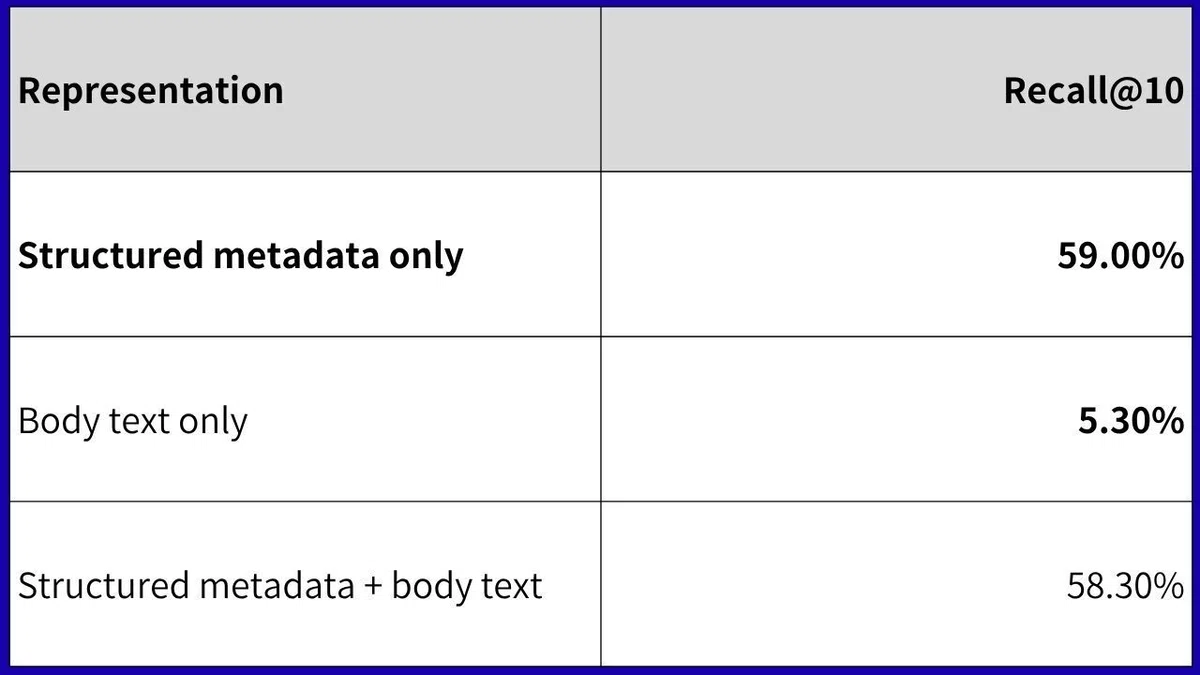
A 53.7-point gap, an 11.1× difference (p < 0.001). And a second finding hiding in the third row: adding the body text back made it slightly worse. More text was not better.
The multiplier is conditional, and the condition is the useful part. The same table reports a second query style. When the query was a verbatim excerpt from the original text, both representations scored 100%. Ratio: 1.0×. So the honest claim is narrower than the headline — when the question used the vocabulary of the structured metadata, structure mattered enormously; when it used the vocabulary of the source text, it did not matter at all.
That is a design instruction, not a disappointment. Collect the questions your people actually ask before you decide your metadata vocabulary. If the use case is quotation or checking an original passage, full-text search is sufficient. If the use case is conditions, exceptions, and scope — judgment — structure is what moves the number.
The paper used TF-IDF deliberately, to observe vocabulary control directly, and left dense retrieval as future work. I ran that follow-up on the same data afterwards:
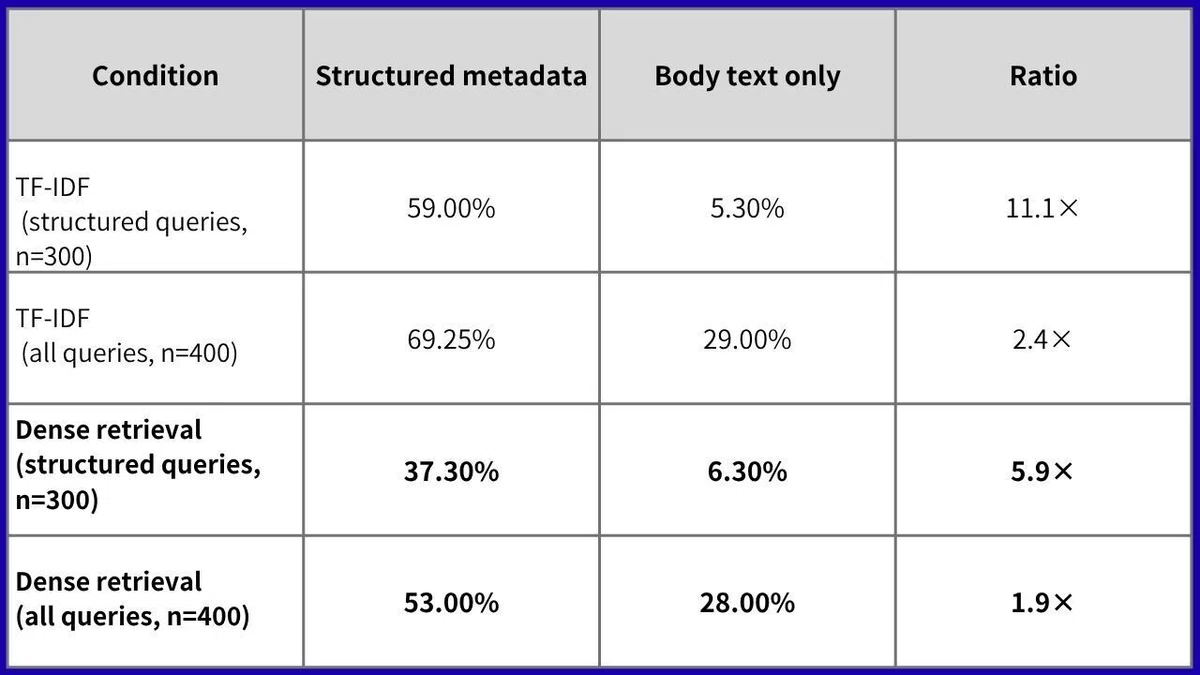
The advantage survives dense retrieval at a smaller ratio. That follow-up is outside the paper and not peer reviewed. Neither, for that matter, are the conference proceedings (CC BY 4.0). The study is 321 items, one domain, one annotator. Other dense models and other domains are untested.
And the boundary I care most about: what I demonstrated was reference retrieval inside a RAG setup. It does not mean structuring your website makes ChatGPT mention you 11.1 times more. Extending the principle to public AI search is a hypothesis I am testing, not a result I am reporting. The two are not unrelated — Google's own documentation describes its generative features as grounded in retrieval from the search index — but I would rather state the seam than paper over it.
What the experiment does support is more fundamental than any multiplier: the same knowledge becomes dramatically easier or harder for AI to reach depending on how it is represented. Human-readable and AI-referenceable are not the same property.
Why purity beat volume
Three mechanisms explain the gap, and all three are decisions a human has to make.
Noise. Prose written for humans carries context, analogy, restatement, and colour. That is what makes it good writing. For the narrow task of locating the right reference point, it is interference.
Controlled vocabulary. If the same entity is recorded as customer, client, account, and partner depending on who typed it, retrieval degrades. Deciding what is the same thing and what is not is human work, done before the AI is asked to guess.
Strategic blanks. Filling unknown fields with "none" or "N/A" makes those words searchable and dilutes everything. In the experiment, unknown fields were skipped. The ability to leave things out turns out to be a capability, not a gap.
The paper's formulation: volume is not quality. Purity is quality.
The cost lands when agents act
With a chatbot, a wrong reference point usually ends as a bad paragraph. A human reads it, notices, corrects it.
An agent searches, compares, decides, calls a tool, sends the email, updates the CRM, and moves to the next task. Nobody necessarily reads the intermediate steps. So the operative question stops being what did the AI say? and becomes what did the AI treat as correct before it acted?
Can this customer have a 15% discount. Can this candidate advance. Can this content be reused in an AI product. Is this refund within policy. What does this company count as revenue. For each of these, someone in the organization has already decided what the correct answer is and under what conditions it holds. The failure is not that the decision is missing. The failure is that the AI reached the nearest paragraph instead of that decision.
Two jobs, not one
Which brings back the five pricing documents. Deciding which of them is the one in force is not a retrieval problem. No amount of structure answers it. A person has to decide, approve, date it, and own it.
I use a Japanese term for that work: AI Seihon-ka (AI 正本化) — canonical knowledge design for AI. Seihon means the authoritative version, the copy of record. AI Seihon-ka is the work of turning organizational knowledge into reference points AI can trust: definitions, judgment criteria, exceptions, approval authority, effective dates, prior decisions, ownership, and responsibility for updating them.
So the pair is clean. AI Seihon-ka decides what AI should treat as authoritative — what is current, what conditions apply, who approved it. AI Referenceability asks whether AI can reliably reach that reference point when it is needed. One is the process; the other is the quality axis that tells you whether the canonical reference point it produced is actually reachable by AI.
Both matter, and in that order. Making the wrong information highly referenceable is worse than useless. Building perfect canonical knowledge the AI never reaches is merely expensive.
Both sit inside the larger discussion of Context Engineering — what context the model receives, when, from where, in what order, with which tools, and what it retains. Within that category I separate four things: Context Engineering as the design category, AI Seihon-ka as the process, AI Referenceability as the quality axis, and AI Knowledge Engineer as the professional role. Category, process, quality, profession.
Where to start
The common mistake is trying to make an entire company referenceable at once.
Take one theme. One canonical document. One named owner. One effective date. Discounts, credit limits, returns, leave policy, safety rules — choose the one where a wrong answer costs the most, settle what the correct reference point is, make it reachable, then take the next one. That is both jobs performed on a single object, which is the smallest unit where either of them can be judged.
The external problem and the internal problem are converging anyway. Public AI search, RAG, enterprise search, internal copilots, and agents all depend on the same thing: whether the knowledge was designed to be consumed by a machine that cannot ask a colleague which version is current.
AI Visibility asks whether AI can see you. AI Referenceability asks whether it can reach the intended reference point. Companies will need both, because the objective was never to appear inside an AI answer. The objective is for AI to act on the reference point your organization actually decided on — which takes both jobs, not just one.
Being visible to AI is valuable. It is also only half the problem.
References
Jun Ikematsu (2026).「RAG時代の言語資源設計原理―構造化テキストによる『参照可能性』の実証」『言語処理学会第32回年次大会発表論文集』. CC BY 4.0. The official title is in Japanese. English reference translation: Design Principles for Language Resources in the RAG Era: Demonstrating "Referenceability" Through Structured Text, Proceedings of the 32nd Annual Meeting of the Association for Natural Language Processing, NLP2026. https://www.anlp.jp/proceedings/annual_meeting/2026/pdf_dir/Q5-8.pdf
Azzopardi, L. & Vinay, V. (2008). "Retrievability: An Evaluation Measure for Higher Order Information Access Tasks." CIKM '08, pp. 561–570.
Google Search Central Blog (June 3, 2026). Introducing Search Generative AI performance reports in Search Console. https://developers.google.com/search/blog/2026/06/gen-ai-performance-reports
Google Search Console Help. Generative AI performance report (Search). https://support.google.com/webmasters/answer/16984139
Google Search Central. AI features and your website. https://developers.google.com/search/docs/fundamentals/ai-optimization-guide
Jun Ikematsu
— AI Knowledge Engineer
いいなと思ったら応援しよう!
 チップありがとうございます!
よい日をお過ごしください。
チップありがとうございます!
よい日をお過ごしください。