
61.モササウルスの大きな眼とは? どんな構造?

【恐竜の化石専門ショップ】ジュラシック王国 です。
▼ショップは下記URLから。
https://jurassic-fossil.shop-pro.jp/
ジュラシック王国 店長です。
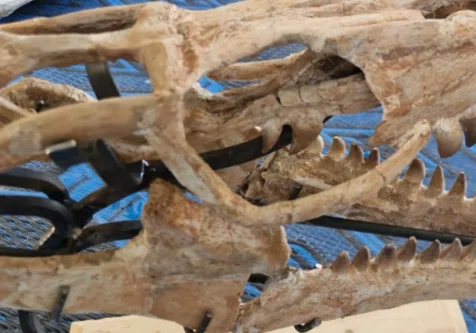
横から見た写真です。
頭骨中央付近にある大きな開口部が眼窩で、ここに眼球が収まっていました。
モササウルスの眼窩は、細長く伸びた吻部の後方に位置しており、歯列の並ぶ上顎骨の後ろ側に明瞭に確認できます。
この配置から、目は頭部のやや後方寄りに置かれていたことがわかります。
前方には長い顎と鋭い歯が並び、後方には頭骨後部が続くため、眼窩は長い吻部と後頭部のあいだに位置する構造的な区切りとして見ることができます。
頭部全体のつくりを理解するうえで、重要な観察ポイントのひとつです。
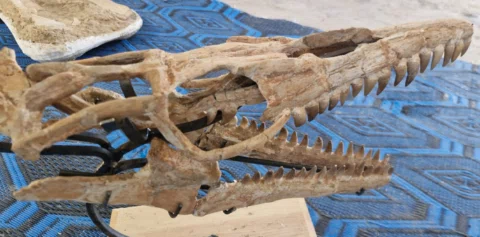
眼窩からわかる頭部構造
眼窩の周囲は複数の骨によって縁取られており、軽量でありながらも強度を保つ構造になっています。
このようなつくりは、水中での運動に適した頭骨設計の一部と考えられます。
また、横から見るだけでも、眼窩にはある程度の奥行きがあり、モササウルスの頭部が単純な平面構造ではなく、立体的に組み上げられていることがわかります。
モササウルスの眼はどのようなものだったのか
化石からは眼球そのものは残りませんが、眼窩の大きさや形状からある程度の推測が可能です。
モササウルスは海中で生活していたため、
水中での視覚に適応した眼
周囲を広く見渡せる視野
を持っていたと考えられます。
また、現生の海生爬虫類や魚類と同様に、水中でのピント調整に適した視覚構造を備えていた可能性もあります。
捕食者として、獲物を正確に捉えるための視覚は重要な役割を担っていたと考えられます。
※画像の無断転載はお断りいたします。
【恐竜の化石専門ショップ】ジュラシック王国
https://jurassic-fossil.shop-pro.jp/
ブログはこちらから
https://jurassic-fossil.shop-pro.jp/?mode=f9
Youtube動画はこちらから
https://www.youtube.com/@jurassicfossilshop/shorts
🇺🇸 English
Mosasaur Eye Socket|Understanding Eye Position and Skull Structure
The eye socket, or orbit, of a Mosasaur skull provides important clues about the structure of the head and the position of the eyes.
In this side view of the fossil skull, the large opening near the central part of the skull is the orbit, where the eyeball would originally have been located.
The orbit is positioned behind the elongated snout and behind the main tooth-bearing section of the upper jaw. This shows that the eyes of the Mosasaur were located relatively far back on the head compared with the tip of the snout.
In front of the orbit are the long jaws and rows of sharp teeth, while behind it lies the posterior portion of the skull. For this reason, the eye socket can be seen as an important structural boundary between the elongated snout and the rear part of the skull.
This makes the orbit one of the most useful features for understanding the overall anatomy of a Mosasaur skull fossil.
What the Eye Socket Reveals About Skull Structure
The orbit is surrounded by several different bones that together form the edge of the eye socket.
This arrangement helped create a skull that was relatively lightweight while still maintaining structural strength. Such a combination would have been advantageous for a large marine reptile moving through water.
Even from a side view, the orbit shows a certain amount of depth. This makes it clear that the Mosasaur skull was not simply a flat structure, but a complex three-dimensional framework composed of multiple bones.
By examining the orbit together with the jaws, snout, and posterior skull, we can better understand how the entire head was assembled.
What Were Mosasaur Eyes Like?
The soft tissues of the eyeball are normally not preserved in fossils, so the actual eye itself cannot usually be observed directly.
However, paleontologists can use the size, shape, and position of the orbit to make cautious interpretations about vision.
Because mosasaurs lived in marine environments, their eyes would have needed to function effectively underwater. Vision would have been important for detecting prey, observing the surrounding environment, and controlling movement while swimming.
The lateral position of the eyes may also have provided a relatively broad field of view around the animal.
Mosasaurs may have possessed visual adaptations suited to underwater focusing, although the exact structure of the living eye cannot be reconstructed from the skull alone.
Mosasaur Vision and Predatory Behavior
As active marine predators, mosasaurs relied on several senses when locating and capturing prey.
Vision was likely one important part of this system. Accurately judging the position and movement of prey would have been especially valuable when approaching fish, cephalopods, and other marine animals.
The combination of an elongated snout, powerful jaws, sharp teeth, and strategically positioned eyes helped create the highly specialized head of a successful Late Cretaceous marine predator.
By studying the Mosasaur orbit, skull anatomy, and eye position, we can gain a clearer picture of how these prehistoric marine reptiles were built and how they may have interacted with their underwater environment.
🇨🇳 中文
沧龙眼眶化石|从头骨了解眼睛的位置与结构
沧龙(Mosasaur)头骨上的眼眶,是理解其头部结构和眼睛位置的重要观察点。
从这件头骨化石的侧面可以看到,位于头骨中央附近的大型开口就是眼眶(orbit),沧龙生前的眼球就位于这里。
眼眶位于细长吻部的后方,也位于具有大量牙齿的上颌骨后部。这说明沧龙的眼睛并不是靠近吻端,而是位于头部相对偏后的位置。
在眼眶前方,是细长的上下颌与锋利的牙齿;在眼眶后方,则连接着头骨后部。因此,从整体结构来看,眼眶可以被视为细长吻部与后部头骨之间的重要分界区域。
通过观察眼眶的位置,可以更加直观地理解一件**沧龙头骨化石(Mosasaur skull fossil)**的整体构造。
从眼眶了解沧龙头骨结构
沧龙的眼眶并不是由单一骨骼形成,而是由多块骨骼共同围成。
这种结构既可以减少头骨不必要的重量,又能够保持必要的强度,对于生活在水中的大型海生爬行动物来说十分重要。
从侧面观察,也能够看到眼眶具有一定深度。这说明沧龙头骨并不是简单的平面结构,而是由多块骨骼组成的复杂三维结构。
将眼眶与吻部、颌骨以及后部头骨一起观察,可以更加清楚地理解整个头部是如何组合起来的。
沧龙的眼睛可能是什么样?
通常情况下,眼球等软组织不会在化石中保存下来,因此我们无法直接看到沧龙真实的眼睛。
不过,通过眼眶的大小、形状以及位置,仍然可以对其视觉能力进行一定程度的推测。
沧龙生活在海洋环境中,因此眼睛必须能够适应水下视觉。在寻找猎物、观察周围环境以及游泳过程中进行方向控制时,视觉都可能发挥重要作用。
由于眼睛位于头部两侧,沧龙可能具有较为宽广的周围视野。
同时,它们可能拥有适合水下对焦的视觉适应结构,不过仅凭头骨化石还无法完全还原眼球的具体形态。
眼睛与沧龙的捕食生活
作为白垩纪晚期海洋中的大型捕食者,沧龙在寻找和捕获猎物时,很可能综合使用多种感官。
视觉应该是其中重要的一部分。准确判断鱼类、头足类以及其他海洋动物的位置和运动方向,对于捕食者来说非常重要。
细长的吻部、强大的颌骨、锋利的牙齿以及眼睛在头骨上的位置,共同构成了沧龙高度适应捕食生活的头部结构。
通过研究沧龙眼眶、头骨结构以及眼睛位置,我们能够更加具体地了解这种史前海生爬行动物如何观察周围环境,以及它们如何适应白垩纪晚期的海洋生活。
🇰🇷 한국어
모사사우루스 안와|두개골로 살펴보는 눈의 위치와 구조
모사사우루스(Mosasaur) 두개골의 안와, 즉 눈이 위치했던 공간은 머리 구조와 시각 기관의 위치를 이해하는 데 중요한 부분입니다.
이 두개골 화석을 측면에서 보면 머리 중앙 부근에 큰 구멍이 보이는데, 이것이 바로 **안와(orbit)**입니다. 모사사우루스가 살아 있을 당시에는 이 공간에 눈이 자리하고 있었습니다.
안와는 길게 뻗은 주둥이의 뒤쪽에 위치하며, 이빨이 배열된 위턱의 주요 부분보다도 뒤쪽에서 확인됩니다. 이를 통해 모사사우루스의 눈이 주둥이 끝보다는 머리의 비교적 뒤쪽에 위치했다는 것을 알 수 있습니다.
안와 앞쪽에는 긴 턱과 날카로운 이빨이 있고, 뒤쪽에는 두개골 후방 구조가 이어집니다. 따라서 안와는 긴 주둥이와 두개골 후방을 구분하는 중요한 해부학적 경계로 볼 수 있습니다.
이러한 특징은 Mosasaur skull fossil의 전체적인 구조를 이해하는 데 매우 유용합니다.
안와로 보는 두개골 구조
모사사우루스의 안와는 하나의 뼈로 만들어진 것이 아니라 여러 개의 뼈가 둘러싸는 형태로 구성되어 있습니다.
이러한 구조는 두개골의 불필요한 무게를 줄이면서도 충분한 강도를 유지하는 데 도움을 주었을 것으로 생각됩니다.
물속에서 생활하는 대형 해양 파충류에게는 이러한 가볍고 효율적인 두개골 구조가 중요한 장점이었을 것입니다.
측면에서 관찰해도 안와에 어느 정도 깊이가 있다는 점을 확인할 수 있습니다. 이는 모사사우루스의 두개골이 단순한 평면 구조가 아니라 여러 뼈가 입체적으로 결합된 복잡한 구조였다는 것을 보여줍니다.
모사사우루스의 눈은 어떤 모습이었을까?
눈 자체와 같은 연조직은 일반적으로 화석으로 남지 않기 때문에 실제 안구의 형태를 직접 확인하기는 어렵습니다.
그러나 안와의 크기, 형태, 위치를 통해 모사사우루스의 시각에 대해 어느 정도 추정할 수 있습니다.
모사사우루스는 바다에서 생활했기 때문에 수중에서 효과적으로 작동하는 시각 능력이 필요했을 것입니다.
먹이를 찾고, 주변 환경을 확인하며, 헤엄치는 방향을 조절하는 데 시각은 중요한 역할을 했을 가능성이 높습니다.
또한 눈이 머리 양쪽에 위치했기 때문에 주변을 넓게 볼 수 있는 시야를 가졌을 가능성도 있습니다.
수중 초점 조절에 적합한 시각적 적응이 있었을 가능성도 있지만, 두개골 화석만으로 실제 눈의 구조를 완전히 복원할 수는 없습니다.
모사사우루스의 시각과 포식 생활
모사사우루스는 백악기 후기 바다에서 활동한 강력한 해양 포식자였습니다.
먹이를 찾고 추적하는 과정에서 시각은 중요한 감각 중 하나였을 것으로 생각됩니다. 특히 어류, 두족류 및 다른 해양 동물의 위치와 움직임을 정확하게 파악하는 능력은 포식 활동에 큰 도움이 되었을 것입니다.
길게 뻗은 주둥이, 강력한 턱, 날카로운 이빨, 그리고 두개골에 위치한 눈은 함께 모사사우루스의 전문화된 머리 구조를 형성했습니다.
Mosasaur orbit, skull anatomy, eye position을 함께 관찰하면 이 선사시대 해양 파충류가 주변 환경을 어떻게 인식하고 백악기 후기 바다에서 살아갔는지를 보다 구체적으로 이해할 수 있습니다.
