Kameoka Festival: Yamahoko Floats, Ohayashi Music, and the Spirit of the Townspeople

October has arrived, and with it comes the season of the Kameoka Festival.
Held every autumn, the Kameoka Festival is the traditional autumn festival of Kuwayama Shrine , passed down through generations in Kameoka.
Sometimes called the “Gion Festival of Tanba” — but with a story of its own
Because of its magnificent yamahoko floats, the Kameoka Festival is sometimes known as the “Gion Festival of Tanba.”
However, it does not share exactly the same origins as Kyoto’s famous Gion Festival.
Kyoto’s Gion Festival originated in prayers for protection from epidemics and other calamities. Kameoka Festival, meanwhile, has been celebrated as an autumn festival in which people prayed for protection from floods, droughts, and other disasters, while giving thanks for a bountiful harvest.
The yamahoko floats and festival music may remind visitors of Kyoto’s Gion Festival, but Kameoka Festival has a character of its own.
It is deeply rooted in the fertile land and agricultural life of the Kameoka Basin, as well as in the prayers and gratitude of the generations who have lived here.

That connection between the land, the people, and their prayers is an important part of what makes Kameoka Festival unique.
Kameoka Festival 2026

Saturday, October 24 — Yoimiya (Festival Eve)
Sunday, October 25 — Main Festival and Yamahoko Procession
On October 25, the procession is scheduled from around 9:30 a.m. to 1:00 p.m., with the floats gathering in Hatago-machi at around 11:00 a.m.
Event Schedule: 亀岡祭山鉾連合会
Eleven Yamahoko Floats Bring the Castle Town to Life

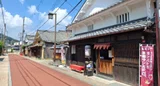
One of the highlights of Kameoka Festival is the procession of 11 yamahoko floats through the historic castle town of Tanba Kameyama.
Each float has its own decorations and repertoire of ohayashi festival music.
With their magnificent textiles and decorative hangings, the floats are often described as “moving museums of decorative arts.”
But the beauty of Kameoka Festival is not found only in the splendor of the floats.
For generations, local people have maintained and restored the floats, taught the festival music, and worked together to keep the tradition alive.
Even today, children play a central role in performing the festival music, or ohayashi.
Those who once learned the music as children grow up and, in turn, pass it on to the next generation.
In this way, the culture of the festival continues to be handed down from person to person and from generation to generation. 亀岡祭山鉾連合会
October 24 — Yoimiya
On the evening of the 24th, take some time to walk through the castle town.
Lanterns illuminate the yamahoko floats, while small paper lanterns called andon light the streets.
Surrounded by the warm glow of lanterns and the sound of ohayashi, the town takes on a magical atmosphere quite different from everyday Kameoka.
The official Yamahoko Association describes the combination of the floats, castle town, and festival music as creating an enchanting festival scene. 亀岡祭山鉾連合会
October 25 — Yamahoko Procession
On the 25th, all 11 yamahoko floats make their way through the castle town.
At around 11:00 a.m., the floats gather in Hatago-machi, where the traditional Kuji-aratame ceremony is held.
During this ceremony, the lot that determines the procession order is formally inspected before the floats continue their procession. 亀岡祭山鉾連合会
The sight of the yamahoko floats moving through the castle town, accompanied by the sound of ohayashi, is one of the distinctive scenes of Kameoka Festival.
It is also important to remember that Kameoka Festival is, first and foremost, a festival of Kuwayama Shrine.
During the Shinkō-sai on October 20, the two mikoshi leave Kuwayama Shrine and travel to the otabisho, where they remain until the main festival.
On October 25, during the Kankō-sai , they return to Kuwayama Shrine.
Understanding this journey of the deities helps us see that Kameoka Festival is much more than a procession of beautiful floats.
An Autumn Festival Carried Forward by the Townspeople
Kameoka Festival is not simply a festival that has “survived from long ago.”
Some traditions were once interrupted and later revived. Floats have been repaired and restored. Festival music has been passed on to younger generations. The Yamahoko Association itself has worked for decades to revive and preserve different parts of the festival.
This is a festival that local people have actively protected and carried forward.
Behind the yamahoko floats are generations of people who contributed their time, resources, skills, and effort to preserve the traditions of their town.
There is gratitude for the blessings of nature, respect for forces beyond human control, care for the community, and a shared determination to pass something precious on to the next generation.
That spirit of the townspeople still lives in the festival today.
As you enjoy the yamahoko floats and ohayashi music, take some time to walk through the castle town as well.
Surrounded by lantern light and the sounds of the festival, Kameoka reveals a different side of itself — one that can only be experienced during the festival.
We are not simply looking at a tradition from the past.
We are living in the continuation of that tradition today.
We hope you will come and experience autumn in Kameoka. 😊

Castle Town History and Streetscape Information Center
Honmachi Machiya Café
The Honmachi Machiya Café will also be open during Kameoka Festival.
Saturday, October 24
10:00 a.m.–3:00 p.m. — Regular hours
5:00 p.m.–9:00 p.m. — Special festival hours
Sunday, October 25
10:00 a.m.–5:00 p.m. — Regular hours
Special Festival Menu: Japanese-style beef tendon curry and chiffon cake.
Available while supplies last each day.
Please feel free to stop by and take a break while enjoying the festival.
Glossary of Japanese Terms
Kuwayama Shrine (鍬山神社): A Shinto shrine in Kameoka and the shrine at the heart of Kameoka Festival.
Tanba (丹波): The historic region of Japan that included present-day Kameoka.
Yamahoko (山鉾): Elaborately decorated festival floats used in processions.
Yoimiya (宵宮): The evening before the main day of a festival.
Ohayashi (お囃子): Traditional festival music, usually performed with instruments such as flutes, drums, and gongs.
Andon (行灯): A traditional Japanese lantern with a paper-covered frame.
Kuji-aratame (籤改め): A ceremony in which the lot determining the procession order of the yamahoko floats is formally inspected.
Shinkō-sai (神幸祭): A ritual procession in which a deity leaves the shrine and travels to a temporary resting place.
Mikoshi (神輿): A portable shrine used to carry a deity during a festival procession.
Otabisho (御旅所): A temporary resting place where the deity stays during a festival.
Kankō-sai (還幸祭): The return procession in which the deity is carried from the otabisho back to the shrine.
References
The historical background, festival schedule, procession details, ohayashi tradition, and preservation activities are based primarily on information published by the Kameoka Festival Yamahoko Association and Kameoka City.