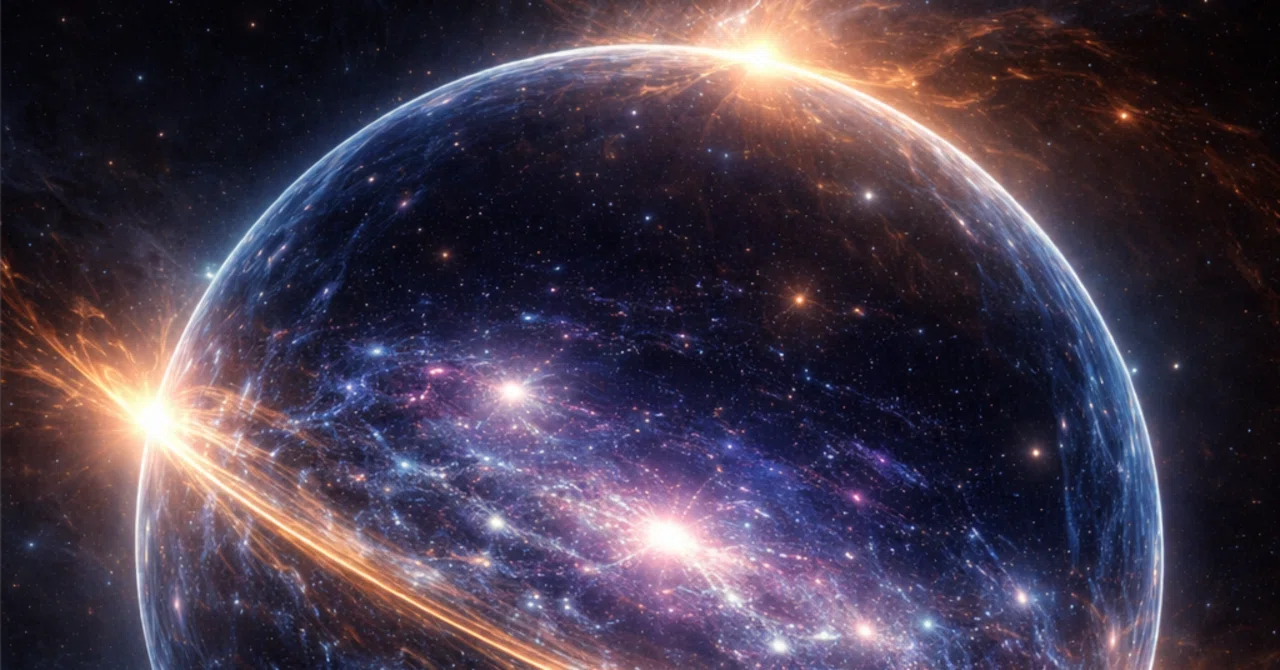
素人が本気で宇宙を再設計してみた#101

1. Reinterpreting Cosmic Acceleration: Motivation and Conceptual Framework
The accelerated expansion of the universe is one of the most firmly established
observational results in modern cosmology. Measurements of distant Type Ia
supernovae, the cosmic microwave background, and large-scale structure all
indicate that the expansion rate of the universe is increasing with time.
Within the standard ΛCDM framework, this phenomenon is attributed to an unknown
component termed dark energy. Dark energy is assumed to possess negative
pressure, and in its simplest form it is modeled by a cosmological constant Λ,
for which the equation of state satisfies
[
p \approx -\rho.
]
This relation leads to accelerated expansion through the Friedmann equations.
However, the dark-energy hypothesis faces several fundamental challenges.
First, the physical nature of dark energy remains entirely unknown. Second, the
observed value of the cosmological constant differs from quantum-field-theory
estimates by many orders of magnitude. Third, the so‑called coincidence problem
raises the question of why dark energy becomes dominant precisely in the
current epoch.
These issues suggest that the difficulty may lie not merely in the details of
dark-energy modeling, but in the underlying assumption that cosmic acceleration
must originate from a new internal energy component.
In this work, we revisit this assumption and propose an alternative viewpoint:
cosmic acceleration may arise not from internal energy but from boundary
conditions.
Specifically, we treat the universe not as an infinite spatial manifold but as a
finite region whose boundary evolves in time. We introduce a physical membrane
(the cosmic membrane) at this boundary and interpret the observed expansion as
the motion of this membrane as seen by internal observers.
Furthermore, we posit the existence of an unobservable external sector outside
the membrane. In this external region, we assume the presence of repulsive
interactions that do not directly influence internal matter but act on the
membrane as an effective force. This force drives the membrane outward, causing
its radius to increase with time.
Crucially, the repulsion responsible for acceleration does not originate from
any internal fluid or energy component. Instead, it emerges from interactions
across the boundary. In this framework, the apparent negative pressure and
unusual energy behavior inferred by internal observers arise naturally as
effective quantities obtained by re-describing boundary dynamics.
The aim of this paper is to formulate this boundary-driven cosmological model
and clarify the conditions under which accelerated expansion arises. We derive
the equation of motion for the cosmic membrane and show that acceleration
emerges generically when the external repulsive interaction dominates over the
membrane tension.
In Chapter 2, we construct a minimal model in which the membrane is treated as a
single dynamical degree of freedom. By introducing an effective repulsive
potential originating from the external sector, we demonstrate that accelerated
expansion follows naturally from the boundary dynamics.
