
What Is Self-Alignment?

The Growing Core Within Us
——A quiet process that takes shape as we return to ourselves again and again——
In this note, I share my current conclusion about “What is Self-Alignment?”
What you read here is simply the point I’ve reached for now.
Every time our self-understanding deepens, we are updated—again and again.
I hope you can savor that unfolding process gently as you read.
▶︎ Every human being has emotions
It sounds obvious—but there are times in life when we can’t treat the obvious as obvious.
People who prioritize rationality can keep functioning while pushing emotions aside.
This is why they often feel confused when they experience:
• I should be able to do this, but I can’t.
• I know the logic, yet I’m stuck.
But no matter how rational someone appears,
there is always an emotional layer beneath their actions.
A lack of motivation, a sense of paralysis—
these are often precise emotional signals:
I’m tired.
I’m scared.
Something feels off.
Self-Alignment begins when we stop treating emotions as noise,
and start receiving them as messages.
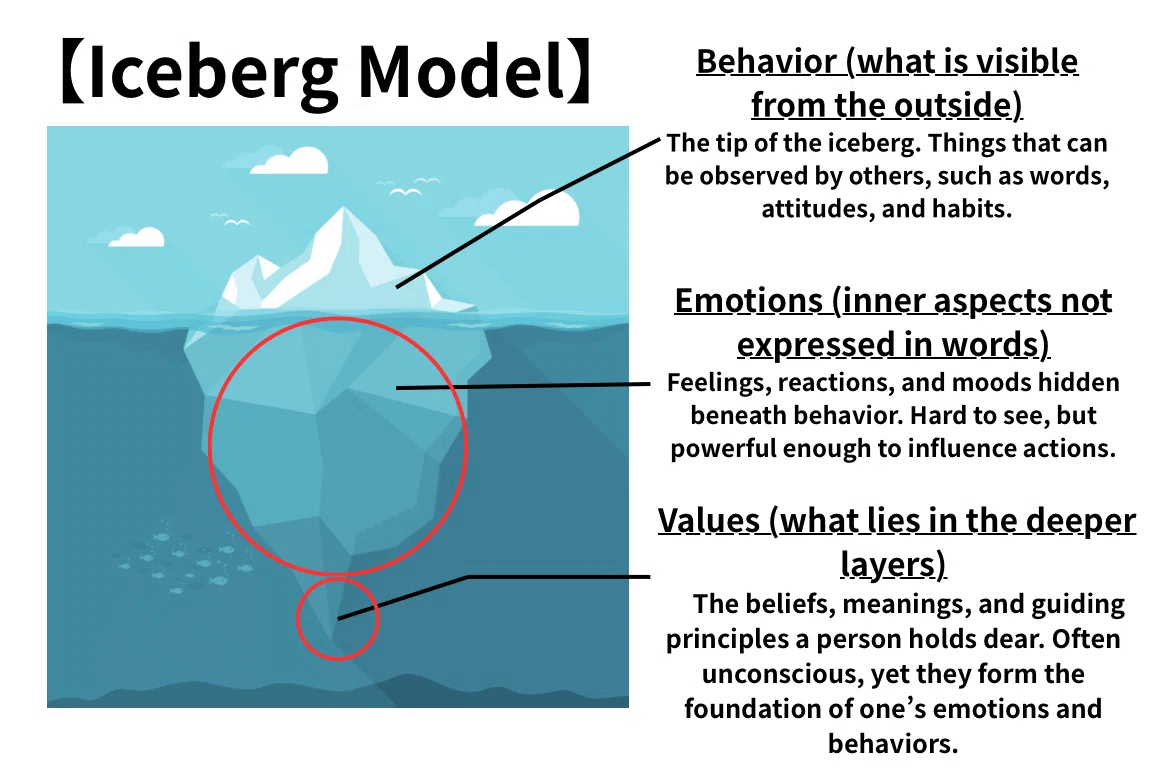
▶︎ The Iceberg Model of the Mind
Our behavior is only the visible tip of the iceberg.
Beneath the surface lie layers such as:
• emotions
• values
• beliefs
• memories
• expectations internalized from others
These unconscious layers shape everything we do.
Just as anger often hides loneliness or the need for recognition,
our own behaviors always have reasons below the surface.
When light reaches the lower layers,
our actions suddenly begin to make sense.
In counseling, I value not just “fixing behaviors,”
but exploring these deeper layers together—
because that is how people change in a natural, sustainable way.
▶︎ The Difference Between Self-Understanding, Self-Acceptance, and Self-Alignment
In Kinari Theory, I describe the process like this:
• Self-understanding
Becoming aware of one’s emotions and values.
The inner world begins to take shape in words.
• Self-acceptance
Recognizing what has surfaced—without judgment or denial.
Simply letting it be.
• Self-Alignment
A state where emotions, values, and behavior are internally aligned
and move in one coherent direction.
The important point is this:
Self-Alignment is not a one-time achievement.
It is a spiral process in which
Self-understanding → Self-acceptance → Self-Alignment
repeat over and over, gradually forming the person’s core.
As long as we compare ourselves to others, we cannot enter this spiral.
The reference point must always be within.
Self-Alignment begins when we quietly return to:
How do I wish to live?
What kind of life actually feels right in my body and mind?
▶︎ Where Does “Life Friction” Come From?
Most of our emotional struggles come from a mismatch between:
• Values (inner)
• Behaviors (outer)
For example:
• Wanting rest, yet continuing to work
• Having someone important, yet postponing time with them
• Disliking something, yet being unable to say “No”
• Living around someone else’s expectations
These small misalignments accumulate
and eventually show up as fatigue, emptiness, or anxiety.
Self-Alignment is the quiet work of closing this gap, step by step.
Simply listening to the quiet voice of
“This is what I really want”
and shifting behavior even by 1 millimeter
can change everything.
▶︎ Summary
• Self-understanding is awareness
• Self-acceptance is acknowledgment
• Self-Alignment is integration and inner alignment
These three stages form a spiral, not a straight line.
Through repeated cycles, the core of a person grows quietly.
Phase 1 (Defrag) is the stage where the first outline of that spiral is formed.
The values discovered here later become the foundation of your actions.
What shape will your Self-Alignment take?
I hope you explore it with patience and gentleness.
🕊️ Additional Notes on Counselar-ppy
• The mechanism of “finding what matters” is based on value excavation
• The dialogue exists only between you and the AI
• The design avoids giving advice, to protect the integrity of your inner core
• The free version is usable—just manage your logs consciously
• The experiential part is for feeling;
the explanation part is for organizing
Both are necessary to truly see your inner world.
Take your time, and move at your own pace.
▷ Try Counselar-ppy here
🔗 Navigation for This Post
🌐 Language Versions
• Japanese: https://note.com/kinari_tokieda/n/n588d80dc53f8
🫧 Emology Note
Emology Note is a hybrid series that blends emotionally grounded storytelling with clear psychological logic.
Each episode begins with a small “emotional disturbance” —
a moment of discomfort, confusion, or quiet ache —
and traces the inner reasoning behind it.
Through the journey of the protagonist Nako and the lens of Kinari Theory, Emology reveals:
• why we feel what we feel
• the unseen structures beneath our reactions
• how Self-Alignment quietly takes shape
• and how a person returns to themselves, one layer at a time
Emology is not advice.
It is a mirror — a space where emotion meets understanding,
and where readers can gently rediscover the architecture of their own inner world.
✨ Start from Ep1
https://note.com/kinari_tokieda/n/n4bea2365c833
