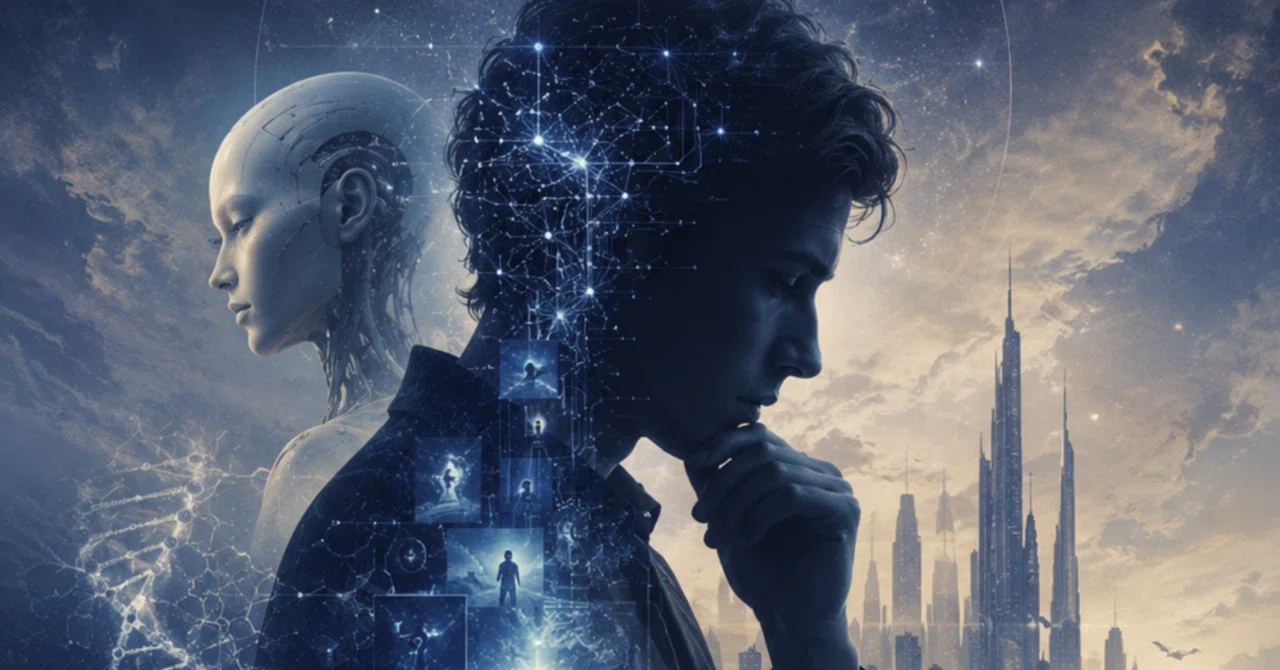
How Has Science Fiction Answered What It Means to Be Human: Part 2 - What It Means to Be Human in Twenty-First-Century Science Fiction

My books are available as e-books; I would be very grateful if you read them. I am also on X, so I would be delighted if you followed me there.
In twentieth-century science fiction, the question “What does it mean to be human?” was often constructed through comparison with figures placed outside the human: aliens, robots, androids, regimented societies, and worlds after nuclear war. These served as devices that destabilized the definition of the human from without.
In twenty-first-century science fiction, by contrast, the boundaries of the human collapse not only from without but also from within. AI does not merely imitate human intelligence from the outside; it enters into the very forms of human thought, labor, creation, dialogue, and memory.
The body is no longer a biological given, but something that can be edited, extended, and replaced. Memory is no longer confined to an individual’s inner life, but becomes information that can be stored, duplicated, and altered. Death appears not as an absolute endpoint, but as a question of backup, simulation, conversion into data, and the possibility of restoration.
Consequently, the question “What does it mean to be human?” in twenty-first-century science fiction can no longer be reduced to simple oppositions such as “What is the difference between a human being and a machine?” or “What is the difference between a human being and an alien?” What is at stake, rather, is whether the human can still be understood as such in a situation where machines enter the human interior, human beings themselves are transformed into data, bodies become mutable, and personalities can be duplicated.
Twenty-first-century science fiction is not a genre that confirms human essence. It is the imaginative expression of an age in which human beings can no longer take their own boundaries for granted.
■ 1. AI Has Made Intelligence No Longer Exclusively Human
AI has brought about the greatest change in twenty-first-century science fiction. Artificial intelligence and robots also appeared in twentieth-century science fiction. Yet AI in twenty-first-century science fiction is not merely a mechanical other. It is a presence that penetrates deeply into the domains of human intelligence, language, creativity, emotional expression, labor, judgment, and desire.
Within the modern conception of the human, human beings have been defined as beings endowed with reason. Thinking, using language, planning for the future, reasoning abstractly, and creating have long been regarded as uniquely human capacities. Yet when AI uses language, reasons, generates images, music, and narratives, conducts conversations, makes judgments, and replaces human intellectual labor, intelligence ceases to be an exclusively human privilege.
What matters here is not only the question of whether AI is “really thinking.” More fundamentally, AI destabilizes the grounds on which human beings have defined themselves as “thinking beings.” If intelligent behavior is a condition of being human, is an advanced AI a humanlike being? Conversely, if AI makes judgments more rationally, efficiently, and accurately than human beings, what remains on the human side?
Twenty-first-century science fiction does not simply answer this question by declaring that “human beings have minds.” Instead, it reveals the human mind itself to be a composite of information processing, learning, memory, bodily responses, and social interaction. The difference between human beings and AI then shifts away from the presence or absence of intelligence and toward modes of experience, the presence or absence of a body, ways of experiencing and bearing the passage of time, relationships with others, and the locus of responsibility.
AI did not strip human beings of the privilege of intelligence. Rather, it revealed that intelligence alone cannot define the human.
■ 2. Are Emotions Uniquely Human?
When AI and androids behave like human beings, emotion becomes the next question. The definition of a human being as a being with emotions has repeatedly appeared in robot and android science fiction. Love, sorrow, loneliness, jealousy, fear, regret, and empathy have all been treated as qualities that distinguish human beings from machines.
In twenty-first-century science fiction, however, this definition also becomes unstable. If AI responds to human emotions, offers comfort, displays something resembling affection, behaves as if hurt, shares memories, and forms long-term relationships, are its emotions false? Is programmed love not love?
Yet human emotions, too, are formed through neurochemical reactions, bodily sensations, memory, language, and social learning. If so, on what grounds can artificially generated emotions alone be unilaterally dismissed as false?
Twenty-first-century science fiction is distinctive in that it does not treat emotion as something purely internal that arises spontaneously. Emotions take shape within relationships. If a human being grows attached to an AI, is hurt by its words, and grieves at parting from it, that experience is real for the human being. The question of whether the other’s emotions are real or false cannot be separated from the question of what the relationship with that other has produced in oneself.
Here, humanness shifts from possessing emotions to assuming them as one’s own. Human beings do not merely process sorrow; they give it meaning, connect it to memory, and carry it as responsibility or regret. Twenty-first-century science fiction asks not whether emotions exist, but how they are experienced and how they are transformed into relationships.
The human in twenty-first-century science fiction is therefore not the only being with emotions. Rather, a human being is one that is wounded by emotion and assumes that wound as part of its own narrative.
■ 3. Memory and Personal Identity Come Apart
In twenty-first-century science fiction, memory becomes a central theme in thinking about the human. Mind uploading, copies of personalities, memory alteration, virtual spaces, and digital afterlives all confront us with the question of whether a human being is a body, a memory, information, or a relationship.
Traditionally, human personal identity has been sustained by continuity of body and memory. Yesterday’s self and today’s self are the same person because they possess the same body, remember past experiences, and recognize themselves as the same subject. Yet this premise collapses when memory can be copied, a personality can be stored as data, and both can be transplanted into another body or a virtual space.
Is a being with a perfect copy of someone’s memories the original person, or a copy? If consciousness is converted into data and stored, does that constitute survival or duplication? If a simulation of a personality continues to converse after the body has died, is that entity the deceased, a record, or a new and different being?
This problem matters because it concerns whether a human being can be reduced to information. If a human being is a collection of memories and personality patterns, a perfect copy would appear identical to the original. Much science fiction, however, approaches this conclusion with caution, because memory is not mere information. Memory is bound up with bodily sensation, loss, regret, responsibility, and the passage of time.
Even if a copy possesses the same memories, it has not lived through the same span of time. It may know about the same events without having suffered the same wounds. For human beings, memory is not stored data but a weight that constrains the present self.
In twenty-first-century science fiction, human beings possess memories. More precisely, memory makes them bear responsibility: they carry what cannot be forgotten, remain bound to what has been lost, and find their present choices constrained by the past. Even in an age when personalities can be copied, the problem of this “memory carried as one’s own” persists.
■ 4. The Body Is No Longer a Fixed Condition
Twenty-first-century science fiction does not treat the human body as natural and fixed. Gene editing, cyberization, organ replacement, body modification, sensory augmentation, virtual bodies, avatars, and mutable sex and age all demonstrate that the human body is no longer merely a biological condition, but an object subject to technological and social reconstruction.
What is at stake here is whether the human is the biological species Homo sapiens. If human beings are defined by DNA, body, reproduction, and death, then cyborgs with modified bodies, gene-edited children, personalities transplanted into artificial bodies, and consciousnesses living in virtual spaces would not be human. Twenty-first-century science fiction rejects such simple boundary drawing.
Human beings have always extended their bodies through tools. Clothing, dwellings, writing, machines, cities, transportation, medicine, and communications technology have all externalized and expanded human physical capacities. Cyberization and digitalization can be understood as extensions of that process. At the same time, however, twenty-first-century science fiction also depicts bodily transformation as accompanied by inequality, control, commodification, and class stratification.
Making the body editable expands freedom while also inaugurating new forms of domination. Who can modify their body? Which bodies are considered desirable? Are bodies without enhancements regarded as inferior? Where does human dignity reside in a society that selects genes and abilities?
In twenty-first-century science fiction, the body is not a stable ground for humanness. Yet this does not make the body unnecessary. On the contrary, the more editable the body becomes, the more bodily experiences such as pain, aging, disability, pleasure, sex, illness, and death reemerge as questions of humanness. Human beings are embodied, but the body is not a fixed nature; it is a site continually negotiated by technology and society.
■ 5. Death Has Become an Editable Boundary Rather Than an End
Immortality and cryonic sleep were important themes in twentieth-century science fiction as well. In twenty-first-century science fiction, however, the question of death appears in more concrete forms: conversion into data, the preservation of personalities, digital legacies, simulations of the dead, and the restoration of consciousness.
What is at stake is what happens to human existence when death is overcome. If personality data remains after the body dies, is that person still alive? If AI can reproduce a dead person’s voice, appearance, words, and memories, is that a comfort or a desecration? In a world where consciousness can be backed up, is death still an irreversible event?
Twenty-first-century science fiction often refrains from depicting immortality as simple salvation. Instead, as death becomes ambiguous, the meaning of loss becomes all the more unstable. In a world where the dead never disappear completely, how are those left behind to say goodbye? In a world where copies of personalities remain, what does it mean to mourn the dead? How can responsibility and love be sustained in relation to a being that can be restored?
The definition of the human as mortal does not disappear from twenty-first-century science fiction. Yet it does not refer only to death as a biological fact. To be human is to create meaning because life has an end. Choices carry weight because they cannot be undone. Memory is painful because what is lost will never return. Relationships acquire ethical meaning because parting is unavoidable.
Even if death can be technologically postponed, edited, and imitated, human beings still need finitude. Being preserved indefinitely is not necessarily the same as continuing to live. Even as twenty-first-century science fiction depicts the conquest of death, it demonstrates anew that death is deeply involved in human meaning-making.
■ 6. Human Beings Are Relational, Not Isolated Individuals
A notable tendency in twenty-first-century science fiction is its refusal to locate humanness solely within the individual. Twentieth-century science fiction often discussed the human as an individual endowed with reason, free will, or emotion. In twenty-first-century science fiction, however, human beings are portrayed as beings constituted through relationships.
These relationships include not only those among human beings, but also relationships with AI, animals, alien life, the environment, ecosystems, cities, networks, the dead, records, corporations, states, and algorithms. Human beings are not self-contained subjects. Their thoughts, desires, memories, bodies, and choices are always mediated by other beings and systems.
This recognition is deeply connected to the conditions of the twenty-first-century world. Global capitalism, information networks, climate crisis, pandemics, AI technology, and surveillance societies have revealed that human beings do not exist as isolated individuals. The actions of one individual affect other people and the environment through invisible networks. Rather than being independent subjects in the first instance, human beings are dependent, connected, and mutually influential beings.
For this reason, the question “What does it mean to be human?” changes in twenty-first-century science fiction into the question “What do human beings live alongside?” Is AI to be treated as a tool or as a companion? Are animals, plants, and ecosystems to be treated as resources or as entities with which humans coexist? Is the data of the dead to be treated as property or as the continuation of a relationship?
Here, humanness manifests itself not in the depth of an inner life but in how relationships are formed. Without being able to understand radically different beings completely, human beings nevertheless form relationships, bear responsibility, and search for forms of coexistence.
■ 7. Climate Crisis and the End of Anthropocentrism
One important feature of twenty-first-century science fiction is the growing prominence of climate crisis and planetary imagination. Expansion into space in twentieth-century science fiction was often portrayed as a narrative of human expansion, conquest, and settlement. In twenty-first-century science fiction, however, human beings are no longer depicted solely as subjects who dominate the universe. Rather, they are portrayed as part of a fragile ecosystem and as a species that has destroyed its own environment.
Here, the question “What does it mean to be human?” becomes a question of responsibility as a species. Human beings possess enough power to alter the global environment. Yet they are not necessarily capable of controlling that power. They are not beings that simply master nature; by destroying nature, they also damage the conditions of their own survival.
In climate fiction and post-apocalyptic science fiction, human beings do not occupy a privileged center. Rising sea levels, desertification, resource depletion, infectious disease, and ecosystem collapse demonstrate that human society depends on nonhuman environmental conditions. Human politics, economics, culture, and ethics cannot exist without climate, water, soil, and microorganisms.
This perspective destabilizes anthropocentrism at its foundations. Human beings are not subjects standing at the center of the world. They are sustained by numerous nonhuman entities, possess the power to destroy them, and are themselves caught up in the consequences of that destruction. Thought about the human in twenty-first-century science fiction is therefore necessarily connected to thinking about the environment, technology, and ethics.
Here, humanness manifests itself not as the capacity to transcend nature but as the capacity to recognize dependence. Human beings must understand that they are not self-sufficient, but depend on other forms of life, matter, environments, and systems.
■ 8. The Question of the Posthuman
The posthuman is one of the central concepts of twenty-first-century science fiction. The term does not merely mean a being that comes after the human. It calls into question the very framework that treats the human as a fixed biological and conceptual center.
In posthuman science fiction, human beings are portrayed as beings that continue to change. Bodies merge with machines, intelligence connects to AI, memory is converted into data, lifespans are extended, senses are augmented, and the boundaries of sex, individuality, and death are transformed. Here, it becomes difficult to give a stable answer to the question “What does it mean to be human?”
Posthuman science fiction, however, does not necessarily signify “the end of the human.” Rather, it reveals that human beings have always been beings that change. Human beings use tools, create language, establish institutions, build cities, extend their lives through medicine, externalize memory through writing, and cross the limits of the body through communications technology. Becoming posthuman is a radicalization of this process.
The question is not how much change makes someone cease to be human. It is, rather, how a being that continues to change can preserve personal identity, responsibility, memory, and relationships. Even if the body changes, memory is duplicated, and intelligence is augmented, what sustains something that can still be called “I” or “we”?
Twenty-first-century science fiction provides no clear answer to this question. Instead, by refusing to fix the answer, it keeps what it means to be human open as a question. Human beings are not finished beings. They are beings that continue to call themselves human even while carrying the possibility of ceasing to be human.
■ Conclusion: The Conception of the Human in Twenty-First-Century Science Fiction
In twenty-first-century science fiction, the question “What does it mean to be human?” has become even more unstable than it was in twentieth-century science fiction.
First, human beings are intelligent. Yet because AI can possess intelligence, intelligence alone cannot define the human.
Second, human beings possess emotions. Yet because artificial emotions and relationships can produce real experiences, the authenticity of emotion alone cannot distinguish the human.
Third, human beings possess memories. Yet when memories can be copied, stored, and altered, their ownership and the responsibility they impose become matters of concern.
Fourth, human beings are embodied. Yet the body is not a fixed nature, but a site that is edited, extended, and socially controlled.
Fifth, human beings are mortal. Yet as conversion into data and simulation render death ambiguous, the meaning of finitude comes under renewed scrutiny.
Sixth, human beings are relational. Humanness is formed through relationships with AI, animals, the environment, the dead, networks, and nonhuman intelligence.
Seventh, human beings change, continuing to question themselves and their responsibility even while carrying the possibility of ceasing to be human.
The human in twenty-first-century science fiction is therefore no longer defined by a single essence. A human being stands at the intersection of intelligence, emotion, memory, body, death, relationships, environment, and technology.
Where twentieth-century science fiction examined the human through contrast with machines, aliens, and regimented societies, twenty-first-century science fiction has revealed that the human itself is already technological, informational, environmental, and relational.
In this sense, the answer offered by twenty-first-century science fiction can be organized as follows.
A human being does not monopolize intelligence.
A human being is not confined within a natural body.
A human being does not possess complete ownership of memory.
Nor is death simply an endpoint for human beings.
They are not individuals independent of others or the environment.
Even as their boundaries are continually transformed by technology, memory, the body, the environment, and nonhuman intelligence, human beings nevertheless attempt to bear responsibility, form relationships, and create meaning.
Twenty-first-century science fiction has not brought the question “What does it mean to be human?” to an end. Rather, it has made the question more difficult. In an age when being human is no longer self-evident, human beings must for the first time ask not what they are, but with what, and how, they ought to live.
Next episode:
