Exploring Japanese Literary Culture for High School Learners A Clear Guide to Classical Japanese, Kanbun, Modern Literature, Reading Skills, and Self-Expression

Book Introduction
A clear and accessible guide to Japanese literary culture for high school learners. This book introduces Classical Japanese, Kanbun, modern literature, essays, waka, tanka, reading strategies, and self-expression. It helps readers move beyond memorization and discover how words connect people, emotions, ideas, and time.
Introduction
Chapter 1 What Is Japanese Literary Culture?
Why Words Continue Across Time
Chapter 2 An Introduction to Classical Japanese
The Basics for Reading the Language of the Past
Chapter 3 Reading Stories
Characters’ Emotions and Changes in Scenes
Chapter 4 Reading Essays
Observing Perspectives, Sensibility, and Everyday Discoveries
Chapter 5 Reading Waka and Tanka
The Heart Held in Short Poems
Chapter 6 An Introduction to Kanbun
From Reading Marks to Ideas, Thought, and Human Life
Chapter 7 Reading Modern and Contemporary Literature
Connecting Literature with Your Own Time
Chapter 8 The History and Expression of Language
How Japanese Has Changed Over Time
Chapter 9 Building Strong Reading Skills
Key Points Often Asked in School Tests
Chapter 10 Using Literary Culture in Your Own Expression
From Reading to Writing
Appendix
Appendix 1 A Mini Dictionary of Essential Classical Japanese Words
Appendix 2 Key Points of Classical Japanese Grammar
Appendix 3 Basic Kanbun Sentence Patterns
Appendix 4 A Checklist for Reading Literary Works
Appendix 5 How to Prepare for Regular School Tests
Conclusion
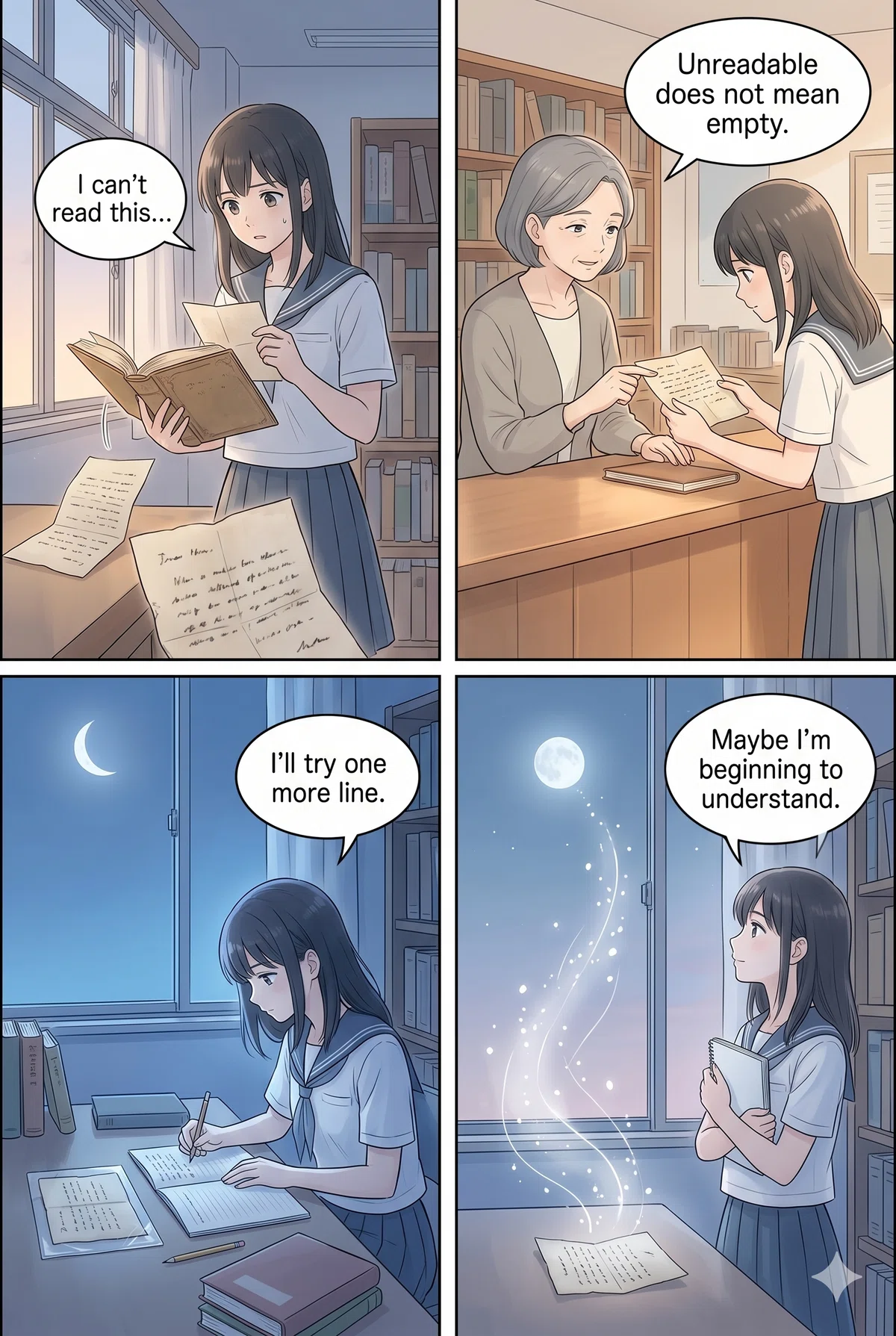
Bonus Short Story The Paper Moon and the Letter I Could Not Yet Read
Japanese Literary Culture: A Comprehensive Guide for Learners
Executive Summary
Japanese literary culture is a multifaceted study of human life through the medium of words. It encompasses Classical Japanese (Kobun), Kanbun (Chinese classics read as Japanese), and modern/contemporary literature, including essays and poetry (Waka and Tanka). Far from being a mere academic exercise or a collection of dead texts for memorization, this field allows learners to understand how people across generations have perceived the world, expressed emotions, and recorded their values.
The core of successful engagement with these texts lies in moving from intuitive guesswork to evidence-based interpretation. By mastering specific grammatical tools—such as auxiliary verbs in Kobun, reading marks in Kanbun, and narrative perspective in modern fiction—readers can bridge the gap between historical distance and contemporary relevance. Ultimately, the study of literary culture is intended to refine a learner's own self-expression, providing them with a deeper vocabulary and more precise ways of thinking.
--------------------------------------------------------------------------------
1. The Nature and Purpose of Japanese Literary Culture
Japanese literary culture is defined as the study of human life through words. It serves as a bridge connecting the past, the present, and the self.
Human Experience Across Time: While writing systems and social backgrounds change, fundamental human concerns—loneliness, beauty, memory, and the passing of time—remain constant.
Cultural Memory: Texts from different periods are not isolated boxes but parts of a continuous movement. Concepts from Kanbun survive in modern compound words, and emotions from ancient poetry reappear in contemporary media.
Expansion of Perspective: Studying older language forms teaches that current ways of thinking are not the only ways. It allows readers to see the present more clearly by comparing it with the values and customs of earlier eras.
The Goal of Study: Beyond passing examinations, the study of literary culture aims to develop the ability to read carefully, think clearly, and express oneself with genuine precision.
--------------------------------------------------------------------------------
2. Classical Japanese (Kobun): Accessing the Past
Classical Japanese is the root of the modern language. While it uses unfamiliar spelling and grammar, it remains accessible through systematic study.
Key Vocabulary and Nuance
Classical words often carry multiple shades of meaning that modern equivalents may lack.
Aware: Deep emotional movement, pathos, beauty, or wonder.
Okashi: Charming, delightful, elegant, or intellectually interesting.
Arigatashi: Originally "rare" or "difficult to exist," leading to the sense of "precious."
Utsukushi: Dear, lovely, or adorable (often referring to small things), rather than just "beautiful."
Structural Elements
Omitted Subjects: Subjects are frequently omitted because they are implied by context, social rank, or honorifics.
Honorifics: These act as structural clues. Respectful language (Sonkeigo) raises the actor, while humble language (Kenjōgo) lowers the actor relative to the recipient.
Kakarimusubi: A grammatical signal where specific particles (zo, namu, ya, ka, koso) change the sentence ending to provide emphasis or indicate a question/rhetorical point.
Auxiliary Verbs: These "engines of meaning" define tense, completion, negation, conjecture, and intention.
--------------------------------------------------------------------------------
3. Kanbun: Intellectual Heritage and Logic
Kanbun represents the Chinese classical tradition absorbed into Japanese culture. It is approached through Kundoku, a method of reading Chinese-based texts in Japanese order and style.
The Technical Reading System
Feature
Function
Reading Marks
Guides such as re-ten (return marks) and number marks that dictate the reading order.
Okiji
Characters that are not read aloud but shape the tone, emphasis, or connection between words.
Rereading Characters
Characters read twice to express concepts like "not yet," "should," or "must."
Fixed Patterns
Grammatical structures that indicate negation, causation, passive voice, comparison, or rhetorical questions.
Core Themes in Kanbun
Learning and Self-Cultivation: Focuses on the idea that learning is not just information gathering but the shaping of character and humility.
Leadership and Politics: Explores the responsibilities of authority and the relationship between power and virtue.
Friendship: Emphasizes trust, sincerity, and the role of friends in providing honest advice.
--------------------------------------------------------------------------------
4. Reading Modern and Contemporary Literature
Modern literature deals with themes closer to contemporary life, such as the self, family, and the individual's place in the city.
The Modern Self: Explores the gap between an individual's inner desires and social expectations.
Family Dynamics: Uses small details—a meal, a shared silence, or a parent's comment—to reveal complex histories of obligation or care.
The Urban Experience: The city serves as a symbol of both freedom and "digital loneliness," where people are physically close but emotionally disconnected.
War and Memory: Approaches history through individual trauma and the "silence" that occurs when experiences are too painful for direct speech.
--------------------------------------------------------------------------------
5. Literary Forms: Essays and Poetry
The Essay (Zuihitsu)
Essays record the "movement of thought" rather than a sequence of events.
The Art of Noticing: Essays often begin with a concrete, ordinary detail (a cracked mug, a fading ticket) and move toward a broader reflection on time or life.
Sensibility: The writer's specific way of feeling the world is revealed through their choice of what to observe and what words they use to describe it.
Short Poetry (Waka and Tanka)
The power of short poetry lies in its compression and the rhythm of 5-7-5-7-7 sound units.
Suggestion and Space: Rather than explaining, poetry uses images (moonlight, falling blossoms) to suggest emotions.
Techniques:
Kakekotoba (Pivot Words): Words with double meanings based on sound.
Engo (Associated Words): Related terms (e.g., "sea," "tide," "boat") that create a network of meaning.
Yojō (Lingering Feeling): The resonance that remains after the poem ends.
--------------------------------------------------------------------------------
6. Strong Reading and Test-Taking Skills
Successful reading is a disciplined form of inference. It requires moving from "I feel" to "I can explain based on the text."
The Evidence Rule: Every interpretation of a character's emotion or a writer's theme must be supported by specific words, actions, or structural clues in the text.
Specific Question Types:
Reason Questions: Identify the result first, then find the causal evidence (often marked by connectives like "therefore" or "as a result").
Emotion Questions: Avoid vague terms like "sad." Specify the target, cause, and exact nature of the emotion (e.g., "regret due to a misunderstanding").
Extraction Questions: These require copying a phrase exactly as it appears, matching the character count or punctuation requested.
--------------------------------------------------------------------------------
7. The Evolution of the Japanese Language
Japanese is a layered language that has adapted over centuries.
Vocabulary Layers:
Native Japanese (Wago): Soft, emotional, and connected to daily life.
Sino-Japanese (Kango): Abstract, intellectual, and used for formal concepts.
Loanwords (Gairaigo): Modern, technical, and used for international concepts.
Script and Form: The combination of Kanji, Hiragana, and Katakana allows for visual nuance. For instance, writing a word in Hiragana can make it appear softer than using Kanji.
Media Influence: The speed and brevity of digital media are changing how language is used, making context and "media literacy" increasingly important.
--------------------------------------------------------------------------------
8. From Reading to Expression
Expression is the process of making language one's own. It involves choosing words and organizing thoughts so they can be received by others.
Writing Types:
Response Essay: Focuses on a specific part of the text that affected the reader and explains why.
Appreciation Essay: Analyzes how the text creates beauty or meaning through specific techniques.
Opinion Essay: Presents a clear claim supported by reasons and evidence, acknowledging opposing views.
The Art of Revision: Writing is not finished at the first draft. Revision ensures the main point is clear and the tone is appropriate for the audience.
Daily Application: The skills learned from literary culture—slowness, attention to detail, and respect for words—make daily communication more thoughtful and effective.
Comprehensive Study Guide to Japanese Literary Culture
This study guide provides a structured review of Japanese literary culture, encompassing Classical Japanese, Kanbun, modern literature, poetry, and reading strategies. It is designed for learners to move beyond rote memorization and toward a deep, evidence-based understanding of how language connects human emotion and thought across time.
Part 1: Short-Answer Quiz
Instructions: Answer the following ten questions in 2–3 sentences each, based on the principles outlined in the provided text.
What is the primary purpose of studying Japanese literary culture beyond academic testing?
How does the classical word aware differ in meaning from the word okashi?
Why is it essential to understand honorifics when identifying omitted subjects in Classical Japanese?
Define the term kundoku and explain its role in reading Kanbun.
What is yojō, and how does it function in short poetic forms like waka and tanka?
In the context of reading essays, what is the difference between an "event" and "awareness"?
What are "rereading characters" in Kanbun, and what grammatical functions do they serve?
How does modern literature represent the "gap between appearance and inner life"?
Explain the different emotional and functional effects created by Native Japanese words versus Sino-Japanese words.
What is the distinction between "summary" and "interpretation" when writing about a literary work?
--------------------------------------------------------------------------------
Part 2: Quiz Answer Key
The primary purpose of studying Japanese literary culture is to understand how people have used words to see the world, express emotions, and record values across generations. It develops the ability to read carefully, think logically, and express oneself with original, precise language.
In Classical Japanese, aware suggests deep emotional movement, pathos, and a quiet sense of being moved by beauty or sadness. In contrast, okashi is lighter and more observant, suggesting charm, delight, elegance, or an intellectual interest in something noticed.
Because Classical Japanese frequently omits subjects, honorifics serve as structural clues; respectful language raises the status of the person acting, while humble language lowers the actor relative to the receiver. By analyzing these directions of respect, a reader can accurately infer who is performing the action.
Kundoku is the traditional Japanese method of reading Chinese-based texts (Kanbun) by adding reading marks and grammatical elements to convert the Chinese word order into Japanese. It allows Japanese readers to absorb Chinese classical thought while maintaining the text’s original structure and force.
Yojō refers to the lingering feeling or emotional resonance that remains after a short poem ends. Because waka and tanka are highly compressed, they use suggestion rather than direct explanation, leaving an open space for the reader’s imagination to complete the emotional experience.
An event in an essay is a concrete occurrence, such as noticing a cracked mug, while awareness is the writer’s resulting reflection on that event. The awareness is the true center of the essay, where the writer finds deeper meaning or a discovery about life within an ordinary moment.
Rereading characters are specific Kanbun characters that are read twice—once in one position and again later as part of a Japanese expression. They typically convey complex relational meanings such as "not yet," "about to," "should," "must," or "ought to."
Modern literature often shows characters behaving one way (appearance) while feeling something entirely different (inner life). This gap is revealed through the tension between a character’s polite dialogue and their hidden anxiety, shame, or loneliness as described by the narrator or through setting.
Native Japanese words tend to feel soft, warm, and close to daily life or physical sensations. Sino-Japanese words, based on Chinese character readings, provide a more formal, abstract, and intellectual tone, allowing for the precise expression of complex academic or social concepts.
Summary is the act of retelling what happened or what the text says on the surface to orient the reader. Interpretation explains what the text means and why it matters, using textual evidence to analyze themes, character motivations, and the effects of specific language choices.
--------------------------------------------------------------------------------
Part 3: Essay Format Questions
Instructions: These questions are designed to promote deeper analysis and synthesis of the source material. Use specific examples from the text to support your arguments.
The Bridge of Language: Discuss how the study of Classical Japanese and Kanbun deepens a reader's understanding of modern Japanese vocabulary and social expression. How do these older layers of language continue to influence how people speak and write today?
Nature as a Mirror: Analyze the role of nature in Japanese literary culture across different genres (poetry, essays, and stories). Compare how natural imagery is used to suggest human emotion in a classical tanka versus how it might reflect a character’s psychological state in a modern city setting.
The Evolution of the Self: Examine the theme of the "self" in modern and contemporary literature. How do modern characters navigate the conflict between individual desire and social expectations within the frameworks of family, school, and urban life?
The Discipline of Reading: Explain why "textual evidence" is the most critical component of literary interpretation. How does a reader move from a subjective impression ("I somehow feel this") to a structured interpretation ("I can explain this because of the text"), and why is this transition valuable for critical thinking?
The Relationship Between Reading and Writing: Argue why reading and writing should be viewed as a single, connected process. How does noticing a writer’s techniques—such as metaphor, contrast, or the use of silence—provide a learner with the tools necessary for their own self-expression?
--------------------------------------------------------------------------------
Part 4: Comprehensive Glossary
Term
Category
Definition
Aware
Classical Vocabulary
Deep emotional movement; pathos, beauty, sadness, or tenderness; the quality of being "moving."
Okashi
Classical Vocabulary
Charming, delightful, interesting, elegant, or intellectually appealing.
Arigatashi
Classical Vocabulary
Originally "rare" or "difficult to exist"; suggests something precious or worthy of gratitude.
Ayashi
Classical Vocabulary
Strange, mysterious, unusual, lowly, poor, or rough, depending on the context.
Yukashi
Classical Vocabulary
The desire to see, hear, know, or experience something; curiosity or attraction.
Yojō
Literary Concept
Lingering feeling; the emotional resonance that remains in the silence after a poem or text ends.
Kakekotoba
Poetic Technique
"Pivot words"; a sound or word that carries two meanings at once, often connecting nature with emotion.
Engo
Poetic Technique
"Associated words"; a network of words related by theme (e.g., sea, waves, boat) that creates unity and depth.
Kundoku
Kanbun Technique
The method of reading Chinese-based texts in Japanese order and style using marks and grammar.
Okiji
Kanbun Grammar
Characters placed in a text that are not read aloud in Japanese but influence tone, connection, or emphasis.
Kakarimusubi
Classical Grammar
A system where specific particles (zo, namu, ya, ka, koso) require a change in the sentence's ending form.
Irrealis Form
Classical Grammar
A conjugation form indicating something not yet realized; often connects with negation or conjecture.
Realis Form
Classical Grammar
A conjugation form used to indicate something that has actually occurred or for strong emphasis with koso.
Sino-Japanese Words
Language History
Words based on Chinese characters and readings; often formal, abstract, or academic in tone.
Native Japanese Words
Language History
Words that developed within Japanese from early times; often softer and more emotionally direct.
Historical Spelling
Language History
Older kana spelling conventions that reflect historical sounds, often differing from modern pronunciation.
Rhetorical Question
Literary Device
A question form used to make a strong statement or denial rather than seeking information.
Causation
Grammar Pattern
A structure expressing making or allowing someone to perform an action.
Passive Meaning
Grammar Pattern
A structure expressing being acted upon or receiving an influence from another.
Textual Evidence
Reading Skill
Specific words, phrases, or actions in a text used to support an interpretation or answer.
Introduction
Language is one of the quietest and strongest forces in human life. We use it every day, often without thinking about it. We greet people, ask questions, send messages, read books, listen to songs, write notes, and explain our thoughts. Words seem ordinary because they are always around us. Yet words do far more than carry information. They hold feelings, memories, values, questions, and traces of the time in which people lived.
This book is about Japanese literary culture. It introduces the world of Classical Japanese, Kanbun, modern and contemporary literature, essays, waka, tanka, reading skills, and self-expression. These may sound like separate fields at first. Classical Japanese may seem distant from daily life. Kanbun may look like a wall of Chinese characters. Modern literature may feel closer, yet still difficult when it deals with complex emotions or social questions. However, these areas are connected by one important idea: language allows us to understand how people have seen the world, felt about life, and expressed what could not easily be said.
Japanese literary culture is not simply the study of old texts. It is not only a subject for tests, grammar drills, or memorization. Of course, knowledge matters. Students need to understand vocabulary, grammar, sentence patterns, reading marks, literary devices, and the structure of texts. These skills help with school lessons, regular tests, and entrance examinations. But the deeper purpose of this study is larger than that. It is to learn how to read carefully, think clearly, and express yourself with words that are truly your own.
Classical Japanese gives us access to the language of the past. At first, it may feel difficult because the words, spelling, grammar, and ways of expressing emotions are different from modern Japanese. Subjects are often omitted. A single word may carry several shades of meaning. A short passage may require attention to honorifics, auxiliary verbs, and context. Yet beyond these difficulties, Classical Japanese contains human feelings that still speak to us today. People admired the moon, waited for someone, felt the passing of seasons, suffered from separation, treasured letters, and wondered about the shortness of life. The language is old, but the emotions are not dead.
Kanbun opens another door. It shows how texts from the Chinese classical tradition were read, studied, and absorbed into Japanese intellectual culture. Reading marks, word order, omitted elements, fixed sentence patterns, and rereading characters may seem technical at first. But Kanbun is not only a system of rules. It is also a way to encounter ideas about learning, friendship, politics, morality, nature, and human life. A short sentence can carry a sharp insight. A compact expression can hold a question that remains meaningful even today.
Modern and contemporary literature brings the study closer to our own time. It often deals with the self, family, school, cities, war, memory, loneliness, and relationships with others. These themes are not locked in the past. They are part of our present lives. A character’s silence, a scene in a classroom, a walk through a city, a memory of a family member, or a sentence about loneliness may connect directly with questions that students and adults still face. Reading literature helps us notice not only what happens in a story, but also what changes inside a person.
Essays teach us to look carefully at ordinary life. A small object, a season, a conversation, a road, a window, or a memory can become the beginning of thought. Essays do not always depend on dramatic events. Their strength often lies in quiet observation. They show how a writer notices something, reflects on it, and turns that reflection into language. Through essays, we learn that thinking does not always begin with a large theme. Sometimes it begins with a small detail that most people pass by.
Waka and tanka show the power of short language. In only a few lines, a poem can suggest a landscape, a season, a feeling, a memory, and an unspoken wish. These poems do not explain everything. They leave space. That space invites the reader to imagine, feel, and connect the poem with personal experience. The beauty of short poetry lies not only in what is said, but also in what remains unsaid.
This book also focuses on reading skills. Many students feel that reading questions in Japanese language classes depend on intuition. They may think that answers are vague, or that literature has no clear way to be studied. In fact, strong reading is not guesswork. A good answer must be supported by evidence from the text. When explaining a character’s feelings, we look at actions, dialogue, silence, setting, and description. When explaining a reason, we examine the flow of events or ideas. When identifying a theme, we consider the whole text, not only one sentence. Reading becomes stronger when it moves from “I somehow feel this” to “I can explain this based on the text.”
At the same time, reading should not stop at answering questions. Language that we read can become language that we use. A student who reads carefully can write more clearly. A person who studies expression can express feelings with greater precision. Reading Classical Japanese, Kanbun, modern literature, essays, and poetry gives us more ways to think and more ways to speak. It teaches us that words can be direct or indirect, logical or emotional, brief or expansive, quiet or powerful.
This book is written for high school learners, but it is also for adults who want to return to Japanese literary culture with fresh eyes. Many adults once studied classical texts only for tests. They may remember memorizing grammar tables or sentence patterns without feeling the life inside the words. Returning to these texts later can reveal something different. A line that once seemed difficult may now feel deeply human. A poem that once felt distant may suddenly connect with memory, loss, hope, or time.
The purpose of this book is not to imitate any specific textbook or reproduce protected textbook materials. Instead, it provides an original and safe guide to the core ideas and skills needed to understand Japanese literary culture. It explains key concepts in a clear way, avoids unnecessary difficulty, and respects intellectual property. The goal is to help readers build a foundation for reading, thinking, and expressing themselves.
To study literary culture is to listen to voices across time. Some voices are clear. Others are faint. Some words can be understood immediately. Others must be approached slowly, one phrase at a time. But when we continue reading, something begins to change. A text that once looked like a closed door becomes an entrance. A word that seemed unfamiliar begins to carry feeling. A question from the past begins to speak to the present.
Language connects people who never meet. It allows a feeling written long ago to reach someone living today. It allows a reader to discover not only another person’s world, but also hidden parts of their own heart. Reading leads to thinking, and thinking leads to expression. In that sense, Japanese literary culture is not only about the past. It is about how we live with words now, and how we will carry them into the future.
Chapter 1 What Is Japanese Literary Culture?
Why Words Continue Across Time
Japanese Literary Culture Is the Study of Human Life Through Words
Japanese literary culture is not simply the study of old books. It is not only about memorizing difficult vocabulary, identifying grammar forms, or answering test questions. Those skills are important, but they are not the whole purpose. At its heart, Japanese literary culture is the study of how people have used words to see the world, express feelings, record values, and leave traces of their lives for later generations.
Every person lives inside language. We think with words, remember with words, ask for help with words, hurt others with words, comfort others with words, and try to understand ourselves with words. Even silence often has meaning because it stands beside words that were not spoken. Literature, essays, poems, letters, historical writings, and philosophical passages all show how human beings have struggled to give shape to what they experienced.
In this subject, readers meet many kinds of texts. Classical Japanese texts show how people in earlier periods expressed beauty, sadness, love, uncertainty, longing, social position, and the passing of time. Kanbun introduces compact and powerful ways of thinking about learning, friendship, politics, morality, and human life. Modern and contemporary literature brings readers closer to questions about selfhood, family, school, cities, memory, loneliness, war, peace, and relationships with others.
These areas may look separate at first. Classical Japanese may seem like one world, Kanbun another, and modern literature another. Yet they are connected by a shared concern: human beings use language to understand life. The form of the language changes. The writing system changes. The social background changes. But the need to express feeling, thought, doubt, hope, and memory continues.
Japanese literary culture asks us to read not only what is written on the surface, but also what lies behind the words. Who is speaking? What is being seen? What feeling is being suggested? What values are hidden in the expression? What has changed between the past and the present? What remains surprisingly familiar? These questions help readers move from simple understanding to deeper interpretation.
Classical Japanese, Kanbun, and Modern Literature Are Connected
In school, Classical Japanese, Kanbun, and modern literature are often studied in separate units. This is practical because each area requires different knowledge. Classical Japanese requires attention to historical spelling, classical vocabulary, omitted subjects, auxiliary verbs, honorifics, and grammatical patterns. Kanbun requires knowledge of reading marks, word order, fixed sentence patterns, omitted elements, and the process of reading Chinese-based texts in Japanese form. Modern and contemporary literature requires attention to narrative perspective, character psychology, social background, symbolism, and structure.
However, these areas should not be treated as unrelated boxes. They are part of a long movement of language and culture. Classical Japanese shows how people in Japan expressed emotions, nature, seasons, court life, travel, separation, memory, and religious feeling. Kanbun shows how Chinese classical thought and expression influenced Japanese education, politics, ethics, vocabulary, and literary style. Modern literature shows how Japanese writing responded to changing ideas about the individual, society, family, education, cities, war, and modern life.
When we read them together, we begin to see how words travel across time. A feeling expressed in an old poem may reappear in a modern novel. A concept from Kanbun may survive in a modern compound word. A theme from ancient literature, such as longing for someone far away or feeling moved by the moon, may still appear in contemporary songs, stories, or films. The surface changes, but certain human concerns continue.
This connection is important because it prevents us from seeing old texts as dead material. Classical Japanese is not merely a puzzle. Kanbun is not merely a set of marks and rules. Modern literature is not merely a collection of stories from the past century. Together, they form a cultural memory. They show how people have used words to hold experiences that might otherwise disappear.
The student who studies these fields carefully gains more than test knowledge. They gain the ability to see language as a living inheritance. Every word has a history. Every expression has a background. Every text was created by someone who lived in a certain time and place, yet may still speak to readers far beyond that original setting.
Why Study Texts from the Past?
Many students ask a natural question: why study old texts at all? Classical Japanese can be hard to read. Kanbun may seem distant from everyday life. If the language is no longer used in ordinary conversation, why spend time learning it?
The answer is not that old texts are useful in a simple, immediate way. We do not study Classical Japanese because we will use classical auxiliary verbs in daily speech. We do not study Kanbun because we will write messages in classical Chinese-style syntax. We study them because they expand our ability to understand language, culture, and human experience.
Old texts show us that our present way of thinking is not the only way. People in earlier periods had different customs, social systems, values, and ways of expressing emotion. Sometimes their world feels very different from ours. At other times, their feelings feel surprisingly close. This combination of distance and closeness is valuable. It helps us notice what has changed and what has remained.
For example, people in the past also experienced longing, embarrassment, gratitude, ambition, loneliness, admiration, regret, and fear. They looked at the moon, listened to rain, waited for letters, remembered absent people, and felt the passing of seasons. These experiences are not limited to one age. Yet the way they expressed them was shaped by their time. By studying their language, we learn how culture gives form to feeling.
Old texts also deepen our understanding of modern Japanese. Many modern words, expressions, and ideas have roots in older language. Classical vocabulary reveals earlier shades of meaning. Kanbun helps us understand the structure and force of many Sino-Japanese compound words. Honorifics show how language reflects social relationships. Poetry shows how a few words can suggest a wide emotional world.
Studying the past is not an escape from the present. It is a way to see the present more clearly. When we learn how language has changed, we become more aware of the words we use now. We begin to ask better questions: Why do we speak this way? What does this expression suggest? What kind of relationship does this wording create? What do we lose when we use only quick and easy words? What do we gain when we choose words carefully?
The Difference Between Old and Modern Language
One of the first challenges in Japanese literary culture is the difference between older and modern language. Classical Japanese uses words, spelling, grammar, and sentence structures that do not always match modern Japanese. Some words look familiar but mean something different. Some sentences omit subjects. Some expressions depend on context, social position, or poetic convention.
This difference can be frustrating. A student may feel that the text is hiding its meaning. But difficulty does not mean impossibility. It simply means that the text must be approached with the right tools.
Classical vocabulary is one important tool. A word such as aware does not fit neatly into one modern English translation or one modern Japanese equivalent. It can suggest deep emotional movement, pathos, beauty, sadness, tenderness, or wonder, depending on the context. Okashi can suggest charm, interest, delight, elegance, or intellectual pleasure. These words show that older language sometimes carries emotional shades that cannot be reduced to a single modern word.
Grammar is another tool. Auxiliary verbs show time, completion, negation, conjecture, intention, possibility, respect, and other meanings. Honorifics show relationships between people. Kakarimusubi, often translated as係り結び in Japanese study, changes the form of the sentence ending and highlights emphasis, question, or rhetorical force. These features are not random obstacles. They are signals that help readers understand the text.
Kanbun has different challenges. Since it is based on Chinese-style word order, readers must follow marks and patterns to read it as Japanese. Reading marks show the order of reading. Rereading characters require special attention because one character may be read in two positions. Fixed patterns show negation, question, rhetorical question, comparison, passive voice, causation, and limitation. Again, these are not merely technical details. They are tools for reaching meaning.
Modern literature has its own kind of difficulty. The words may be easier to recognize, but the meaning can be subtle. A character may not say what they truly feel. A narrator may be unreliable. A scene may suggest a social problem without stating it directly. A poem may create meaning through rhythm, line breaks, imagery, or silence. Modern language can be clear on the surface while complex underneath.
In all cases, the goal is the same: to read carefully and patiently. Different kinds of language require different methods. Once readers learn those methods, texts that seemed closed begin to open.
Reading Literature Requires Attention and Imagination
Literature cannot be read only by collecting information. Facts matter, but literature also requires attention to feeling, structure, and implication. A story is not only a sequence of events. A poem is not only a set of words. An essay is not only a record of opinion. Each literary form invites readers to think about how words create meaning.
When reading a story, we ask who the characters are, where they are, what happens, what changes, and how the characters feel. However, feelings are not always directly stated. A character’s silence, movement, gaze, hesitation, or choice of words may reveal more than an explicit explanation. A setting may reflect emotion. Rain, moonlight, a classroom, a road, a closed room, or a distant city can shape the reader’s sense of the character’s inner life.
When reading an essay, we ask what the writer notices and how that observation leads to thought. Essays often begin with ordinary things: a season, a small object, a memory, a conversation, a daily scene. The important question is not only what happened, but what the writer discovered through it. Essays train readers to notice the meaning hidden in ordinary life.
When reading poetry, especially waka and tanka, we must listen to what is said and what is left unsaid. Short poems depend on selection. Because there is little space, every word matters. A season word, an image, a sound, a pause, or an implied feeling can open a large emotional world. Poetry teaches us that language does not always need to explain fully in order to communicate deeply.
Reading literature also requires imagination. This does not mean inventing anything we want. Interpretation must be based on the text. But within the boundaries of textual evidence, imagination helps us understand situations and emotions that are not directly explained. We imagine a character’s hesitation, a writer’s memory, or the silence after a poem ends. In this way, reading becomes an active process.
Sound, Vocabulary, and Context Matter
Japanese literary culture is not only visual. It is also sound. Reading aloud can help readers understand rhythm, structure, and feeling. Classical Japanese, waka, tanka, and Kanbun all have distinctive rhythms. When read aloud, sentence endings, pauses, repetitions, and sound patterns become clearer. Even modern prose can reveal its structure through sound.
Vocabulary is equally important. Words are not interchangeable labels. Each word carries history, nuance, and emotional weight. In Classical Japanese, a single word may carry a range of meanings. In modern literature, an abstract word may take on a specific meaning within the text. In Kanbun, a compact phrase may contain a strong judgment or principle. Understanding vocabulary means understanding how words function in context.
Context gives words their full meaning. A phrase spoken by a child, a parent, a teacher, a ruler, or a friend may carry different force. A moon in a romantic scene, a farewell scene, or a scene of loneliness may suggest different emotions. A short statement in Kanbun may be advice, criticism, moral judgment, or political reflection depending on the situation.
Historical and cultural background also matters. In Classical Japanese texts, court culture, social rank, travel, letters, poetry, religion, and seasonal awareness often shape meaning. In Kanbun, ideas about learning, governance, virtue, and human conduct may be essential. In modern literature, modernization, urban life, war, education, family structure, and social change may influence characters and themes.
Still, background knowledge must support reading, not replace it. The final evidence must come from the text itself. A reader should move between background and words: learn the context, return to the text, and see how the language works.
Words Continue Because Readers Continue to Read
Why do some words continue across time? Why do certain poems, stories, essays, and sayings remain meaningful even after the society that produced them has changed?
One reason is that they hold human experiences that do not disappear. People continue to feel love, grief, longing, pride, shame, wonder, fear, hope, and regret. They continue to face separation, uncertainty, aging, failure, ambition, and the need to communicate. When a text gives powerful form to such experiences, later readers can still respond to it.
Another reason is that language preserves ways of seeing. A text may show how people once understood nature, society, beauty, learning, or human relationships. Even when we do not share all of those values, we can learn from them. We can ask what feels familiar, what feels distant, what we accept, what we question, and what the comparison teaches us about our own time.
Words also continue because each generation reads them differently. A text does not remain alive simply because it is old. It remains alive because readers return to it, interpret it, teach it, question it, and connect it with new experiences. Reading is not passive preservation. It is renewal.
A student reading a classical poem today does not stand in the same world as the person who wrote it. Yet the poem may still create a moment of contact. A phrase written long ago may suddenly describe a feeling the reader knows. A Kanbun sentence may challenge the reader’s view of learning or responsibility. A modern story may reveal a kind of loneliness that still exists. In such moments, words cross time.
This does not mean that old texts should be accepted without criticism. Some past values may feel limited or unfair from a modern perspective. Some social relationships in older texts may reflect structures we no longer support. Reading across time requires both respect and critical thought. We listen carefully, but we also think for ourselves.
The Purpose of Studying Japanese Literary Culture
The purpose of studying Japanese literary culture is not only to perform well on tests, though test skills are useful and necessary. Students should be able to understand vocabulary, translate important passages, identify grammar, explain character emotions, recognize literary devices, and support answers with evidence. These abilities matter because they train careful reading.
But the larger purpose is to develop the ability to understand language deeply. A person who reads carefully can notice details that others miss. A person who thinks about words can understand feelings more precisely. A person who studies different periods and styles can see beyond the habits of their own time. A person who learns to support interpretations with evidence can think more clearly in many areas of life.
Reading leads to thinking. Thinking leads to expression. Expression shapes how we relate to others. This is why literary culture is not limited to literature classes. The skills developed here are useful in conversation, writing, public speaking, media literacy, social understanding, and self-reflection.
In everyday life, we constantly interpret language. We read messages, news, advertisements, comments, instructions, opinions, and stories. We decide whether words are sincere, persuasive, vague, biased, kind, careless, or harmful. We also choose our own words when we respond. The study of literary culture helps us become more responsible readers and more thoughtful speakers and writers.
Japanese literary culture invites us to slow down. In a world where words move quickly, it teaches us to pause. What does this word really mean? Why was it chosen? What is not being said? What feeling remains after the sentence ends? What does this text ask of me as a reader?
These questions are not small. They are the beginning of a deeper relationship with language.
Language as a Bridge Between Past, Present, and Self
Language connects people who never meet. A writer from a distant time can leave behind a sentence that reaches a reader centuries later. A poem can carry a season that no longer exists in the same way. A story can preserve a feeling that might otherwise have vanished. A saying from Kanbun can continue to shape thought long after its original setting has disappeared.
At the same time, language connects us with ourselves. Sometimes we do not understand our own feelings until we meet words that describe them. A poem may give shape to loneliness. An essay may name a small discovery we have also felt. A story may show us a part of ourselves through a character. A classical phrase may make us realize that a feeling we thought was private has existed for a long time.
This is why literary culture matters. It is not only about learning what others wrote. It is also about discovering what we can think and say. As we read older and newer texts, our own language grows. We gain more precise words, more flexible ways of seeing, and more careful ways of responding.
Words continue across time because people need them. They continue because each reader gives them another moment of life. When we read, we receive language from the past. When we think, we reshape it in the present. When we speak or write, we send it forward.
Japanese literary culture is the study of that movement. It is the study of words as memory, feeling, thought, and expression. It teaches us that language is not only something we use. It is something we inherit, examine, renew, and pass on.
Chapter 2 An Introduction to Classical Japanese
The Basics for Reading the Language of the Past
Classical Japanese Is Not a Completely Foreign Language
Classical Japanese can feel difficult at first. The spelling looks unfamiliar. Some words seem close to modern Japanese but mean something different. Subjects are often omitted. Sentences may feel indirect. Grammar terms such as auxiliary verbs, honorifics, and kakarimusubi can make the language seem like a wall before the meaning even appears.
Yet Classical Japanese is not a completely foreign language. It is the older form of Japanese that leads to the language used today. Modern Japanese did not appear suddenly. It grew from earlier forms of expression, changing little by little through time. When we study Classical Japanese, we are not entering a sealed museum. We are looking at the roots of modern Japanese.
This matters because many modern words, expressions, values, and ways of feeling have connections with older language. The way Japanese uses honorifics, the way it values indirect expression, the way nature and emotion are often connected, and the way silence can suggest meaning all have long histories. Classical Japanese helps us see those histories more clearly.
The first goal is not to translate every sentence perfectly at once. That is where many students become discouraged. Classical Japanese should be approached step by step. First, identify the general situation. Who appears in the passage? Where are they? What is happening? What feeling seems to be present? Then look at vocabulary, grammar, omitted subjects, and context. Meaning becomes clearer when the text is read patiently.
A Classical Japanese passage may seem distant on the surface, but the emotions inside it are often familiar. People in earlier periods admired the moon, waited for letters, felt lonely, missed someone, worried about reputation, noticed the changing seasons, and wondered about the shortness of life. The language is old, but the human heart inside it is not beyond reach.
Getting Used to Historical Spelling
One of the first barriers in Classical Japanese is historical spelling. The written form often differs from modern pronunciation. A word may look strange even though it has a modern equivalent. Students may feel that the text is difficult before they even begin to think about meaning.
Historical spelling reflects older ways of writing Japanese. In many cases, the written form preserves sounds or spelling conventions that have changed over time. For example, words that appear with older kana spellings may be pronounced differently in modern reading. Once readers learn common patterns, the text becomes less intimidating.
The purpose of learning historical spelling is not to memorize every detail in isolation. The practical goal is to recognize frequent patterns and read them correctly. When a reader sees an older form, they should learn to ask: What is the modern reading? Is this a form I have seen before? Does the spelling affect meaning, or does it mainly affect pronunciation?
Reading aloud helps. When Classical Japanese remains only on the page, unfamiliar spelling can feel like a visual obstacle. When it is read aloud correctly, the rhythm and sound of the language become easier to feel. Many classical passages have a flow that becomes clearer through voice.
Historical spelling is like the first gate. At first, it may look heavy. But once you learn how it opens, it no longer blocks the whole path. The key is repeated contact. Each time you meet an older spelling and connect it with its modern reading, the language becomes more familiar.
Classical Vocabulary Requires Context
Vocabulary is one of the most important tools for reading Classical Japanese. Some classical words have no simple one-word equivalent in modern English or even in modern Japanese. Others look familiar but have different meanings from their modern forms. This is why context matters.
A famous example is aware. In modern Japanese, the related word often suggests pity or sadness. In Classical Japanese, however, aware can express deep emotional movement, pathos, beauty, tenderness, sadness, admiration, or a quiet sense of being moved. The exact meaning depends on the situation. A person may feel aware when seeing a beautiful moon, remembering someone absent, witnessing suffering, or sensing the passing of time.
Another important word is okashi. In modern Japanese, a related form often means strange or funny. In Classical Japanese, okashi can mean charming, delightful, interesting, elegant, lovely, or appealing. It often suggests a bright, attentive pleasure in something seen or noticed. If aware is often deep and moving, okashi is often lighter, sharper, and more observant.
Words such as ito, arigatashi, medetashi, utsukushi, ayashi, natsukashi, and yukashi also require careful reading. Ito often strengthens meaning, like very or greatly. Arigatashi originally means rare or difficult to exist, and can then suggest preciousness. Medetashi can mean splendid, admirable, beautiful, or worthy of celebration. Utsukushi often means dear or lovely, especially toward something small or beloved. Ayashi can mean strange, lowly, poor, or mysterious, depending on context. Natsukashi can mean dear, familiar, or emotionally attractive, not only nostalgic in the modern sense. Yukashi often means wanting to see, hear, or know.
These examples show why vocabulary should not be learned as a flat list of one-to-one translations. A list is useful, but it is only a starting point. The real meaning of a word appears when it is placed inside a sentence, a scene, and a human situation.
When reading, ask these questions: Who is feeling this? What has just happened? Is the word describing a person, a place, an object, a feeling, or a situation? Is the tone positive, negative, sad, admiring, surprised, or uncertain? A classical word often opens when the surrounding context is examined.
Why Subjects Are Often Omitted
One of the most confusing features of Classical Japanese is the omission of subjects. Modern Japanese also omits subjects, but Classical Japanese often does so even more frequently. A reader may ask, “Who did this?” or “Who said this?” many times in a single passage.
Subjects are omitted because the text often expects the reader to infer them from context. The situation, social rank, honorific language, previous sentences, and flow of conversation all provide clues. Classical Japanese does not always state what modern learners want stated clearly. It often relies on shared understanding and careful attention.
Honorifics are especially important. If a respectful verb form is used, the person performing the action may be someone of high status. If a humble expression is used, the action may be directed toward someone who is being respected. By identifying who is honored and how, readers can often determine the subject or object of a sentence.
Conversation also requires attention. A line of speech may appear without a clear speaker. In such cases, readers must examine the surrounding context. Who would naturally say this? Whose emotion or position matches the statement? Has the scene shifted? Is the sentence responding to a previous remark?
The key is not to guess wildly. Omitted subjects must be supplied based on evidence. Classical Japanese reading is a disciplined form of inference. Readers learn to gather clues from grammar, honorifics, setting, and character relationships.
This skill is valuable beyond Classical Japanese. Many real-life situations also require us to understand what is not directly said. People imply things, avoid saying things openly, or rely on shared context. Classical Japanese trains readers to notice subtle signals.
Why the Same Word Can Mean Different Things
In Classical Japanese, a single word may have several meanings. This can feel frustrating, but it is not unusual. Modern languages also have many words with multiple meanings. The difference is that learners are less familiar with the older meanings.
A word changes meaning depending on the scene. It may describe emotion in one passage and social condition in another. It may be positive in one context and negative in another. It may carry both literal and emotional meaning.
For example, if a word can mean rare, admirable, or precious, the reader must decide which meaning fits the passage. Is the writer describing something uncommon? Is the object being praised? Is there a sense of gratitude or wonder? The answer depends on context.
Modern intuition can sometimes mislead readers. If a classical word looks similar to a modern word, it is tempting to read it with the modern meaning. This often causes mistakes. Words that look familiar deserve special attention. They may have traveled through time and changed along the way.
The best method is to begin with the basic range of meanings, then narrow the meaning through context. Do not force the first dictionary meaning into every passage. Instead, ask which meaning makes the sentence, scene, and emotion work together.
Language changes because people use it across generations. Meanings shift, narrow, widen, soften, or intensify. Classical Japanese gives us a direct view of this change. It reminds us that words are not stone objects. They are living forms shaped by human use.
Kakarimusubi as a Signal in the Sentence
Kakarimusubi is one of the most important grammar features in Classical Japanese. It occurs when certain particles in a sentence affect the form of the sentence ending. The main particles are zo, namu, ya, ka, and koso.
When zo, namu, ya, or ka appears, the sentence usually ends in the attributive form. When koso appears, the sentence usually ends in the realis form. At first, this may sound like a rule to memorize for tests. But kakarimusubi is more than a mechanical grammar point. It is a signal that tells us how the sentence is working.
Zo and namu often mark emphasis. They show that something is being highlighted. Ya and ka can indicate a question or rhetorical question. Koso often gives strong emphasis and is especially important because it changes the ending in a distinctive way.
When you find one of these particles, do not only ask, “What form should the ending be?” Also ask, “What is being emphasized?” or “Is this a question, a rhetorical question, or a strong assertion?” Grammar and meaning should be connected.
For example, if a passage uses a question particle, the speaker may truly be asking something, or the sentence may imply a deeper emotional or rhetorical force. If koso appears, the writer may be stressing a particular word, feeling, or situation. In this way, kakarimusubi helps reveal the focus of the sentence.
Grammar often seems dry when it is studied outside a text. Inside a passage, however, grammar becomes a guide. Kakarimusubi is not an obstacle placed before meaning. It is a signpost pointing toward meaning.
Auxiliary Verbs Show Time, Judgment, and Feeling
Auxiliary verbs are one of the largest challenges in Classical Japanese. They show past, completion, negation, conjecture, intention, possibility, passive meaning, spontaneous feeling, respect, and other meanings. Because there are many forms and connections, students often try to memorize tables without understanding why they matter.
Auxiliary verbs matter because they shape the meaning of the sentence. They tell us whether something happened in the past, has been completed, is being guessed, is intended, is denied, is possible, or is being treated with respect. Without them, the reader may misunderstand the entire passage.
For example, a past auxiliary tells us that an action has already occurred. A conjectural auxiliary shows that the speaker is not stating a fact directly but imagining, guessing, or expecting something. A negative auxiliary reverses the meaning of a verb. A completion auxiliary may show that an action has been finished or that the statement has a certain force.
Some auxiliary verbs have multiple meanings. This is where context becomes essential. A form that can mean passive, respectful, possible, or spontaneous must be interpreted through the sentence. Who is the subject? Is the action voluntary? Is there honorific language nearby? Does the meaning make sense as possibility? Is the feeling arising naturally? These questions help determine the correct reading.
When studying an auxiliary verb, check three things. First, what form does it attach to? Second, how does it conjugate in the sentence? Third, which meaning fits the context? This process is more useful than memorizing forms without applying them.
Auxiliary verbs are not decorations. They are engines of meaning. Once readers begin to see what they do, Classical Japanese becomes much more readable.
Honorifics Reveal Human Relationships
Honorific language is essential in Classical Japanese. It often gives clues about social position, relationships, subjects, and objects. In many passages, especially narratives involving people of different rank, honorifics are the key to understanding who is doing what.
There are three main types of honorific language: respectful language, humble language, and polite language. Respectful language raises the person who performs the action. Humble language lowers the speaker or actor in relation to someone respected, often showing respect toward the person receiving the action. Polite language shows politeness toward the listener or reader.
In Classical Japanese, honorifics are not only about good manners. They are structural clues. If a respectful expression is used for an action, the subject may be a person of high status. If humble language is used, the action may be directed toward a respected person. This can help identify omitted subjects and clarify relationships.
When reading honorifics, ask: Who is being respected? Is the respect directed toward the person acting, the person receiving the action, or the listener? Does this match the social situation? Does it help identify the omitted subject?
Honorifics also show the values of the society in which the text was written. Rank, distance, respect, and social awareness are built into the language. This can feel unfamiliar to modern readers, but it reveals how language reflects social structure.
Understanding honorifics gives the reader access not only to grammar but also to the human world of the text. Who stands above whom? Who serves whom? Who admires whom? Who must speak indirectly? Honorific language answers these questions quietly but powerfully.
Grammar Is a Tool for Reading
Many students think Classical Japanese grammar is something separate from reading. They memorize conjugation charts, auxiliary verb lists, and honorific categories, but then struggle to use them in actual passages. This happens when grammar is treated as an end in itself.
Grammar should be understood as a tool for reading. A tool matters because it helps us do something. In Classical Japanese, grammar helps us identify relationships between words, determine time and mood, understand omitted elements, and interpret tone.
A verb form tells us how a sentence continues. An auxiliary verb tells us whether something is past, completed, guessed, denied, or respected. Kakarimusubi tells us what is emphasized and what form the ending should take. Honorifics tell us about social relationships and possible subjects. Particles show connections between words and ideas.
If grammar is studied only as a table, it remains lifeless. If it is applied to a text, it becomes useful. Each grammar point should be connected with a question of meaning: How does this form change the sentence? What does this auxiliary verb add? What relationship does this honorific reveal? Why does this particle matter here?
Classical Japanese becomes easier when grammar and reading are not separated. The goal is not to admire grammar as a structure. The goal is to use grammar to reach the voice inside the text.
A Practical Reading Process
When reading Classical Japanese, a clear process helps reduce confusion. Trying to translate every word immediately can make the passage feel overwhelming. Instead, proceed step by step.
First, read the passage aloud if possible. Even if the meaning is not fully clear, sound helps reveal rhythm and sentence boundaries. Classical Japanese often becomes less distant when heard.
Second, identify the scene. Who appears? Where is the passage set? Is it a conversation, a description, a memory, a poem, or a narrative moment? What seems to be happening?
Third, mark important vocabulary. Look for words that express emotion, action, judgment, time, and relationships. Words such as aware, okashi, ito, arigatashi, medetashi, and others may shape the tone of the passage.
Fourth, examine grammar. Identify verbs, auxiliary verbs, honorifics, particles, and kakarimusubi. Do not analyze everything equally. Focus on the grammar that affects meaning.
Fifth, supply omitted subjects carefully. Use context, honorifics, dialogue flow, and character relationships as evidence.
Sixth, create a rough modern meaning. Do not worry about perfect style at first. Aim to understand who does what, what is felt, and how the scene changes.
Finally, interpret the passage. What emotion is central? What relationship is shown? What image or expression matters? What does the passage suggest beyond its surface meaning?
This process turns reading into a series of manageable steps. It also prevents careless guessing. A reader who follows a method can approach even difficult passages with greater confidence.
Classical Japanese and Modern Expression
Studying Classical Japanese is not only useful for reading old texts. It also changes how we see modern expression. When we learn that words have histories, modern language becomes more layered.
Many modern Japanese expressions have older roots. Honorific patterns, seasonal sensitivity, indirect emotional expression, poetic images, and certain word choices all carry traces of the past. Even when modern people no longer use classical grammar in daily conversation, the older language still influences literary style, ceremonial language, idioms, and cultural memory.
Classical Japanese also teaches precision. Because one word may have several meanings, the reader must pay attention to context. Because subjects may be omitted, the reader must follow relationships carefully. Because emotion may be suggested indirectly, the reader must notice subtle details. These skills are valuable for reading modern literature as well.
It also teaches patience. Modern life often encourages quick reading and quick response. Classical Japanese demands a slower approach. It asks the reader to pause, examine, infer, and reconsider. This slowness is not weakness. It is a form of strength. It allows deeper understanding.
Studying older language can also enrich writing. A student who reads Classical Japanese may become more aware of rhythm, silence, implication, and the power of a carefully chosen word. Not every feeling must be explained directly. Sometimes a scene, image, or small gesture can express more than a direct statement.
In this way, Classical Japanese is not only a subject of the past. It is a training ground for reading and expression in the present.
Reading the Voice Behind the Old Words
At first, Classical Japanese may seem like a collection of difficulties: unfamiliar spelling, vocabulary, omitted subjects, auxiliary verbs, kakarimusubi, honorifics, and cultural background. These difficulties are real. They should not be ignored or dismissed. But they are not the final meaning of Classical Japanese.
Beyond them is a human voice. Someone saw something, felt something, feared something, admired something, missed someone, or tried to understand life. The old words are the form in which that experience remains.
When a student learns to read even one sentence that once seemed unreadable, something changes. The text is no longer a closed wall. It becomes a door. The language of the past begins to speak, not loudly, but clearly enough to be heard.
Classical Japanese rewards careful attention. It asks readers not to throw away what they cannot understand immediately. It asks them to return, look again, listen again, and allow meaning to appear slowly. This is not only a reading skill. It is also a way of facing difficult things in life.
Not everything important is easy to read at first. A poem, a letter, another person’s feeling, one’s own future, even one’s own heart may appear unclear. Classical Japanese teaches us that what is unclear is not worthless. It may simply require time, tools, and patience.
The language of the past is waiting not to be memorized mechanically, but to be read with care. When we read it, we receive more than old grammar. We receive traces of feeling, thought, and life that have crossed time through words.
Chapter 3 Reading Stories
Characters’ Emotions and Changes in Scenes
A Story Is More Than a Sequence of Events
When reading a story, many readers first ask, “What happened?” This is an important question. A story usually includes events: someone meets another person, receives a letter, leaves home, enters a classroom, makes a mistake, loses something, remembers the past, or changes after an encounter. Without following events, we cannot understand the story.
However, a story is not only a list of events. The deeper question is not only what happened, but what changed because it happened. A character sees something, hears something, remembers something, chooses something, or fails to say something. Through that moment, the character’s emotions may shift. A quiet scene may become painful. A small object may become important. A simple conversation may reveal a distance between people.
This is true in Classical Japanese stories, modern fiction, and contemporary narratives. The language, setting, and social background may differ, but the basic movement of storytelling remains similar. A story places human beings inside time. Something happens. A person responds. The meaning of the event appears through that response.
For example, if a character finds an old letter, the event itself is simple. But the story begins to deepen when we ask what the letter means to that character. Does it bring back memory? Does it create regret? Does it reveal something hidden? Does it make the character see another person differently? The emotional meaning of the event is what turns it into literature.
When reading stories, it is useful to ask five basic questions: Who is involved? Where and when does the scene take place? What happens? How does the character feel? What changes by the end of the scene? These questions help readers move beyond summary and enter interpretation.
A strong reader does not stop at “a character was sad” or “a character was happy.” A strong reader asks why the emotion appears, what words or actions show it, and how it connects with the structure of the story. In this way, reading becomes a careful act of listening to the text.
Identifying the Characters
The first step in reading a story is identifying the characters. This may sound simple, but it is often more complex than it appears. Stories may include several people, and not all of them are introduced clearly. In Classical Japanese narratives, characters may be referred to by rank, relationship, or position rather than by personal name. In modern stories, a narrator may reveal relationships gradually.
When identifying characters, do not only ask their names. Ask how they are related to one another. Are they parent and child, friends, teacher and student, ruler and servant, classmates, strangers, rivals, or people who once knew each other? Relationships shape the meaning of actions and words.
For example, silence between close friends has a different meaning from silence between strangers. A short reply from a parent may feel heavy because of family history. A polite expression from a lower-ranking person toward a higher-ranking person may reveal social distance. A character’s hesitation may make sense only when we understand who is standing before them.
In Classical Japanese stories, social position is especially important. Honorific language, titles, clothing, location, and ways of speaking can show status. A character may not directly express emotion because the social situation does not allow it. Feelings may be suggested through poems, letters, or indirect gestures. Modern readers must be careful not to judge every action by present-day habits alone.
In modern and contemporary stories, social position may appear in different forms. A character’s place in school, family, workplace, city, or community may affect how they act. A student who feels invisible in a classroom, a child who cannot speak honestly at home, or a person alone in a crowded city may be shaped by their environment.
When reading, it is helpful to create a mental map of the characters. Who holds power? Who feels uncertain? Who understands the situation? Who misunderstands it? Who speaks directly? Who remains silent? These questions reveal the emotional structure of the story.
Understanding the Scene
A story takes place in scenes. A scene is a unit of time, place, and situation. To understand a story, we must understand where and when each scene occurs, and what emotional atmosphere surrounds it.
Time matters. A morning scene may suggest beginning, freshness, or anxiety before an event. Evening may suggest ending, reflection, loneliness, or transition. Night may suggest secrecy, memory, fear, or quiet thought. Seasons also matter. Spring may suggest beginning or farewell. Summer may suggest energy or passing youth. Autumn may suggest reflection, loneliness, or ripening. Winter may suggest silence, endurance, or inner life.
Place also matters. A classroom, a library, a garden, a road, a station, a room, a palace, a mountain path, or a city street is not only a background. It shapes the character’s feelings and actions. A closed room may create pressure. A wide landscape may suggest freedom or isolation. A familiar place may become strange after an emotional change.
The situation within the scene must also be examined. Is the character alone or with others? Are they waiting, leaving, returning, hiding, confessing, remembering, or avoiding something? Has something already happened before the scene begins? Is something about to happen?
Scenes often change alongside emotions. A movement from a bright place to a dark place may reflect fear or uncertainty. A shift from a crowded place to an empty place may reveal loneliness. A scene that begins with ordinary calm may change after one sentence, one look, or one discovery.
In Classical Japanese stories, nature often participates in the scene. Moonlight, mist, rain, flowers, wind, snow, insects, and seasonal sounds may echo a character’s emotions. These elements should not be treated as decoration only. They may help reveal what cannot be directly spoken.
In modern stories, everyday settings can carry deep meaning. A desk, a train platform, a school hallway, a convenience store, a window, or a phone screen may become emotionally charged. A skilled writer can turn an ordinary place into a mirror of inner life.
Understanding the scene means asking not only “Where are we?” but also “What does this place make possible?” and “What feeling does this setting create?”
Following the Order of Events
Stories unfold through events. Readers must follow the order carefully. Sometimes the order is simple: one event follows another in time. At other times, stories include memories, flashbacks, dreams, letters, or shifts in perspective. Then the reader must distinguish between present action and past experience.
When following events, it is useful to connect cause and effect. What happens first? What does it cause? How does the character respond? What changes afterward? A story is rarely a random list of actions. Events usually build pressure, reveal character, create conflict, or lead to discovery.
Small events may matter greatly. A character looks away. A letter is not opened. A book is returned to the shelf. Someone almost speaks but stops. A cup is placed quietly on a table. These may seem minor, but in literature, small gestures can carry large emotional weight.
To follow events, pay attention to words that mark change: then, however, suddenly, after that, nevertheless, at that moment, later, before, once, and similar expressions. In translated or English-language explanations of Japanese literature, these markers help readers follow movement through time. In original Japanese texts, particles, verb forms, and context often provide similar guidance.
It is also important to notice turning points. A turning point is a moment when the direction of the story changes. A character learns something, feels something, decides something, or sees something differently. The turning point may be dramatic, but it may also be quiet. A story can turn on a single sentence.
Readers should not rush through the plot. Instead, they should ask what each event does. Does it reveal a relationship? Does it change the character’s view? Does it deepen a conflict? Does it create contrast between appearance and truth? The meaning of an event lies in its effect.
Reading Emotions That Are Not Directly Stated
One of the most important skills in reading stories is understanding emotions that are not directly stated. A text may not say, “She was lonely” or “He felt ashamed.” Instead, emotion may appear through action, silence, setting, dialogue, or imagery.
A character may close a book slowly. A person may not answer immediately. Someone may look at the floor instead of another person’s face. A character may laugh at a strange moment. A room may be described as too quiet. Rain may continue after a painful conversation. These details invite interpretation.
When reading emotions, do not jump to conclusions too quickly. A character who is silent may be angry, sad, afraid, thoughtful, embarrassed, or simply unable to respond. The correct interpretation depends on context. What happened before? What relationship is involved? What words surround the silence? What does the character do afterward?
Dialogue is especially important. What a character says matters, but what they do not say may matter even more. A short reply can show distance. A repeated phrase can show anxiety. An overly cheerful tone can hide pain. A polite expression can create emotional separation. Literature often works through the difference between spoken words and hidden feeling.
Actions also reveal emotion. A character who keeps an old object may be unable to let go of the past. A character who walks more slowly may be hesitating. A character who avoids a familiar place may be afraid of memory. Physical behavior often gives shape to inward feeling.
Setting can reflect emotion as well. This does not mean every landscape has one fixed meaning. Rain is not always sadness, and moonlight is not always loneliness. But in a specific scene, natural or physical description can echo a character’s state of mind. The reader must ask how the description works in that particular passage.
A strong emotional interpretation should be supported by evidence. It is not enough to say, “I think the character is sad.” We should ask, “Which words, actions, or descriptions support that reading?” Interpretation becomes convincing when it grows from the text.
Point of View Matters
Point of view is the position from which the story is told. It shapes what the reader can know, what remains hidden, and how events are understood.
A story may be told in the first person, using “I.” In that case, readers see events through the narrator’s experience. This can create closeness, but it can also create limits. The narrator may not understand everything. They may misunderstand others, hide facts, exaggerate, or fail to recognize their own feelings.
A story may also be told in the third person, using “he,” “she,” or character names. A third-person narrator may stay close to one character’s mind, or may describe several characters from a wider perspective. If the narrator is close to one character, the reader’s understanding is shaped by that character’s perceptions. If the narrator is more distant, the reader may observe the character from outside.
Point of view is important because the same event can look different depending on who sees it. A letter may seem cold to the person who receives it, but painful to the person who wrote it. A classroom may seem ordinary to one student and suffocating to another. A farewell may seem calm from outside but devastating from within.
When reading, ask: Whose thoughts are shown? Whose thoughts are hidden? Does the narrator know more than the characters, or less? Is the narrator reliable? Does the story invite us to question the narrator’s view?
In Classical Japanese narratives, the narrator may move close to a character’s feelings while still maintaining distance. Honorifics, indirect description, poetry, and social context may all affect point of view. In modern stories, point of view may be used to show inner conflict, isolation, memory, or misunderstanding.
Understanding point of view prevents shallow reading. It reminds us that a story is not simply “what happened.” It is what happened as seen, remembered, told, or misunderstood by someone.
The Narrator Guides the Reader
The narrator is the voice that presents the story. Sometimes the narrator is a character. Sometimes the narrator stands outside the events. In either case, the narrator guides what the reader notices.
A narrator can describe events directly, but can also withhold information. A narrator can create sympathy for a character, distance from a character, irony, suspense, or uncertainty. The way the narrator chooses words matters.
For example, if a narrator describes a character’s smile as “thin,” “bright,” “forced,” or “quiet,” each word creates a different impression. The narrator does not only report the smile. The narrator shapes how we understand it.
A narrator may also leave gaps. Not every motive is explained. Not every relationship is clarified. Not every ending is closed. These gaps are not always weaknesses. They may be part of the story’s design, inviting readers to think.
In some stories, the narrator seems neutral, but the arrangement of scenes reveals judgment. In others, the narrator’s personal voice is strong. A first-person narrator may be honest but limited. They may tell us what they felt at the time, but not fully understand what the event meant. Sometimes readers must understand more than the narrator does.
When studying a story, ask what the narrator emphasizes. Which scenes are described in detail? Which events are skipped? Which character’s feelings are explained? Which are left to inference? What tone does the narration create: gentle, ironic, distant, regretful, nostalgic, tense, or calm?
The narrator is not just a delivery system for events. The narrator is part of the meaning of the story.
Scene Changes Often Reflect Emotional Changes
A story often develops through changes in scenes. A character moves from one place to another, from one time to another, from public space to private space, or from memory back to the present. These changes often reflect emotional movement.
For example, a character may begin in a noisy classroom and end alone by a window. The movement from noise to silence may show isolation or reflection. Another story may begin at night and end at dawn, suggesting a movement from confusion to hope. A character may return to a place from childhood and realize that memory and reality are different.
In Classical Japanese literature, seasonal and natural changes often carry emotional meaning. A flower falling, mist rising, a moon fading, or autumn wind sounding may suggest change in the heart. These images are not always symbolic in a simple way, but they often create emotional resonance.
In modern literature, scene changes may show psychological or social movement. A train ride may mark transition. A city street may create anonymity. A hospital room may force a character to face fragility. A library, classroom, or home may become a place where hidden feelings appear.
When reading scene changes, compare the beginning and end of a passage. What was the character’s state at first? What happens in the middle? What is different at the end? The change may be large, such as a decision, or small, such as a shift in awareness. Small changes can still be meaningful.
Not every story ends with clear growth. Sometimes a character remains uncertain. Sometimes nothing is solved. But even then, the reader may notice a change in understanding. The character may not change dramatically, but the reader may see the situation more deeply.
A scene change is often a quiet signal. It tells us that the story has moved, not only in space or time, but also in emotional meaning.
An Original Example: Reading a Short Scene
Consider the following original scene:
Mina returned to the classroom after everyone had left. The sky outside the window was turning pale orange. On her desk lay the bookmark she thought she had lost that morning. She picked it up and noticed that one corner was slightly bent. Across the hallway, her classmate Aoi stood near the door, looking away as if she had only happened to pass by. Mina said nothing. She placed the bookmark inside her notebook, then walked toward the door more slowly than before.
Nothing dramatic happens in this scene. No one confesses a secret. No one cries. No one gives a long explanation. Yet the scene contains many clues.
First, identify the characters. Mina is the main figure in the scene. Aoi appears near the hallway. Their relationship is not explained fully, but they are classmates. The bookmark connects them, or at least suggests a possible connection.
Second, identify the scene. It is an empty classroom after everyone has left. The sky is pale orange. This suggests a quiet time near evening, after the ordinary school day has ended. The emptiness of the classroom creates space for private emotion.
Third, identify the event. Mina finds the bookmark she thought she had lost. She notices a bent corner. Aoi is nearby but looks away. Mina says nothing and puts the bookmark in her notebook.
Fourth, consider emotion. The text does not say Mina is surprised, grateful, confused, or hesitant. But her actions suggest that something is happening inside her. She says nothing, yet she does not ignore the moment. She keeps the bookmark. She walks more slowly. These details suggest hesitation and awareness.
Fifth, consider what changes. At the beginning, Mina enters the classroom to find something lost. At the end, she seems to have noticed not only the object but also Aoi’s possible involvement. The emotional distance between the two characters may have changed slightly, even without spoken words.
A weak reading would say only, “Mina found her bookmark.” A stronger reading would say, “Mina finds the bookmark and begins to sense that Aoi may have returned it, but because neither of them speaks directly, the scene leaves a quiet feeling of hesitation and possible connection.”
The difference between these readings is the difference between summary and interpretation.
Using Textual Evidence
When interpreting a story, personal response is important, but it must be supported by textual evidence. Without evidence, interpretation becomes guesswork. With evidence, it becomes convincing.
Textual evidence can be a word, a phrase, an action, a repeated image, a line of dialogue, a description of setting, or a structural change. The evidence does not always state the meaning directly. It supports the interpretation by giving the reader a reason to think so.
In the original scene above, if we say Mina feels some hesitation, the evidence includes “Mina said nothing” and “walked toward the door more slowly than before.” If we say Aoi may have returned the bookmark, the evidence includes her position near the door and her looking away. These details do not prove everything completely, but they support a careful reading.
It is dangerous to overstate. Saying “Aoi definitely returned the bookmark because she loves Mina” goes beyond the evidence. The passage does not support such a strong claim. A responsible reader distinguishes between what is clear, what is likely, and what is only possible.
In school reading questions, this distinction matters. When explaining a character’s emotion, find the words or actions that support your answer. When explaining a reason, locate the event or thought that causes the result. When identifying a theme, consider repeated patterns across the whole story.
Evidence does not make reading cold. It makes reading stronger. A thoughtful interpretation is like a bridge: imagination gives it reach, but evidence gives it structure.
Reading Classical Stories
Classical Japanese stories require special attention because their language and culture differ from modern life. Readers must consider vocabulary, grammar, honorifics, omitted subjects, and social background. At the same time, the basic questions of story reading still apply: Who is involved? What happens? How does the character feel? What changes?
In classical stories, direct emotional explanation may be limited. Feelings may be expressed through poems, letters, seasonal images, or small gestures. A character may not say “I miss you.” Instead, the text may describe a moonlit night, a delayed letter, or a poem sent with a branch of flowers. The feeling is present, but it is shaped by cultural expression.
Social rank often affects action. A character may be unable to speak openly because of position, gender, family, court etiquette, or public reputation. Modern readers should avoid assuming that all indirectness means weakness. In many classical contexts, indirect expression is a refined and meaningful form of communication.
Honorifics are especially useful. They help readers identify who is respected and who may be acting. Since subjects are often omitted, honorific language can clarify relationships. A respectful verb may show that the action is performed by someone of high status. A humble form may show direction toward a respected person.
Natural imagery also matters. Moon, mist, flowers, autumn wind, snow, rain, and birds may connect with emotion. These images should be read within the scene. A moon may suggest longing in one passage, beauty in another, and loneliness in another.
Reading classical stories is not only about solving grammar. It is about using grammar and context to hear the emotions hidden within old forms of expression.
Reading Modern and Contemporary Stories
Modern and contemporary stories may be easier to read at the sentence level, but they often contain complex inner life. Characters may struggle with identity, family expectations, school pressure, city life, memory, loneliness, or relationships. The difficulty lies not in old grammar, but in psychological and social depth.
When reading modern stories, pay attention to interiority. Does the text show the character’s thoughts directly? Or does it reveal them through action and setting? Is the character aware of their own feelings? Or does the reader understand something the character does not?
Modern stories often make use of ordinary details. A classroom desk, a train station, a phone screen, a kitchen table, a pair of shoes, a notebook, or a window may carry emotional meaning. These objects are not always symbols in a fixed way, but they may become important through repetition or placement.
Dialogue is also central. Modern characters may speak indirectly, avoid certain topics, or use casual language to hide serious feelings. The gap between what is said and what is meant can be important. A cheerful line may cover sadness. A short reply may create distance. A joke may avoid truth.
Social background matters as well. A character’s problem may not be only personal. It may be connected to family structure, school culture, economic pressure, urban loneliness, war memory, gender expectations, or changes in society. A story often shows how private emotion and public context meet.
Modern stories invite readers to connect the text with their own time. This does not mean reducing the story to personal experience. It means asking how the story’s questions still matter. What kind of loneliness does it show? What kind of relationship is difficult? What does it reveal about growing up, memory, or belonging?
Reading Stories in a Three-Dimensional Way
To read a story in a three-dimensional way means to combine plot, character, setting, emotion, point of view, narration, expression, and background. A flat reading gives only the outline. A deeper reading shows how the parts work together.
For example, if a story ends with a character smiling, a flat reading says, “The character smiled.” A deeper reading asks what kind of smile it is. Is it relief, sadness, courage, resignation, kindness, or concealment? What happened before the smile? Who sees it? Is the smile described directly or indirectly? Does the setting change at that moment? Does the narrator seem to approve, question, or simply observe?
A story often places meaning in small details. Readers should not ignore them. Repeated objects, seasonal references, changes in light, movement from one place to another, and shifts in speech style can all matter.
At the same time, not every detail has a secret meaning. Careful reading does not mean forcing symbolism onto everything. It means noticing patterns and asking whether the text supports a meaningful connection. Interpretation should be bold enough to think, but disciplined enough to stay close to the words.
Three-dimensional reading also includes the reader’s response. Literature is not a machine that produces only one feeling. Readers bring memory, experience, and imagination. However, personal response should begin after understanding the text, not before. First read what the text says and suggests. Then ask how it speaks to you.
This kind of reading takes time. But it transforms stories from simple entertainment into encounters with human experience.
Reading Stories Is Reading Human Beings
Stories matter because human beings are difficult to understand. People rarely explain themselves completely. They act from mixed motives. They hide pain, misunderstand others, speak too late, remain silent too long, or change without noticing. Literature gives us a place to observe these complexities carefully.
A story allows us to enter another life. We may meet a person from a distant period, a different social position, another generation, or an unfamiliar emotional world. We may not agree with the character. We may not even like the character. But reading asks us to understand before judging.
This is one of the greatest values of story reading. It trains empathy, but not simple agreement. True literary empathy is not saying, “I would feel the same.” It is asking, “What does this person feel, and why might they feel that way?” It is the effort to imagine a mind different from our own.
Stories also help us understand ourselves. A character’s hesitation may resemble our own. A scene of loneliness may name something we have felt. A conflict between personal desire and social expectation may make us think about our own choices. Literature often reveals us to ourselves indirectly.
In Japanese literary culture, stories connect past and present, private feeling and social world, spoken words and silence. Whether the text is classical or modern, long or short, realistic or poetic, the central task remains the same: to read human experience through language.
A story begins with words on a page, but it does not end there. As readers follow characters, scenes, emotions, and changes, the story becomes a space where another life can be imagined and one’s own life can be reconsidered. That is why stories continue to matter. They teach us to notice what happens inside people when the world around them changes.
Chapter 4 Reading Essays
Observing Perspectives, Sensibility, and Everyday Discoveries
An Essay Records the Movement of Thought
An essay is a form of writing that often begins with something small. A writer may describe a season, a sound, a memory, a person, a road, a room, an object, or an ordinary event. At first, nothing dramatic may seem to happen. There may be no major conflict, no mystery, no large turning point, and no clear plot like in a story. Yet an essay can leave a deep impression because it records how the writer notices something, feels something, and thinks through it.
The center of an essay is not always the event itself. The center is the writer’s way of seeing. Two people may look at the same rain, the same flower, the same old notebook, or the same evening sky, but they may notice different things. One person may feel loneliness. Another may feel calm. Another may remember someone from the past. Another may think about time, aging, or change. The object is the same, but the perspective is different.
This is why reading essays requires attention to perspective and sensibility. Perspective means the writer’s way of looking at the world. Sensibility means the ability to feel subtle differences in things, moods, and experiences. In an essay, the writer’s perspective and sensibility shape everything. What is selected, what is described, what is compared, what is left unsaid, and what conclusion is reached all reveal the writer’s inner movement.
Essays are important in Japanese literary culture because they connect observation with reflection. They show how ordinary life can become meaningful when someone looks at it carefully. A small detail can become a doorway into memory. A seasonal change can become a thought about human life. A casual conversation can reveal something about relationships. A familiar place can suddenly appear strange or precious.
When reading an essay, do not ask only, “What happened?” Ask, “What did the writer notice?” “Why did this matter to the writer?” “What feeling or idea developed from this observation?” These questions lead to deeper reading.
The Difference Between Event and Awareness
A story often moves through events. An essay often moves through awareness. This does not mean essays have no events. They may include walking down a road, seeing a flower, hearing a voice, opening a drawer, meeting someone, or remembering a past day. But the event is usually not the final point. It is the starting point for thought.
Consider this original example:
On a cold morning, I noticed a small crack in my old mug. I had used it for years without looking closely. The crack was thin, almost like a pale line of thread. I thought of all the mornings when I had held that mug without noticing it changing. The mug had not suddenly become old. It had been growing older beside me, quietly, day by day.
In this passage, the event is simple: the writer notices a crack in a mug. But the essay’s meaning comes from the awareness that follows. The writer realizes that time does not always announce itself. Things change quietly. The mug becomes a way to think about daily life and the passage of time.
When reading essays, separate the event from the awareness. The event answers, “What happened?” The awareness answers, “What did the writer come to see or understand?” Many test questions about essays ask about this second part. If we only summarize the event, we miss the essay’s true meaning.
An essay may begin with a concrete detail and move toward a broader idea. It may begin with a personal memory and move toward a reflection on human relationships. It may begin with nature and move toward a thought about life. This movement from concrete experience to reflection is one of the most important patterns in essay writing.
A strong reader follows that movement carefully. What small detail begins the essay? What feeling does it create? What memory or idea does it call forth? How does the writer’s understanding change by the end? These questions reveal the structure of the essay.
Reading the Writer’s Sensibility
Sensibility is difficult to define because it is not a single idea. It is the writer’s way of feeling the world. Some writers notice light and color. Some notice sound. Some notice the texture of old objects. Some notice silence between people. Some notice the small sadness hidden inside ordinary days.
In essays, sensibility appears through word choice. If a writer describes light as “sharp,” the impression is different from describing it as “soft.” If rain is “thin,” “heavy,” “silver,” “restless,” or “quiet,” each word creates a different emotional world. The writer’s choice of words tells us how the world is being felt.
Sensibility also appears in what the writer chooses to notice. A writer may ignore the large building and instead focus on a single leaf on the stairs. Another may ignore the conversation and focus on the way someone folded a piece of paper. These choices are not random. They show where the writer’s attention lives.
Reading sensibility requires slowing down. In stories, readers may rush to find the next event. In essays, the important meaning may be in a small description. A phrase about the color of evening, the smell of rain, the sound of a closing door, or the warmth of a cup may reveal the emotional center of the essay.
Sensibility is not the same as sentimentality. A good essay does not simply say, “This was beautiful” or “I felt sad.” Instead, it lets the reader feel why something was beautiful or sad. It uses concrete details to create emotional understanding.
When reading, ask: What kind of things does this writer notice? What emotions are connected with those things? Does the writer look at the world gently, sharply, humorously, sadly, calmly, critically, or with wonder? The answers help us understand the writer’s voice.
Nature in Essays
Nature is a frequent subject in Japanese literary culture. Essays often describe the moon, rain, wind, flowers, snow, birds, insects, rivers, mountains, trees, and changing seasons. These natural elements are not merely background. They often become partners in thought.
In classical essays, nature may be connected with beauty, impermanence, solitude, elegance, or emotional awareness. A moonlit night may lead to reflection. A fading flower may suggest the passing of time. Autumn wind may bring loneliness. Snow may create stillness or purity. These associations are not fixed rules, but they are part of a long literary tradition.
In modern essays, nature may appear in city life as well. A tree beside a road, rain on a station platform, sunlight on a classroom window, or a plant on a balcony can become the center of reflection. Nature does not have to be grand. Even a small patch of sky can change the mood of a day.
When reading nature in essays, first identify what is being described. Then ask how it is described. Is the language bright, cold, quiet, vivid, fragile, heavy, or transparent? Next, ask how the description connects with the writer’s thoughts or feelings. Does the natural scene reflect the writer’s mood? Does it contrast with the writer’s situation? Does it lead to memory or discovery?
For example, a writer may describe rain not as sadness, but as relief. Another may describe spring not as joy, but as a reminder of separation. The meaning of nature depends on the essay. We should not force a fixed interpretation onto every image.
Nature in essays teaches readers to look again. A season is not only a date on a calendar. A flower is not only a plant. Rain is not only weather. Through the writer’s words, ordinary nature becomes a way to understand human feeling.
The Sense of Seasons
Seasonal awareness is deeply important in Japanese literary culture. Spring, summer, autumn, and winter carry not only physical differences but also emotional and cultural associations. Essays often use seasons to organize memory, feeling, and thought.
Spring may suggest beginning, light, youth, and renewal. At the same time, it may suggest farewell, because flowers bloom and fall quickly. Summer may suggest energy, brightness, heat, growth, or the intensity of life. It may also suggest exhaustion or the awareness that bright days pass quickly. Autumn often brings reflection, loneliness, clear air, harvest, or the sound of insects. Winter may suggest silence, endurance, purity, coldness, or inner thought.
However, these associations should not be treated mechanically. A writer may describe winter as hopeful, or spring as painful. The season’s meaning must be read within the essay’s own language.
Seasonal words often work quietly. A single mention of fallen leaves, a distant cicada, early snow, a spring breeze, or the smell of summer rain can create atmosphere. The writer may not explain the emotion directly. The season carries part of the feeling.
When reading, ask why the season matters. Could the essay have taken place in another season? If not, what does this season add? Does it connect to memory? Does it create contrast? Does it deepen the writer’s awareness of time?
Seasonal awareness also helps readers understand time as something felt, not only measured. A clock tells time in numbers. A season tells time through light, sound, temperature, plants, and memory. Essays often show this felt time. They remind us that human life is experienced not only through schedules, but also through atmosphere.
Everyday Life as a Source of Discovery
One of the strengths of essays is their ability to find meaning in ordinary life. A dramatic event is not necessary. A writer may begin with washing a cup, opening a window, walking to school, waiting for a train, seeing an old chair, hearing a familiar voice, or finding something left in a drawer.
The ordinary becomes meaningful when the writer looks closely. A pencil worn down by use may suggest effort. A pair of shoes near the door may suggest someone’s absence or return. A notebook with old notes may remind the writer of a former self. A road taken every day may suddenly reveal a forgotten memory.
This kind of discovery is not loud. It does not announce itself like a major event. It appears when attention becomes sharp enough. Essays teach us that the world is full of unnoticed meanings. What seems common may become important when seen through the writer’s sensibility.
When reading an essay about everyday life, ask why this ordinary thing was chosen. What does the writer see in it? What thought grows from it? Does the object or event reveal time, memory, relationship, loss, gratitude, or change?
An essay may make readers feel, “I have seen something like this, but I never thought about it this way.” That is one of the great pleasures of essay reading. It renews familiar things.
For students, this also matters for writing. You do not need a dramatic experience to write an essay. You need careful observation. The desk in your room, the sound before morning rain, a message you did not send, the light in a hallway, or a book you could not finish can all become material for thought.
Memory in Essays
Essays often move between present and past. A present object or scene may call forth memory. A smell may bring back childhood. A street may recall a former home. A voice may remind the writer of someone absent. A season may return the writer to a particular year.
Memory in essays is not only a record of what happened. It is the past seen from the present. This distinction is important. The writer is not simply returning to an old event. The writer is thinking about what that event means now.
For example, a writer may remember a teacher’s short comment. At the time, the comment seemed ordinary or even unpleasant. Years later, the writer may understand it differently. The meaning of memory changes because the person remembering has changed.
When reading memory in essays, ask these questions: What causes the memory to appear? How does the writer describe the past? Does the writer feel nostalgia, regret, gratitude, sadness, distance, or surprise? What does the writer understand now that was not understood then?
Essays about memory often contain two versions of the self: the past self who experienced the event, and the present self who reflects on it. The difference between these two selves can be the center of the essay. The writer may notice growth, loss, misunderstanding, or a change in values.
Memory is powerful because it connects time. It allows the writer to place the present beside the past and see both differently. A small object in the present may become a bridge to an earlier life. Through memory, the essay shows that time does not simply disappear. It remains in things, places, words, and feelings.
Essays About Human Relationships
Many essays focus on relationships. The subject may be family, friends, teachers, neighbors, strangers, or people encountered only briefly. Unlike stories, essays may not develop these relationships through plot. Instead, they often focus on a moment of realization.
A writer may remember a parent’s quiet act of kindness, a friend’s unexpected silence, a teacher’s difficult advice, or a stranger’s small gesture. The event itself may be simple, but the writer’s reflection gives it meaning.
Human relationships in essays are often shown through small details. A cup placed silently on a table. A hand that does not wave goodbye. A letter kept for years. A sentence said casually but remembered for a long time. These details can reveal affection, distance, regret, gratitude, or misunderstanding.
When reading such essays, pay attention to what is said and what is not said. Relationships are not made only of clear statements. They are also made of hesitation, timing, tone, memory, and silence. A writer may understand another person only after time has passed.
Essays about relationships often include a change in understanding. A child may not understand a parent’s concern until later. A student may understand a teacher’s words only after leaving school. A person may regret not answering someone more kindly. Such essays show that human understanding often arrives late.
This kind of writing helps readers think about their own relationships. It reminds us that people are not always easy to understand in the moment. Sometimes we need time, distance, and language before we can see what another person meant to us.
Reading Classical Essays
Classical essays require attention to older language, but their central appeal often lies in observation and sensibility. They may describe nature, seasons, social behavior, religious feeling, personal reflection, or the beauty and sadness of life. Their language may be brief, but the thought can be deep.
When reading classical essays, begin with vocabulary and grammar, but do not stop there. Ask what the writer notices. What is being praised? What is being criticized? What is considered beautiful, elegant, foolish, moving, or empty? Classical essays often reveal the values of their age through small observations.
A classical essay may describe a seasonal scene and then move toward a reflection on impermanence. It may observe human behavior and comment on vanity, taste, manners, or wisdom. It may begin with a personal feeling and expand into a general thought about life.
Because classical essays often use concise expression, readers must pay attention to implication. The writer may not explain everything. A short phrase can contain judgment. A simple observation can carry emotional or philosophical weight. The reader must slow down and allow the meaning to unfold.
Cultural background is useful. Knowledge of seasonal awareness, courtly taste, religious ideas, social rank, and older forms of daily life can help. But background should support the reading of the words. The final question remains: how does this specific passage create meaning?
Classical essays also show that the desire to observe and reflect is not modern. People long ago also noticed small things, judged manners, felt time passing, and tried to put life into words. Reading them connects us with that long practice of attention.
Reading Modern Essays
Modern essays may use language closer to our own, but that does not make them simple. They often connect personal experience with larger questions. A writer may begin with a daily event and move toward ideas about society, memory, nature, language, family, or selfhood.
When reading modern essays, identify the main movement of thought. What concrete experience begins the essay? What question or feeling arises from it? How does the writer develop the reflection? What idea remains at the end?
Modern essays often make use of comparison. The writer may compare past and present, city and countryside, childhood and adulthood, silence and speech, nature and technology, or private feeling and public life. These comparisons help create meaning.
Tone is also important. A modern essay may be calm, humorous, critical, nostalgic, sharp, gentle, or ironic. Tone affects how the reader understands the writer’s view. A writer may describe something ordinary with affection, or something serious with restraint. The emotional temperature of the prose matters.
Modern essays also invite personal response. Because the subjects are often close to everyday life, readers may connect them with their own experiences. However, response should follow understanding. First read what the writer says. Then ask how your own experience agrees, differs, or expands the idea.
Modern essays are valuable because they teach readers how thought can begin anywhere. A small observation can become a larger insight. The ordinary can become a mirror.
An Original Example: Reading an Essay Passage
Consider this original passage:
I found an old ticket inside a book I had not opened for years. The date printed on it had almost faded. I could no longer remember clearly where I had gone that day. Yet when I held the ticket, I remembered the station wind, the sound of a train arriving, and the feeling that I was leaving something behind. It was strange. I had forgotten the event, but the paper had remembered the air around it.
This passage begins with an object: an old ticket. The event is simple. The writer finds the ticket in a book. But the essay’s meaning lies in the reflection that follows.
First, the ticket leads to memory. The writer does not remember the exact event, but remembers fragments: station wind, train sound, and the feeling of leaving something behind. This shows that memory is not always complete. It may return as atmosphere rather than clear information.
Second, the ticket becomes more than paper. The final sentence, “the paper had remembered the air around it,” personifies the ticket. Of course, paper cannot literally remember. The expression suggests that objects can hold traces of time and emotion.
Third, the writer’s awareness changes. At first, the ticket is only something found. By the end, it becomes a carrier of memory. The writer realizes that forgotten experiences may remain in ordinary objects.
A weak reading would summarize only: “The writer found an old ticket.” A stronger reading would say: “The writer finds an old ticket and realizes that objects can preserve emotional traces of the past, even when clear memory has faded.”
This example shows how essays move from detail to thought. The detail is the door. The thought is the room beyond it.
From Understanding the Writer to Thinking for Yourself
Reading essays does not end with understanding the writer. After understanding comes response. What do you think? Have you experienced something similar? Do you agree with the writer’s way of seeing? Does the essay make you notice something in your own life?
However, personal response must be built on accurate reading. If you respond before understanding the writer’s point, your response may drift away from the text. First, identify the subject, observation, feeling, and reflection. Then connect the essay with your own experience or thought.
For example, after reading an essay about an old ticket and memory, you might think of an object you have kept without knowing why. You might consider how objects can hold feelings that words cannot. You might disagree and think that memory belongs only to people, not objects. Any of these responses can be meaningful if they are connected clearly to the essay.
This is also useful for writing. Many essay assignments ask students to explain what the writer noticed and then add their own thoughts. A strong answer separates these two parts clearly: “The writer notices…” and “I think…” This prevents confusion between interpretation and personal opinion.
Essays train both reading and thinking. They ask us to understand another person’s sensibility, then return to our own life with sharper eyes.
A Checklist for Reading Essays
When reading an essay, several questions are especially helpful.
What is the concrete subject of the essay? Is it nature, a season, an object, a memory, a person, a place, a word, or an everyday event?
What does the writer notice? Which detail receives special attention? Why might that detail matter?
What feeling appears? Is the tone calm, nostalgic, lonely, amused, critical, grateful, uncertain, or reflective?
How does the essay move from observation to thought? Does a small event lead to a larger idea? Does a memory change the meaning of the present?
What expressions are important? Are there metaphors, contrasts, repetitions, sensory descriptions, or symbolic objects?
What is the writer’s main awareness or discovery? What does the writer understand by the end that was not clear at the beginning?
How does the essay connect with your own experience or thinking? What did it make you notice?
These questions help readers avoid shallow summary. They guide attention toward the true center of the essay: the movement of perception and thought.
Essays Teach the Art of Noticing
Essays are powerful because they teach the art of noticing. They show that meaning does not always arrive through large events. It can appear in quiet places: a window at evening, a cup with a crack, a road after rain, a seasonal sound, a remembered voice, a page found inside a book.
To read essays well is to become more attentive. The reader learns to observe how language turns experience into thought. The reader also learns that ordinary life is not empty. It is filled with possible meanings, waiting for someone to notice.
This is why essays matter in Japanese literary culture. They stand between literature and daily life. They are personal but not merely private. They begin in the writer’s experience, but invite the reader into reflection. They may be quiet, but they can change how we see.
After reading a good essay, the world may look slightly different. A familiar object may seem to carry time. A season may feel more layered. A small gesture from another person may become meaningful. A memory may return with a new shape.
The essay does not shout. It opens a window. Through that window, the ordinary world appears again, but with deeper light.
Chapter 5 Reading Waka and Tanka
The Heart Held in Short Poems
Short Poems Open Wide Worlds
Waka and tanka are short poetic forms, but their shortness does not make them simple. In fact, their power often comes from how little they say. A few lines can suggest a season, a landscape, a memory, a hidden feeling, a farewell, a longing, or a quiet moment of discovery. A long explanation is not needed. The poem creates space, and the reader enters that space.
The basic form most often associated with waka and tanka is a rhythm of five, seven, five, seven, and seven sound units. In Japanese, this creates a compact structure of thirty-one sound units. Within that small frame, poets have expressed emotions that continue to move readers across time.
A story can develop through characters and events. An essay can unfold through reflection. A poem works differently. It selects. It cuts away. It places only a few words before the reader. Because the poem does not explain everything, each word becomes important. A season word, an image of moonlight, a sound of wind, a reference to a sleeve, a path, a river, or a falling flower can carry emotional weight.
This is why reading waka and tanka requires patience. A poem may look too short to study, but it often contains more than it first reveals. The reader must ask: What scene appears? What season is suggested? Who may be speaking? What emotion is present? What is directly stated, and what is left unsaid? What remains in the mind after the poem ends?
The beauty of short poetry often lies in suggestion. Rather than saying, “I am sad because someone is far away,” a poem may show moonlight, an empty room, or a night wind. Rather than saying, “Time passes quickly,” a poem may show falling blossoms or fading autumn light. The reader feels the emotion through the image.
Waka and tanka teach us that language does not always need to be large to be deep. A small vessel can hold a wide sky.
The Basic Form of Waka and Tanka
The classic waka form most commonly studied is built on a pattern of five, seven, five, seven, and seven sound units. Tanka, which developed in the modern period while preserving this basic shape, also uses this thirty-one-sound structure. Although classical waka and modern tanka differ in language, historical background, and style, both rely on the power of compression.
This structure is not just a number pattern. It creates rhythm. The first three units, five-seven-five, often introduce a scene, an image, or a situation. The last two units, seven-seven, may deepen, shift, or complete the emotional movement. This does not mean every poem follows the same pattern mechanically, but the structure often creates a natural movement from image to feeling.
When reading waka or tanka, it is useful to read the poem aloud. The rhythm can reveal pauses, emphasis, and emotional flow. A poem that seems unclear on the page may become more understandable when heard. Sound is part of meaning.
The short form also creates pressure. There is no room for unnecessary explanation. If a word appears, it has likely been chosen carefully. If a feeling is not directly named, the omission may be intentional. A poem may depend as much on what it leaves out as on what it includes.
For students, one common mistake is trying to turn the poem into a long literal explanation too quickly. Explanation is useful, but it should not flatten the poem. First, see the image. Then feel the atmosphere. Then examine the words. Finally, explain the emotion or theme. If explanation comes too early, the poem’s music and ambiguity may be lost.
Waka and tanka are not puzzles to be solved and thrown away. They are small structures that invite repeated reading. Each reading may reveal a different shade of feeling.
Season Words and Seasonal Awareness
Seasonal awareness is central to waka, tanka, and much of Japanese literary culture. A season word does more than identify the time of year. It brings emotional and cultural associations into the poem.
Spring may suggest beginning, youth, brightness, reunion, or hope. But it may also suggest farewell, because blossoms fall. Summer may suggest energy, heat, intensity, and growth, but also exhaustion or the quick passing of bright days. Autumn may suggest clear air, reflection, loneliness, maturity, or the sound of insects. Winter may suggest silence, cold, endurance, purity, or inward thought.
However, season words do not have fixed meanings in every poem. A spring poem is not always joyful. A winter poem is not always lonely. The meaning depends on the poem’s context. The reader should ask how the season works in that particular poem.
For example, consider this original tanka-style poem:
A pale spring rain
rests on the school window
after the bell
one unopened notebook
keeps the scent of morning
The spring rain does not simply tell us the season. It creates softness and hesitation. The unopened notebook suggests something not yet begun or not yet expressed. The scent of morning suggests possibility. The poem may be read as a moment before a new beginning, but also as a quiet pause before action.
Season words work because they bring a larger world into a small poem. A single image of cherry blossoms, autumn wind, winter moon, summer grass, or spring rain can create atmosphere without long explanation. The reader brings cultural memory and personal experience to the image.
Seasonal awareness also connects human emotion with natural change. People change, relationships change, memories change, and seasons change. Waka and tanka often place human feeling inside this larger rhythm.
Images That Carry Emotion
Short poems often depend on images. An image is something the reader can picture or sense: the moon, a river, a sleeve, a path, snow, a bird call, a lamp, a window, a letter, a wave, a flower, a cloud. These images are not merely decorative. They carry emotion.
A poet may not say, “I cannot forget.” Instead, the poem may show a path covered with fallen leaves. A poet may not say, “I am waiting.” Instead, the poem may show a door left open at night. The image invites the reader to feel what is not directly stated.
Images are powerful because they allow emotion to become visible. Feelings such as longing, regret, tenderness, uncertainty, and loneliness are difficult to describe directly. A concrete image gives them shape.
For example:
Beside the river
a stone still holds the warmth
of the vanished sun
I place my hand there once
and remember no name
The image of the stone holding warmth suggests memory after absence. The speaker remembers something or someone, but the memory is incomplete. The poem does not explain the past event. It lets the image carry the emotional trace.
When reading images, ask what is literally shown first. Do not jump to symbolism too quickly. Then ask what feeling the image creates. Is the image bright, cold, fragile, distant, heavy, quiet, or restless? Finally, ask how the image connects with the poem’s emotional movement.
In waka and tanka, an image may carry several meanings at once. A moon may be beautiful, distant, lonely, shared by two people in different places, or a reminder of time. A flower may be beauty, youth, change, or loss. A sleeve may suggest tears, longing, or intimacy. Meaning grows through context.
Kakekotoba: Pivot Words
One of the most distinctive techniques in classical waka is kakekotoba, often translated as pivot words or wordplay based on sound. A kakekotoba allows one sound or word to carry two meanings at once. This is not simple decoration. It helps the poem expand meaning within a short form.
For example, a sound that can suggest both a natural object and a human action may connect landscape with emotion. A word that refers to “pine” may also suggest “waiting” if the sound allows it in Japanese. Through this technique, the outer scene and inner feeling become linked.
The key point is that kakekotoba is not merely a pun. In a casual joke, wordplay may exist only for cleverness. In waka, the pivot word deepens the poem. It lets the reader experience two meanings at the same time. The poem becomes layered.
Because this technique depends on Japanese sound and meaning, it can be difficult to translate fully into English. A translation may explain the two meanings, but the original sound relationship may not survive. This is one reason waka should be appreciated with attention to the original language whenever possible.
When reading a poem with a possible pivot word, ask: What is the surface meaning? What second meaning may be suggested by the same or similar sound? How do the two meanings interact? Does one meaning belong to nature and the other to emotion? Does the pivot create irony, longing, or ambiguity?
Kakekotoba reminds us that poetry is not only about meaning. It is also about sound. A single sound can become a hinge between two worlds.
Engo: Associated Words
Another important technique is engo, or associated words. Engo refers to words that are related to one another by meaning or theme and appear within the same poem. These related words create a network of association.
For example, if a poem includes words connected with the sea, such as waves, shore, boat, tide, and harbor, those words may form an associated field. If a poem includes words connected with clothing, travel, dream, or night, those words may similarly support one another.
Engo gives unity to a poem. It allows a small poem to feel internally connected. The words echo one another quietly, creating depth and atmosphere.
Consider this original example:
At the far shore
the tide returns in silence
one small boat waits
between the waves I hide
a sentence never sent
Here, shore, tide, boat, and waves form an associated field related to the sea. The emotional meaning is not only in the direct statement about an unsent sentence. It is also in the sea imagery. The returning tide and waiting boat suggest hesitation, distance, and the possibility of communication.
When reading engo, look for words that belong to the same world of meaning. Then ask how that network supports the emotional content. Are the associated words creating movement, stillness, distance, fragility, or longing? Are they connecting human feeling with nature or objects?
Like kakekotoba, engo helps waka create richness in a small space. Instead of explaining emotion directly, the poem builds an atmosphere through related words. The reader feels the connection before fully explaining it.
Metaphor and Comparison
Metaphor is essential in poetry. A metaphor presents one thing through another. It allows an invisible feeling to become visible. In waka and tanka, metaphors often connect human emotion with natural scenes or everyday objects.
For example, loneliness may be suggested through a winter field. Hope may appear as a small light. Regret may appear as a path no longer used. Memory may appear as a faded ticket, a folded letter, or a moon reflected in water. Through metaphor, the poem gives feeling a physical form.
A metaphor does not need to be obvious. Sometimes the poem simply places an image beside a feeling, allowing the connection to form in the reader’s mind.
Consider this original tanka-style poem:
The last train leaves
and in the station glass
my face remains
like a lamp forgotten
after the morning came
The speaker’s reflection is compared indirectly to a forgotten lamp. The image suggests being left behind, unnecessary, or still glowing after the proper time has passed. The poem does not directly say, “I feel left behind.” The metaphor allows the reader to feel it.
When reading metaphor, ask what two things are being connected. What qualities are shared? Does the comparison suggest fragility, distance, brightness, coldness, weight, movement, or silence? Why did the poet choose this image instead of a direct statement?
Metaphor is not only a decorative technique. It is a way of thinking. It helps us understand one experience through another. Poetry uses metaphor because human feeling is often too complex for plain explanation.
Yojō: Lingering Feeling
A crucial idea in reading waka and tanka is yojō, or lingering feeling. Yojō refers to the emotional resonance that remains after the poem ends. The poem does not explain everything. It leaves something in the air.
This lingering quality is one reason short poems can feel larger than they are. The final line may not close the meaning completely. Instead, it may open a space of silence. The reader continues to feel the poem after the words stop.
For example:
After your letter
the room grows quiet again
moonlight on the floor
I fold the empty envelope
without throwing it away
The poem does not tell us exactly what the letter said. It does not explain the relationship between speaker and recipient. It ends with the action of folding the empty envelope. That action leaves a lingering feeling: attachment, hesitation, memory, perhaps unwillingness to let go. The unsaid part becomes important.
To read yojō, pay attention to the ending. What remains unresolved? What feeling continues? What does the final image leave behind? Does the poem end with clarity, silence, question, distance, or faint hope?
Yojō is not vagueness in a careless sense. It is carefully shaped openness. The poet leaves room for the reader’s mind to move. A poem with strong yojō does not disappear after reading. It stays, like light after sunset.
In studying poems, students often want a clear answer. This is natural, especially for tests. But poetry also trains us to accept meaningful ambiguity. We can support our interpretation with evidence while still recognizing that a poem may hold more than one shade of feeling.
Reading Haiku-like Expression
Although this chapter focuses on waka and tanka, haiku-like expression is also useful to understand. Haiku is usually based on a five-seven-five sound pattern and often includes a season word. It is even shorter than tanka, so selection becomes even more intense.
Haiku-like expression often presents a moment rather than an explanation. It may show one image, one sound, one movement, or one contrast. Emotion is not always stated. It emerges through the scene.
Consider this original haiku-like example:
Winter morning
my white breath goes ahead
before I do
The poem presents a simple image. A person walks in cold air, and their breath appears before them. The image may suggest coldness, hesitation, solitude, or the feeling that even one’s breath is moving ahead first. It does not explain. It lets the moment speak.
Haiku-like expression teaches careful attention to the present moment. It also shows how a small image can hold a large feeling. This is closely related to waka and tanka, even though the forms differ.
When reading very short poetry, begin with the literal scene. What can be seen, heard, or felt? Then ask what emotional atmosphere appears. Finally, consider what remains unsaid.
Short poetry rewards readers who slow down. A few words can contain a whole season of feeling.
A Practical Method for Reading Waka and Tanka
Because waka and tanka are short, readers may be tempted to read them too quickly. A useful method can prevent this.
First, read the poem aloud. Feel the rhythm. Notice where the poem seems to pause or shift. Sound is part of the poem’s structure.
Second, identify the scene. What is visible? Is there a season, time of day, place, object, or natural image? Does the poem show a person directly, or only imply one?
Third, check important words. In classical waka, vocabulary may differ from modern Japanese. A single word may have several meanings. Do not assume the modern meaning too quickly.
Fourth, look for techniques. Is there a pivot word? Are there associated words? Is there metaphor, contrast, repetition, or seasonal imagery? If a technique appears, ask what effect it creates.
Fifth, identify the emotional movement. Does the poem move from image to feeling? From nature to human emotion? From memory to present awareness? From silence to realization?
Sixth, consider the lingering feeling. What remains after the last line? What is not directly explained? What does the poem leave for the reader to imagine?
Finally, express your interpretation using textual evidence. Do not simply say, “This poem is sad.” Explain which words or images create that sadness, and what kind of sadness it is. Is it loneliness, longing, regret, tenderness, or quiet acceptance?
This method turns a short poem into a rich reading experience. The poem may be brief, but the reading can be deep.
An Original Tanka Reading Example
Consider this original tanka-style poem:
In the library
a pale moon fills the window
before I leave
the book I could not finish
waits with a folded page
First, the scene is a library. The time is likely evening or night, because a pale moon is visible. The speaker is about to leave. A book remains unfinished, marked by a folded page.
Second, the central images are the moon, the window, the unfinished book, and the folded page. These images suggest quietness, incompletion, and return. The folded page marks a place to come back to. The unfinished book may represent something not yet understood.
Third, the feeling is not directly stated. The poem does not say the speaker feels regret, hope, or longing. However, the phrase “could not finish” suggests limitation or incompletion, while “waits” personifies the book. The book seems to remain there, ready for the speaker’s return.
Fourth, the moon adds atmosphere. It is pale, not bright. This creates a quiet, delicate feeling. The moon may suggest distant light, partial understanding, or something visible but not fully grasped.
A possible interpretation is: The poem expresses the feeling of leaving something unfinished without abandoning it. The unfinished book and folded page suggest that not understanding something immediately is not failure; it may be part of a continuing relationship with words.
This interpretation is supported by the images of the unfinished book, the folded page, and the waiting moonlit scene. The poem’s emotion is gentle and open, not despairing.
This example shows how a short poem can hold a learning experience, a personal feeling, and a quiet image at the same time.
From Memorization to Appreciation
Students often study waka and tanka by memorizing authors, historical periods, vocabulary, and techniques. These are useful. Knowing the background of a poem can deepen understanding. Recognizing kakekotoba or engo can reveal the poet’s skill. Understanding classical vocabulary can prevent misreading.
However, memorization alone is not enough. The purpose of studying poetry is not only to identify techniques. It is to understand how those techniques create meaning and feeling.
If a poem uses a pivot word, do not stop at naming it. Ask how the two meanings interact. If a poem uses a season word, do not stop at identifying the season. Ask what emotional atmosphere the season creates. If a poem has a strong final image, ask what lingering feeling remains.
Appreciation means reading with both knowledge and sensitivity. Knowledge gives structure. Sensitivity gives life. Without knowledge, interpretation may become vague. Without sensitivity, reading becomes dry and mechanical.
A good appreciation statement might say: “The image of the pale moon suggests a quiet and uncertain light, which reflects the speaker’s feeling of not yet fully understanding what remains in the heart.” This kind of statement connects image, feeling, and interpretation.
Poetry asks readers to be precise and open at the same time. We must be precise about words, but open to resonance. We must support our reading with evidence, but allow the poem’s silence to remain meaningful.
Writing Short Poems as a Way to Understand Them
Writing a short poem can help students understand waka and tanka more deeply. When you try to write in a limited form, you realize how difficult it is to choose words. You cannot explain everything. You must select one image, one feeling, one moment.
The goal is not to become a professional poet. The goal is to experience how language changes when space is limited. What do you include? What do you leave out? Do you state the feeling directly, or suggest it through an image? Where should the poem end? What should remain unsaid?
A student might write about a classroom after everyone leaves, a message not sent, a train window, rain on a notebook, a page marked by a bookmark, or the moon above a school building. Ordinary moments are enough. Poetry often begins with a small shift in attention.
Writing also changes reading. Once you have struggled to choose a final word, you become more aware of final words in poems. Once you have tried to suggest emotion without naming it, you understand why classical poets used moonlight, flowers, sleeves, wind, and seasonal images.
Reading and writing support each other. Reading gives models of expression. Writing gives respect for the difficulty of expression.
Why Short Poems Remain
Waka and tanka remain meaningful because they capture human moments with extraordinary concentration. They preserve not full stories, but flashes of feeling. A moon seen by someone waiting. A flower falling at the moment of farewell. A sleeve wet with tears. A path that no one walks anymore. A word that was never sent. These moments are small, but they carry emotional truth.
Short poems also remain because they invite readers to complete them. They do not close every door. They leave silence, and the reader’s heart enters that silence. This is why a poem written long ago can still feel alive. The reader brings a new life to it.
A waka from the past and a modern tanka may be separated by centuries, but both show the same trust in concise language. They trust that a few words, chosen carefully, can hold more than they appear to hold.
In a world filled with fast and excessive language, short poems remind us of another possibility. They teach that one image can be enough. One season word can shift the air. One silence can speak. One line can remain in memory longer than a long explanation.
To read waka and tanka is to learn how words can become light. Small, quiet, and brief, yet able to travel far.
Chapter 6 An Introduction to Kanbun
From Reading Marks to Ideas, Thought, and Human Life
Kanbun Is a Way of Reading Across Languages
Kanbun often looks difficult before it is even read. A page of Kanbun may seem like a wall of Chinese characters. The word order may not match modern Japanese or English. There are reading marks, omitted elements, fixed sentence patterns, and special forms that must be learned. Because of this, many students first think of Kanbun as a technical subject rather than a literary or cultural one.
However, Kanbun is not only a set of rules. It is a reading tradition. In Japan, texts written in classical Chinese or Chinese-style writing were studied and read through a Japanese method called kundoku, or Japanese-style reading. This method allowed readers to approach Chinese-based texts as meaningful Japanese readings while preserving the structure and force of the original writing.
Kanbun is important because it shows how ideas traveled across cultures. Through Kanbun, readers in Japan encountered ways of thinking about learning, leadership, friendship, morality, history, nature, and human conduct. Many words and concepts that still appear in modern Japanese came through this long tradition. Kanbun is therefore not only a subject in school. It is one of the roots of Japanese intellectual and written culture.
At first, the marks and patterns may seem mechanical. Reading marks tell us the order in which to read. Rereading characters require special handling. Fixed sentence patterns help us understand negation, questions, rhetorical questions, causation, passive meaning, comparison, and limitation. These are necessary tools.
Yet the goal is not to stop at the tools. A carpenter does not study tools only to name them. Tools are used to build something. In the same way, Kanbun grammar and reading marks are used to reach ideas. Behind the compact sentences are human questions: How should people learn? What makes a good person? How should a ruler act? What is friendship? What does nature teach? Why do people fail, and how can they improve?
Kanbun begins with marks on a page, but it leads toward thought.
What Is Kundoku?
Kundoku is the method of reading Chinese-based texts in Japanese order and style. Classical Chinese and Japanese have different word orders. If a text is read only from top to bottom or left to right according to the original order, it may not become natural Japanese. Kundoku solves this by using reading marks and added grammatical elements so that the text can be read as Japanese.
This method is historically important because it allowed Japanese readers to study Chinese classics, histories, philosophical writings, and literary works without simply replacing them with a full translation. Kundoku preserves a relationship with the original structure while making the text readable in Japanese.
For students, the most important point is simple: Kanbun is read by following a system. You do not guess the order freely. You follow marks, recognize patterns, and build the sentence step by step.
In a Kanbun passage, a character may represent a verb, a noun, an adjective, or a function word. Some characters are read directly. Some are not read aloud in Japanese but still shape the meaning. Some are read twice in different positions. Some indicate a fixed pattern. Kundoku organizes all of this into a readable form.
Kundoku also reminds us that reading is not always direct. A text may cross from one language into another through a long cultural practice. Kanbun is a record of that process. It shows how language can move, adapt, and continue.
When learning Kanbun, it is helpful to think of kundoku as a bridge. On one side is a Chinese-based written text. On the other side is Japanese reading and interpretation. The bridge is built from marks, grammar, vocabulary, and cultural knowledge. Once we learn how the bridge works, the text becomes less remote.
Reading Marks as Guides
Reading marks are one of the first things students learn in Kanbun. They show the order in which characters should be read when converting the text into Japanese-style reading. Without them, beginners can easily lose their way.
The most basic mark is the return mark often known in Japanese study as the re-ten. It tells the reader to read the character below first, then return to the character above. This is necessary because Chinese-style word order often places elements differently from Japanese.
There are also number marks, such as one and two, that indicate a larger return. A reader may read the character marked one first and then return to the character marked two. More complex passages may use upper, middle, and lower marks to organize even wider structures.
At first, these marks may feel like obstacles. But they are actually guides. They do not make Kanbun difficult; they make Kanbun readable. They are like signs on a mountain path. Without signs, the path would be harder to follow.
When reading a sentence, the first task is to trace the order. Do not rush into translation. Find where the reading begins. Follow the return marks. Check whether there are larger structures. Once the order is clear, meaning becomes easier.
It is useful to practice aloud. Reading silently may hide confusion. Reading aloud forces the reader to follow the order. If the reading does not form a natural sentence, something may have been missed.
Reading marks train logical attention. They teach the reader to see structure before conclusion. This habit is useful not only in Kanbun but in all reading. A difficult text often becomes manageable when its structure is found.
Okiji: Characters That Are Not Read Aloud
Kanbun includes characters that are often not read aloud in Japanese-style reading. These are called okiji, or placed characters. Examples commonly studied include characters such as those used to indicate location, connection, emphasis, completion, or tone. Depending on the passage, they may not appear directly in the Japanese reading, but they still influence the sentence.
This can confuse students. If a character is not read aloud, why is it there? The answer is that reading aloud is not the same as meaning. Some elements shape the relationship between words or the tone of the sentence even if they are not pronounced in kundoku.
An okiji may indicate where something happens, to whom something is directed, how two parts of a sentence connect, or how the sentence should be understood emotionally or logically. It may function like a hinge or a silent support.
When reading Kanbun, do not ignore okiji. Instead, ask what role they play. Do they mark location? Do they connect ideas? Do they add finality or emphasis? Do they help clarify the relationship between phrases?
Okiji can be compared to stage lighting. The audience may focus on the actors, not the lights, but the lights shape how the scene is seen. In the same way, okiji may not be read as visible words in the Japanese sentence, but they help shape the meaning.
For test preparation, students should know common okiji and their typical functions. For deeper reading, students should understand that silence in reading does not mean absence in meaning.
Rereading Characters
Some Kanbun characters are read twice. These are called rereading characters. They are important because they show meanings such as “not yet,” “about to,” “should,” “ought to,” “must,” or “still like.” A single character may first be read in one position and then again later as part of the Japanese expression.
This is one of the areas where students often struggle. It feels unnatural at first to read one character twice. But the pattern becomes easier once the meaning is understood.
For example, a character meaning “not yet” may be read in a way that creates the expression “not yet ….” A character meaning “about to” may indicate that something is about to happen. A character related to obligation or appropriateness may express “should” or “ought to.” These forms affect time, expectation, duty, or judgment.
Rereading characters are not random. They are compact ways of expressing relationships that Japanese reading expands into a fuller form. A short written form becomes a longer Japanese expression.
When encountering a rereading character, ask three questions. First, what is the standard reading pattern? Second, what meaning does it add to the sentence? Third, what part of the sentence does it affect?
For example, if the meaning is “not yet,” then the sentence is about something incomplete or unrealized. If the meaning is “about to,” then the sentence points toward future action. If the meaning is “should,” then the sentence contains judgment or obligation.
Rereading characters show the efficiency of Kanbun. A small written form can carry a large grammatical meaning. Learning these forms helps readers understand not only sentence structure but also the writer’s attitude toward events.
Fixed Sentence Patterns
Kanbun relies heavily on fixed sentence patterns. These patterns are often called句法 in Japanese study. They include negation, questions, rhetorical questions, causation, passive voice, comparison, limitation, and addition. Learning them is one of the fastest ways to improve Kanbun reading.
A sentence pattern is more than a translation formula. It is a way of organizing thought. If you recognize the pattern, you can understand the direction of the sentence even before every word is clear.
Negation tells us that something is denied. A question asks something. A rhetorical question uses the form of a question but actually makes a strong statement. Causation expresses making someone do something. Passive voice expresses being acted upon. Comparison places two things side by side. Limitation narrows the focus to “only” or “just.” Addition expands the point by saying “not only this, but also that.”
Rhetorical questions are especially important. In Kanbun, a sentence may look like a question but actually mean, “How could this be so? It cannot be so.” If a reader translates it as a simple question, the meaning may become weak or incorrect. Rhetorical questions often carry strong argument, criticism, or emotional force.
When learning sentence patterns, do not stop at memorizing their English equivalents. Ask what the pattern does in the passage. Does it strengthen a claim? Does it reject an idea? Does it compare values? Does it show responsibility? Does it urge action?
The patterns of Kanbun reveal patterns of thought. They show how the writer reasons, argues, advises, or judges.
Negation and What It Denies
Negation is one of the basic sentence functions in Kanbun. It indicates that something is not so, does not happen, does not exist, or should not be done. Common negative characters may deny actions, existence, identity, or permission.
When reading negation, the most important question is: what exactly is being denied? A negative word may apply to a verb, an adjective-like idea, an entire statement, or a specific relationship. If the scope of negation is misunderstood, the whole sentence may be misread.
For example, denying “to know” is different from denying “to know the reason.” Denying “this person is wise” is different from denying “this person alone is wise.” The range of negation matters.
Negation can also create contrast. A text may say not this, but that. It may reject one view in order to support another. In such cases, negation is part of the argument’s structure.
In moral or philosophical passages, negation often has force. It may warn against pride, laziness, selfishness, rash judgment, or poor leadership. It may also define an ideal by showing what it is not.
When reading, mark the negative character and connect it with the word or phrase it controls. Then ask why the writer uses negation at that point. What idea is being refused? What value is being protected? Negation is not only grammar; it is often judgment.
Questions and Rhetorical Questions
Questions in Kanbun may be direct questions, but they may also be rhetorical questions. This distinction is essential.
A direct question seeks information. It asks who, what, where, why, or how. A rhetorical question does not seek an answer. Instead, it uses the question form to make a strong statement. In English, this is similar to saying, “How could that be right?” when the real meaning is “That is not right.”
Kanbun often uses rhetorical questions to strengthen argument. A writer may ask, “How could such a person be called wise?” The expected meaning may be that such a person cannot be called wise. The question form adds force.
When reading a question, consider the context. Is the writer truly asking for information? Or is the writer criticizing, denying, emphasizing, or persuading? The surrounding sentences often reveal the function.
Rhetorical questions are common in moral, philosophical, and political writing because they make the reader participate in the judgment. Instead of stating the conclusion directly, the writer leads the reader to it.
Students should pay special attention to question words and final particles that suggest question or rhetorical force. The translation should reflect the meaning, not only the surface form. If it is rhetorical, the answer should often be expressed as a strong negative or strong assertion.
A question can be a door to thought. A rhetorical question can be a hammer striking an argument into place.
Causation and Passive Meaning
Causation expresses making someone do something or allowing something to happen. In Kanbun, causative patterns are often used in passages about leadership, education, political action, or moral influence.
When reading causation, identify three parts: the person who causes the action, the person who performs the action, and the action itself. If any of these is unclear, the sentence may be misunderstood.
For example, a ruler may cause the people to act. A teacher may cause students to learn. A situation may cause a person to reflect. The meaning of causation depends on context. It may imply command, permission, influence, or arrangement.
Passive meaning expresses being acted upon. A person may be harmed, praised, used, chosen, or influenced by another. Passive constructions may show suffering, respect, or simple reception of action depending on the passage.
Causation and passive meaning are important because they reveal relationships of power and influence. Who acts? Who is acted upon? Who controls the situation? Who is affected? These questions matter in reading human relationships and social thought.
In moral passages, causation may show how good leadership influences people. In historical passages, it may show how decisions affect events. In stories or anecdotes, it may show how one person’s behavior changes another’s life.
Grammar here leads directly to meaning. A causative or passive construction is not only a translation issue. It reveals how agency and responsibility are distributed in the text.
Comparison and Limitation
Comparison is another key pattern in Kanbun. It places two things together and evaluates their relationship. One may be better, worse, greater, smaller, wiser, more valuable, or less useful than the other.
When reading comparison, identify what is being compared. Are two people compared? Two ways of living? Two types of learning? Two political choices? Two values? Then identify which side the writer favors.
Comparison is often used to teach judgment. A text may compare shallow knowledge with deep wisdom, speed with carefulness, words with action, wealth with virtue, or temporary success with lasting value. Through comparison, the writer shows what should be valued.
Limitation narrows the focus. Words meaning only, alone, merely, or just show that the writer is restricting the statement. Limitation can create emphasis. It tells the reader that the point is not broad and vague, but sharply focused.
For example, a passage may say that not wealth but learning is valuable, or that only sincerity matters in a certain situation. The limiting word directs attention to the core idea.
Comparison and limitation often work together. A writer may compare several things and then limit value to one. This creates a strong message.
When reading these patterns, ask what hierarchy of values the text creates. What is placed above what? What is rejected? What is singled out as essential? Kanbun often expresses ideas compactly, and comparison helps reveal its structure.
Kanbun and Stories of Wisdom
Kanbun is often connected with short anecdotes, sayings, and stories that preserve lessons. These may involve rulers, scholars, students, friends, travelers, or ordinary people. A brief story may lead to a sharp conclusion.
Such stories are not merely old moral tales. They show how people used narrative to think. A small event becomes an example of wisdom, foolishness, loyalty, courage, restraint, or learning. The story invites readers to judge human conduct.
When reading a Kanbun anecdote, identify the situation first. Who is involved? What problem appears? What decision is made? What result follows? Then ask what lesson the passage suggests.
Many traditional stories have been transmitted for a long time, and some have become the source of idioms or well-known expressions. In studying them, it is important to understand the original situation behind the phrase. A short expression often contains an entire story.
However, readers should not accept every old lesson without thought. Some values may reflect a society different from ours. A wise reader respects the historical text while also asking modern questions. What remains valuable? What should be questioned? How would this idea apply today?
Kanbun stories are powerful because they compress human experience. They often present a problem in a clear shape. The reader is asked to see not only what happened, but what kind of life or conduct is being recommended.
Ideas About Learning
Many Kanbun texts emphasize learning. Learning is not presented merely as gathering information. It is often connected with self-cultivation, discipline, humility, and moral growth.
A passage about learning may ask what it means to truly know something. Is knowledge only memorization? Does learning require practice? Should a student be humble? Is it better to speak quickly or to reflect carefully? These questions remain relevant.
In Kanbun, learning is often tied to character. A person who studies only for appearance may be criticized. A person who learns patiently, corrects mistakes, and seeks wisdom may be praised. Learning is not only a school activity. It is a way of becoming a better human being.
For high school learners, this idea is useful. Modern study often feels connected to tests, grades, and entrance examinations. These are important realities. But Kanbun reminds us that learning also shapes the person who learns. It changes how one judges, speaks, acts, and relates to others.
When reading passages about learning, ask what kind of learner is being described. Is the text praising effort, humility, persistence, questioning, practice, or reflection? Is it warning against pride, laziness, shallow knowledge, or empty words?
Kanbun’s compact style can make these ideas feel strong. A short sentence may say more about learning than a long explanation. It asks readers to examine their own habits.
Ideas About Friendship and Human Relationships
Kanbun also includes many reflections on friendship and human relationships. Friendship is often connected with trust, sincerity, loyalty, advice, and shared moral growth. A true friend may not simply agree with everything. A true friend may correct, warn, or support.
When reading passages about friendship, consider what the text values. Does it praise honesty? Does it emphasize loyalty in difficulty? Does it warn against superficial relationships? Does it distinguish between useful acquaintances and true friends?
Human relationships in Kanbun are often expressed through short statements or anecdotes. A person may be judged by how they treat others, how they respond to advice, or whether they remain faithful in hardship.
These ideas still matter. In school life and beyond, people must decide whom to trust, how to speak honestly, how to receive criticism, and how to support others. Kanbun may use old examples, but the questions are alive.
At the same time, readers should think critically. Some older texts may reflect hierarchical relationships that differ from modern values. Respecting a text does not mean abandoning judgment. It means understanding the idea in its context and then considering its value today.
Kanbun asks us to take relationships seriously. A few characters may open a large question: What does it mean to be a good friend? What kind of words help another person? When is silence wise, and when is it avoidance?
Ideas About Politics and Leadership
Many Kanbun passages deal with politics and leadership. They may discuss rulers, ministers, laws, the people, justice, virtue, and responsibility. These passages often ask what makes leadership good or bad.
In older texts, political systems differ from modern democratic society. Yet the questions can still be meaningful. Should leaders act for personal gain or public good? Should power be guided by virtue? What happens when rulers ignore the suffering of people? How should advice be given to those in authority?
When reading political Kanbun, identify the main value being promoted. Is the text emphasizing fairness, restraint, wisdom, benevolence, order, responsibility, or moral example? Is it criticizing greed, arrogance, violence, empty speech, or neglect?
Causative and comparative patterns often appear in political writing. A ruler causes people to act. A good policy is compared with a bad one. The writer may use rhetorical questions to criticize foolish leadership. Grammar and thought are closely connected.
Modern readers should be careful not to simplify. A passage may reflect historical values that do not match present political ideals. But that does not make it useless. It can still help us think about authority, responsibility, public language, and the relationship between power and ethics.
Kanbun political thought reminds us that language has long been used to advise, warn, criticize, and guide society. Words are not only private feelings. They can shape public life.
Ideas About Nature
Kanbun also contains reflections on nature. Mountains, rivers, wind, clouds, moonlight, seasons, and landscapes may appear not only as scenery but also as sources of thought. Nature can be a place of retreat, reflection, moral insight, or poetic feeling.
A person looking at a river may think about time. A mountain may suggest stability or distance from worldly concerns. Clouds may suggest change. Wind may suggest freedom or impermanence. These are not fixed meanings, but possibilities shaped by context.
Compared with waka and tanka, Kanbun often presents nature with a different style. It may be concise, balanced, philosophical, or strongly visual. Nature may become a way to think about human conduct or the limits of ambition.
When reading nature in Kanbun, ask whether the passage is primarily descriptive, reflective, moral, or emotional. Is the writer enjoying the landscape? Escaping society? Comparing nature with human life? Finding a principle in the natural world?
Nature writing in Kanbun helps readers see that thought does not arise only in society or school. It can arise from looking at the world. A mountain, river, or moon can become a teacher if the writer reads it that way.
Kanbun and Modern Japanese
Kanbun is deeply connected to modern Japanese vocabulary and expression. Many Sino-Japanese compound words used today are related to the long tradition of reading and using Chinese characters. Words connected with learning, society, politics, ethics, literature, nature, and thought often have roots in this tradition.
Studying Kanbun helps students understand how kanji work. A compound word is often built from relationships between characters. Some compounds combine similar meanings. Others combine opposite meanings. Some have modifier and head relationships. Others express action and object. Kanbun reading trains the mind to notice these relationships.
This is useful for modern reading. Academic writing, news articles, essays, and commentary often use abstract Sino-Japanese vocabulary. A student who understands kanji relationships can approach difficult words more confidently.
Kanbun also teaches concise expression. A short phrase can carry a strong idea. This can influence modern writing. Not every explanation must be long. Sometimes a clear, compact sentence has great force.
However, concise expression requires precision. Kanbun is powerful because it is compressed, not because it is vague. The words are carefully arranged. Readers should learn from this discipline.
Studying Kanbun therefore supports both reading and writing. It deepens vocabulary, strengthens logical awareness, and shows how compact language can carry thought.
A Practical Process for Reading Kanbun
A clear reading process helps students approach Kanbun without panic.
First, look at the sentence as a whole. Do not immediately translate character by character. Notice whether the sentence is short or long, whether it contains marks, and whether familiar patterns appear.
Second, follow the reading marks. Determine the order in which the sentence should be read. If there are return marks, number marks, or larger structures, trace them carefully.
Third, identify important grammatical features. Are there okiji? Are there rereading characters? Is there a negative expression, question, rhetorical question, causative form, passive form, comparison, or limitation?
Fourth, build the Japanese-style reading or a clear reading order. This helps prevent misreading. If the structure is unclear, return to the marks.
Fifth, translate the meaning. Begin with a literal understanding, then make it natural. Be careful not to lose important grammatical meanings such as negation, rhetorical force, causation, or obligation.
Sixth, interpret the idea. What is the sentence saying about learning, conduct, society, friendship, or nature? Is it advising, warning, praising, criticizing, or reflecting?
Finally, connect the idea with the larger passage. A single Kanbun sentence may be part of an argument, story, or moral lesson. Do not isolate it too quickly.
This process turns Kanbun from a wall into a series of steps. Each step gives the reader more control.
From Grammar to Thought
Kanbun study begins with structure, but it should not end there. Reading marks, okiji, rereading characters, and sentence patterns are necessary. Without them, the text remains difficult. But if we stop at them, we miss the life of Kanbun.
The deeper task is to understand thought. Kanbun asks what kind of person one should become, how one should learn, how one should act toward others, how power should be used, how nature can be seen, and how brief words can hold strong meaning.
A good Kanbun reading therefore has two levels. The first level is technical accuracy. The second is interpretation. Technical accuracy asks, “How should this sentence be read?” Interpretation asks, “What does this sentence mean for human life?”
Both levels are necessary. Without accuracy, interpretation becomes unreliable. Without interpretation, accuracy becomes empty.
Kanbun may seem old, compact, and severe. But inside it are questions that still reach us. What is true learning? What is a worthy friendship? What kind of speech has value? What should a person do when facing power, failure, or uncertainty?
A few characters can become a mirror. The reader looks at old words and sees a present question.
The Strength of Kanbun
Kanbun’s strength lies in its compactness. It does not always explain at length. It often presents an idea with sharp economy. This can make it difficult, but also powerful.
A long explanation may fade. A short sentence, if well formed, can remain in memory. This is why many expressions from classical traditions have become idioms, sayings, or cultural references. Their form is brief enough to carry, yet deep enough to revisit.
Kanbun teaches readers to respect the weight of words. It shows that language can advise, warn, compare, judge, and inspire with very few elements. It also shows that reading carefully is necessary when language is dense.
For high school learners, Kanbun may first appear as one of the hardest areas of Japanese literary culture. That impression is understandable. But once the basic system becomes familiar, Kanbun reveals a different face. It becomes a place where language, thought, and human conduct meet.
To read Kanbun is to cross a bridge built through history. On that bridge, readers meet old sentences that still ask new questions. The marks guide the eyes. The patterns guide the mind. The ideas wait beyond them.
Chapter 7 Reading Modern and Contemporary Literature
Connecting Literature with Your Own Time
Modern Literature Is Closer Than It First Appears
Modern and contemporary literature may seem easier than Classical Japanese or Kanbun at first. The vocabulary is closer to the language used today. The sentence structure is more familiar. Readers do not usually need to follow reading marks or memorize many classical auxiliary verbs. For this reason, some students think modern literature should be simple.
However, modern and contemporary literature can be difficult in another way. The difficulty is not always in the words themselves. It is often in the emotions, ideas, social background, and silence behind the words. A character may speak casually while hiding deep anxiety. A family scene may look ordinary while revealing pressure or distance. A classroom may appear familiar while showing loneliness. A city street may be crowded, yet the character walking through it may feel completely alone.
Modern literature often asks questions that are close to our own lives. What does it mean to be yourself? How do families shape people? Why can school feel both safe and painful? What happens when people move to cities? How do people live with memories of war, loss, or social change? Can people truly understand one another? How do words fail, and how do they still matter?
These questions are not limited to one period. A story written decades ago may still speak to a student today. A poem from an earlier modern period may express a feeling that appears again in the age of smartphones and social media. The surface of life changes, but human uncertainty remains.
When reading modern and contemporary literature, it is important not to treat works only as famous texts from the past. They should be read as living questions. We read them not only to learn literary history, but also to understand our own age more clearly. Literature becomes powerful when the reader can say, “This was written in another time, but the question still reaches me.”
Reading the Self
One major theme in modern literature is the self. The self means the awareness of being an individual person with thoughts, feelings, desires, doubts, and conflicts. Modern literature often shows characters asking, directly or indirectly, “Who am I?” “What do I really want?” “How do others see me?” “Can I live according to my own feelings?”
In older societies, people’s roles were often strongly shaped by family, rank, custom, or community. Modern literature frequently shows people becoming more conscious of their individual inner lives. This does not mean that they become completely free. In fact, many modern characters suffer because they are caught between personal desire and social expectation.
A student may want to choose a future different from what the family expects. A young person may feel pressure to become someone admirable. A character may want to be honest but fear rejection. Another may appear confident while feeling empty inside. These inner conflicts are central to modern literature.
When reading the self in literature, pay attention to inward language. Does the text show the character’s thoughts? Does the narrator describe hesitation, shame, fear, pride, jealousy, longing, or uncertainty? Does the character understand their own feelings, or do they misunderstand themselves?
It is also important to notice the gap between appearance and inner life. A character may behave politely while feeling anger. A character may laugh while feeling isolated. A character may say, “I am fine,” while the surrounding description suggests otherwise. Modern literature often lives in that gap.
Reading the self does not mean turning every character into a direct reflection of ourselves. Instead, it means observing how literature represents inner life. Through that observation, we may also gain new words for our own emotions.
Reading Family
Family is one of the most familiar and complicated themes in modern and contemporary literature. Family can be a place of care, memory, pressure, conflict, silence, gratitude, duty, and misunderstanding. Because family is close, it can be difficult to see clearly. Literature helps make that closeness visible.
A family scene does not need dramatic conflict to be meaningful. A meal, a quiet room, a parent’s short comment, a sibling’s silence, an old photograph, or an object left in the house can reveal emotional history. Family relationships often appear through small details rather than large speeches.
When reading family in literature, ask what kind of relationship is being shown. Is there warmth? Distance? Obligation? Resentment? Dependence? Regret? Is the character trying to leave the family, protect the family, escape expectation, or understand someone after time has passed?
Family is also shaped by history and society. In some modern works, family expectations may be connected with education, marriage, work, gender roles, inheritance, reputation, or social class. A character’s personal conflict may actually reveal a larger social structure.
For example, a character who cannot speak honestly to a parent may not simply be shy. There may be years of expectation behind the silence. A parent who says little may not lack feeling. Their generation may express care through action rather than words. A child may misunderstand this care until later.
Family literature often involves delayed understanding. What a character could not understand at one age becomes clearer at another. A scene remembered from childhood may take on a different meaning in adulthood. This movement between past and present is a major source of depth.
Readers should be careful not to judge too quickly. A family member’s action may appear cold, but the text may reveal hidden care. Another action may appear kind, but may carry control. Literature asks us to look patiently at the layers of human relationships.
Reading School
For high school readers, school is one of the most immediate settings in literature. School is a place of study, friendship, competition, rules, dreams, pressure, and self-discovery. It is also a small society. Inside classrooms, hallways, club rooms, libraries, and schoolyards, characters learn not only subjects but also how to exist among others.
School stories often involve growth, but growth is not always simple. A character may gain confidence, but may also become aware of weakness. A student may find a friend, but may also experience exclusion. A classroom may seem ordinary to most people, while one character feels invisible inside it.
When reading school settings, examine the character’s position. Is the character at the center of the group or at the edge? Does the character speak freely, or remain silent? Is school a place of belonging, pressure, performance, or escape? How do teachers, classmates, exams, clubs, and future plans shape the character’s emotions?
Objects in school settings can be important. A desk, notebook, test paper, chalkboard, library book, uniform, empty hallway, or window can carry meaning. A folded paper in a desk may suggest a hidden decision. A blank answer sheet may suggest fear. A book not returned may suggest attachment. A seat by the window may suggest distance from the group.
School literature is especially powerful because it shows the formation of identity. Students are constantly being named, judged, compared, encouraged, misunderstood, and asked to choose. Literature can reveal the emotional cost of that process.
Modern school life may differ from earlier periods, but the questions continue. How do we find a place among others? How do we endure comparison? How do we decide our future? How do we speak when our real feelings are still unclear? These questions make school literature relevant across generations.
Reading the City
Modern literature often places characters in cities. A city is full of movement, noise, buildings, signs, stations, rooms, crowds, shops, lights, and anonymous encounters. It can represent freedom and possibility. It can also represent loneliness and disconnection.
In a city, people are close in physical distance but often far apart emotionally. A character may pass hundreds of people without speaking to anyone. A train may be crowded, yet each person remains alone. A small apartment may hold private anxiety inside a large urban system. This contrast between crowd and loneliness is a common modern theme.
When reading city scenes, pay attention to sensory detail. What does the character see, hear, smell, or feel? Is the city bright, cold, noisy, narrow, dazzling, dirty, restless, or empty? The description of the city often reflects the character’s emotional state.
A city may also represent change. A person coming from a rural area or smaller community may experience the city as a place of opportunity, confusion, or loss. A character may feel that the city allows reinvention, but also erases identity. Modern literature often explores this double quality.
In contemporary life, urban feeling is not limited to people who live in large cities. The internet and media create another kind of crowd: many voices, many images, constant connection, and yet a strong sense of isolation. Modern city literature can help readers think about this present condition as well.
When reading the city, ask what kind of human life the place creates. Does it free the character? Does it overwhelm them? Does it hide them? Does it make relationships easier or harder? The city is not only a setting. It is an emotional and social force.
Reading War and Memory
War and memory are major themes in modern and contemporary literature. War affects not only battlefields but also families, homes, language, bodies, cities, silence, and future generations. Literature often approaches war through individual experience rather than abstract history.
A war story may not show combat directly. It may show a person who returns changed, a family that lost someone, a city that remembers destruction, a child who hears fragments of the past, or a survivor who cannot speak easily. The emotional force may be in what is not said.
When reading war literature, it is important to distinguish between historical fact and literary expression. Historical understanding gives background, but literature focuses on how events are lived, remembered, or transmitted. The question is not only what happened, but how people carry what happened.
Memory is often incomplete. A character may remember a sound, a smell, a light, a name, or a silence rather than a full sequence of events. A later generation may receive memory through stories, photographs, objects, or gaps in family conversation. Literature can show both the necessity and difficulty of remembering.
Silence is especially important. Some experiences are too painful to describe directly. Some people avoid speaking because words feel insufficient. Some memories are hidden because society does not want to face them. In literature, silence may be a sign of trauma, respect, fear, guilt, or the limits of language.
Readers should approach war literature with seriousness. It should not be reduced to simple moral slogans. The purpose is to understand human suffering, responsibility, memory, and the value of peace through language. A literary text can make large history visible through one person’s life.
Connecting such literature with our own time means asking how memory should be carried forward. What must not be forgotten? How should later generations listen? What can language do when experience is nearly impossible to express?
Reading Loneliness
Loneliness appears again and again in modern literature. It is not only the state of being physically alone. A character can be lonely in a family, in a classroom, in a crowd, or while exchanging messages with others. Loneliness often means that one’s inner life does not reach another person.
Modern literature is especially interested in this kind of loneliness because modern society gives people more individual freedom, but also more separation. A person may be free to choose, but also unsure where they belong. A person may speak many words, but still fail to communicate what matters.
When reading loneliness, look for signs beyond direct statement. A character may avoid eye contact, stay in a room, walk through a city alone, keep an unsent letter, repeat a daily routine, or focus on an object instead of speaking. Setting can also reveal loneliness: an empty classroom, a late train platform, a room lit by a single lamp, a window facing another building.
Loneliness is not always only negative. Sometimes solitude allows reflection. A character may discover something about themselves because they are alone. But unwanted loneliness, the feeling of being unseen or unheard, often becomes a source of pain.
Contemporary readers may recognize this theme strongly. In a world of constant communication, loneliness has not disappeared. Sometimes it has become more difficult to name. Literature gives form to this hidden feeling.
When explaining loneliness in a reading response, be specific. Do not simply write, “The character is lonely.” Explain what kind of loneliness it is. Is it caused by family distance, school pressure, city life, memory, guilt, or inability to speak? Which details show it? Strong interpretation requires exact language.
Reading Relationships with Others
Modern and contemporary literature often explores the difficulty of understanding others. People want to be understood, but they also hide, misunderstand, judge, fear, and fail to speak. Relationships with others are rarely simple.
A character may think they know another person, only to discover later that they misunderstood. A friend may say something lightly that hurts deeply. A parent may act out of love in a way the child experiences as pressure. A stranger may offer a small kindness that changes a character’s day. Literature pays attention to these uncertain spaces between people.
When reading relationships, dialogue is central. What is said? What is avoided? Does the character answer directly? Does one person change the subject? Does politeness create distance? Does silence communicate more than speech? The shape of dialogue often reveals the shape of the relationship.
Physical distance also matters. Characters may sit across from each other, stand by a door, walk side by side without speaking, or turn away. These movements can show emotional distance or closeness.
In some stories, characters do not fully understand each other even by the end. This does not mean the story fails. It may be the point. Human beings cannot be completely transparent to one another. Literature often shows both the desire to connect and the limits of connection.
Reading others in literature trains readers to think beyond their own viewpoint. It asks us to imagine how a situation looks from another person’s side. This does not mean we excuse every action. It means we try to understand before judging.
In daily life, this skill matters. Many conflicts begin because people assume they already understand. Literature slows that assumption down.
Reading Poetry in the Modern Period
Modern and contemporary literature includes poetry as well as fiction and essays. Modern poetry often differs from waka and tanka because it may not follow a fixed pattern. It may use free verse, unusual line breaks, repetition, imagery, and silence.
Modern poetry often expresses feelings that are difficult to state directly. It may present a city image, a body sensation, a memory, a dreamlike scene, or a series of sounds. The meaning may not be immediately clear. This can frustrate readers, but poetry is not always meant to be reduced quickly to one explanation.
When reading modern poetry, begin with what is concrete. What images appear? What sounds are repeated? What words stand out? What is the mood? Is the poem bright, tense, calm, broken, lonely, playful, or sharp?
Then consider structure. Where are the line breaks? Are there repeated phrases? Does the poem move from one image to another? Does it build toward a final image or leave the reader suspended? In poetry, form is part of meaning.
Metaphor is especially important. A poem may turn a city into a sea, memory into dust, hope into light, or silence into a room. These comparisons may not be explained. The reader must feel and think through them.
As with all literature, interpretation should be supported by the text. It is acceptable for a poem to have more than one possible reading, but each reading must grow from the words on the page.
Modern poetry teaches that language can be intense, fragmentary, musical, and open. It gives readers a different way to encounter thought and feeling.
Reading Critical and Reflective Prose
Modern and contemporary literary culture also includes critical and reflective prose. These are essays or essay-like texts that discuss society, culture, language, literature, art, identity, memory, or human life. They may be more argumentative than personal essays and may use abstract vocabulary.
When reading critical prose, identify the central claim. What problem is the writer addressing? What position does the writer take? What reasons or examples support the claim? What contrast or comparison helps develop the argument?
Abstract words require special attention. Terms such as self, society, culture, memory, language, expression, modernity, other, freedom, and identity may have broad meanings. The important question is how the writer uses them in that specific text. Do not rely only on dictionary meaning. Look for definitions, examples, contrasts, and repeated usage.
Critical prose often uses structure clearly. A writer may begin with a problem, present an example, introduce a contrast, challenge a common view, and then reach a conclusion. Following this structure helps readers avoid getting lost.
This kind of reading also connects literature with thinking. Literary culture is not only emotional appreciation. It also involves analyzing ideas. A strong reader can understand both the feeling of a poem and the argument of an essay.
When responding to critical prose, separate the writer’s claim from your own opinion. First explain what the writer says. Then explain whether you agree, disagree, or want to add another view. This distinction is essential for mature reading and writing.
Historical Background and the Text
Modern and contemporary literature is shaped by history. Modernization, urban growth, changes in education, family structures, war, media, economic change, and social movements all influence literature. Knowing background can deepen reading.
However, background knowledge should not replace textual analysis. A reader should not say, “This work was written in a difficult period, so the character must feel despair,” without evidence from the text. Historical background provides context, but the words of the text remain central.
A good reading moves between text and background. First, identify what the text shows. Then consider how the historical context may help explain it. Return to the text to see whether the interpretation is supported.
For example, a story about a student struggling with future plans may reflect not only personal anxiety but also educational pressure or social expectations of the period. A story set in a city may reflect modernization and isolation. A family conflict may reveal changing values between generations.
Historical background also prevents shallow judgment. A character’s choices may seem strange from a present-day perspective, but may make more sense when social expectations of the time are understood. At the same time, modern readers can still question those expectations.
Literature belongs to history, but it also exceeds history. It is shaped by its time, yet it can speak beyond that time. Reading well means honoring both facts.
An Original Example: Reading a Modern Scene
Consider this original passage:
Yui sat in the classroom after the final bell. On her desk lay a career survey form. The first-choice line was still blank. Outside, the soccer goal stood white and empty in the schoolyard. Voices came closer from the hallway, bright and careless. Yui folded the paper once, then again, and pushed it deep into her bag.
This short passage contains several modern literary themes.
First, it presents the self. Yui has not written her first choice. This suggests uncertainty about her future. The blank line is not only an empty space on paper. It represents an unanswered question about herself.
Second, it uses the school setting. The classroom, career survey, hallway voices, and schoolyard create a familiar environment. But for Yui, the familiar place becomes emotionally heavy.
Third, it suggests loneliness. Other students’ voices are approaching, but Yui remains separate. Their voices are described as bright and careless, which contrasts with her quiet anxiety.
Fourth, the soccer goal outside the window is an image. It may suggest a goal or future direction, but it is empty. This image supports the idea that Yui cannot yet see her own direction.
Fifth, Yui’s action of folding the paper and pushing it into her bag shows avoidance. The text does not say, “Yui was anxious about her future.” Instead, it shows her anxiety through action and setting.
A strong interpretation might say: This passage shows a student’s quiet anxiety about the future through the blank career form, the empty goal outside, and her action of hiding the paper. The school setting makes the pressure feel immediate and familiar.
This example shows how modern literature often turns ordinary school life into a space of inner conflict.
Connecting Literature with Your Own Time
The title of this chapter emphasizes connection with your own time. This does not mean forcing every work to match modern life. It means asking how the questions raised by the text continue, change, or return in the present.
A story about selfhood can connect with modern questions about identity, future plans, online presence, and social expectation. A family story can connect with changing family forms, generational differences, and communication. A school story can connect with exams, belonging, comparison, and mental pressure. A city story can connect with digital loneliness and constant movement. War literature can connect with memory, peace, violence, and responsibility. A poem about silence can connect with the difficulty of speaking honestly today.
To connect literature with your own time, first understand the text accurately. Then ask what question it raises. Finally, consider how that question appears now. This process keeps the reading grounded while making it meaningful.
For example, if a story shows a character unable to speak honestly to a friend, we can connect it with modern communication. Today, people have many ways to send messages, yet still struggle to express important feelings. The technology changes, but the difficulty of honest speech remains.
If a poem shows loneliness in a crowd, we can connect it with contemporary social life. People may be constantly connected through devices, yet still feel unseen. The city street and the digital timeline are different, but both can create a feeling of being surrounded and alone.
This kind of connection gives literature energy. It prevents reading from becoming a dead exercise. It also prevents present life from feeling isolated from history. Literature becomes a meeting place between past experience and present awareness.
The Skills Needed for Reading Modern Literature
Reading modern and contemporary literature requires several skills.
First, read for detail. Do not ignore small actions, objects, or descriptions. Modern literature often places meaning in quiet details.
Second, read for inner life. Ask what the character feels, what the character hides, and what the character may not understand about themselves.
Third, read for setting. A classroom, city, home, train, hospital, or room is not just a background. It shapes emotion and theme.
Fourth, read for structure. How does the passage begin? What changes in the middle? What remains at the end? Does the text move through memory, contrast, repetition, or silence?
Fifth, read for language. Word choice, metaphor, tone, dialogue, and rhythm all matter. Modern language may look familiar but still carry subtle meaning.
Sixth, read for society. Ask how the character’s private problem may connect with family, school, city, history, or social values.
Seventh, read with evidence. Interpretation must be supported by the text. A feeling is not enough unless it can be explained through words, actions, or structure.
These skills help readers move beyond simple impressions. Instead of saying, “This story felt sad,” a strong reader can say, “The story creates a quiet sadness through the empty classroom, the unfinished form, and the character’s repeated act of hiding the paper.”
That difference is the difference between reaction and interpretation.
Why Modern Literature Matters
Modern and contemporary literature matters because it helps us see the human condition in changing times. It shows people facing new social systems, new cities, new schools, new family pressures, new forms of loneliness, and new questions about the self. Yet it also shows feelings that are deeply familiar.
A person wants to be understood. A person cannot say what matters. A person remembers someone absent. A person is pressured by expectation. A person stands between past and future. A person searches for words. These situations remain meaningful.
Literature does not always give solutions. It may not tell us exactly how to live. Instead, it gives form to questions. It allows us to stay with uncertainty without turning away too quickly. It teaches us to notice hidden feelings and social pressures. It helps us understand others and ourselves with more care.
For high school learners, this is especially important. The years of school are filled with choices, comparisons, friendships, silence, hope, and uneasiness. Modern literature can become a mirror, not because every character is the same as the reader, but because the questions are alive.
For adults returning to literature, modern works can also feel different from how they once did. A family scene, a memory, or a poem about loneliness may carry new meaning after more life experience. Literature changes because readers change.
Reading modern and contemporary literature is not only about understanding works from the past century or the present day. It is about learning how language captures the pressure of living in one’s time. The characters may stand in another classroom, another city, another decade. Yet their silence, hesitation, anger, tenderness, and hope may reach us.
When literature connects with our own time, reading becomes more than study. It becomes a way to think about how we live now.
Chapter 8 The History and Expression of Language
How Japanese Has Changed Over Time
Language Changes Because People Change
Japanese is not a fixed object. It is a living language that has changed over time as people’s lives, values, writing systems, education, media, technology, and relationships have changed. The Japanese used in classical texts is not the same as the Japanese used in modern novels, school essays, news articles, messages, or social media posts. Yet these forms are connected. Modern Japanese did not appear suddenly. It grew from earlier forms of language, absorbing influences and adapting to new needs.
When students study Japanese literary culture, they often meet different layers of the language. Classical Japanese may appear in old stories, essays, diaries, and poems. Kanbun shows the influence of Chinese-based writing and thought. Modern and contemporary literature uses language closer to the present, but still reflects historical change. Everyday Japanese today includes native Japanese words, Sino-Japanese words, loanwords, honorifics, casual speech, written styles, and digital expressions.
This chapter explores how Japanese has changed and how different kinds of words create different effects. It is not necessary to memorize the entire history of the Japanese language in detail. The main goal is to understand that language has a history and that this history affects reading and expression.
A word is never only a word. It carries sound, meaning, origin, usage, tone, and cultural background. A native Japanese word may feel soft and close to daily life. A Sino-Japanese word may sound formal, abstract, or intellectual. A loanword may sound modern, technical, fashionable, or casual. An honorific expression may create respect or distance. A casual expression may create closeness but may be unsuitable in formal writing.
To read well, we need to notice these differences. To write well, we need to choose language according to purpose, audience, and situation. Studying the history and expression of Japanese helps us become more conscious users of words.
Classical Words and Modern Words
Classical Japanese and modern Japanese are connected, but they are not identical. Some classical words are no longer used in daily speech. Some have changed their form. Some look familiar but have different meanings from modern words. These differences are one reason classical texts can be difficult.
For example, a classical word may have a wide emotional range that does not fit neatly into one modern expression. Words such as aware and okashi are well-known examples. Aware can suggest deep emotional movement, beauty, sadness, tenderness, or pathos. Okashi can suggest charm, interest, delight, elegance, or appealing beauty. If we translate these words too quickly into a single modern equivalent, we may miss their richness.
Other words changed meaning over time. Arigatashi originally suggests something rare or difficult to exist, and from that sense comes the idea of something precious or worthy of gratitude. Utsukushi often means dear or lovely in classical usage, especially toward something small or beloved, while the modern related word often means beautiful. Such changes show how meaning shifts through use.
Classical language also differs in grammar. Auxiliary verbs, honorifics, particles, and sentence endings often carry meanings that modern readers must learn. A sentence may omit the subject, expecting the reader to infer it from context. A phrase may depend on social rank or poetic convention. These features make classical texts challenging, but they also reveal older ways of thinking and expressing.
When reading classical words, students should avoid two mistakes. The first is assuming that every classical word has one simple modern translation. The second is reading a familiar-looking word with only its modern meaning. Instead, the reader should ask: What did this word mean in its classical context? What feeling or judgment does it carry? How does it function in this passage?
Classical vocabulary teaches us that words have depth. Modern meanings are not the only meanings. Behind today’s language are older layers that still shape expression.
Native Japanese Words, Sino-Japanese Words, and Loanwords
Japanese vocabulary includes several major layers. Three especially important categories are native Japanese words, Sino-Japanese words, and loanwords.
Native Japanese words are words that developed within Japanese from early times. They often feel close to daily life and physical experience. Words connected with body, emotion, nature, family, basic actions, and ordinary feeling often belong to this layer. Examples include words for seeing, hearing, thinking, sadness, joy, mountains, rivers, flowers, sky, and everyday movements. Native Japanese words often have a softer, more direct emotional quality.
Sino-Japanese words are words based on Chinese characters and Chinese-derived readings. They are essential in academic, political, scientific, social, and abstract writing. Words related to society, culture, politics, economy, education, expression, history, nature, judgment, responsibility, cause, result, and thought often belong to this layer. Sino-Japanese words can express complex ideas compactly.
Loanwords are words taken from other languages and adapted into Japanese, often written in katakana. They are common in technology, media, fashion, food, business, entertainment, and everyday life. Words such as camera, television, radio, internet, smartphone, application, data, design, image, and media have become part of Japanese expression.
These categories are not about superiority. They are about effect. A native Japanese word may sound warm and familiar. A Sino-Japanese word may sound precise and formal. A loanword may sound modern or specialized. Choosing among them changes the tone of a sentence.
For example, a simple Japanese expression meaning “to think” may feel personal and direct. A Sino-Japanese word meaning “consideration” or “reflection” may sound more formal and academic. A loanword like idea may suggest creative or practical thinking. The basic concept overlaps, but the impression differs.
Good writing depends on choosing the right layer of vocabulary. Too many abstract Sino-Japanese words can make writing stiff. Too many casual loanwords can make writing vague. Too many simple native words can make academic explanation less precise. A strong writer balances them.
The Power of Sino-Japanese Vocabulary
Sino-Japanese vocabulary has given Japanese a powerful way to express abstract ideas. Many words used in school subjects, news, essays, and academic writing are Sino-Japanese. Without this layer, it would be difficult to express many complex ideas with the same compactness.
Words related to education, society, culture, politics, economy, literature, philosophy, history, psychology, and science often use kanji compounds. These compounds can carry meaning efficiently because each character has meaning. A reader who understands the parts of a compound can often infer the whole.
For example, a compound related to reading and understanding may combine characters connected with reading and explanation. A word related to expression may combine characters connected with showing and appearing. A word related to memory may combine characters connected with recording and remembering. This structure helps readers analyze unfamiliar words.
Kanbun study strengthens this ability. Because Kanbun requires attention to the relationships between characters, it trains readers to see how meaning is built. This helps not only with classical texts but also with modern academic Japanese.
However, Sino-Japanese vocabulary must be used carefully. It can make writing precise, but it can also make writing unnecessarily difficult. A sentence filled with abstract compounds may sound serious while saying very little. Clear writing chooses Sino-Japanese words when precision is needed and uses simpler expressions when clarity matters more.
In reading, students should not fear abstract Sino-Japanese words. Instead, they should break them into parts, examine the context, and ask how the writer uses them. In writing, students should choose them with purpose. A strong word is not always a difficult word. A strong word is the word that fits.
Loanwords and Modern Life
Loanwords are now a natural part of Japanese. They appear in technology, music, fashion, sports, food, business, education, medicine, entertainment, and everyday communication. Many modern objects and systems arrived together with foreign terms, and Japanese adapted those terms into katakana forms.
Loanwords can be useful because they name new things quickly. They can also create a modern, light, international, or technical impression. In some areas, using a loanword feels more natural than forcing a native or Sino-Japanese equivalent.
However, loanwords also require care. Some are widely understood. Others are used in specialized fields and may be unclear to general readers. Some loanwords become vague because people use them without agreeing on a precise meaning. A word may sound fashionable but fail to communicate clearly.
For example, in public writing or educational writing, a loanword should be used only when it helps the reader. If the meaning may be unclear, a short explanation should be added. In casual conversation, a loanword may work naturally. In formal writing, the writer must decide whether a native Japanese word or Sino-Japanese word would be clearer.
Loanwords also show how language responds to change. New technology, new cultural forms, and new ways of living require new vocabulary. This does not mean that older language disappears. Instead, Japanese becomes layered. A single paragraph may include native Japanese words, Sino-Japanese words, and loanwords working together.
Some people worry that too many loanwords weaken Japanese. That concern is understandable when words are used carelessly. But the existence of loanwords itself is not a problem. Japanese has always grown by absorbing outside influence. The important question is not whether a word is foreign in origin, but whether it communicates well in its context.
Honorifics and Human Relationships
Honorifics are one of the most distinctive features of Japanese. They show respect, distance, humility, politeness, social awareness, and relationship. Honorifics appear in both classical and modern Japanese, though their forms and social meanings have changed over time.
In Classical Japanese, honorifics are essential for reading. They help identify subjects, objects, social rank, and relationships. A respectful expression may indicate that the person performing the action has high status. A humble expression may show that the action is directed toward someone respected. Without understanding honorifics, readers can misunderstand who is doing what.
In modern Japanese, honorifics remain important, though the social system is different. Instead of rigid court ranks, modern honorifics often depend on social role, age, relationship, workplace, formality, and situation. Students use different language with friends, teachers, family members, strangers, and public audiences. A person may speak casually in one setting and formally in another.
Honorifics are not only rules of politeness. They are tools for adjusting distance. Too little politeness can sound rude. Too much politeness can sound unnatural, cold, or even sarcastic. Proper use requires sensitivity to context.
For learners, honorifics can feel like a grammar problem. But they are also a social reading problem. Who is speaking? To whom? About whom? In what situation? What distance is being created? These questions are central.
Literature often uses honorifics to reveal relationships. A sudden shift from polite speech to casual speech may show closeness, anger, emotional collapse, or a change in power. A character who always speaks politely may be hiding distance. A character who cannot use the right form may reveal anxiety or social awkwardness.
Studying honorifics helps readers understand not only language but also human relationships.
Writing Systems: Kanji, Hiragana, and Katakana
Japanese uses kanji, hiragana, and katakana together. This combination gives Japanese writing a unique texture. Each script has different functions and impressions.
Kanji carry meaning strongly. They allow readers to grasp concepts visually and help distinguish between words that sound the same. Kanji compounds are especially important in academic and formal writing.
Hiragana supports grammatical flow. It is used for particles, inflectional endings, native words without common kanji usage, and softer expression. Hiragana gives Japanese sentences smoothness and readability.
Katakana is often used for loanwords, foreign names, emphasis, sound-symbolic words, technical terms, and special stylistic effects. It can create a modern, sharp, foreign, mechanical, or emphatic feeling depending on context.
The development of kana was especially important for Japanese literary culture. It allowed Japanese expression to grow in ways not fully dependent on Chinese characters. Classical stories, diaries, poems, and personal writing were deeply shaped by kana expression. The history of writing systems is therefore also the history of literary expression.
Script choice affects tone. Writing a word in kanji may make it formal or conceptually strong. Writing it in hiragana may make it softer or more emotional. Writing it in katakana may make it stand out, sound foreign, or create a special effect. Writers can use this consciously.
For students, paying attention to script is part of reading. Why is this word written in hiragana instead of kanji? Why does this katakana word appear here? Does the script choice create softness, emphasis, distance, or modernity? In literature, such choices can matter.
Writing systems are not only technical tools. They are part of expression.
Spelling and Orthographic Change
Japanese spelling has also changed over time. Classical texts often use historical kana spelling, which differs from modern spelling. Modern Japanese generally uses spellings closer to current pronunciation, while older texts preserve earlier written forms.
Historical spelling can confuse beginners. A word may look unlike its modern form even when it is related. Learning common patterns helps readers connect older writing with modern pronunciation and meaning.
Orthographic reform and modern writing conventions made Japanese easier to standardize for education, publishing, administration, and everyday use. This does not make older spelling wrong. It simply belongs to a different historical stage of the language.
For literary study, spelling matters because it affects the experience of reading. Historical spelling can preserve traces of older sound and form. It can also contribute to the atmosphere of a classical text. Modernized spelling may make reading easier but may reduce some historical texture.
Students do not need to become specialists in the entire history of orthography. But they should understand that spelling is not eternal. It is a convention that changes according to time, education, and society.
This awareness also helps with modern writing. Consistent spelling, punctuation, number style, and formatting make a text easier to read. In published writing, consistency creates trust. A book with random spelling and notation feels careless, even if the ideas are good.
Language history reminds us that writing is both meaning and form. The visual shape of words affects how they are received.
Spoken Language and Written Language
Spoken language and written language are related, but they are not the same. Spoken language depends on voice, facial expression, timing, shared situation, and immediate response. Written language must stand on the page or screen without the writer present.
Spoken language can be incomplete and still understood. People can use gestures, tone, shared context, and quick correction. A short phrase may be enough in conversation. For example, a friend can say only a few words, and the listener may understand because both people share the situation.
Written language usually requires more structure. The reader may not know the situation. The writer must provide enough context, logical order, and clarity. Pronouns and omitted subjects must be controlled. Reasons and examples must be included when necessary.
In literature, spoken and written language often interact. Dialogue may imitate natural speech. Narrative description may use more polished written language. A character’s speech style can reveal age, personality, relationship, social position, or emotion. A sudden change in speech style can signal a change in feeling.
In student writing, it is important to distinguish casual speech from formal written expression. Words that are natural in conversation may be too vague or informal in an essay. On the other hand, overly stiff written language may sound unnatural in a speech or personal reflection.
A good communicator adjusts style. A message to a friend, a school essay, a presentation, a literary appreciation, and a public statement require different forms. Mastering language means learning this flexibility.
Media and Language Change
Media change language. Books, newspapers, radio, television, the internet, smartphones, social media, video platforms, and messaging applications all shape how people write and speak. Each medium has its own speed, length, audience, and style.
Printed books encourage sustained reading. Newspapers and articles organize information for public understanding. Radio and television combine spoken language with voice, image, and timing. Digital media often favor speed, short expression, visual elements, and immediate reaction.
Social media has made short expression especially powerful. A sentence, phrase, image, or short comment can spread quickly. New expressions can appear and disappear rapidly. Abbreviations, emojis, hashtags, line breaks, and visual rhythm can influence meaning.
This does not mean digital language is automatically bad. It can be creative, expressive, and efficient. It allows many people to communicate easily. But it also creates risks. Short messages can be misunderstood because context is missing. Strong words can spread before they are reconsidered. Emotional reactions can become public quickly.
Media literacy is therefore part of language study. When reading language in media, ask: Who is speaking? To whom? For what purpose? Is this information, opinion, advertisement, entertainment, criticism, or emotional reaction? What context is missing? How might different readers receive it?
Literary culture may seem far from social media, but both are about language. Classical poems compressed emotion into short forms. Modern digital posts also often compress feeling into short forms. The difference is context, speed, and purpose. Studying older forms can help us think more carefully about new ones.
New Words and Changing Values
Every age creates new words. Some disappear quickly. Others become part of standard language. New words often appear because society needs to name new tools, new habits, new feelings, new relationships, or new problems.
When new words appear, people often worry that language is being corrupted. Sometimes the concern is reasonable. Words can become vague. Careless language can harm others. Overused fashionable terms can weaken thought. But change itself is not the enemy of language. A language that never changes cannot serve a changing society.
The important question is how words are used. Does a new word express something useful? Does it clarify or obscure? Does it include people or exclude them? Does it respect others? Does it fit the situation?
Some new expressions begin in youth culture, media, technology, or specialized communities. They may feel fresh inside one group but confusing outside it. A skilled speaker or writer knows when such words are effective and when they are not.
Values also change through language. Words that were once common may become unacceptable because society becomes more aware of discrimination or harm. New words may appear to describe identities, experiences, or social issues that were previously ignored. Language change can therefore reflect ethical change.
Studying language history helps us respond wisely. We do not need to accept every new word blindly. We also should not reject every change automatically. We should ask what the word does, how it is used, and what kind of relationship it creates.
Choosing Words for Audience and Purpose
Expression depends on audience and purpose. The same idea can be expressed in several ways, and each choice creates a different effect.
If the audience is a close friend, casual language may be natural. If the audience is a teacher, a public reader, or an unknown group, more careful written language is needed. If the purpose is emotional expression, native Japanese words or concrete images may be effective. If the purpose is academic explanation, Sino-Japanese terms may provide precision. If the purpose is to discuss technology or modern culture, loanwords may be necessary.
Strong writing does not mean using difficult words. It means using fitting words. A simple word can be powerful if it is exact. A technical word can be useful if the reader understands it. A poetic word can be beautiful if it serves the meaning. A casual word can create closeness if the situation allows it.
Students often make two opposite mistakes. One is writing too casually, as if every assignment were a message to a friend. The other is writing too stiffly, using difficult words to sound intelligent without clear meaning. The best writing is clear, purposeful, and appropriate.
Before writing, ask: Who will read this? What do I want to communicate? Should the tone be formal, reflective, personal, analytical, persuasive, or creative? Which words will help the reader understand?
This awareness turns writing from word placement into communication. Words are chosen not only for the writer, but also for the reader.
Vertical Writing, Horizontal Writing, and Notation
Japanese can be written vertically or horizontally. Each format has its own visual rhythm and practical uses. Literary texts, novels, essays, and many traditional forms often appear naturally in vertical writing. Academic materials, digital documents, data, charts, and global communication often use horizontal writing.
The choice of format affects notation. In vertical Japanese writing, kanji numerals often fit more naturally than Arabic numerals. Katakana may be preferred for loanwords when they can be naturally written that way. Alphabet letters may require special handling. In horizontal writing, Arabic numerals and alphabet letters often appear more naturally.
This matters for publication and presentation. A book should maintain consistency. If notation changes randomly, the reader may feel discomfort even without knowing why. Consistency in numbers, script, punctuation, spacing, and foreign terms creates a professional impression.
For an English-language book about Japanese literary culture, horizontal writing is natural. However, when explaining Japanese examples, it is still useful to be aware of how vertical Japanese texts function. Literature is not only semantic meaning. It also has visual form. A waka written vertically may create a different impression from the same poem displayed horizontally.
Students should understand that formatting is not decoration. It affects reading. A poem, a classical passage, a note, a message, and an academic explanation each asks for a suitable form.
Good expression respects both content and appearance.
Language History as a Tool for Reading
Why does language history matter for reading? Because many texts make more sense when we understand that language has layers.
A classical passage becomes easier when we know that old words may differ from modern words. A Kanbun sentence becomes clearer when we understand Sino-Japanese vocabulary and character relationships. A modern essay becomes deeper when we notice how the writer chooses native words, Sino-Japanese words, loanwords, or colloquial expressions. A contemporary story becomes richer when we see how media language affects communication between characters.
Language history also prevents narrow judgment. We stop assuming that present-day usage is the only natural form. We learn that what feels normal now is also historical. Future readers may look at today’s expressions as markers of our time.
This awareness creates humility. The language we use every day is not something we invented alone. It was inherited, changed, and passed to us. We now participate in its ongoing change.
Reading with historical awareness means asking: What kind of Japanese is this? What period, style, or social situation does it reflect? What vocabulary layer is dominant? What tone does the language create? How does this form of language shape meaning?
These questions help us see more than content. They help us see the life of language itself.
Language History as a Tool for Expression
Language history also helps writing and speaking. When we know that Japanese has many layers, we can choose words with greater precision.
If we want warmth, we may choose simpler native expressions. If we want formal clarity, we may choose suitable Sino-Japanese words. If we discuss modern technology, we may use widely understood loanwords. If we write literary prose, we may use rhythm, imagery, and silence. If we write an academic explanation, we may structure sentences logically and define key terms.
Understanding honorifics helps us choose respectful language. Understanding spoken and written styles helps us avoid inappropriate tone. Understanding media language helps us communicate carefully in digital spaces. Understanding classical expression helps us appreciate indirectness, suggestion, and poetic compression.
Expression is not only saying what we feel. It is shaping words so that they can reach others. Language history gives us more tools for that shaping.
A person with a wide sense of language can move between styles. They can write a clear essay, speak politely, understand literature, enjoy poetry, analyze media, and choose words that match purpose. This flexibility is one of the goals of studying Japanese literary culture.
Words are not only inherited. They are used. Each time we speak or write, we participate in the continuing history of language.
Japanese as a Living Cultural Memory
Japanese has changed through contact with other languages, changes in writing systems, shifts in society, education, literature, technology, and everyday life. Native Japanese words, Sino-Japanese vocabulary, loanwords, honorifics, scripts, spelling, spoken language, written language, and media expression all form part of its history.
This history is not only for specialists. It matters to every reader and writer. When we read old texts, we meet earlier forms of language. When we read modern texts, we see language responding to new social realities. When we write today, we choose from the resources created by that long history.
Japanese is a cultural memory. It remembers old poems, classical stories, Kanbun expressions, modern novels, school essays, songs, conversations, newspapers, digital posts, and countless unnamed voices. Not all of that memory is visible at once, but it lives inside the words people use.
To study language change is to realize that words are never empty. They carry time. They carry relationships. They carry values. They carry the marks of those who used them before.
This does not mean we must protect language by freezing it. A frozen language cannot breathe. A living language changes. The task is not to stop change, but to use language consciously, respectfully, and creatively.
When we understand how Japanese has changed, we become better readers of the past and better speakers and writers in the present. We learn that every word has a path behind it and a future ahead of it.
Chapter 9 Building Strong Reading Skills
Key Points Often Asked in School Tests
Reading Questions Require Evidence
Many students feel that literature questions are vague. They may think that answers depend on personal feeling or on guessing what the teacher wants. This feeling is understandable, especially when dealing with stories, poems, essays, Classical Japanese, or Kanbun. Literature often contains subtle emotions and more than one possible interpretation. However, school reading questions are not meant to be answered by guesswork alone.
The most important principle is simple: a strong answer is supported by evidence from the text. Your personal impression matters, but it must be connected to words, expressions, scenes, grammar, structure, or context found in the passage. If you say that a character feels lonely, you need to show what action, description, or line supports that reading. If you say that a writer is criticizing a certain idea, you need to identify the part of the text that shows the criticism.
This principle applies to every area of Japanese literary culture. In Classical Japanese, evidence may come from vocabulary, auxiliary verbs, honorifics, particles, or omitted subjects inferred from context. In Kanbun, evidence may come from reading marks, sentence patterns, negation, rhetorical questions, comparison, or the structure of the argument. In modern literature, evidence may come from dialogue, silence, setting, repeated images, or narration. In essays, evidence may come from the writer’s observation and the reflection that follows. In waka and tanka, evidence may come from seasonal words, images, pivot words, associated words, metaphor, or lingering feeling.
The goal of reading questions is not to destroy the beauty of literature by turning it into mechanical analysis. The goal is to make your reading clear, responsible, and explainable. When you can support your answer with textual evidence, your interpretation gains strength.
A good reader does not only say, “I feel this.” A good reader says, “I feel this because the text shows this.” That difference changes reading from impression to interpretation.
Read the Question Before Answering
A surprisingly common reason students lose points is not misunderstanding the passage, but misunderstanding the question. Even if you understand the text, your answer will be wrong if it does not match what is being asked.
Before answering, identify the type of question. Is it asking for the meaning of a word? A modern-language translation? A character’s emotion? A reason? The effect of an expression? The theme? A passage to extract from the text? A summary? Your answer must match the question type.
For example, if the question asks, “Why does the character remain silent?” you should explain the reason for the silence. If you only write, “The character feels sad,” the answer may be incomplete. The sadness may be part of the reason, but you must explain what caused it and why silence resulted.
If the question asks, “What kind of feeling is shown here?” you should focus on emotion. If you write only the event, such as “The character received a letter,” you have not answered the emotional question.
If the question asks, “Explain in your own words,” you should not merely copy the passage. If it asks, “Find and copy the phrase from the text,” you should not paraphrase. If there is a word limit, your answer must fit it. If the question asks for two reasons, one reason is not enough.
The wording of the question is part of the test. Pay attention to phrases such as “why,” “how,” “what kind of,” “from the text,” “in your own words,” “within the given number of words,” and “explain the effect.” These words are instructions.
Before writing an answer, pause and ask: What exactly is being required? What form should the answer take? Where in the text can I find evidence? This short pause prevents many avoidable mistakes.
Vocabulary Questions
Vocabulary questions test whether you understand words in context. In Classical Japanese, this may involve classical vocabulary whose meaning differs from modern usage. In Kanbun, it may involve the meaning of a character or phrase. In modern literature and essays, it may involve abstract words, metaphorical expressions, or words whose meaning depends on the passage.
The first step is to know basic meanings. There is no way around vocabulary study. Words such as aware, okashi, arigatashi, utsukushi, ayashi, natsukashi, yukashi, and many others must be learned as part of Classical Japanese. Common Kanbun characters and patterns must also be understood. Modern critical prose often uses abstract vocabulary that must be interpreted carefully.
However, memorization alone is not enough. Words live inside context. A word with several meanings must be understood according to the sentence, scene, and tone. A dictionary meaning may be correct in general but wrong for that specific passage.
For example, a classical word may mean “rare,” “precious,” or “admirable” depending on the context. If the passage describes something uncommon, “rare” may fit. If it describes something valuable and moving, “precious” may be better. If it describes a person or action being praised, “admirable” may be more natural.
In modern texts, abstract words also require context. Words such as self, society, memory, culture, language, expression, and other may have broad dictionary meanings. But in a specific essay, the writer may use them in a particular way. Look for explanation, examples, contrast, and repetition.
When answering vocabulary questions, avoid choosing a meaning only because it is the one you memorized first. Read the surrounding sentences. Ask what the word is describing and what tone it carries. A strong vocabulary answer is not only remembered; it is selected.
Modern-Language Translation Questions
In Classical Japanese and Kanbun, modern-language translation questions are common. These questions test grammar, vocabulary, sentence structure, and context at the same time.
For Classical Japanese, start by identifying the subject. Subjects are often omitted, so you must infer them from context, honorifics, and the flow of the passage. If you choose the wrong subject, the translation may collapse.
Next, check important auxiliary verbs. They may show past, completion, negation, conjecture, intention, possibility, passive meaning, spontaneous feeling, or respect. A single auxiliary verb can change the meaning of the sentence. Do not ignore endings.
Honorifics are also essential. A respectful expression may indicate a high-ranking subject. A humble expression may show respect toward the receiver of the action. Understanding honorific direction helps clarify relationships.
For Kanbun, first follow the reading marks. Reading order must be clear before meaning can be accurate. Then identify okiji, rereading characters, and fixed sentence patterns. A rhetorical question must not be translated as a simple question. A causative pattern must show who makes whom do what. A passive pattern must show who receives the action.
A good translation is accurate and natural. If it is too free, it may lose the grammar. If it is too literal, it may become unnatural or unclear. First understand the structure correctly. Then express the meaning in clear modern language.
Do not memorize translations without understanding why they work. School tests often ask slightly different sentences or require explanation of grammar. If you know only the final translation, you may struggle. If you understand the process, you can handle new passages.
Translation is not replacing old words with new words one by one. It is rebuilding meaning carefully in modern language.
Questions About Character Emotions
Questions about emotion are common in stories, essays, poems, and even classical passages. They may ask what a character feels, why the character feels that way, or how the feeling changes.
The first rule is to avoid vague answers. Words such as “sad,” “happy,” “angry,” or “lonely” are often too broad. What kind of sadness? Sadness from loss, regret, disappointment, shame, longing, or helplessness? What kind of happiness? Relief, pride, affection, hope, surprise, or gratitude?
Emotion questions usually require three elements: the target of the emotion, the cause of the emotion, and the nature of the emotion. For example, instead of saying “She feels sad,” a stronger answer might say, “She feels a quiet regret because she realizes that she misunderstood the other person’s kindness.” This answer is more specific.
When emotions are directly stated, use that statement as evidence. But often emotions are indirect. Look at action, dialogue, silence, facial expression, setting, repeated images, and changes in behavior. A character who folds a letter and keeps it may be unable to let go. A character who answers too quickly may be hiding discomfort. A character who looks out the window during a conversation may be avoiding direct emotion.
In Classical Japanese, emotion may appear through nature, poetry, letters, or indirect phrasing. In modern literature, emotion may appear through interior monologue or through subtle description. In short poems, emotion may be held in an image rather than a direct statement.
When answering, always connect your interpretation with textual evidence. The answer should not sound like a psychological guess. It should sound like a reading built from the text.
Questions About Reasons
Reason questions ask why something happens, why a character acts in a certain way, why a writer makes a certain statement, or why a feeling appears. These questions often begin with “Why” or ask for “the reason.”
To answer a reason question, first identify the result. What exactly needs to be explained? Is it an action, emotion, statement, decision, or change? Then look for the cause in the surrounding text.
The reason may be close to the underlined part, but not always. Sometimes the cause appears earlier in the passage. In stories, a character’s action may be caused by past events or relationships. In essays, a conclusion may be based on an observation described several paragraphs earlier. In critical prose, a claim may be supported by examples or logical contrast.
Look for signals of cause and effect. Words equivalent to because, therefore, as a result, for this reason, however, and in other words may guide the reading. In Japanese texts, particles and connectives often show these relationships. In Kanbun, sentence patterns may show logical structure.
A weak reason answer repeats the underlined part. A strong answer explains what lies behind it. For example, if a character “could not open the letter,” the reason is not simply “because the letter was unopened.” The reason may be fear of what it contains, guilt toward the sender, or unwillingness to face the past. The evidence must decide.
When writing the answer, use a clear structure. For a “why” question, ending with “because” or “for this reason” style is usually natural in English. The answer should show the causal relationship, not only a related detail.
Reason questions measure your ability to see connections. Literature is full of causes that are emotional rather than mechanical. A strong reader can explain those causes without losing the text’s subtlety.
Questions About Expression and Literary Devices
Questions about expression ask how a writer’s language works. They may involve metaphor, contrast, repetition, personification, symbolism, imagery, tone, sentence rhythm, dialogue, silence, or structure. In waka and tanka, they may involve season words, pivot words, associated words, metaphor, and lingering feeling. In Kanbun, they may involve rhetorical questions, comparison, or parallel structure.
The most common mistake is naming the device without explaining its effect. If a question asks about expression, it usually wants more than the label. It wants to know what the expression does.
For metaphor, identify what is compared to what. Then explain what quality is emphasized. If memory is compared to a fading light, the metaphor may suggest fragility, distance, or persistence. If hope is compared to a small flame, it may suggest weakness and endurance at the same time.
For contrast, identify the two sides. Past and present, light and dark, silence and speech, city and nature, self and others, childhood and adulthood may be contrasted. Then explain what the contrast highlights.
For repetition, ask what feeling or idea becomes stronger through repetition. Repetition may show anxiety, longing, rhythm, insistence, or memory. It may also create a musical effect.
For imagery, ask which senses are involved. Visual, auditory, tactile, and seasonal details can create atmosphere and emotion. A quiet room, distant bell, cold rain, or pale moon may shape the reader’s understanding.
In Kanbun, rhetorical questions often strengthen argument. Parallel structure can create balance and authority. Comparison can reveal values. These are not merely technical patterns; they shape thought.
A strong answer explains both the technique and the effect: “By comparing the unfinished book to something waiting, the passage gives the object emotional presence and suggests that understanding is still possible.” This is better than simply saying, “This is personification.”
Questions About Theme
Theme questions ask about the central meaning of a text. They may be phrased as the main idea, central message, overall meaning, or what the work makes the reader think about. Theme is not the same as plot. It is what the plot, characters, images, and structure suggest.
To find the theme, look at the whole text. Do not rely only on one sentence. Ask what changes from beginning to end. What words or images repeat? What conflict is central? What does the ending leave behind? What is the title’s relationship to the text? What does the writer emphasize?
In stories, the theme often appears through a character’s change or realization. A character may learn something, fail to learn something, lose something, or come to see another person differently. The theme is connected to that movement.
In essays, the theme often appears through the writer’s discovery. The essay may begin with a small observation and end with a broader reflection. The theme lies in that movement from detail to insight.
In waka and tanka, the theme may be the central emotion or lingering feeling created by the images. It may involve longing, impermanence, memory, beauty, waiting, separation, or quiet hope.
In critical prose, the theme is close to the writer’s central claim. Identify the argument, not only examples.
Avoid themes that are too vague. “Life,” “human beings,” or “sadness” are usually too broad. A better theme is more specific: “The text shows that people may understand another person’s kindness only after time has passed.” This gives a clear idea.
Theme answers should be general enough to cover the whole text, but specific enough to reflect that text. This balance is important.
Finding Textual Evidence
Textual evidence is the foundation of strong reading. Evidence may be direct or indirect. Direct evidence includes clear statements of feeling, thought, or reason. Indirect evidence includes actions, images, descriptions, silence, and structure.
When looking for evidence, start near the underlined passage if there is one. The answer often appears before or after it. But do not stop there. Sometimes the key evidence appears earlier in the text, especially when the question asks about a character’s motivation or the passage’s overall meaning.
Pay attention to repeated words. Repetition often signals importance. If a word or image appears several times, it may connect with the theme.
Pay attention to contrast. A shift from bright to dark, past to present, silence to speech, or confidence to hesitation may reveal meaning.
Pay attention to the ending. Endings often contain a final image, thought, or emotional state that helps reveal the text’s main point.
In Classical Japanese, grammatical evidence matters. An auxiliary verb, honorific expression, or particle may support interpretation. In Kanbun, reading patterns and sentence forms are evidence. In poetry, a single image or season word may be key evidence.
When writing answers, evidence does not always need to be quoted fully. Sometimes it can be referred to briefly. But you must know where your answer comes from. If you cannot point to the text, your answer is not secure.
Evidence is what turns interpretation into explanation.
Extracting Words from the Text
Some questions ask you to find and copy a word, phrase, or sentence from the text. These questions seem simple because the answer is already in the passage. However, they require precision.
If the question asks for a word, do not copy a phrase. If it asks for a phrase, do not copy an entire sentence unless that is required. If it specifies a number of characters or words, follow that limit exactly. If it asks for a sentence, include the full sentence.
Do not paraphrase when the instruction is to extract. The answer must match the text exactly. Spelling, particles, endings, and punctuation may matter depending on the test format.
To solve extraction questions, first understand what kind of content is required. Is it a word showing emotion? A phrase that explains a reason? A sentence that states the writer’s main claim? Then search the relevant section.
Be careful with similar phrases. Tests often include several possible phrases, but only one fits the condition. Read the question closely and confirm whether the extracted part answers it fully.
Extraction questions reward careful reading. The answer is visible, but only to the reader who understands what they are looking for.
Writing Short Answers
Short-answer and written-response questions test both reading and expression. You must understand the text and then shape your answer clearly.
First, identify the required content. If the question asks about emotion, answer with emotion. If it asks about reason, answer with cause. If it asks about meaning, explain the content. If it asks about effect, explain how the expression works.
Second, include necessary context. A vague answer may be marked incomplete. Instead of “because she was sad,” write what caused the sadness. Instead of “it shows loneliness,” write what kind of loneliness and how it is shown.
Third, use evidence from the text. You do not always need long quotation, but your answer should reflect the passage.
Fourth, match the sentence ending to the question. For a reason question, an answer ending in “because…” or “for this reason” is natural. For an emotion question, an answer should identify the feeling. For a meaning question, an answer should explain “the fact that…” or “the situation in which….”
Fifth, stay within the word limit if one is given. A short answer must be concentrated. Remove unnecessary background, personal comments, and repeated phrases.
A strong written answer is clear, specific, and text-based. It does not need to be decorated. It needs to answer the question accurately.
Multiple-Choice Questions
Multiple-choice questions can be tricky because several options may look possible. The correct answer is usually the one most fully supported by the text, while incorrect options often contain small distortions.
Common wrong options include statements that are partly true but not the answer to the question, statements that go beyond the text, statements that reverse cause and effect, statements that exaggerate, statements that confuse characters, and statements that use words too strong for the evidence.
Be cautious with absolute expressions such as always, never, completely, only, or entirely. These are not automatically wrong, but they require strong textual support. If the text is more moderate, an extreme option may be incorrect.
A good method is to check each option against the text. Do not choose only because the option sounds literary or impressive. Ask: Where is this supported? Does it match the character’s situation? Does it match the writer’s claim? Does it answer the question?
Sometimes it is easier to eliminate wrong answers than to immediately identify the right one. Cross out options that contain unsupported details, incorrect relationships, or excessive claims. Then compare the remaining options carefully.
Multiple-choice questions are still evidence-based. The answer is not the most beautiful sentence. It is the option that best matches the text.
Classical Japanese Test Points
In Classical Japanese, school tests often ask about vocabulary, modern translation, grammar, omitted subjects, honorifics, and character emotions.
Vocabulary questions frequently involve words whose classical meanings differ from modern meanings. Students should study important words in context, not only as isolated meanings.
Grammar questions often focus on auxiliary verbs, particles, conjugation forms, kakarimusubi, and honorifics. For auxiliary verbs, know the connection, conjugation, and possible meanings. For kakarimusubi, identify the particle and the required ending form. For honorifics, determine who is being respected.
Omitted subjects are especially important. Use honorifics, context, and dialogue to infer the subject. Do not assume the previous subject always continues.
Modern translation questions require combining vocabulary and grammar. A correct translation must reflect tense, negation, conjecture, respect, and sentence relationships.
Emotion questions in Classical Japanese often depend on indirect expression. Poetry, nature, letters, and social position may reveal feeling. Do not expect every emotion to be directly stated.
The best preparation is to read the passage repeatedly, identify important grammar, confirm vocabulary, and explain who does what in each sentence. Classical Japanese becomes manageable when each sentence is tied to context.
Kanbun Test Points
In Kanbun, school tests often ask about reading order, write-down style, modern translation, okiji, rereading characters, sentence patterns, and the meaning of the passage.
Reading marks must be followed carefully. If the order is wrong, everything after it becomes unstable. Practice tracing the order before translating.
Okiji may not be read aloud, but their function matters. Know common types and how they shape meaning.
Rereading characters are frequent test points. Learn their common patterns and meanings, such as not yet, about to, should, ought to, must, or still like, depending on the character and context.
Sentence patterns are crucial. Negation, question, rhetorical question, causation, passive voice, comparison, limitation, and addition should be recognized quickly. Rhetorical questions are especially important because they often mean the opposite of a simple question.
Kanbun content often involves learning, conduct, friendship, leadership, morality, nature, or wisdom. After translating, ask what idea the passage expresses. Kanbun is not only grammar; it is compressed thought.
Effective study includes reading aloud in the correct order, writing the Japanese-style reading, checking sentence patterns, and summarizing the central idea in your own words.
Modern Literature and Essay Test Points
In modern literature, tests often focus on character emotion, reason, setting, symbolism, expression, narrative perspective, and theme. In essays and critical prose, tests often focus on the writer’s observation, claim, reasoning, examples, contrast, and conclusion.
For stories, pay attention to actions, dialogue, silence, and setting. If a character’s emotion is not stated, look for indirect clues.
For essays, identify the movement from concrete experience to reflection. Ask what the writer notices and what idea develops from that observation.
For critical prose, identify the central claim and supporting reasons. Abstract words should be defined according to the text. Contrast is often a key structure.
For poetry, pay attention to images, rhythm, line breaks, repetition, and lingering feeling. Do not reduce the poem too quickly to a single flat message.
Modern texts may look easy because the language is familiar, but the questions can be subtle. Always return to the text. Familiar language can hide complex meaning.
How to Study for Reading Tests
Strong reading skills improve through deliberate practice. Simply reading the passage once is not enough.
First, read the text aloud if possible. This helps with rhythm, sentence boundaries, and tone.
Second, check vocabulary. Mark important words and confirm their meanings in context.
Third, summarize each section. For stories, summarize scene by scene. For essays, summarize the movement from observation to thought. For critical prose, summarize each paragraph’s role.
Fourth, identify likely test points. Which words have special meanings? Which grammar forms are important? Which scene shows emotional change? Which expression is repeated? Which sentence states the main idea?
Fifth, practice written answers. Do not only look at model answers. Write your own, then compare. Check whether your answer includes the necessary elements and textual evidence.
Sixth, analyze mistakes. Did you misunderstand vocabulary? Miss grammar? Misread the question? Fail to find evidence? Write too vaguely? Each mistake has a different solution.
Seventh, review actively. Instead of rereading passively, ask yourself questions. Who is acting here? Why does this matter? What evidence supports this interpretation? What is the writer’s main point?
Reading skill grows from repeated, focused practice. There is no magic shortcut, but there is a reliable method.
From “Somehow” to “Because”
The purpose of this chapter can be summed up in one movement: from “somehow” to “because.”
A weak reading says, “Somehow, this character feels lonely.” A stronger reading says, “The character feels lonely because the text shows them surrounded by others yet unable to speak honestly, especially through the repeated image of the closed window.”
A weak reading says, “This poem feels sad.” A stronger reading says, “The poem creates sadness through the image of the fading moon and the final line that leaves the speaker’s wish unanswered.”
A weak reading says, “The writer thinks language is important.” A stronger reading says, “The writer argues that language shapes human relationships, as shown by the contrast between careless speech and words chosen with respect.”
The word because is powerful. It forces the reader to connect interpretation with evidence. It turns impression into explanation.
Reading questions are not enemies. They are training. They teach students to notice words carefully, think logically, and express interpretations responsibly. These skills are useful far beyond tests.
In literature, not everything is simple. Emotions are layered. Meanings are indirect. Language carries silence. But that does not mean reading is random. With the right method, readers can approach even difficult texts with confidence.
Read the question. Return to the text. Find the evidence. Explain clearly. This is the core of strong reading.
