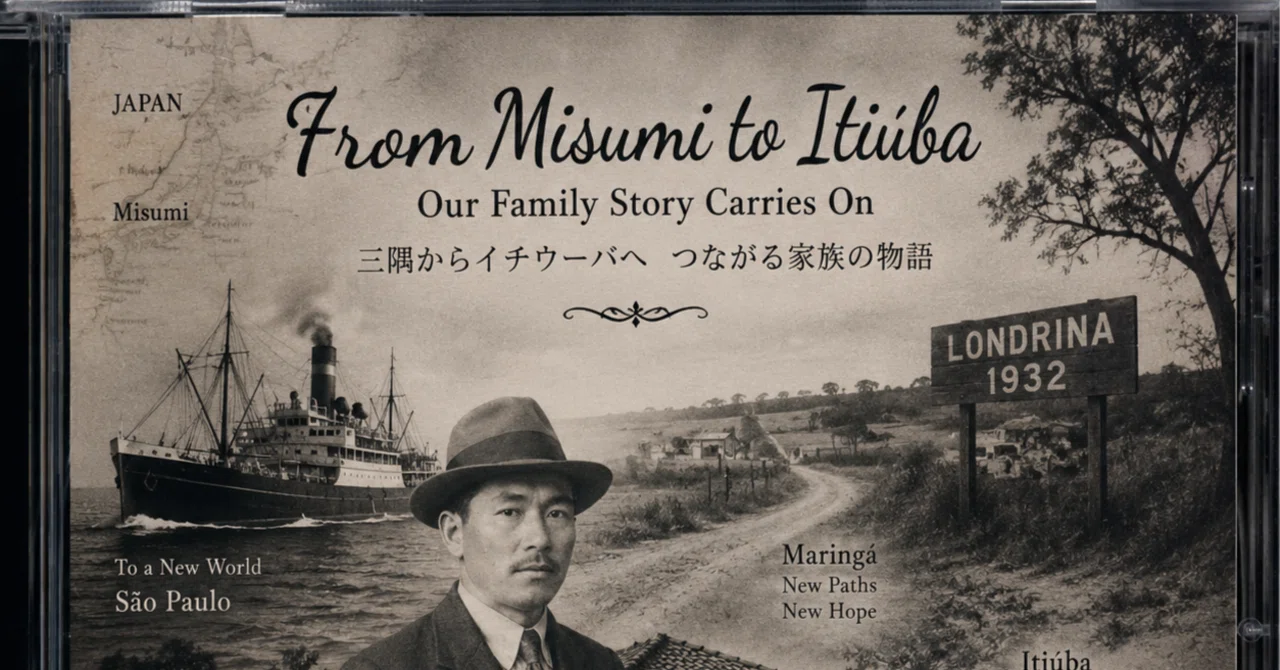
A TRANS-PACIFIC HISTORY OF MIGRATION, MEMORY, AND GRATITUDE

THE AGARI FAMILY:
A TRANS-PACIFIC HISTORY OF MIGRATION, MEMORY, AND GRATITUDE
From Medieval Nagato to the Modern Pacific World
A Historical and Genealogical Study of the Agari Family
Masashi Nakatani (Mountain Mouth Mercy)
Independent Researcher in Family History, Migration Studies, and Community Heritage
Abstract
The history of migration is often told through nations, governments, wars, and economic systems. Yet the true story of migration is ultimately the story of families.
This study examines the historical development of the Agari family, a lineage whose roots extend from medieval western Japan to the Philippines, the United States, Brazil, and contemporary Japan. Through genealogical records, local historical documents, oral traditions, migration narratives, and family memories, this paper reconstructs the movement of one family across nearly seven centuries of history.
The Agari family first appears in documented records in fourteenth-century Nagato Province. During the medieval period, members of the family served the Ōuchi clan and later entered the service of the Mōri clan. By the early modern era, the family had become deeply embedded within local administrative, agricultural, fishing, and maritime networks.
The twentieth century marked a dramatic transformation. Members of the family migrated to Davao in the Philippines, Stockton in California, and Londrina in Brazil. These migrations connected the Agari family to some of the most important movements in global Japanese migration history.
The present study argues that the Agari family represents a unique microcosm of Japanese migration history and demonstrates how family memory can illuminate broader patterns of trans-Pacific mobility, cultural adaptation, and intergenerational identity.
Chapter 1
Why Study One Family?
At first glance, the history of a single family may appear insignificant when compared to wars, revolutions, or international politics.
Yet historians increasingly recognize that large historical movements are experienced through individual lives.
Empires rise and fall.
Governments change.
Borders shift.
But families remain the primary vessels through which memory is transmitted.
The story of the Agari family is remarkable precisely because it intersects with many of the major historical currents that shaped modern Japan.
The family's history touches medieval feudal society, maritime trade, regional administration, overseas migration, colonial expansion, wartime displacement, postwar reconstruction, and contemporary globalization.
More importantly, it demonstrates how one family carried its identity across oceans while continuously adapting to new environments.
Chapter 2
The Medieval Origins of the Agari Family
Historical records preserved in Nagato City indicate that the Agari family was already established in the region by the fourteenth century.
The oldest surviving Agari family document dates to 1339.
This places the family within the turbulent era of the Northern and Southern Courts, one of the most complex periods in Japanese medieval history.
The Agari family emerged as local elites in the coastal district of Ohibi, near present-day Senzaki and Omijima.
According to local historical records, the first and second generations served the powerful Ōuchi clan.
The Ōuchi were among the most influential regional powers in western Japan, controlling trade routes linking Japan, Korea, and China.
To serve the Ōuchi clan was not merely to hold local authority.
It meant participation in an international maritime world.
Thus, from its earliest known history, the Agari family existed at the intersection of local community life and larger transregional networks.
Chapter 3
Agari Yoshiyo and the Fall of the Ōuchi Clan
One of the most dramatic moments in the family's history appears during the Tainei-ji Incident of 1551.
Following the rebellion of Sue Harukata, Lord Ōuchi Yoshitaka fled Yamaguchi and attempted to escape toward the Sea of Japan.
Historical accounts record that Agari Yoshiyo of Ohibi was ordered to secure vessels for Yoshitaka's escape.
Although the attempt ultimately failed, the episode reveals several important facts.
First, the Agari family possessed significant maritime resources.
Second, they occupied a position of trust within regional power structures.
Third, they stood at the crossroads of politics, transportation, and coastal society.
This event symbolizes a recurring pattern within Agari family history:
whenever historical change occurred, members of the family often found themselves near the center of transformation.
Chapter 4
From Nagato to Mine:
The Emergence of the Kama Branch
Family traditions and genealogical evidence suggest that a branch of the family eventually became established in Kama, present-day Mine City.
Although further documentary verification remains necessary, this branch would later become central to the family's global migration story.
The known lineage includes:
Kiyosaburo Agari (1818–) ↓
Masakichi Agari (1855–1905) ↓
Ichisuke Agari and Yoichi Agari
The lives of these brothers would fundamentally transform the geographic destiny of the family.
Chapter 5
Ichisuke Agari and the Philippine Frontier
Ichisuke Agari became part of the Japanese migration movement into Mindanao.
At the beginning of the twentieth century, Davao represented one of the most important destinations for Japanese migrants in Southeast Asia.
Japanese settlers participated in agriculture, trade, transportation, and plantation development.
Within this context, Ichisuke established roots in the Philippines.
His descendants became part of the broader Japanese-Filipino community that emerged in Davao.
This branch later connected with Bagobo indigenous ancestry, creating a unique cultural bridge between Japan and Mindanao.
The Agari story therefore became not merely a Japanese migration story, but a multicultural and transnational one.
Chapter 6
Yoichi Agari and the American Dream
While Ichisuke moved southward toward the Philippines, his brother Yoichi moved eastward across the Pacific.
Settling in California, Yoichi became part of the Japanese-American experience.
Records place him in the San Francisco Bay Area and later Stockton.
Stockton was one of the most important centers of Japanese-American agricultural life during the early twentieth century.
The descendants of Yoichi would continue their educational and professional achievements into the twenty-first century.
Their story reflects themes of adaptation, resilience, and upward mobility within the Japanese-American community.
Chapter 7
Shinkichi Agari and Brazil
Another branch of the broader Agari family story appears in Brazil.
Shinkichi Agari emigrated in 1913 and became associated with the development of Londrina and surrounding regions.
His life parallels the experiences of thousands of Japanese immigrants who transformed agricultural frontiers in South America.
Yet his achievements went beyond farming.
Historical materials indicate involvement in community development, land projects, and regional growth.
His story demonstrates how Japanese migrants helped shape modern Brazil while simultaneously preserving elements of their ancestral heritage.
Chapter 8
Women Who Carried the Family Forward
Traditional genealogy often focuses on surnames.
However, surnames change.
Life continues.
A maternal perspective reveals another dimension of history.
Shizue Agari ↓
Sachiko Yamashita ↓
Mitsuko Kase ↓
Ogoi
Through these women, one can trace connections between Japan, the Philippines, and indigenous Mindanao communities.
Their lives remind us that family history is not preserved solely through documents.
It is preserved through care, memory, sacrifice, and love.
The continuity of the family depended not only upon the men who migrated, but equally upon the women who sustained life across generations.
Chapter 9
Salvia Sachiko:
Memory as Historical Evidence
One of the most significant sources in this study is the family narrative preserved through the song "Salvia Sachiko."
The song is based on stories told by Minoru Agari, son of Ichisuke Agari.
It recounts the wartime experiences of Sachiko, who returned from the Philippines to Japan in 1944.
During the journey, her father died aboard the ship.
She arrived in Japan alone, facing uncertainty and loss.
Yet from this tragedy emerged a new family.
The story survived not through official archives, but through oral testimony and music.
In this sense, the song functions as a form of historical preservation.
It transforms memory into a living archive.
Conclusion
The history of the Agari family spans nearly seven centuries.
It begins in medieval Nagato.
It extends through Mine City.
It crosses the waters of the Pacific.
It reaches Davao, Stockton, and Londrina.
It survives war, migration, separation, and change.
Yet despite these transformations, one theme remains constant.
Gratitude.
Names change.
Countries change.
Languages change.
But gratitude remains.
The story of the Agari family ultimately teaches us that migration is not simply the movement of people.
It is the movement of memory.
It is the movement of hope.
And above all, it is the movement of human connection across generations, oceans, and time itself.
Gratitude, Thank You, and the Chain of Happiness
Yamaguchi Furusato Ambassador
Mountain Mouth Mercy
#AgariFamily #MigrationHistory #JapaneseDiaspora #FamilyHistory #Genealogy #Philippines #Brazil #Stockton #Yamaguchi #MountainMouthMercy
