
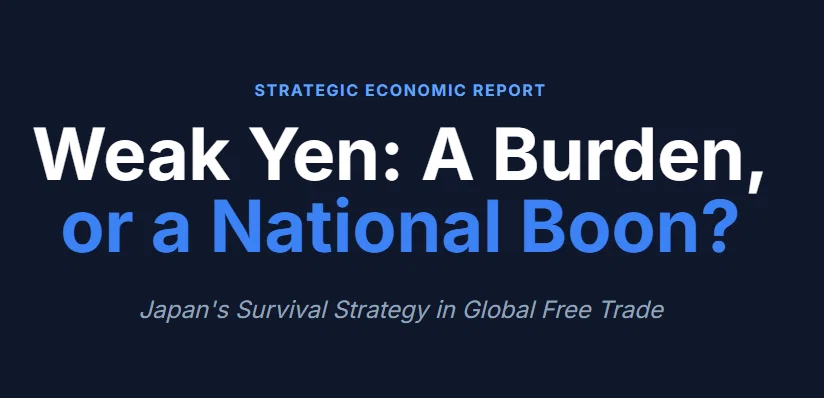
260124-Weak Yen: A Burden, or a National Boon?

#Gemini_Slides #English_Presentation #円安は国益
## Slides
## Speakers' notes
Speaker's Notes: The Case for a Weak Yen
Target Audience: British Professional (30s), 6-year Japan Resident. Tone: Analytical, provocative, and intellectually rigorous.
Slide 1: Introduction – The Great Currency Debate
Welcome, everyone. As someone who has lived in Japan for over six years, you’ve likely felt the "pain" of a weak Yen first-hand—perhaps when visiting family back in the UK or ordering something from overseas. However, today we are stepping away from the "consumer's eye view" and moving toward a Macroeconomic Survival Strategy.
The prevailing narrative in mainstream media often equates a "strong currency" with a "strong nation." It’s a psychological comfort, a vestige of the gold standard era where currency was a proxy for national pride. But in the cold, hard logic of global trade and industrial preservation, this pride can be a trap. We are here to argue that a Sovereign Devaluation isn't a sign of weakness; it is a calculated deployment of a national tool to protect the productive base of the country. Japan is currently at a crossroads, and the direction we choose regarding the Yen will determine whether we remain a tier-one industrial power or fade into a service-oriented museum of a nation.
Key Terms: Chapter 1
Sovereign Devaluation: The deliberate downward adjustment of a currency value by a government.
Purchasing Power Parity (PPP): A metric suggesting that exchange rates should adjust so that an identical basket of goods costs the same in different currencies.
Macroeconomic Survival: Prioritizing long-term industrial health over short-term consumer purchasing power.
Slide 2 & 3: The "Domestic-Led" Paradox
One of the most profound misunderstandings about Japan—even among those who live here—is the idea that Japan is an "Export Nation" like Germany or South Korea. Statistically, it is not. Japan is a Domestic-Led Economy, where the vast majority of GDP is generated by internal consumption. However, here lies the paradox: while exports are a small slice of the GDP pie, they are the High-Value Catalyst.
Think of the Japanese economy as a massive, high-performance engine. Domestic demand is the fuel, but the Global Manufacturing Sector is the spark plug. When the Yen is weak, these manufacturing giants—Toyota, Sony, Keyence—become hyper-competitive. They don't just sell more cars; they bring back massive "paper profits" when converting Dollars to Yen. These profits aren't just for shareholders; they fund the R&D, the infrastructure, and the high-wage jobs that eventually trickle down into the "domestic" side of the economy. If the spark plug fails because the Yen is too strong, the entire engine stalls, regardless of how much fuel (domestic demand) you have.
Diagram: The Catalyst Effect
[ Global Markets ] <----( Competitive Pricing via Weak Yen )---- [ Export Sector ]
                                                                       |
                                                               ( Profit Reinvestment )
                                                                       |
                                                                       v
[ Domestic Economy ] <---( Wage Growth & Infrastructure )--- [ R&D / Local Supply Chains ]
Key Terms: Chapters 2-3
Internal Consumption: Economic activity occurring within the borders, excluding exports.
Net Exports: The value of a country's total exports minus its total imports.
Economic Catalyst: A sector that triggers growth in other, larger sectors of the economy.
Slide 4 & 5: The Financial Mirage – Why Trade Doesn't Determine Forex
Now, let's address the elephant in the room: the "Technology = Strong Currency" Fallacy. You often hear that if Japanese technology is superior, the world will buy more products, demand more Yen, and the currency will rise. This is "Economic Text-book 101" from the 1970s. It is no longer true.
The modern reality is dominated by Hyper-Globalization and Capital Flows. The volume of "real" trade—buying a Toyota or a bag of rice—is a tiny fraction of the daily turnover in the Forex market. The market is ruled by Financial Arbitrage and the search for Yield (Carry Trade). Money is no longer a medium of exchange for goods; it is a commodity in itself. It moves from "Point A" to "Point B" simply because the interest rate is 0.5% higher there. When financial institutions talk about "fundamentals," they are often providing a sophisticated veneer to what is essentially a high-speed hunt for interest rate differentials. We must recognize that the Yen’s value is being manipulated by the logic of Finance Capital, which often runs counter to the needs of the Industrial Base.
Image Description: The Iceberg of Currency
Imagine an iceberg. The visible tip represents "Trade Transactions" (Real goods). The massive, submerged 90% represents "Financial Capital Flows" (Derivatives, Speculation, Interest Rate Arbitrage).
Key Terms: Chapters 4-5
Capital Flows: The movement of money for investment, trade, or business production.
Financial Arbitrage: The simultaneous purchase and sale of an asset to profit from a difference in the price.
Carry Trade: Borrowing in a low-interest currency (Yen) to invest in a higher-interest currency (Pound/Dollar).
Slide 6 & 7: The Geopolitical Game & Economic Security
Finally, we look at the historical and geopolitical context. We live in an era of Aggressive Devaluation as a tool of statecraft. Look at China. For decades, they have strategically suppressed the Yuan to maintain the "World's Factory" status. Japan once did the same during the "Economic Miracle" years.
The Western world—including the UK and the US—is finally waking up to the fact that "Pure Free Trade" was a mirage that allowed their industrial bases to be hollowed out. We are entering the era of Economic Security. It is no longer just about getting the cheapest smartphone; it is about ensuring your nation has the factories and the skills to build its own future. A weak Yen is a defensive shield. It makes it expensive to outsource and lucrative to "insource." It protects the "Made in Japan" brand not just as a luxury, but as a strategic asset. If we allow the Yen to strengthen too much, we are essentially inviting the hollowing out of our own nation for the sake of cheaper holidays.
Key Terms: Chapters 6-7
Economic Security: The ability of a nation to follow its own choice of policies to develop the national economy.
Industrial Hollowing: The process where manufacturing jobs move abroad, leaving a service-only economy.
Currency Devaluation: A tool of statecraft used to gain a competitive edge in global markets.
Key Takeaways
Prioritize Production over Consumption: A nation’s health is measured by what it can build, not just what it can buy.
Beware the Financial Veil: Understand that Forex rates are driven by the search for interest yield, not just "how good" a country is.
Weak Yen as a Shield: View currency devaluation as a strategic necessity to prevent industrial hollowing.
Inflation is a Tool: Moderate, Yen-driven inflation is the only way to break the psychological chains of a 15-year deflationary mindset.
Blog Tags
#Macroeconomics #JapanEconomy #WeakYen #CurrencyStrategy #EconomicSecurity #GlobalTrade #FinanceCapital #IndustrialPolicy
