2609A- Why Government Subsidies Still Matter Even When Taxes Rise

#economics #inflation #governmentpolicy #subsidy #taxes #japanEconomy #energyprices #foodprices #gdp #publicsupport
## Chiebukuro
本投稿は、「知恵袋」のQ&Aの内容をもとに、英語学習用に対話文を生成AIで生成したものです。
Please make a image from below sentence using color pallet, like light blue, light yellow, light grenn and gray, black.

# title
- Why Government Subsidies Still Matter Even When Taxes Rise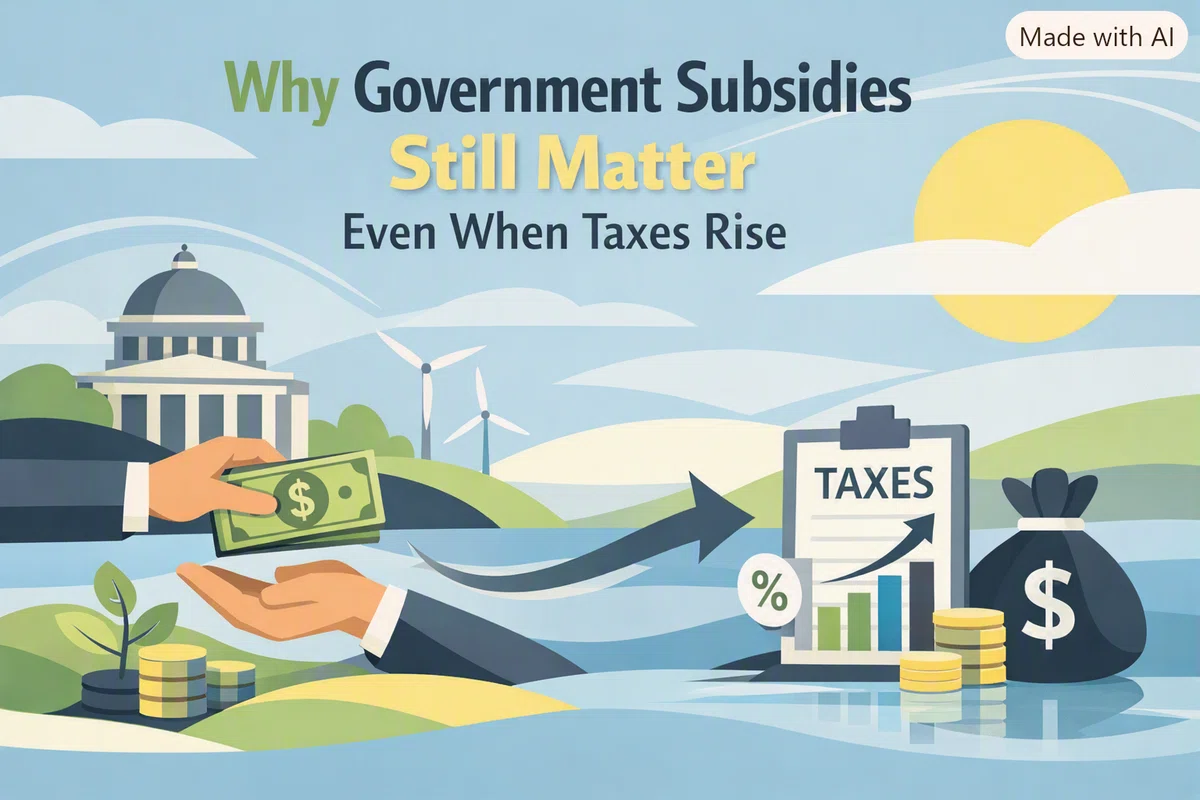
## A conversation
Please make a conversation over 200 terms in eacy English using below a Question and Answer for English bignner.

Role:
Jee: He is a economic teacher in high school.
Bie: She is curious about Economics.

---
## Question
-

## Answer
-
Below is a simple, clear, beginner‑friendly English conversation between Jee (teacher) and Bie (student). It is over 200 terms, uses easy vocabulary, and follows the meaning of your Question & Answer.
🌼 Conversation
Bie: Jee, I have a question. The government gives money for electricity and gasoline. They say it is “for the people” and “to control prices”. But if taxes go up because of this, is there any meaning?
Jee: That is a good question, Bie. Many people think the same. Let me explain slowly.
Bie: Yes, please. I want to understand.
Jee: First, electricity, gas, gasoline, and food are basic needs. Everyone uses them every day. When the prices of these things go up, low‑income people feel the biggest pain.
Bie: Because they already have little money, right?
Jee: Exactly. So the government tries to help them. For example, food prices sometimes rise by 4–5%, which is higher than the government’s target inflation rate of 2%. So the government sometimes reduces tax on food.
Bie: Oh, so tax goes down for food.
Jee: Yes. And for energy, like gasoline or electricity, the price goes up because of world problems, like trouble in the Middle East. Oil becomes expensive. So the government gives subsidies to keep the price stable.
Bie: I see. They want to stop big price jumps.
Jee: Right. The goal is economic stability. Since October 2022, Japan has had inflation. Because of inflation, the government now gets more tax revenue than ever before.
Bie: More tax money because prices go up?
Jee: Yes. When prices rise, the nominal GDP also rises. From 2020 to 2026, nominal GDP is expected to grow by 100 trillion yen.
Bie: Wow, that is a lot.
Jee: It is. And the tax system is simple: When nominal GDP increases, tax revenue also increases.
Bie: So the government gets more money automatically.
Jee: Exactly. And with that extra money, the government gives subsidies and tax cuts to help people.
Bie: So even if taxes rise, the government uses the extra money to support low‑income people?
Jee: Yes. That is the idea. The government is not trying to make life harder. They want to help people who suffer most from high prices.
Bie: Then it is not meaningless?
Jee: No, it is not meaningless. It is a cycle: Inflation → higher nominal GDP → higher tax revenue → government gives support → people get help.
Bie: Oh, now I understand. The government is returning the extra tax money to the people.
Jee: Exactly. That is why it is not a problem.
Bie: Thank you, Jee. Your explanation is very easy to understand.
Jee: I’m happy to hear that, Bie. Economics becomes simple when we talk step by step.
Bie: Yes, I want to learn more next time.
Jee: Anytime. I am always here to help you learn.
## Takeways
Please extract some useful expression from the conversation with detailed explanation and examples.Here are useful English expressions taken from the conversation, with easy explanations and clear example sentences. All examples are written in beginner‑friendly English and follow your structured learning style.
⭐ 1. “That is a good question.”
Meaning
A polite way to say the question is important or interesting.
Why it’s useful
Teachers and professionals often use this to show respect for someone’s question.
Examples
That is a good question. Many people think the same.
That is a good question. Let me explain step by step.
⭐ 2. “Let me explain slowly.”
Meaning
I will explain in a simple and clear way.
Why it’s useful
Shows kindness and helps beginners feel comfortable.
Examples
Let me explain slowly so you can understand.
Let me explain slowly because this topic is difficult.
⭐ 3. “Basic needs”
Meaning
Things people must have to live: food, water, electricity, gas.
Why it’s useful
Common in economics, social studies, and daily conversation.
Examples
Food and electricity are basic needs.
The price of basic needs is very important for families.
⭐ 4. “Low‑income people”
Meaning
People who earn little money.
Why it’s useful
Used often in news, economics, and government policy.
Examples
Low‑income people feel more pain when prices rise.
The government gives support to low‑income people.
⭐ 5. “Price goes up / price goes down”
Meaning
Price increases / price decreases.
Why it’s useful
Very common in daily life and economics.
Examples
The price of gasoline goes up because of world problems.
The price of food goes down when tax is reduced.
⭐ 6. “Keep the price stable”
Meaning
Stop the price from changing too much.
Why it’s useful
Used in economics, business, and government policy.
Examples
The government gives subsidies to keep the price stable.
We need to keep the price stable for customers.
⭐ 7. “Economic stability”
Meaning
A calm and steady economy without big changes.
Why it’s useful
A key term in economics and news.
Examples
The goal is economic stability.
Economic stability helps people feel safe.
⭐ 8. “Nominal GDP”
Meaning
GDP measured with current prices (not adjusted for inflation).
Why it’s useful
Important in economics and government reports.
Examples
Nominal GDP increases when prices rise.
Japan’s nominal GDP is expected to grow by 100 trillion yen.
⭐ 9. “Tax revenue”
Meaning
Money the government gets from taxes.
Why it’s useful
Used in economics, politics, and news.
Examples
Tax revenue increases when nominal GDP increases.
The government uses tax revenue to help people.
⭐ 10. “Step by step”
Meaning
Slowly and clearly, one part at a time.
Why it’s useful
Great for teaching, explaining, and learning.
Examples
Economics becomes simple when we talk step by step.
Let’s learn English step by step.
⭐ 11. “I see.”
Meaning
I understand.
Why it’s useful
A short, natural phrase used in conversation.
Examples
I see. They want to stop big price jumps.
I see. Now it makes sense.
⭐ 12. “Anytime.”
Meaning
I am always ready to help.
Why it’s useful
Friendly and natural in conversation.
Examples
Anytime. I am always here to help you learn.
If you have questions, ask me anytime.
いいなと思ったら応援しよう!
 Generative AIを使って何ができるかを実践しています。応援ありがとうございます。