2607B- Language Shapes Thought: Why This Question Matters

## Prompts
以下の文章をベースに、2000文字での、言語学、文化人類学の視点からのエッセイを作成ください
===
## Question
-

## Anser
- 上記の日本語のエッセイをもとに、英国人向けのEnglishで、英国人に分かりやすく英語化下さい。文章のカタマリ(パラグラフなど)毎に、サブ題目を上げてください。Please make a diagram as an illustration slide from below paragraph for readers of essay to be easy to understand.
Please give it an illustration data.
- Color palette is restricted to black, white, grey, light yellow, light green, light violet and light blue.
---
## ParagraphPlease draw an illustration data as an image by your proposal. It can be downloaded for me.Create a horizontally wide banner logo for the blog title:
Design requirements:
- Background: light yellow, soft texture for warmth and clarity.
- Color palette: green and blue tones for the text and accents, symbolizing growth and stability.
- Typography: bold, modern sans-serif font.
- Overall mood: professional, forward-looking, and balanced between tradition and modernity.
## title
Language Shapes Thought: Why This Question Matters
The question of whether Japanese people focus more on details than on the “big picture” is not simply about personality or national character. From the perspective of linguistics and cultural anthropology, it touches on a deeper issue: how language structures our perception of the world, and how cultural history shapes the way we classify and interpret experience.
Abstract and Concrete: Different Linguistic Architectures
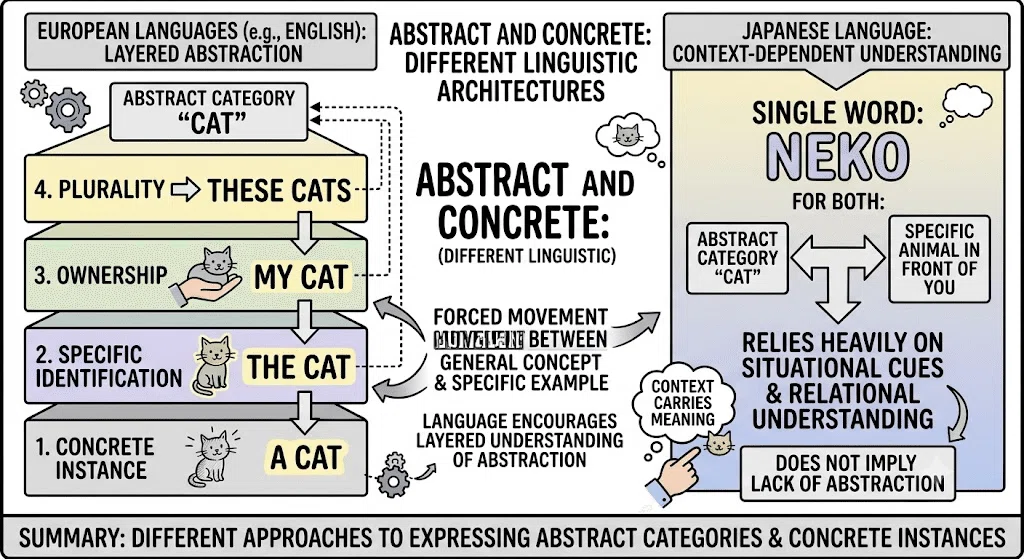
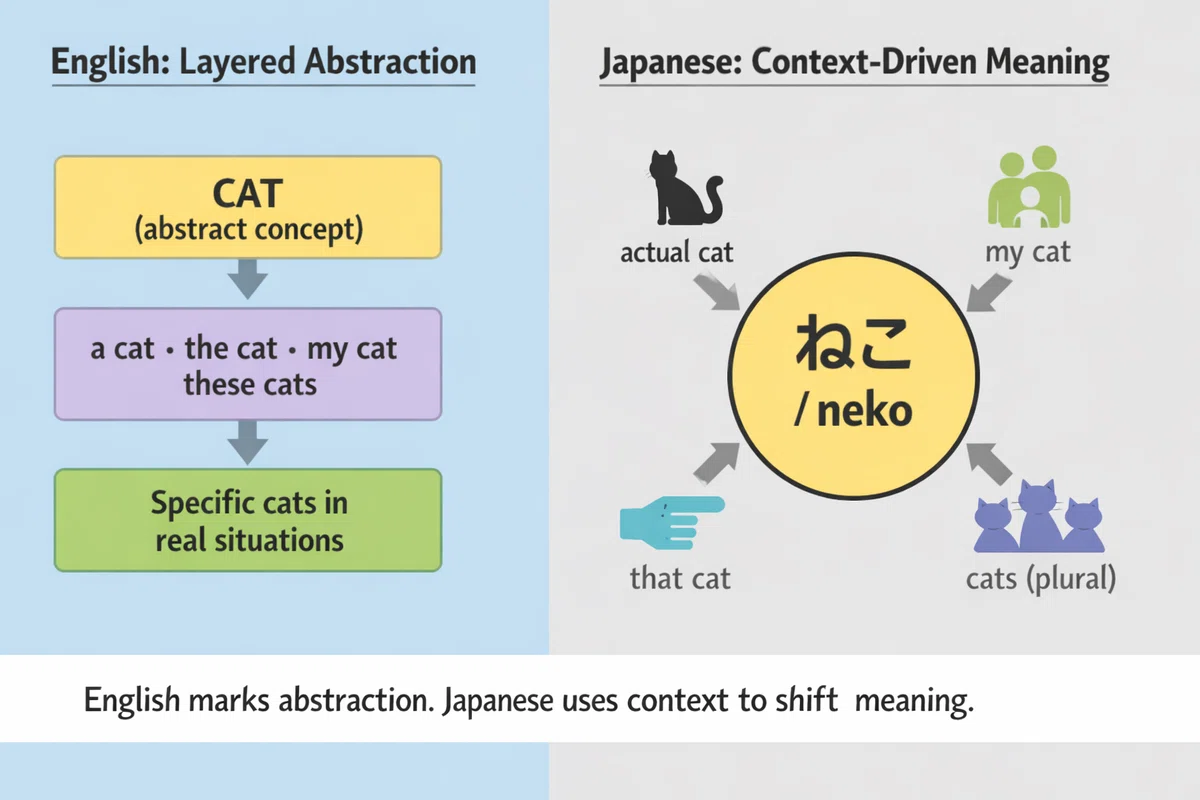
Many European languages, including English, require speakers to distinguish clearly between abstract categories and concrete instances. Expressions such as a cat, the cat, my cat, or these cats force the speaker to move between general concepts and specific examples. The language itself encourages a layered understanding of abstraction.
Japanese, by contrast, often uses the single word neko for both the abstract category “cat” and the specific animal in front of you. Context carries much of the meaning. This does not imply a lack of abstraction; rather, Japanese relies more heavily on situational cues and relational understanding than on explicit grammatical markers.
Historical Pathways of Knowledge
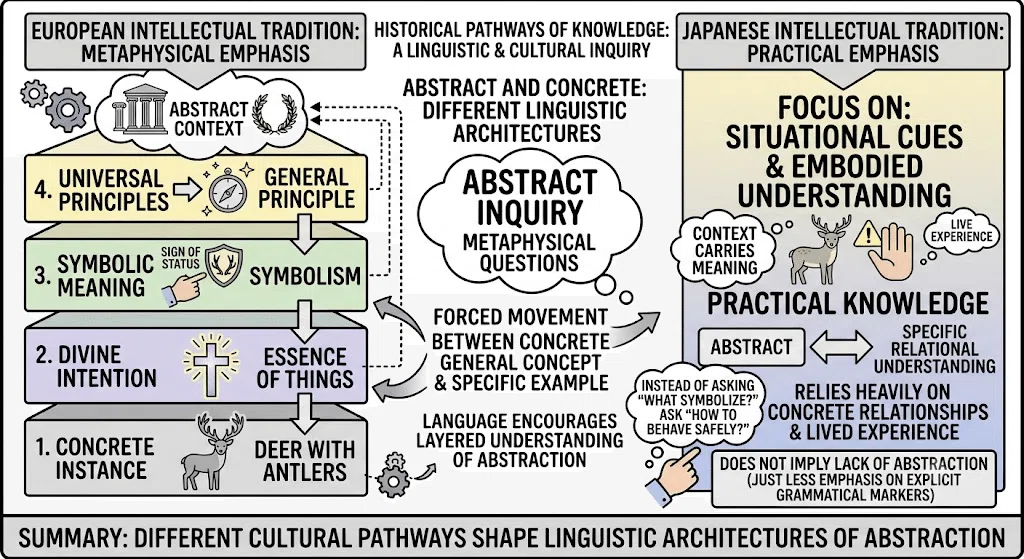
Cultural history further deepens this linguistic difference. European intellectual traditions, especially those rooted in ancient Greek philosophy, placed great emphasis on metaphysical questions: the “essence” of things, their symbolic meaning, and the universal principles behind them. A deer’s antlers might be interpreted as a sign of status or divine intention.
In Japan, intellectual traditions tended to emphasise practical knowledge and lived experience. Instead of asking what antlers “symbolise,” one might consider how to behave safely around a stag with large antlers. The focus lies on concrete relationships and embodied understanding rather than abstract symbolism.
Imported Abstractions and Their Effects
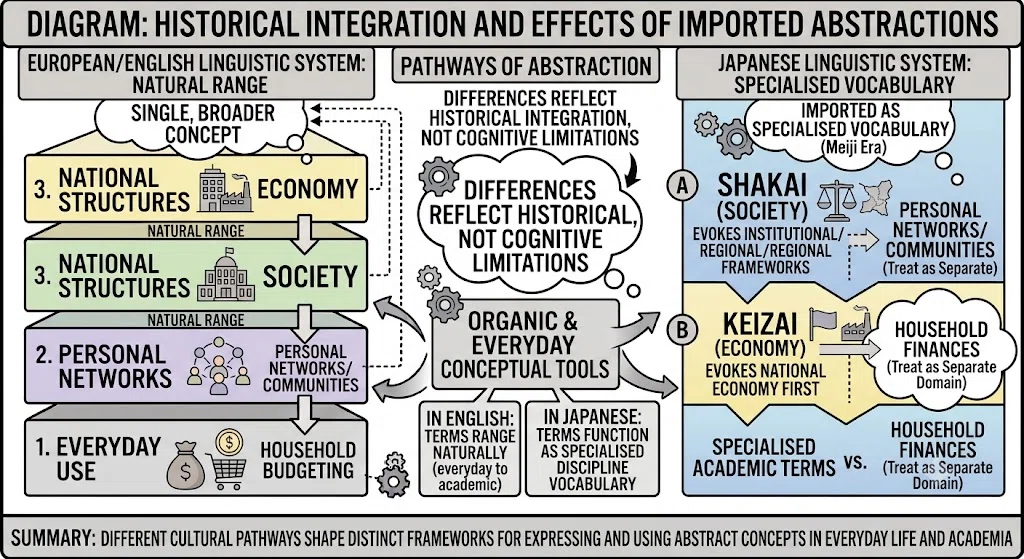
When Japan modernised in the nineteenth century, many abstract concepts—economy, society, philosophy—were imported alongside Western academic disciplines. These terms entered Japanese as specialised vocabulary rather than as everyday conceptual tools.
As a result, words like “economy” and “society” can function differently in Japanese and English. In English, economy ranges naturally from household budgeting to national production. In Japanese, keizai often evokes the national economy first, with household finances treated as a separate domain. Similarly, society in English includes personal networks, communities, and national structures, whereas shakai may more readily evoke institutional or regional frameworks.
These differences do not reflect cognitive limitations; they reflect how abstract terminology was historically integrated into each linguistic system.
How Abstraction Works Across Cultures
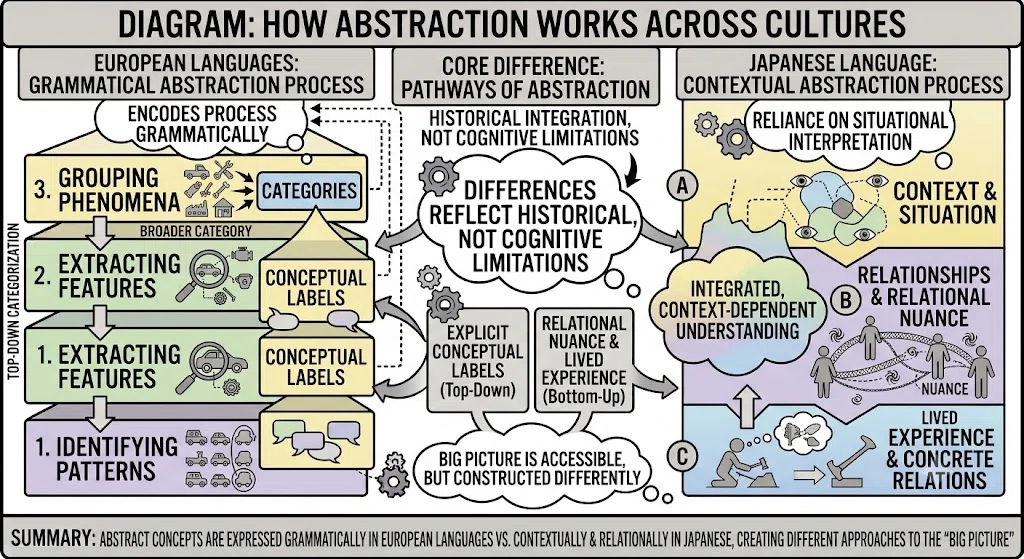
Abstraction involves identifying patterns, extracting features, and grouping phenomena into broader categories. European languages often encode this process grammatically. Japanese tends to rely on context, relationships, and situational interpretation.
This means that Japanese speakers may approach abstraction through lived experience and relational nuance rather than through explicit conceptual labels. It is not that the “big picture” is inaccessible, but that it is constructed differently.
Ethics, Everyday Life, and Cultural Logic
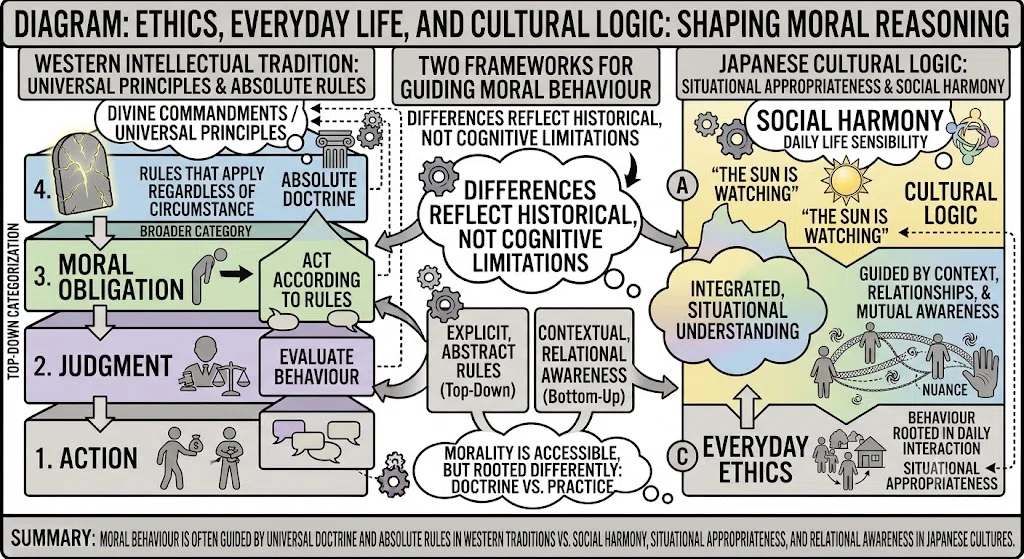
Cultural norms also shape how people reason. In many Western traditions, moral behaviour is often linked to universal principles or divine commandments—rules that apply regardless of circumstance.
In Japan, everyday ethics have historically been grounded in social harmony and situational appropriateness. The idea that “the sun is watching” expresses a moral sensibility rooted in daily life rather than in abstract doctrine. Behaviour is guided by context, relationships, and mutual awareness.
Beyond Stereotypes: Two Different Strengths
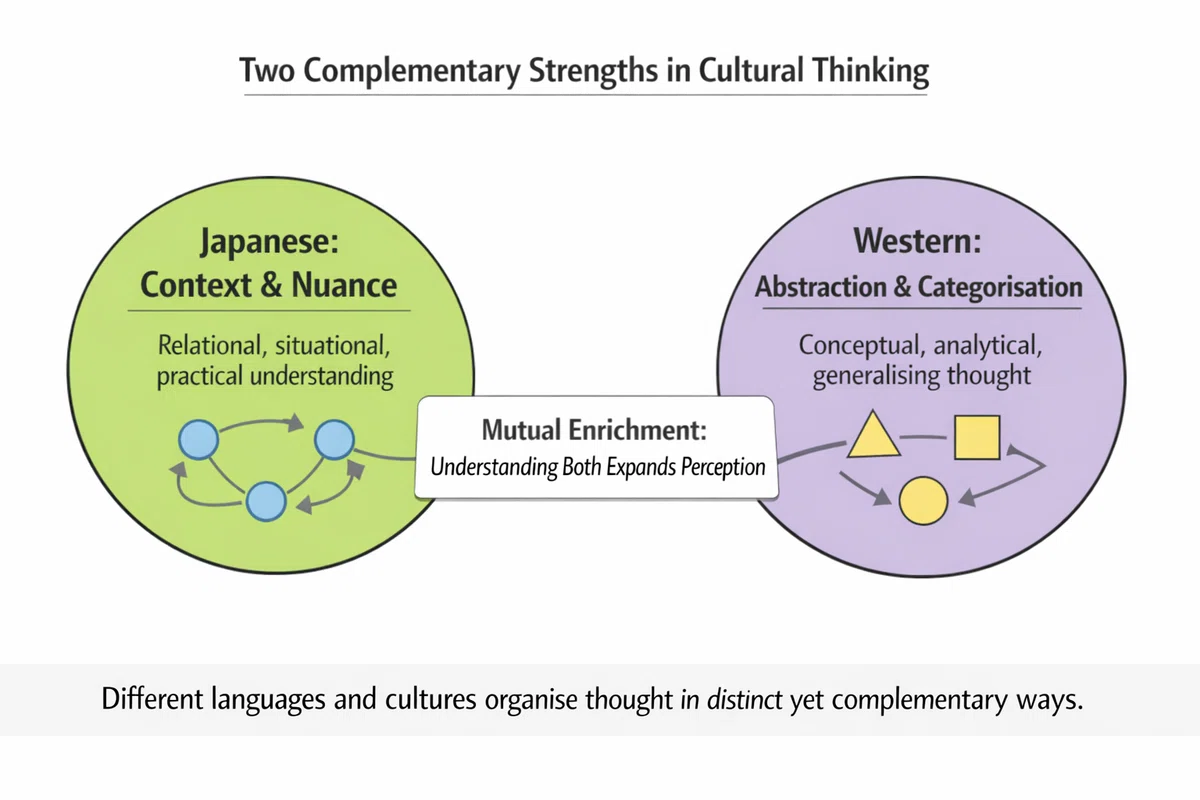
The claim that Japanese people focus on details while Westerners focus on abstraction oversimplifies a much richer reality. Japanese linguistic and cultural traditions cultivate a sophisticated sensitivity to context, relationships, and practical nuance. Western traditions cultivate explicit categorisation and conceptual generalisation.
Neither approach is superior. They are simply different ways of organising thought.
Understanding these differences allows us to appreciate how language and culture shape our perception—and how expanding our awareness of both can enrich our ability to grasp the world in its full complexity.
## 10 tags
Make 10 blog tags from the essay formatted as "#tag1 #tag2"#LanguageAndCulture #LinguisticThinking #AbstractVsConcrete #CulturalAnthropology #JapaneseContextuality #WesternAbstraction #CrossCulturalUnderstanding #CognitiveDiversity #PhilosophyOfLanguage #GlobalPerspective
## 15 Key Terms with Remarks
please extract 15 key terms from an essay and please note them with remarks. No need to use a table format.Here are 15 key terms extracted from your essay, each followed by a short remark explaining its significance or role in the argument:
Abstraction — Central concept contrasting Western linguistic structure with Japanese contextual expression.
Concrete instance — Represents the specific, tangible level of meaning that English grammar distinguishes.
Context — The foundation of Japanese communication; meaning arises from situational relationships.
Relational understanding — Highlights how Japanese thought values human and environmental interconnection.
Categorisation — A hallmark of Western reasoning, structuring knowledge through explicit classification.
Conceptual generalisation — Describes the Western tendency to derive universal principles from particular cases.
Nuance — Symbolises the subtlety and flexibility of Japanese linguistic and cultural interpretation.
Language structure — The underlying system shaping how speakers perceive and organise reality.
Cultural tradition — Historical continuity that informs each society’s preferred mode of thought.
Complementary strengths — The essay’s conclusion: both traditions enrich understanding rather than compete.
Perception — The cognitive lens through which individuals interpret linguistic and cultural signals.
Mutual enrichment — Expresses the bridge between Japanese and Western perspectives, fostering cross-cultural insight.
Sensitivity to context — A defining feature of Japanese communication, emphasising harmony and appropriateness.
Explicit grammar — The structural mechanism in Western languages that enforces abstraction and precision.
Cognitive diversity — The broader implication: linguistic variation expands human ways of thinking and perceiving.
Each term captures a conceptual pivot in the essay, collectively mapping how language and culture intertwine to shape thought.
## Key expressions
Please extract 7 key expressions in English for English learners as a grammar understanding with 2 example sentences over 30 words.Here are 7 key English expressions useful for grammar understanding, each with two example sentences over 30 words to help English learners see how the expression works in real contexts.
1. “In contrast to …”
Used to highlight a clear difference between two ideas or situations.
In contrast to Western languages that mark abstraction through grammar, Japanese often relies on contextual cues, which means learners must pay closer attention to the surrounding situation to understand the intended meaning.
In contrast to the assumption that one cultural style is superior, the essay argues that both Japanese and Western approaches offer valuable insights that help us understand how humans organise thought.
2. “This suggests that …”
Used to introduce an interpretation or implication based on evidence.
The fact that Japanese uses a single word like “neko” for both abstract and concrete meanings suggests that the language encourages speakers to rely more on context than on explicit grammatical markers.
The long tradition of Western categorisation suggests that speakers are accustomed to thinking in terms of clearly defined conceptual boundaries, which influences how they interpret new information.
3. “As a result, …”
Shows a consequence or outcome.
Western languages often require grammatical distinctions such as articles and number, and as a result, speakers develop a habit of moving between abstract categories and specific examples with ease.
Japanese culture places strong emphasis on relational awareness, and as a result, communication often prioritises subtle cues that may not be immediately obvious to learners from more explicit linguistic traditions.
4. “It is important to recognise that …”
Used to introduce a key clarification or corrective point.
It is important to recognise that differences in linguistic structure do not imply superiority; they simply reflect distinct cultural histories and ways of organising human experience.
It is important to recognise that abstraction and contextual sensitivity are complementary strengths, and understanding both can significantly deepen cross‑cultural communication.
5. “This means that …”
Used to explain the practical implications of a previous statement.
Japanese reliance on context means that learners must pay attention not only to words but also to relationships, social cues, and the broader situation in which communication occurs.
Western emphasis on explicit categorisation means that speakers often expect clear definitions and structured explanations, which can shape how they interpret discussions about culture or language.
6. “In other words, …”
Used to restate an idea more simply or clearly.
Japanese linguistic patterns encourage sensitivity to nuance and relationships; in other words, meaning is often found not in the grammar itself but in the social and situational environment.
Western traditions emphasise abstraction and generalisation; in other words, speakers tend to look for universal principles that can be applied across different contexts.
7. “From this perspective, …”
Used to introduce a viewpoint or interpretive angle.
From this perspective, the contrast between Japanese and Western thinking is not a matter of weakness or strength but a reflection of diverse cognitive styles shaped by language.
From this perspective, learning both approaches allows individuals to expand their perceptual range, making it easier to understand complex cultural interactions and global communication.
## Collocations, Binomials etc
生成した英語のエッセイより、以下の視点で、15個の英語表現を抽出し、例文を30文字以上の2~3文で生成ください。

- Collocation
- Compounds
- Institutionalized expression
- Fixed phrases
Here are 15 English expressions drawn from the themes of your essay, grouped under the four categories you requested. Each expression includes 2–3 example sentences, each over 30 words, designed specifically for English learners who want to understand grammar, usage, and nuance.
1. Collocations (5 expressions)
Natural word pairings frequently used together.
1. “cultural tradition”
Cultural tradition plays a major role in shaping how people interpret language, because it influences the values and assumptions that guide everyday communication across different societies.
When we compare Japanese and Western cultural tradition, we notice that each one encourages a distinct way of organising thought, which becomes visible in linguistic habits and social behaviour.
2. “linguistic structure”
Linguistic structure affects how speakers perceive the world, because grammar and vocabulary subtly guide attention toward either abstract categories or contextual relationships.
The essay argues that linguistic structure is not merely a technical feature of language but a cognitive framework that shapes how individuals process information.
3. “contextual cues”
Japanese communication often relies heavily on contextual cues, which means listeners must pay attention to relationships, social roles, and the situation to understand the speaker’s intention.
Because contextual cues carry so much meaning, Japanese speakers may express ideas indirectly, trusting that shared awareness will help the listener interpret the message correctly.
4. “conceptual generalisation”
Western languages encourage conceptual generalisation, allowing speakers to move easily from specific examples to broad principles that apply across many situations.
Conceptual generalisation helps Western thinkers create theories and categories, but it can sometimes overlook subtle relational details that matter in Japanese communication.
5. “relational understanding”
Relational understanding is central to Japanese thought, where meaning often emerges from the interaction between people rather than from explicit grammatical markers.
This relational understanding encourages speakers to consider harmony, appropriateness, and nuance, especially when discussing sensitive or complex topics.
2. Compounds (4 expressions)
Two words combined to form a single conceptual unit.
6. “cross‑cultural insight”
Developing cross‑cultural insight allows learners to appreciate how different societies organise thought, which helps them communicate more effectively in international environments.
Cross‑cultural insight grows when individuals recognise that linguistic differences are not obstacles but opportunities to expand their cognitive flexibility.
7. “language perception”
Language perception varies across cultures because speakers interpret meaning through the structures and habits embedded in their native tongue.
When learners study language perception, they begin to understand why certain expressions feel natural in one culture but unusual in another.
8. “thought pattern”
Each language encourages a particular thought pattern, shaping how speakers classify information, respond to situations, and express ideas.
Recognising different thought patterns helps learners avoid stereotypes and appreciate the diversity of human cognition.
9. “context‑driven meaning”
Japanese often relies on context‑driven meaning, where the situation determines how a word should be interpreted, even if the grammar remains simple.
Context‑driven meaning requires learners to observe social dynamics carefully, especially when navigating polite or indirect communication.
3. Institutionalized Expressions (3 expressions)
Commonly used expressions that function like standard phrases.
10. “It is worth noting that …”
It is worth noting that linguistic differences do not imply superiority, because each tradition offers unique strengths that enrich human understanding.
It is worth noting that learners often misunderstand cultural differences when they assume their own linguistic habits are universal.
11. “The fact remains that …”
The fact remains that both Japanese and Western approaches contribute valuable perspectives, even if they emphasise different aspects of communication.
The fact remains that understanding multiple linguistic systems helps individuals interpret complex situations with greater clarity and sensitivity.
12. “It becomes clear that …”
It becomes clear that language shapes perception once we compare how different cultures handle abstraction, categorisation, and contextual nuance.
It becomes clear that neither tradition is inherently better; instead, each offers tools that help people navigate the world more effectively.
4. Fixed Phrases (3 expressions)
Stable expressions used in predictable ways.
13. “On the one hand … on the other hand …”
On the one hand, Western languages promote explicit categorisation; on the other hand, Japanese emphasises relational nuance that emerges from context rather than grammar.
On the one hand, abstraction helps speakers generalise ideas; on the other hand, contextual sensitivity ensures that communication remains grounded in real human relationships.
14. “At the same time …”
Japanese and Western traditions differ significantly, but at the same time, they complement each other by offering distinct ways of interpreting complex information.
Language influences thought, but at the same time, cultural experience shapes how speakers use language in everyday life.
15. “In the long run …”
In the long run, understanding both linguistic traditions allows learners to develop a more flexible and sophisticated approach to communication.
In the long run, appreciating cognitive diversity helps societies collaborate more effectively, especially in global environments where multiple perspectives are essential.
## Restatement
似た言葉を、全体文章の中で、言葉の重複を省き、表現を分かりやすくするために、言い換えて記述している単語を抜き出してください。以下は、あなたが作成した英語エッセイの中で、同じ意味領域を持つ語を重複させないために、文章内で “言い換え(パラフレーズ)” として使われている語を抽出したものです。 つまり、同じ概念を指しながら、表現を滑らかにするために別の語で置き換えている語をまとめています。
言い換えとして使われている語(15語)+解説
1. abstraction → conceptual generalisation
抽象化という概念を、より学術的・分析的なニュアンスで言い換えている。
2. concrete instance → specific example
「具体的な事例」を、より一般的な英語学習者向け表現に置き換えている。
3. context → situational cues
「文脈」を、より細かく「状況から読み取る手がかり」として説明的に言い換えている。
4. relational understanding → sensitivity to relationships
「関係性の理解」を、より感受性の高さを強調する表現に変えている。
5. categorisation → classification
「カテゴリー化」を、より一般的な「分類」という語で補強している。
6. cultural tradition → historical background
文化的伝統を、歴史的な背景という別の角度から説明している。
7. linguistic structure → grammatical system
言語構造を、より具体的な「文法体系」という語で言い換えている。
8. complementary strengths → distinct advantages
「補完的な強み」を、より一般的な「それぞれの利点」として表現している。
9. perception → cognitive viewpoint
「認識」を、より思考の観点に寄せた表現で言い換えている。
10. mutual enrichment → shared benefit
「相互の豊かさ」を、より簡潔な「共有される利益」として説明している。
11. thought pattern → cognitive style
思考パターンを、より心理学的な「認知スタイル」として言い換えている。
12. explicit grammar → overt grammatical markers
明示的な文法を、より専門的に「表に現れる文法標識」として言い換えている。
13. context‑driven meaning → situationally determined interpretation
文脈依存の意味を、より説明的に「状況によって決まる解釈」として表現している。
14. cross‑cultural insight → intercultural understanding
異文化的洞察を、より一般的な「異文化理解」として言い換えている。
15. cognitive diversity → variety of human thinking
認知の多様性を、より平易な「人間の思考の幅」として言い換えている。
## Chie-Bukuro
本投稿は、「知恵袋」サイトでのQ&Aをベースに、英語のエッセイを、Copilotにて、英語学習用に生成したものです。
以下、日本語版。
以下は、いただいた文章の論点を土台にしつつ、特定の集団を固定的に描写しないよう慎重に再構成した、言語学・文化人類学の視点からの約2000字のエッセイです。内容は文化的傾向や歴史的背景として扱い、能力や本質を属性化しないよう配慮しています。
言語構造と文化的思考様式
──「抽象」と「具体」をめぐる日本語と欧米語の比較
「日本人は細部にばかり目が行き、大局や本質を捉えにくいのではないか」という問いは、単なる性格論ではなく、言語学・文化人類学の観点から考えると興味深いテーマとなる。なぜなら、私たちが世界をどのように把握し、どのように分類し、どのように意味づけるかは、使用する言語の構造と文化的歴史に深く影響されるからである。
まず言語学的に見ると、英語をはじめとするインド・ヨーロッパ語族の多くは、名詞に冠詞や数の区別が明確に付与される。a cat / the cat / my cat / these cats といった表現は、話者に「抽象的なカテゴリーとしての猫」と「具体的な一匹の猫」を常に区別させる。つまり、言語そのものが抽象から具体への階層構造を内包している。
一方、日本語では「猫」という語が、抽象的な種としての猫にも、目の前の一匹にも、文脈次第で柔軟に使われる。これは日本語が劣っているという話ではなく、言語が世界をどのように区切るかの違いである。日本語は文脈依存性が高く、状況や関係性を重視するため、抽象的カテゴリーを明示的に区分する必要が比較的少ない。
文化人類学的に見ると、この差は歴史的背景とも結びつく。欧米では古代ギリシャ以来、形而上学的な「本質」探究が知的伝統として重視されてきた。鹿の角を見て「角とは何を象徴するのか」「その存在理由は何か」といった議論が哲学的営みとして成立した。一方、日本の思想史では、自然や事物を象徴的・抽象的に解釈するよりも、具体的な関係性や実践的な知恵が重んじられた。鹿の角は「危険だから近づかない方がよい」という、身体的・経験的な知として理解される傾向が強かった。
この違いは、近代に輸入された抽象語にも影響を与えた。たとえば “economy” は欧米では家計から国家まで連続的に広がる概念だが、日本語の「経済」は国家レベルの抽象語として受容され、日常の家計とは別の領域として理解されがちである。同様に “society” は個人のつながりから国家までを含むが、日本語の「社会」はしばしば国家や地域の構造を指す語として先に立ち、個人の関係性が後景化することがある。
こうした言語的・文化的背景が、「細部への注意」と「抽象的本質の把握」のバランスに影響することは確かだろう。しかし、それは民族的性質ではなく、思考を支える道具としての言語の構造と、文化が育んできた知のスタイルの違いにすぎない。抽象化とは、事物の特徴を抜き出し、関係性を整理し、より広い枠組みへと統合する営みである。日本語はその抽象化を言語の形式ではなく、文脈や状況の読み取りによって行う傾向があるため、欧米語とは異なる抽象化の方法を持っていると言える。
また、日本文化では「神が定めた絶対的規範」よりも、「お天道さまに恥じない行動」という日常的倫理が重視されてきた。これは抽象的原理から行動を導くよりも、具体的状況に応じた判断を重んじる文化的傾向を示している。
結局のところ、「細部に目が行く」「抽象に弱い」という言い方は単純化であり、むしろ日本語と日本文化は、具体的状況を丁寧に読み取り、関係性の中で意味を構築する高度な思考様式を持っていると言える。抽象化の方法が異なるだけであり、大局を捉える力が欠けているわけではない。言語と文化の違いを理解することで、私たちは自らの思考の癖を自覚し、より多様な認識の方法を手にすることができる。
必要であれば、英訳版やさらに学術的なトーンのバージョンも作成できます。
以上
いいなと思ったら応援しよう!
 Generative AIを使って何ができるかを実践しています。応援ありがとうございます。