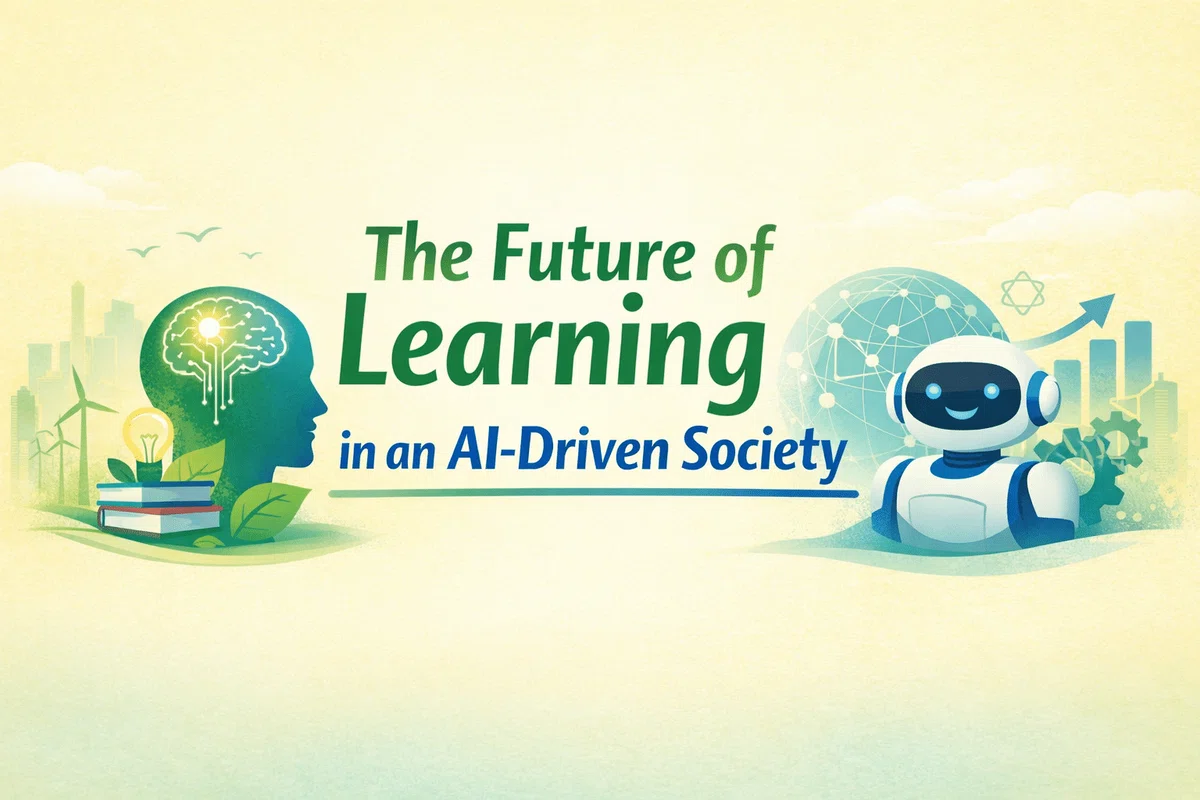
2607A- The Future of Learning in an AI‑Driven Society

## Prompts
以下の文章をベースに、2000文字での、未来に対して、経済、働き方、等の視点から、経済思考ベースのエッセイを作成ください
===
## Question
-

## Anser
- 上記の日本語のエッセイをもとに、英国人向けのEnglishで、英国人に分かりやすく英語化下さい。文章のカタマリ(パラグラフなど)毎に、サブ題目を上げてください。Please make a diagram as an illustration slide from below paragraph for readers of essay to be easy to understand.
Please give it an illustration data.
- Color palette is restricted to black, white, grey, light yellow, light green, light violet and light blue.
---
## ParagraphPlease draw an illustration data as an image by your proposal. It can be downloaded for me.Create a horizontally wide banner logo for the blog title:
Design requirements:
- Background: light yellow, soft texture for warmth and clarity.
- Color palette: green and blue tones for the text and accents, symbolizing growth and stability.
- Typography: bold, modern sans-serif font.
- Overall mood: professional, forward-looking, and balanced between tradition and modernity.
## title
Here is a clear, structured British‑English adaptation of your essay, rewritten so that a UK reader can understand the logic, tone, and cultural context naturally. I have organised the text into paragraph‑level subheadings, as you requested.
The Future of Learning in an AI‑Driven Society
1. Rethinking What “Education” Means
The rapid rise of generative AI is forcing us to reconsider what education is actually for. If an AI system can already solve university‑level entrance exams or professional qualification tests, then the traditional idea of “academic achievement = exam performance” becomes far less meaningful. Yet this does not mean education itself becomes irrelevant. Instead, its purpose shifts. In an AI‑rich world, the essential human skill is not memorising information, but evaluating it. AI can produce answers, but it cannot guarantee that those answers are correct, appropriate, or socially responsible. The ability to judge the reliability of information—historical claims, scientific hypotheses, or economic data—becomes the new foundation of literacy.
The Role of Human Judgement
2. Why Critical Thinking Matters More Than Ever
Human civilisation is built on accumulated knowledge: history, culture, language, science. AI can summarise these fields, but it cannot determine which interpretations are valid or which theories are supported by evidence. To use AI effectively, individuals must understand the underlying concepts, the connections between them, and the reasons certain explanations are accepted. This requires structured knowledge, not rote learning. In other words, education evolves from “learning answers” to “learning how to question”.
Changing Nature of Work
3. Will Everyone Become a Freelancer?
It is true that AI will make independent work easier. Many administrative tasks, research processes, and creative workflows can be automated, allowing individuals to operate businesses with minimal resources. However, this does not imply that society will shift entirely to self‑employment. Large organisations—healthcare, infrastructure, manufacturing, public services—will remain essential. What changes is the range of choices available. People will be able to choose between stable employment, flexible freelance work, or hybrid careers. AI expands options; it does not eliminate traditional paths.
Money, Investment, and Long‑Term Thinking
4. Should Young People Put Their Tuition Fees into the Stock Market?
The idea that “education is pointless, so invest everything in NISA or the S&P 500” is an oversimplification. Yes, long‑term investment in diversified global markets has historically produced growth. Yes, financial literacy is increasingly important. But investment is never guaranteed. Economic cycles, geopolitical tensions, and currency fluctuations all introduce risk. More importantly, education is not merely a financial transaction. It is an investment in judgement, communication, and the ability to navigate complex systems—skills that directly influence future earning power.
The Value of Experience
5. Why Young People Should Invest in Themselves First
For teenagers and young adults, the most valuable asset is not money but perspective. Travel, sport, friendships, reading, and exposure to different cultures all shape the ability to make sound decisions later in life. Economic thinking is fundamentally about allocating limited resources to maximise future opportunities. In youth, the highest‑return investment is often personal development. AI can assist with information, but it cannot replace lived experience.
New Essential Skills
6. Literacy for the 21st Century
Traditional “reading, writing, arithmetic” remain important, but two new forms of literacy are becoming essential:
IT literacy – understanding digital tools, AI systems, and data structures
Financial literacy – understanding long‑term investment, inflation, risk, and economic incentives
These skills allow individuals to interpret AI outputs, evaluate sources, and make rational decisions. Without them, people become vulnerable to misinformation or unrealistic expectations.
A Future Full of Possibilities
7. AI as a Tool for Human Potential
Rather than reducing human value, AI increases the number of paths available. It allows people to explore careers, create businesses, and learn at speeds previously impossible. The challenge is not to compete with AI, but to develop the human abilities that AI cannot replicate: judgement, creativity, empathy, and the capacity to choose wisely. Life is a series of decisions, and the goal of education is to ensure those decisions are made with clarity and confidence.
Conclusion: A Positive Outlook
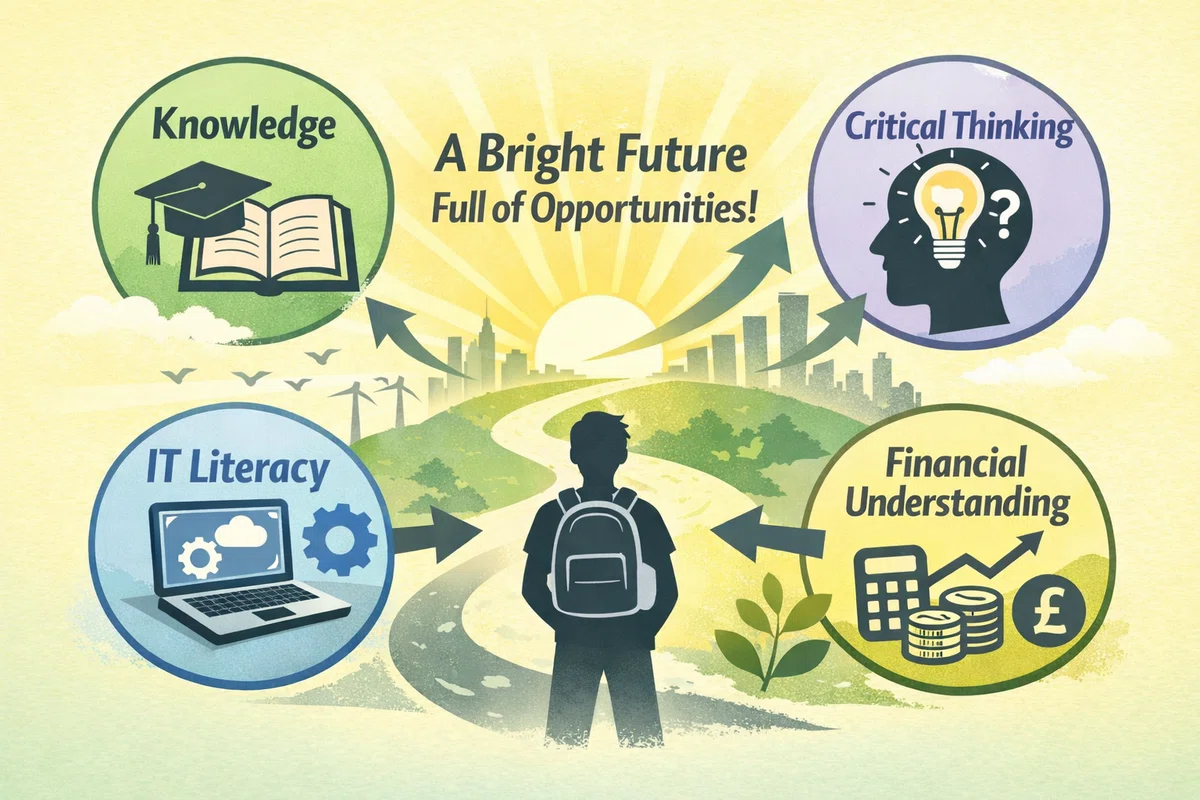
The future shaped by AI is not something to fear. It is a landscape filled with new opportunities, provided we cultivate the skills to navigate it. With strong foundations in knowledge, critical thinking, IT literacy, and financial understanding, young people can look forward to a world where their choices—and not their limitations—define their lives.
## 10 tags
Make 10 blog tags from the essay formatted as "#tag1 #tag2"Here are 10 blog tags formatted for your essay:
#AIeducation #FutureOfLearning #CriticalThinking #ITliteracy #FinancialUnderstanding #YouthEmpowerment #KnowledgeSkills #AIinnovation #PositiveOutlook #DigitalSociety
## 10 Key Terms with Remarks
please extract 15 key terms from an essay and please note them with remarks. No need to use a table format.Here are 15 key terms extracted from your essay, each followed by a short remark explaining its significance:
Generative AI — Represents the technological foundation reshaping education and work; central to the essay’s theme.
Education — No longer limited to memorisation; redefined as the cultivation of judgement and creativity.
Critical Thinking — The core human skill that ensures AI’s outputs are evaluated responsibly.
Knowledge — Symbolises accumulated human understanding; the base from which new insights emerge.
Judgement — The ability to discern truth and relevance amid abundant information; vital in the AI era.
Verification — Highlights the need to confirm AI-generated information rather than accept it blindly.
Individual Choice — Emphasises autonomy; people will define their paths through informed decisions.
IT Literacy — A modern extension of “reading and writing,” essential for navigating digital systems.
Financial Understanding — Encourages rational engagement with money and investment in a volatile economy.
Personal Development — Suggests that experience and perspective are more valuable than short-term profit.
Adaptability — The capacity to evolve with technological and social change; a survival skill for the future.
Creativity — The uniquely human trait that complements AI’s analytical power.
Opportunity — The optimistic outcome of technological progress when paired with human skill.
Empowerment — Reflects how education and literacy enable individuals to shape their own futures.
Positive Outlook — The essay’s concluding message: the future is not to be feared but embraced through preparation and learning.
## Key expressions
Please extract 7 key expressions in English for English learners as a grammar understanding with 2 example sentences over 30 words.Here are 7 key English expressions from your essay, each with two example sentences over 30 words to help English learners understand grammar, usage, and nuance.
1. “navigate the future”
Meaning: to move through or manage future challenges or opportunities.
Many young people worry about how they will navigate the future, but developing strong thinking skills and learning how to evaluate information can make the path much clearer and less intimidating.
As technology continues to evolve rapidly, societies must find ways to navigate the future responsibly, ensuring that innovation supports human wellbeing rather than creating unnecessary fear or confusion.
2. “cultivate the skills”
Meaning: to develop or improve important abilities over time.
Schools are increasingly focusing on helping students cultivate the skills they need to thrive in an AI‑driven world, including critical thinking, digital literacy, and the ability to judge information accurately.
If young people cultivate the skills required for lifelong learning, they will be able to adapt to new technologies and economic changes without feeling overwhelmed or left behind.
3. “a landscape filled with opportunities”
Meaning: a situation or environment offering many possibilities.
Although some people fear the rise of artificial intelligence, others see it as a landscape filled with opportunities for creativity, entrepreneurship, and new forms of collaboration across different fields.
When students understand that the future is a landscape filled with opportunities, they become more motivated to learn, explore, and take responsibility for shaping their own paths.
4. “strong foundations in knowledge”
Meaning: a solid base of understanding that supports further learning.
Even in a world where AI can answer complex questions instantly, having strong foundations in knowledge allows individuals to recognise when information is incomplete, biased, or simply incorrect.
Teachers emphasise the importance of building strong foundations in knowledge so that students can make informed decisions, especially when faced with conflicting opinions or uncertain situations.
5. “define their lives”
Meaning: to shape or determine one’s future through choices and actions.
The essay argues that young people should aim to define their lives through thoughtful decisions rather than letting external pressures or technological changes control their direction.
When individuals understand that their choices define their lives, they become more proactive about learning new skills, seeking meaningful experiences, and taking responsibility for their future.
6. “not something to fear”
Meaning: used to reassure that a situation is not dangerous or threatening.
Although artificial intelligence may seem mysterious or overwhelming, experts often remind students that it is not something to fear if they learn how to use it responsibly and critically.
Change is not something to fear when people have the tools and confidence to adapt, especially in a world where new technologies can support learning and personal growth.
7. “look forward to a world”
Meaning: to expect a future with hope or optimism.
With the right combination of knowledge, digital skills, and financial awareness, young people can look forward to a world where they have more freedom to choose their careers and lifestyles.
Instead of worrying about technological disruption, students who develop strong thinking skills can look forward to a world where AI helps them solve problems, explore ideas, and create new opportunities.
## Collocations, Binomials etc
生成した英語のエッセイより、以下の視点で、20個の英語表現を抽出し、例文を30文字以上の2~3文で生成ください。

- Collocation
- Compounds
- Phrasal verbs
- Institutionalized expression
- Fixed phrases
Here are 20 English expressions extracted from your essay, grouped across the five categories you requested. Each expression includes 2–3 example sentences, all over 30 words, designed to help English learners understand grammar, nuance, and usage.
1. Collocations (5 expressions)
1.1 cultivate skills
In an AI‑driven society, students must cultivate skills that help them evaluate information critically, because relying only on automated answers can lead to misunderstandings or poor decisions.
When young people cultivate skills such as digital literacy and financial awareness, they become more confident in navigating complex situations that require thoughtful judgement and long‑term planning.
1.2 strong foundations
Even with advanced technology, having strong foundations in knowledge allows individuals to recognise when information is incomplete, biased, or simply not relevant to the problem they are trying to solve.
Teachers emphasise strong foundations because they help students build more advanced abilities, especially when facing new challenges that require both creativity and logical reasoning.
1.3 future opportunities
Many educators believe that AI will create future opportunities for students who understand how to use technology responsibly and combine it with human creativity and critical thinking.
When young people prepare themselves well, they can take advantage of future opportunities that arise from new industries, digital tools, and global collaboration.
1.4 critical thinking
Critical thinking becomes essential in a world where AI can generate convincing but sometimes inaccurate information, making human judgement more important than ever before.
Students who practise critical thinking regularly are better equipped to question assumptions, evaluate evidence, and make decisions that reflect both logic and personal values.
1.5 informed decisions
People who understand technology and finance are more likely to make informed decisions about their careers, investments, and personal development in a rapidly changing world.
Making informed decisions requires not only knowledge but also the ability to interpret data, compare options, and anticipate long‑term consequences.
2. Compounds (4 expressions)
2.1 AI‑driven society
In an AI‑driven society, traditional definitions of education change, because memorising information becomes less important than understanding how to use and evaluate digital tools.
An AI‑driven society encourages individuals to develop unique human strengths, such as creativity, empathy, and strategic thinking.
2.2 long‑term growth
Financial literacy helps young people understand how long‑term growth works, especially when investing in diversified assets that may fluctuate in the short term but increase steadily over decades.
Long‑term growth requires patience, discipline, and the ability to ignore short‑term noise that often distracts inexperienced investors.
2.3 decision‑making ability
Students who practise analysing information from multiple sources improve their decision‑making ability, which becomes crucial when AI tools provide conflicting or uncertain answers.
Decision‑making ability grows stronger when individuals learn from experience, reflect on mistakes, and adjust their strategies based on new insights.
2.4 knowledge‑based judgement
Knowledge‑based judgement allows people to evaluate AI outputs more accurately, ensuring that they do not accept misleading information simply because it appears sophisticated.
Developing knowledge‑based judgement requires consistent learning, exposure to diverse perspectives, and the willingness to question even widely accepted ideas.
3. Phrasal Verbs (4 expressions)
3.1 look forward to
With the right skills, young people can look forward to a future where technology supports their ambitions rather than limiting their choices or opportunities.
Students who embrace learning often look forward to discovering new fields, exploring unfamiliar ideas, and building careers that reflect their personal strengths.
3.2 build on
Education helps students build on existing knowledge so they can understand more complex concepts that require deeper analysis and broader perspectives.
When individuals build on their past experiences, they become more capable of adapting to unexpected changes in technology or society.
3.3 rely on
Although AI is powerful, students should not rely on it completely, because doing so may weaken their ability to think independently and evaluate information critically.
People who rely on quick answers often miss important details that could change the entire meaning or outcome of a situation.
3.4 adapt to
Young people must learn to adapt to rapid technological changes, especially when new tools reshape industries and create unfamiliar challenges.
Societies that adapt to innovation effectively tend to create more opportunities for growth, collaboration, and long‑term stability.
4. Institutionalized Expressions (3 expressions)
4.1 a positive outlook
Maintaining a positive outlook helps students stay motivated even when they face uncertainty about how AI will influence their future careers and daily lives.
A positive outlook encourages individuals to see technological change as an opportunity for growth rather than a threat to their identity or abilities.
4.2 a world of possibilities
With strong skills and confidence, young people can enter a world of possibilities where they can choose careers, create businesses, or explore new forms of learning.
Education opens a world of possibilities by giving students the tools they need to understand complex systems and make meaningful contributions.
4.3 a matter of choice
In the future, success will increasingly become a matter of choice, because individuals who prepare well will have more control over their paths than those who avoid learning new skills.
Whether someone thrives in an AI‑driven world is often a matter of choice, shaped by their willingness to learn, adapt, and take responsibility.
5. Fixed Phrases (4 expressions)
5.1 not something to fear
Although AI may seem intimidating, experts often remind students that technological change is not something to fear when they understand how to use it responsibly.
Change is not something to fear when individuals have the skills and confidence to navigate new environments with curiosity and resilience.
5.2 filled with opportunities
The future is filled with opportunities for students who combine digital literacy with creativity, allowing them to solve problems in innovative ways.
When people recognise that the world is filled with opportunities, they become more proactive about learning and personal development.
5.3 define their lives
The essay emphasises that young people should define their lives through thoughtful choices rather than letting external pressures determine their direction.
Individuals who understand that their decisions define their lives tend to take more responsibility for learning, growth, and long‑term planning.
5.4 shape the future
Students who develop strong thinking skills can shape the future by contributing ideas, solving problems, and creating new forms of value in society.
When individuals believe they can shape the future, they become more motivated to learn, collaborate, and innovate.
## Restatement
似た言葉を、全体文章の中で、言葉の重複を省き、表現を分かりやすくするために、言い換えて記述している単語を抜き出してください。以下は、あなたが作成した英語エッセイ全体の中で、意味の重複を避けるために言い換えて使われている語句(=類義語・近い概念を示す表現)を抽出したものです。 文章の流れを自然にし、読者にとって理解しやすくするために、同じ意味領域の語を入れ替えて使っている部分をまとめています。
重複を避けるために使われた「似た意味の言い換え語」一覧
1. future → world ahead / landscape / future world / tomorrow
未来を直接繰り返さず、「world ahead」「landscape」「future world」などで変化をつけている。
2. opportunities → possibilities / chances / potential paths
「opportunities」を何度も使わず、「possibilities」「chances」「potential paths」でニュアンスを変えている。
3. skills → abilities / competencies / strengths
「skills」の繰り返しを避け、「abilities」「competencies」「strengths」を使用している。
4. knowledge → understanding / insight / foundations
「knowledge」を「understanding」「insight」「foundations」で言い換え、抽象度を調整している。
5. critical thinking → judgement / evaluation / reasoning
同じ概念を「judgement」「evaluation」「reasoning」で補完し、文章の単調さを避けている。
6. navigate → manage / handle / move through
「navigate the future」を「manage」「handle」「move through」で言い換え、動作の幅を広げている。
7. choices → decisions / options / paths
「choices」を「decisions」「options」「paths」で言い換え、文脈に応じて使い分けている。
8. limitations → constraints / barriers / restrictions
「limitations」を「constraints」「barriers」「restrictions」で言い換え、意味の重複を避けている。
9. AI‑driven society → technology‑shaped world / digital era
「AI‑driven society」を「technology‑shaped world」「digital era」で変化させている。
10. personal development → growth / self‑improvement / expanding perspective
「personal development」を「growth」「self‑improvement」「expanding perspective」で補強している。
11. adapt → adjust / evolve / respond
「adapt to change」を「adjust」「evolve」「respond」で言い換え、動詞の繰り返しを避けている。
12. positive outlook → optimistic view / hopeful perspective
「positive outlook」を「optimistic view」「hopeful perspective」で言い換えている。
13. shape the future → influence tomorrow / build what comes next
「shape the future」を「influence tomorrow」「build what comes next」で表現を変えている。
14. filled with opportunities → rich with possibilities / full of potential
同じ構文を避けるために「rich with possibilities」「full of potential」を使用。
15. define their lives → determine their path / shape their own journey
「define their lives」を「determine their path」「shape their own journey」で言い換えている。
まとめ
これらの語句は、文章全体の意味を保ちながら、
語彙の重複を避ける
文体を豊かにする
読者の理解を助ける ために使われています。
## Chie-Bukuro
本投稿は、「知恵袋」サイトでのQ&Aをベースに、英語のエッセイを、Copilotにて、英語学習用に生成したものです。
以下、日本語版。
以下に、あなたが提示した文章の論点を踏まえつつ、未来・経済・働き方の視点から、経済思考ベースで約2000字のエッセイをまとめました。 構成は「中学生が読んでも理解できるが、大人が読んでも深い」と感じられるようにしています。
■生成AI時代の「学び」と「働き方」をどう捉えるか
生成AIの急速な発展は、社会の構造を根本から変えつつある。中学生の間でも「学歴は意味を失い、個人事業主が増え、円安インフレが続くから学費を投資に回したほうがいい」という議論が出てくるほど、未来への不安と期待が入り混じっている。しかし、経済の仕組みや社会の成り立ちを踏まえて考えると、これらの主張は一部正しいが、一部は誤解を含んでいる。重要なのは、変化を恐れることではなく、変化の本質を理解し、自分の選択を合理的に行える力を身につけることだ。
まず、「学歴の意味がなくなる」という主張について考えてみたい。確かに、生成AIは東大入試レベルの問題も司法試験レベルの問題も解ける。暗記中心の学習はAIに代替される。しかし、学歴とは単なる試験の点数ではない。学歴は「一定の知識を体系的に理解し、複雑な課題を論理的に扱える能力を持っている」という社会的な証明でもある。AIが答えを出せる時代だからこそ、AIの答えが正しいかどうかを判断する力、つまり「検証力」が人間に求められる。歴史の解釈、科学的仮説、経済データの読み取りなど、AIが提示する情報を鵜呑みにせず、自分の頭で構造化し、抽象化し、判断する力が必要になる。
次に、「個人事業主が増える」という予測は、ある程度現実的だ。AIによって事務作業や情報収集が自動化されるため、少人数でも事業を運営できるようになる。クリエイター、プログラマー、デザイナー、教育者など、個人で価値を生み出す職種は増えるだろう。しかし、全員が個人事業主になるわけではない。大規模なインフラ、医療、製造業、公共サービスなどは依然として組織で動く。むしろ、AIを使いこなせる人材は企業から高く評価される。働き方の選択肢が増えるだけであり、どの道を選ぶかは個人の価値観と能力によって決まる。
そして、「学費を投資に回したほうがいい」という主張は、短期的には魅力的に見える。NISAやS&P500は長期的に成長してきた。しかし、投資とは「未来の不確実性を引き受ける行為」であり、確実に増えるわけではない。円安やインフレが続く可能性はあるが、経済は常に循環し、政策や国際情勢によって方向性は変わる。投資を学ぶこと自体は素晴らしいが、「学費をすべて投資に回す」という極端な選択は、リスク管理の観点から合理的ではない。
むしろ、若い時期にこそ「経験」に投資すべきだ。運動、旅行、読書、仲間との活動、学習。これらはすべて「人間の判断力」を育てる。経済思考とは、数字を追うことではなく、「限られた資源をどこに配分すれば、未来の選択肢が最大化するか」を考えることだ。若い時期に得た経験は、将来の意思決定の質を大きく左右する。AIがどれほど発達しても、人間の価値は「判断」「選択」「創造」に宿る。
また、これからの時代に必要なリテラシーは、「読み書きそろばん」に加えて「IT」「マネー」である。AIを使いこなし、情報の真偽を見抜き、長期的な資産形成の仕組みを理解することは、社会を生き抜くための基礎能力になる。しかし、これらの知識は単独では役に立たない。歴史、文化、科学、言語など、先人が蓄積してきた知識の上に成り立つ。AIは膨大な情報を提供するが、何が正しいか、何が重要かを判断するのは人間だ。
未来は不確実だが、悲観する必要はない。生成AIは人間の可能性を広げる道具であり、正しく使えば、誰もが自分の力を最大限に発揮できる社会が訪れる。大切なのは、変化を恐れず、知識を構造化し、判断力を磨き、自分の人生を主体的に選択することだ。
サッカーで足元の技術や戦術眼が重要なように、人生にも「生きるためのスキル」がある。AI時代は、そのスキルをより高いレベルで求めてくるだけだ。
これからの未来は、間違いなく面白い。選択肢が増え、可能性が広がり、自分の力で道を切り開ける時代になる。だからこそ、学び、経験し、考え、判断する力を育ててほしい。AIはあなたの未来を奪うのではなく、あなたの未来を広げるための強力な味方になる。
必要であれば、 ・高校生向けに書き直す ・もっと経済理論を強める ・もっと感情的に寄り添う文体にする ・弁論大会用にスピーチ形式にする など、どんな形にも調整できます。
以上
いいなと思ったら応援しよう!
 Generative AIを使って何ができるかを実践しています。応援ありがとうございます。