
260102-The Economics of Human Worth

#Gemini_Slides #Enlgish_Presentation #マネーが全て
## Slides
## Speakers' notes
Speaker Notes: The Economics of Worth
These notes are designed to provide a deeper, more analytical context for the accompanying HTML presentation, appealing to an intellectually curious audience familiar with both Western economic principles and the nuances of Japanese society.
Overview and Pacing
The goal is not to dismiss the importance of money, but to re-frame it as an objective market metric rather than the sole measure of human worth. We will explore the historical evolution of capital to understand why the "Money = Everything" assertion feels so compelling today.
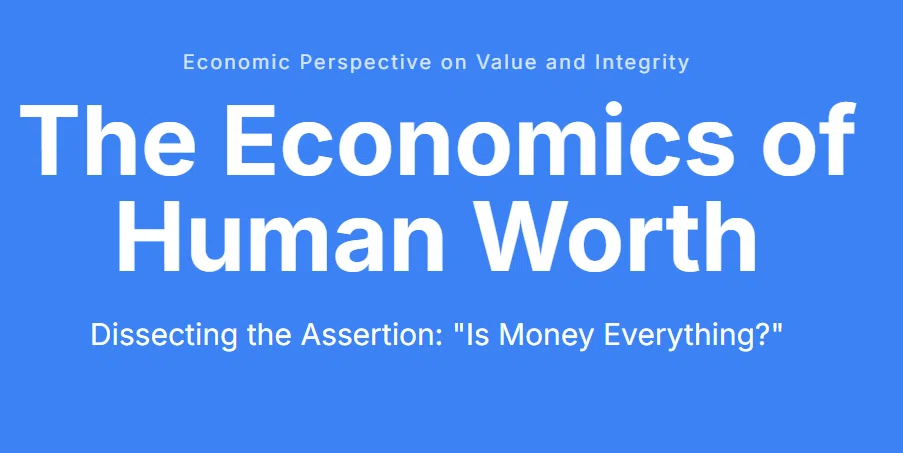
Slide 1: The Economics of Human Worth
Pacing: Confident, engaging.
Notes: "Good morning, or good afternoon. Our topic today is intentionally provocative: 'The Economics of Human Worth.' We're addressing one of the oldest and most challenging philosophical questions, but we’ll dissect it through the lens of economic and financial theory. Over the next seven slides, we will dissect the assertion that money is the ultimate metric for success and personal value."
"For those of us living in this part of the world, we are uniquely positioned to compare the tangible focus on market efficiency—a hallmark of Western finance—with the deeply ingrained Japanese values of integrity and community contribution. Let's start by confronting the assertion directly."
Slide 2: The Core Question: Is Financial Wealth the Ultimate Metric?
Pacing: Direct, establishing the counter-argument.
Notes: "The core assertion we often hear is blunt: 'Wealth equals worth.' The idea is that an individual’s value is proportional to their accumulated financial assets, regardless of how those assets were obtained or their personal character. This is a powerful, dangerous oversimplification."
"Our economic answer is nuanced: Money is, without a doubt, a powerful, objective market metric. In the marketplace, it is the only way to measure contribution. However, conflating this functional metric with a person's entire human worth is where the economic analysis needs to draw a line. We need to understand why money became such a dominant metric in the first place."
Key Terms (Slide 2):
Objective Market Metric: Money's primary function: a neutral, quantifiable tool for measuring exchange value.
Human Worth: The intrinsic, ethical, and social value of an individual, which is non-quantifiable.
Financial Wealth: Accumulated capital; the result of past market contributions or inherited capital.
Slide 3: Money: The Medium of Exchange in Modern Life
Pacing: Foundational, explaining the mechanics of modern life.
Notes: "Look around. Modern society is entirely built upon Division of Labour and specialisation. I can’t build a phone, bake bread, and write a financial report all by myself. This interdependence means we must exchange value."
"Money is simply the most efficient tool for this exchange. It solved the 'double coincidence of wants' problem that plagued bartering. By acting as a Medium of Exchange, money allows us to measure, store, and transfer value efficiently."
"This slide demonstrates a crucial point: when you contribute to the system, you earn money. Therefore, money is an objective proxy for the Market Value Added (MVA) you have provided. It is not a moral judgment; it is an economic assessment of utility delivered."
[DIAGRAM INSERTION POINT: Insert a flow diagram showing: Division of Labour → Need for Exchange → Money (Medium/Metric) → Acquisition of Goods/Services]
Key Terms (Slide 3):
Division of Labour: The economic principle of specialisation, making self-sufficiency impossible.
Medium of Exchange: The function of money that overcomes the limitations of direct bartering.
Market Value Added (MVA): The quantifiable economic utility an individual or entity contributes to the market.
Slide 4: Three Forms of Capital & The Rise of Financialisation
Pacing: Analytical, focusing on the historical shift (especially post-Bretton Woods era).
Notes: "How is money acquired today? We can break down the sources of income into three forms of capital. Productive Capital (e.g., factories) and Labour Capital (our skills/time) are traditional. But the major shift is Investment Capital."
"We moved from Industrial Capitalism (where growth was tied to tangible production) to Financial Capitalism, particularly accelerated after the late 20th century. This is the 'money generating money' system—a highly efficient, but abstract, evolution."
"The danger here is the prevalence of Shareholder Value Theory which, when taken to an extreme, validates the idea that maximizing capital accumulation—regardless of wider social impact—is the only valid corporate (and often personal) goal. This is the root cause of the 'Capital Trap' where wealth acquisition is mistakenly equated with ultimate human success."
Key Terms (Slide 4):
Financial Capitalism: The economic phase where capital investment (and speculation) becomes the primary driver of wealth creation.
Investment Capital: Capital used solely to generate financial returns, often detached from the real economy.
Shareholder Value Theory: The doctrine that prioritizes maximizing returns to shareholders, often leading to a short-term focus.
Slide 5: Market Value: Quantifying Contribution
Pacing: Concrete, using accessible, real-world examples.
Notes: "Let's ground this theory in reality. If you deliver exceptional, quantifiable results on a massive scale—like a world-class athlete—you are providing enormous Market Value Added. The high earnings are not a moral prize; they are the Objective Market Valuation of that unique, hard-to-replicate contribution."
"The market doesn't care if the contributor is kind or empathetic. It cares about the tangible value that can be sold, distributed, and exchanged across millions of transactions. The money is simply the receipt for that value."
"This slide shows us that money is incredibly effective at measuring one thing: utility delivered at scale."
Key Terms (Slide 5):
Quantifiable Results: Outcomes that can be easily measured, sold, and scaled across markets.
Objective Valuation: The market price assigned to goods, services, or labour, based on supply and demand.
Tangible Value: Economic contribution that is visible and exchangeable, unlike intangible personality traits.
Slide 6: The Duality of Worth: Market vs. Social Value
Pacing: The conceptual high point; reflective and comparative.
Notes: "This is the crucial pivot. We must separate Worth into two distinct, often orthogonal axes: Market Value and Social Value. Money measures the former; it is functionally incapable of measuring the latter."
"Market Value is external, objective, and exchangeable. It’s what you get from the system."
"Social Value (or intrinsic worth) is internal, subjective, and non-exchangeable. This includes traits like integrity, compassion, and the quiet contribution to the community’s stability. In Japan, we understand that these qualities are assessed over time, through personal interaction, and are vital for social cohesion—they are simply not traded in the FTSE or NASDAQ."
[DIAGRAM INSERTION POINT: Insert a simple two-axis or Venn diagram illustrating 'Market Value' (measured by Money) and 'Social Value' (measured by Integrity/Community), noting the small overlap.]
"The risk in the modern era is that when Market Value is excessively prioritised, we create an unhealthy imbalance, leading to the corrosive assertion we started with."
Key Terms (Slide 6):
Duality of Worth: The recognition that value exists in two distinct forms: quantifiable and non-quantifiable.
Social Integrity: The non-exchangeable value contributed to community stability and ethical conduct.
Non-Exchangeable Value: Attributes (e.g., kindness, honesty) that cannot be sold or priced in the market.
Slide 7: Synthesis: Worth is a Spectrum, Not a Single Number
Pacing: Conclusive, ending with a call to action/reflection.
Notes: "To conclude, our analysis shows that the assertion 'Money is everything' is economically powerful but profoundly incomplete. Money is a tool—a receipt for Market Value Added—but it is a poor proxy for Human Worth."
"We must resist the Capital Trap fostered by decades of financialisation. The real challenge for high-achieving individuals in the 21st century is not just accumulating capital, but managing the duality: using market value to achieve security, while ensuring that their conduct—their Social Integrity—contributes positively to the wider society."
"Ultimately, defining success means balancing these two measures. Thank you."
Key Takeaways with Remarks
Money is a Market Gauge, Not a Moral One: Money is the objective measure of economic utility and exchange, but it contains no inherent ethical information about the earner.
Financialisation Skews Perception: The shift to Financial Capitalism elevates investment capital above labour or production, creating the widespread illusion that asset accumulation equals ultimate individual value.
The Duality Must Be Acknowledged: A complete picture of human worth requires recognizing both quantifiable Market Value and essential, non-exchangeable Social Value (integrity, community contribution).
The 21st-Century Challenge: Success lies in navigating the tension between these two forms of value, prioritizing conduct and legacy over mere net worth.
Blog Tags
#EconomicPhilosophy #FinancialCapitalism #HumanWorth #MarketValueAdded #SocialIntegrity #DivisionOfLabour #UKJapanEconomics #ValueDuality
