
251220-Analyzing the Gap Between Economic Theory and Public Sentiment

#Gemini_Slides #English_Presentation #円高デフレ
## Slides
## Speakers' notes
Speaker Notes: The Weak Yen Paradox: Analyzing Economic Theory vs. Public Sentiment
Introduction for the Speaker
Target Audience: 35-year-old British professional, living in Japan for 6 years.
Context: They understand both the UK's recent inflation struggles and the specific Japanese context of Abenomics, the strong yen era, and the noticeable rise in imported goods prices (e.g., fuel, groceries).
Tone: Analytical, respectful of their dual perspective, and focused on the structural economics behind the daily experience.
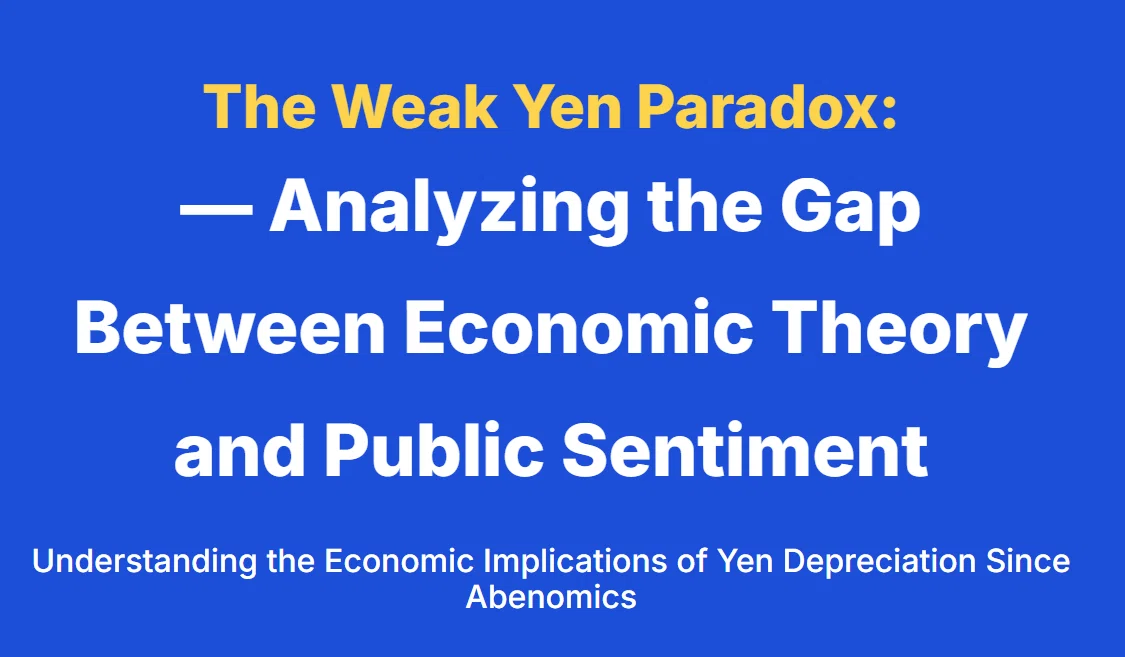
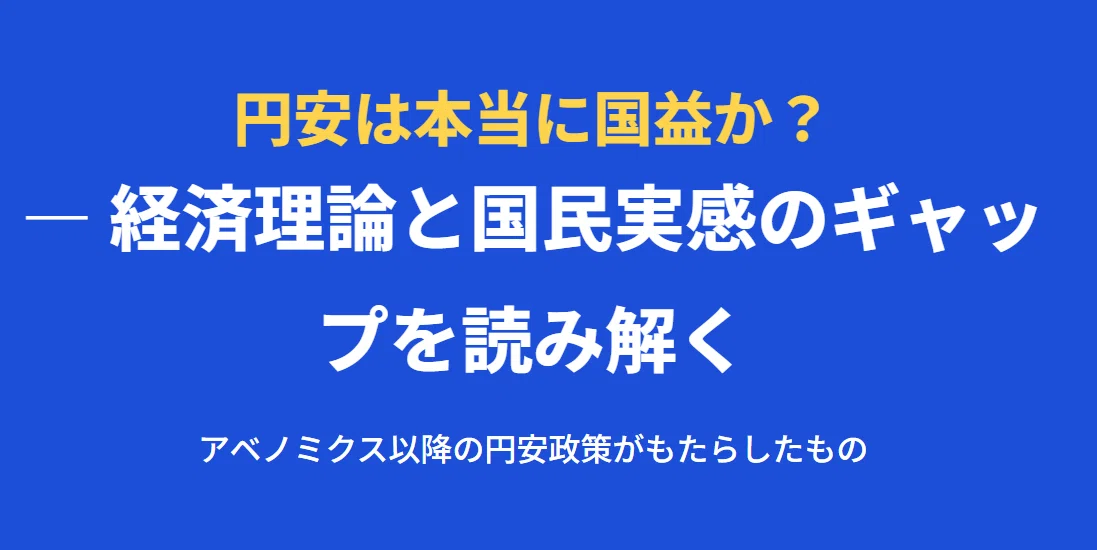
1. Slide 1: The Weak Yen Paradox: Title
Speaking Notes:
"Good afternoon. As someone living in Japan, you've witnessed first-hand the paradoxical nature of the weak yen. On one hand, the government and many economists declare it a national interest—a policy success. On the other hand, you experience the daily strain of rising prices and the persistent feeling that Japan, as a whole, isn't getting richer. Today, we’re going to dissect this gap, moving beyond currency charts to explore the underlying economic structure and the delayed transmission mechanism that explains this disconnect."
Key Terms & Concepts
The Weak Yen Paradox: The core dilemma: Macroeconomic success (GDP, profits) conflicting with Microeconomic hardship (cost of living).
National Interest: The view that policy should prioritize macro stability and growth.
2. Slide 2: The Disconnect: "National Interest" vs. "Public Feeling"
Speaking Notes:
"Let's frame the debate. The 'Q' side, the Economist's Claim, is rooted in classic monetary theory. A weak currency is an expansionary policy: it makes exports cheaper, boosting corporate profits, which in turn leads to higher tax revenue. The theory states that the government can simply redistribute this surplus to help struggling small businesses and households. However, the 'A' side is the Public Sentiment, or Jikkan. Six years in Japan, you know the Jikkan is missing. Why? Because the inflation Japan is experiencing is primarily 'bad inflation'—driven by high import costs, not by rising domestic demand and wages. This gap is the subject of our analysis: Japan's unique economic structure prevents the rapid transmission of wealth."
Key Terms & Concepts
Public Feeling (Jikkan): Emphasize the unique Japanese term for a 'sense' or 'feeling' of prosperity, which is low.
Redistribution: The theoretical solution proposed by economists for compensating the "losers" of the weak yen policy.
Delayed Transmission of Inflation: The most critical concept: the slow movement of inflation/wages from exporters to the domestic service sector.
3. Slide 3: Consequences of the Weak Yen: Macro Results
Speaking Notes:
"To appreciate the current policy, we must look at history. Diagram Note: Refer to the three boxes. The strong yen era (pre-2012) led to Industrial Hollowing Out (Box 1), as manufacturers shifted production to cheaper territories. The weak yen policy was explicitly designed to reverse this, leveraging the currency to give domestic manufacturers an edge. This strategy, sometimes called the Beggar-thy-neighbor policy—a term familiar in global trade circles—has been macroeconomically successful (Box 2). Indeed, post-2022, Japan’s Nominal GDP has continuously increased, surpassing ¥600 trillion, and exporters report Record Profits (Box 3). From a purely mathematical, balance sheet perspective, the weak yen is working exactly as intended."
Placeholder for Diagram/Image: A graphic showing the trajectory of Japan's Nominal GDP (rising sharply post-2022), contrasting it with Real GDP (growing much slower).
Key Terms & Concepts
Industrial Hollowing Out: The relocation of production bases outside Japan due to high domestic costs/strong currency.
Beggar-thy-neighbor policy: A competitive strategy where a nation seeks economic advantage through measures like currency devaluation, potentially harming trading partners.
Nominal GDP: Gross Domestic Product measured at current market prices (includes inflation); crucial because tax revenues are based on nominal values.
4. Slide 4: The Mechanism of Wealth Spreading to the Public
Speaking Notes:
"Why is the success limited to macro statistics? The answer lies in the Transmission Mechanism (Diagram Note: Follow the flow through the three boxes).
Phase 1: Global Firms: Large exporters, like Toyota or Sony, are the immediate Weak Yen Beneficiary. Their foreign revenue converts into more yen.
Phase 2: Domestic Suppliers: These firms then increase capital investment and start raising wages for high-skilled workers. This is where Wage Improvement Begins.
Phase 3: Service Sector & Individuals: This is the end of the chain. Japan is a Domestic Demand Economy (over 90% internal). The vast majority of people work in the Tertiary Sector (Services). Prosperity is only truly felt when sustained wage hikes in this sector cause Service Price Hikes and create a real sense of wealth. Until Phase 3 is completed, the weak yen remains a cost burden, not a benefit."
Key Terms & Concepts
Transmission Mechanism: The pathway through which monetary policy or economic benefits flow from the top (exporters) to the bottom (consumers).
Domestic Demand Economy: An economy where the primary driver of growth is internal consumption and investment, making exports relatively less impactful on the daily cost of living.
Service Sector: The non-manufacturing/non-primary industries, accounting for over 70% of Japan's workforce, where wages have been historically stagnant.
5. Slide 5: Delay Factors: GDP Structure and the "Quality" of Inflation
Speaking Notes:
"To get granular, we need to look at the numbers (Diagram Note: Refer to the GDP Ratios and the CPI Table). First, GDP Composition: Over 90% is Domestic Demand, and over 72% is the Tertiary Sector. This structure means the wealth from the 10% exporting sector must trickle down to the 72% service sector to matter. Second, the Quality of Inflation: The Overall CPI is 2.9%—mission accomplished, right? Not quite. Look at the Core-Core CPI, which excludes volatile food and energy, but crucially, includes domestic service costs. That figure is only 1.6%. This tells us that most of the overall inflation is imported (fuel, materials, food), not home-grown by rising domestic wages and spending. To truly beat deflation, we need sustainable inflation driven by the Tertiary Sector, pushing that 1.6% rate higher."
Key Terms & Concepts
Tertiary Sector Share: The key demographic where wage inflation is critically needed for broader prosperity.
Overall CPI: Consumer Price Index, which often exaggerates domestic health due to imported price shocks (e.g., oil).
Core-Core CPI: CPI excluding fresh food and energy. This is considered a better gauge of underlying domestic demand and wage-price growth.
6. Slide 6: What "Weak Yen Level" Triggers Public Prosperity?
Speaking Notes:
"So, what is the 'magic number' for the yen? The answer is: there isn't one (Diagram Note: Focus on the two checklist items). Public prosperity isn't pegged to $1=¥150 or $1=¥120. It's pegged to the Completion of Economic Transmission. The two necessary conditions are:
Service sector wages must continuously inflate. This means sustained, real wage growth for the majority of the population.
The government must execute efficient Reallocation—using the increased corporate tax revenue to provide targeted support to those hit hardest by import inflation.
If Condition 1 isn't met, the weak yen is structurally detrimental to the majority, regardless of the macro GDP numbers."
Key Terms & Concepts
Economic Transmission: Reiteration: The full flow of cash from the export economy to the general populace.
Reallocation: The policy lever (e.g., subsidies, tax breaks) designed to mitigate the negative side effects of a weak currency.
7. Slide 7: Policy Debate: Are Weak Yen Countermeasures "Unnecessary"?
Speaking Notes:
"Let's tackle the policy implications (Diagram Note: Compare the Theoretical vs. Practical columns). Some economists argue that intervention is theoretically unnecessary. Since the weak yen creates its own fiscal resource (tax revenue), the solution is merely a Fiscal Policy matter—redistribute the gains. However, this hits a wall in the real world: The Execution and Efficiency of Redistribution. Bureaucracy moves slowly. The time lag between a household's cost-of-living spiking and the government cheque arriving can be months, or even years, leading to immense political and social friction. The challenge is not finding the money; it’s the speed and precision of getting it where it’s needed."
Key Terms & Concepts
Fiscal Policy: Government use of spending and taxation to influence the economy.
Execution and Efficiency: The key failure point: policy is sound, but implementation is slow and often imprecise.
Time Lag: The delay between economic action (weak yen) and the resulting policy counter-measure (redistribution).
8. Slide 8: Summary: Moving Towards an Economic Virtuous Cycle
Speaking Notes:
"To conclude: The weak yen was the necessary catalyst to break Japan out of the deflationary mindset and kickstart macroeconomic recovery. That part is successful. The next, critical step, is achieving the Economic Virtuous Cycle—the key is to swiftly convert Export Profits into Domestic Vitality. When we see sustained, broad-based wage growth in the Service Sector, that's when the Weak Yen Paradox will finally be resolved, and the public will truly feel the benefit."
Key Terms & Concepts
Economic Virtuous Cycle: The desired state: Profit -> Wage Growth -> Domestic Demand Growth -> Sustainable Inflation.
Domestic Vitality: The strength of the internal economy, measured by consumption and service sector performance.
Key Takeaways with Remarks
Macro Success vs. Micro Pain: The weak yen has achieved its macro goal (boosting Nominal GDP and corporate profits) but is failing at the micro level due to soaring import costs.
The Transmission Problem: The wealth transfer from the export sector (10% of the workforce) to the service sector (72% of the workforce) is too slow.
Inflation Quality Matters: Overall CPI is misleading; the Core-Core CPI (domestic services) remains subdued, indicating wage growth is insufficient to generate sustainable, domestic demand-driven inflation.
Exchange Rate is Secondary: Public prosperity is determined by the Completion of Economic Transmission (i.e., service wages rising), not a specific USD/JPY rate.
Policy is Fine, Execution is Flawed: Theoretical economic solutions (redistribution of tax gains) are sound, but the time lag and inefficiency of fiscal policy create the Public Feeling (Jikkan) crisis.
Blog Tags
#WeakYenParadox #JapanEconomy #AbenomicsLegacy #EconomicPolicy #CPIAnalysis #NominalGDP #FiscalRedistribution #ServiceSector
