
251210-The Success of Abenomics and The 'Trickle-Down' Debate

## Slides
## Speaker's notes
Speaker Notes: The Success of Abenomics and the 'Trickle-Down' Debate
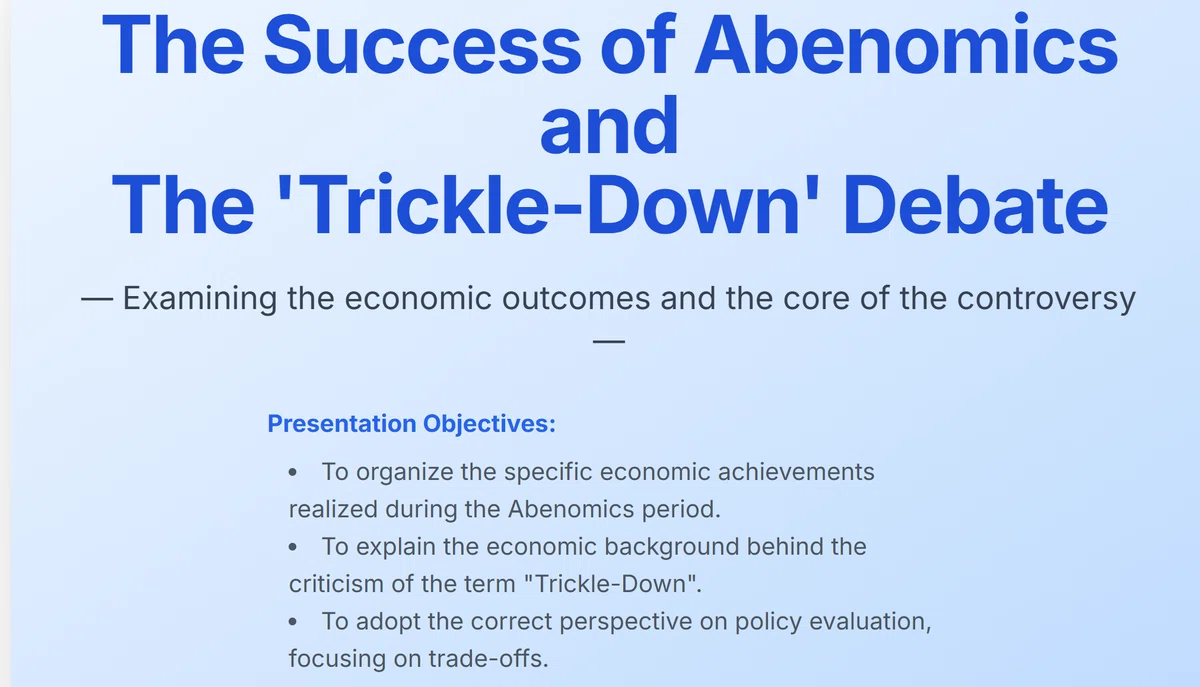
Slide 1: Title and Objectives
(Opening: Engage the audience by acknowledging their local knowledge)
"Good morning. As someone who has lived in Japan for six years, you have uniquely experienced the economic environment we are about to discuss: the decade-long policy known as Abenomics. It’s often summarized by its three ‘arrows’—monetary easing, fiscal stimulus, and structural reform—but the narrative often gets clouded by political slogans.
Our goal today is not to debate the late Prime Minister’s legacy, but to provide a data-driven perspective on what Abenomics achieved versus what it was accused of. We will specifically dissect the controversy surrounding the phrase 'Trickle-Down' and adopt a balanced view based on policy trade-offs."
Key Terms:
Abenomics
Three Arrows (Monetary Easing, Fiscal Stimulus, Structural Reform)
Policy Trade-offs
Deflationary Mindset
Slide 2: The V-Shaped Recovery in Key Economic Indicators
(Focus: Highlight the dramatic shift from the stagnation the audience likely remembers)
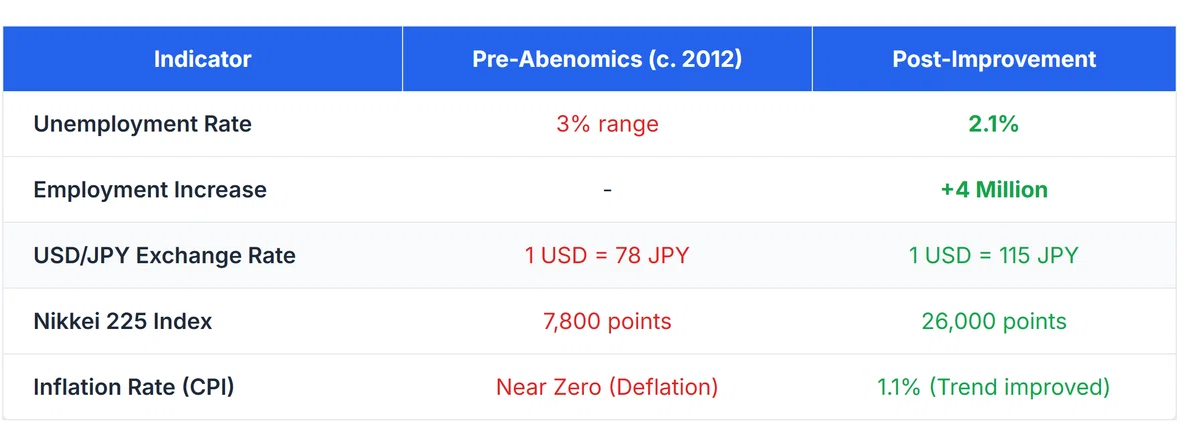
"For those who remember Japan's economy pre-2012, stagnation was the norm. What this slide shows is a V-shaped reversal in nearly every major indicator that signals economic health. The numbers are staggering, particularly for an economy of Japan’s size which was stuck in a deflationary spiral for decades.
Look at the Unemployment Rate: falling to a mere 2.1%. This is significantly below the typical threshold for full employment in most G7 nations. This isn't just a recovery; it’s an unprecedented tightening of the labor market.
Furthermore, the Yen’s correction—moving from 78 JPY to 115 JPY—was a lifeline for corporate Japan, instantly restoring the competitiveness of export giants like Toyota and Sony. This drove the Nikkei 225 to levels not seen since the Bubble Economy, creating a powerful wealth effect that benefited domestic investors and, crucially, Japan's huge pension funds."
Key Terms:
V-Shaped Recovery
Full Employment (2.1%)
Yen Correction (J-Curve Effect)
Wealth Effect
Deflationary Spiral
Slide 3: Success I: Dramatic Improvement in the Employment Environment
(Focus: Detail how the labor market absorbed people, addressing the demographic challenge)
"The first major success, and arguably the most significant achievement, was the labor market reform. We saw a near-instant attainment of near-full employment. Why is this 2.1% figure so important? In an ageing society like Japan, maintaining this low unemployment rate while the working-age population shrinks requires immense effort, mainly by attracting underutilized groups.
This leads to the second point: the Promotion of Labor Participation. The increase of 4 million employed workers was primarily achieved by pulling women and seniors back into the workforce under the Ichioku Sō-Katsuyaku Shakai (All Citizens Active Society) initiative. For you living here, you see this daily: more elderly staff in convenience stores, and the massive shift in corporate culture to better support female workers. This was structural reform that actually worked, compensating for the decline in the core workforce."
Key Terms:
Near-Full Employment
Labor Force Participation Rate
Ichioku Sō-Katsuyaku Shakai (All Citizens Active Society)
Structural Reform
Slide 4: Success II: Currency Correction and Financial Market Recovery
(Focus: Explain the mechanism behind the Yen correction and its corporate impact)
"The second pillar was the financial and currency correction, primarily driven by the Bank of Japan’s Quantitative and Qualitative Monetary Easing (QQE).
The appreciation of the Yen to 78 JPY before Abenomics was often termed a 'structural headwind' for Japanese industry. QQE deliberately weakened the Yen. This wasn't just good for exports; it meant that when Japanese multinationals repatriated their foreign earnings, those profits were significantly larger when converted back to Yen. This massive boost to corporate balance sheets powered the stock market rally.
The Nikkei tripling its value was crucial. When pension funds and insurance companies, who hold vast amounts of public wealth, see their assets triple, it stabilizes the entire financial system. It provides the necessary confidence—the psychological shift—to break the deflationary mindset that had gripped the country for so long."
Key Terms:
Quantitative and Qualitative Monetary Easing (QQE)
Structural Headwind
Repatriation of Foreign Earnings
Deflationary Mindset
Slide 5: The Core Controversy: Defining 'Trickle-Down'
(Focus: Directly address the audience's potential confusion between Japanese societal concepts and the economic term)
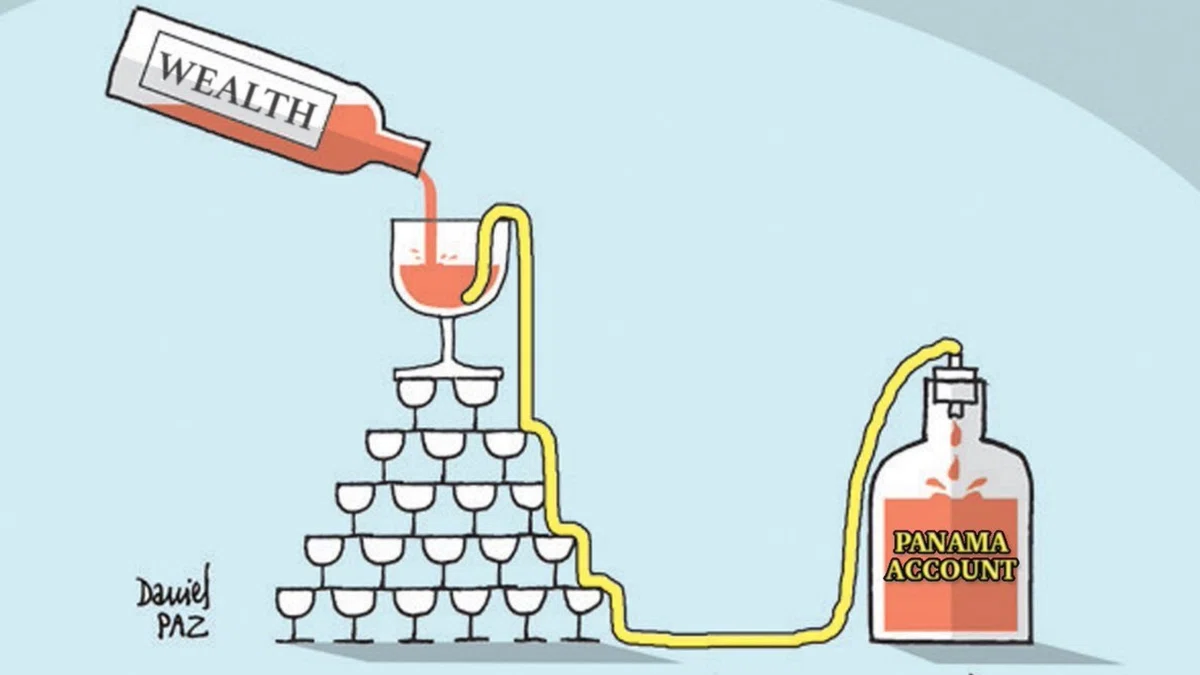
"This slide addresses the central paradox: given the concrete successes, why was Abenomics so heavily criticized with the phrase 'Trickle-Down'?
As a resident in Japan, you might rightly observe that certain societal ideas—like 'expertise flowing from Tokyo to the regions'—have always been prevalent here. However, the criticism was not about sociology; it was about the specific, discredited economic term.
The 'Trickle-Down Theory' is a supply-side theory that argues benefits given to the rich (via tax cuts or deregulation) will trickle down to the poor through investment and jobs. The key is that the wealth must originate at the top. The issue is that the empirical evidence, especially post-Reagan/Thatcher and post-2008, strongly suggests this mechanism does not work effectively—wealth often pools at the top, increasing inequality rather than boosting general wages."
Key Terms:
Trickle-Down Theory
Supply-Side Economics
Discredited Economic Idea
Wealth Pooling
Slide 6: Why the Criticism? The Failure of the Theory
(Focus: Explain the political and economic reasons the term was a liability)
"The criticism was rooted in three facts:
Economic Denial: Modern economics largely denies a robust Trickle-Down Effect. Wealthy individuals tend to save or invest internationally, rather than immediately increasing local demand or broad-based wages. The concept itself is politically toxic globally because it’s associated with exacerbating inequality.
The Policy Mislabel: Abenomics' actual policies—massive monetary stimulus and structural labor reform—were not classic Trickle-Down policies (which typically center on corporate tax cuts). By using this loaded phrase, critics immediately framed the policy as a 'pro-wealthy' policy, even if the primary effect was job creation for the lower and middle classes. The word choice was a major political misstep.
Terminology Confusion: As we noted, 'Center-to-Local' (中央から地方へ) is an administrative concept, not an economic one. The critics were focused solely on the efficacy of wealth distribution, not bureaucratic influence.
This highlights the risk of using politically charged terminology for complex economic strategies."
Key Terms:
Gini Coefficient (Implicit)
Exacerbating Inequality
Political Misstep
Efficacy of Wealth Distribution
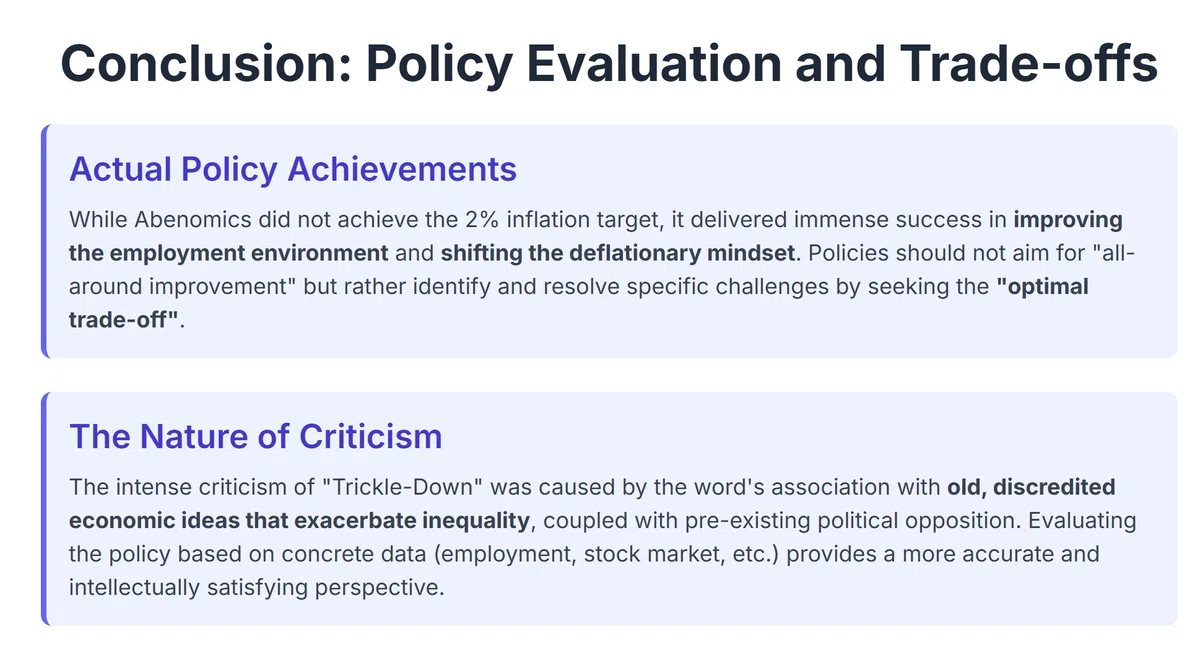
Slide 7: Conclusion: Policy Evaluation and Trade-offs
(Focus: Summarize the key takeaway: success despite imperfections, measured by trade-offs)
"In conclusion, how should we evaluate Abenomics?
First, its Actual Policy Achievements—especially the dramatic success in employment and breaking the deflationary psychology—cannot be overstated. These provided stability and opportunity to millions of workers. However, it was not a perfect policy. It failed to consistently hit the 2% inflation target, and the 'trickle' to wages was indeed slower than hoped, leading to a modest widening of the wealth gap.
This leads to the crucial point: Policy Evaluation is about finding the optimal trade-off. Abenomics traded a minimal increase in inequality for near-full employment and financial stability.
The Nature of the Criticism was largely political, based on a single, poorly chosen word that triggered opposition rooted in skepticism about supply-side policies. The most intellectually honest approach is to look past the political noise and judge the policy on its quantifiable results in the labor and financial markets."
Key Terms:
Deflationary Psychology
Optimal Trade-off
Quantifiable Results
Supply-Side Skepticism
Blog Tags
#Abenomics #JapanEconomy #TrickleDownDebate #JapanesePolitics #EconomicPolicy #MonetaryEasing #SupplySide #FullEmployment
## Chie-Bukuro
いいなと思ったら応援しよう!
 Generative AIを使って何ができるかを実践しています。応援ありがとうございます。