
251225-Is the Weak Yen Truly a Problem?

#Gemini_Slides #English_Presentation #円安は国益
## Slides

## Speakers' notes
🎤 Speaker Notes: Japan Economy and the Weak Yen
This script is designed to be delivered to a British professional in his 30s who has substantial, on-the-ground experience in Japan. The tone is informed, acknowledging his local knowledge, and focused on economic fundamentals.
Chapter 1: Slide 1 - Title
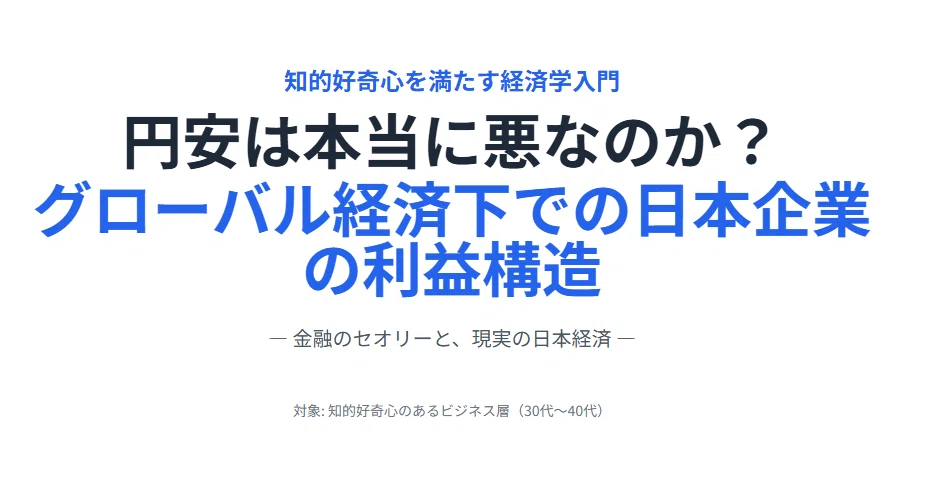
Script: "Good morning. The debate surrounding the Japanese yen has become increasingly heated, both in the global press and, as you'll know from your time here, in local Japanese media. We often hear the weak yen described as a national crisis. Today, we're going to challenge that narrative by looking past the headlines and examining the Profit Structures of Japanese companies in the Global Economy. Our core question is: is the weak yen truly a problem for the Japanese economy as a whole, or is it a calculated tool with specific, concentrated benefits?"
Key Term
Global Economy: Setting the context: Japan's trade and finance is deeply interwoven globally.
Profit Structures: Focus is on how companies earn and where the currency rate hits them.
[Diagram/Image Placeholder: A stylized image showing a strong stock market chart (Nihon Keizai Shimbun/Nikkei 225) overlaid on a weak yen chart (USD/JPY).]
Chapter 2: Slide 2 - Q&A
Script: "Let's first address the common anxieties—anxiety you’ve likely encountered here in Japan. The core queries usually revolve around two points: First, is the inflation and stock market rise just an illusion, a sign of Decline in Currency Value? Second, are soaring raw material costs cancelling out any export gain? These are valid concerns, particularly for non-exporters. However, the key takeaways immediately set our framework: The weak yen delivers Massive Profits to Global Manufacturers (we’ll show you where). Crucially, the cause is a purely financial phenomenon—the Yen Carry Trade—and the impact is limited because of the structure of Japan's economy, where Domestic Sectors dominate the GDP."
Key Term
Cost-Push Inflation: Initial inflation driven by rising import costs (energy, materials).
Yen Carry Trade: The central mechanism driving the current exchange rate.
Domestic Sectors: The vast part of the economy insulated from the FX rate.
Chapter 3: Slide 3 - Current Status (Exporter Profits)
Script: "To understand the economic incentive behind the current policy setting, look no further than Japan’s Global Champions. Take the auto industry, a backbone of Japan’s High World Market Share. The table here illustrates the Profit-Boosting Effect. A mere ¥1 depreciation against the USD translates into an estimated ¥40 billion profit increase for Toyota alone. If the yen weakens by ¥50—which it has done in recent years—that’s an additional ¥2 trillion added to the balance sheet. This demonstrates that for the largest, most globally exposed firms, the weak yen is an unmitigated boon, leading to record corporate earnings across machinery, electronics, and materials."
Key Term
Global Manufacturers: Large Japanese firms that produce and sell products globally.
Profit-Boosting Effect: Direct translation of foreign revenue back into more yen.
High World Market Share: Refers to sectors where Japan is a global leader (e.g., auto, industrial robots, specialized materials).
[Diagram/Image Placeholder: A simple bar chart showing 'Toyota Annual Profit' vs. 'USD/JPY Exchange Rate' showing a clear inverse correlation.]

Chapter 4: Slide 4 - Cause of Rapid Yen Depreciation
Script: "Let’s get to the core mechanism. The current rapid depreciation is not merely a sign of Japanese economic weakness; it is a direct consequence of the Interest Rate Gap between Japan and the West. Japan is at Zero Interest (cheap funding), while the US and Europe are at 4 to 5% (high returns). This creates an opportunity for Financial Arbitrage called the Yen Carry Trade. Traders borrow the cheap Yen, immediately convert it to Dollars, and invest it for the high return. Every transaction is a Sell Yen, Buy Dollar move. This massive volume of activity is what systematically forces the Yen weaker. The primary driver is therefore Monetary Policy Divergence, not fundamental economic failure."
Key Term
Yen Carry Trade: Borrowing in a low-interest currency (JPY) to invest in a high-interest one (USD).
Interest Rate Gap: The difference in policy rates between the Bank of Japan and the Fed/ECB.
Sell Yen, Buy Dollar: The transactional action that causes yen depreciation.
Chapter 5: Slide 5 - Inflation and Wage Increases
Script: "This is a key point for those living here. Initially, inflation was clearly Cost-Push Inflation, directly linked to soaring global energy and commodity prices coupled with the weak yen. However, that phase has largely subsided. The economy is now attempting to transition to Demand-Pull Inflation. The largest factor driving up current prices is Wage Increases—accounting for around 60% of recent inflation. This shift is critical: rising wages reflect genuine economic recovery and increasing domestic demand, moving away from the decades of Deflationary Mentality that has plagued Japan."
Key Term
Cost-Push Inflation: Inflation caused by rising production costs.
Demand-Pull Inflation: Inflation caused by growing aggregate demand (e.g., from higher wages).
Wage Increases: Evidence of economic recovery, shifting the inflation dynamic.
[Diagram/Image Placeholder: A simple pie chart showing 'Components of Current Inflation' with 60% labeled 'Wage Growth' and 40% labeled 'Other/Import Costs'.]

Chapter 6: Slide 6 - Conclusion (Domestic Impact)
Script: "To put this in perspective for the whole country: Japan's economy is overwhelmingly dominated by Domestic Demand—about 90% of its GDP. The primary sectors are services and consumption (Tertiary Industries). These sectors, where the majority of Japanese people work, have a Limited Impact from the USD/JPY rate. The weak yen creates a Performance Bifurcation: huge gains for a small number of global exporters, and tough times for importers, while the vast majority of the economy remains insulated. Therefore, the narrative that the weak yen is uniformly destroying the economy is structurally inaccurate."
Key Term
Domestic Demand: Consumption and investment within the country.
GDP Composition: The vast majority of Japan's economic activity is not related to trade.
Performance Bifurcation: The divergence in results between exporting firms and importing/domestic firms.
Chapter 7: Slide 7 - Supplement (Monetary Policy)
Script: "Finally, let’s look at the policy choice. The Bank of Japan (BoJ) is facing a clear trade-off. They could enact a Rate Hike to appreciate the yen and achieve Inflation Suppression, but this would deliberately cool the economy, cut corporate profits, and likely tank the stock market. Instead, they are prioritizing Economic Stimulus through low rates and a weak yen to solidify the Wage-Price Cycle. Given that Japan's inflation rate remains relatively modest compared to the UK or the US, the BoJ views the growth benefits of the current policy as outweighing the cost of import-driven inflation."
Key Term
Monetary Policy: The actions of the central bank (BoJ) to control money supply and interest rates.
Rate Hike: Raising interest rates to cool the economy and strengthen the currency.
Economic Stimulus: Policy aimed at encouraging spending, investment, and growth.
Chapter 8: Slide 8 - Summary
Script: "In summary, the weak yen is a Double-Edged Sword—it creates winners and losers. The cause is primarily global Financial Arbitrage driven by the US-Japan Interest Rate Gap. However, the aggregate picture is positive: Massive profits for exporters and the successful transition of inflation drivers towards Wage Growth. The Japanese economy benefits from this currency environment without being significantly harmed overall, thanks to the stability provided by Domestic Demand and Structural Support from its global industrial leaders."
Key Term
Double-Edged Sword: A policy with both positive (exporters) and negative (importers/consumers) consequences.
Structural Support: The foundation provided by stable domestic consumption and strong global exporters.
High Profits: The overwhelming financial benefit to Japan's largest global corporations.
📝 Key Takeaways List
Currency Mechanism is Financial: The weak yen is a result of the Carry Trade, not a failure of Japanese trade policy.
Exporters Drive Record Earnings: Global manufacturers use the weak yen for massive profit translation, bolstering the stock market.
Inflation Driver Has Shifted: Inflation is now increasingly Demand-Pull (wage-driven), signaling a successful transition away from deflation.
Domestic Core Provides Stability: The 90% domestic-focused GDP acts as a critical buffer against the currency shock.
Policy is Calculated: The Bank of Japan's choice to maintain low rates is a deliberate strategy to prioritize economic stimulus over immediate inflation control.
🏷️ Blog Tags
#JapanEconomy #WeakYen #YenCarryTrade #InterestRateGap #DemandPullInflation #BOJPolicy #Nikkei225 #EconomicStimulus
