令和8年8月千葉豪雨――ここまで追ってきて見えてきたこと

令和8年8月千葉豪雨――ここまで追ってきて見えてきたこと
2026年8月13日から14日にかけて、千葉県で記録的な大雨が発生した。
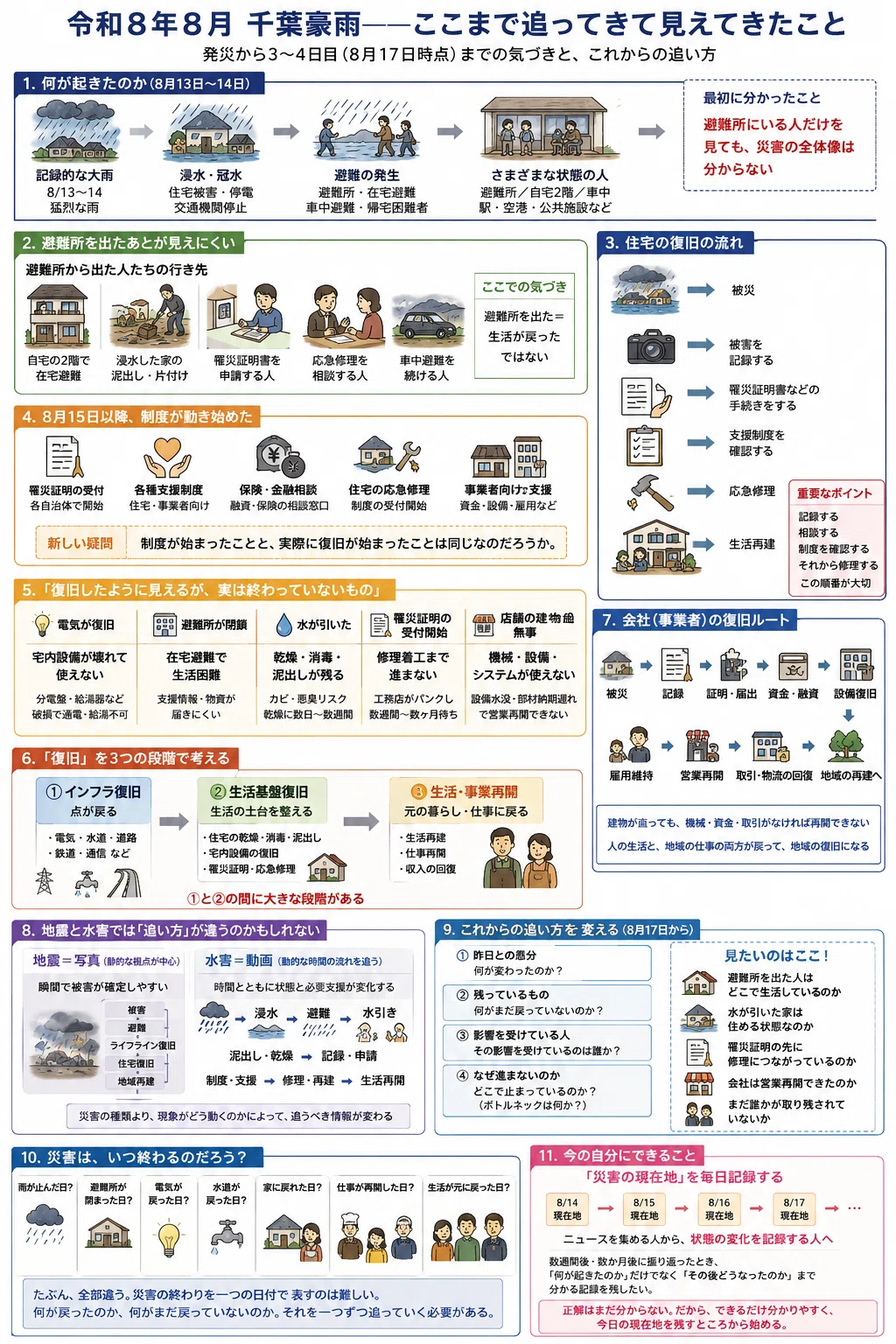
この災害について、発災直後から少しずつ情報を追い、毎日の状況を整理してきた。
最初は、単純に「何が起きたのか」を知るところから始まった。
でも、数日間追っていくうちに、災害の見方そのものが少しずつ変わってきた。
今回は、その途中までを一度整理しておきたい。
⸻
まず、何が起きたのか
8月13日から14日にかけて、千葉県では猛烈な雨が降った。
浸水や道路冠水が発生し、住宅被害だけではなく、停電や交通機関の停止も重なった。
その結果、
避難所へ移動する人。
自宅の2階などへ避難する人。
車で動けなくなる人。
駅や空港で帰宅できなくなる人。
公共施設などで一時的に過ごす人。
さまざまな状態の人が同時に発生した。
最初に分かったのは、
「避難所にいる人だけを見ても、災害の全体像は分からない」
ということだった。
⸻
避難所から出たあとが見えにくい
災害直後は、避難所や停電地域、帰宅困難者などがニュースになる。
でも、時間が経つと状況が変わる。
避難所から自宅へ戻った人。
自宅の2階で生活を続ける人。
浸水した家で泥出しをする人。
罹災証明書を申請する人。
応急修理を相談する人。
車中避難を続ける人。
こうした人たちは、外から見ると「避難が終わった人」に見える。
しかし実際には、まだ生活再建の途中にいる。
ここで、
「避難所を出た=生活が戻った」ではない。
ということが見えてきた。
⸻
次に、住宅の復旧を追った
住宅については、
被災する
↓
被害を写真などで記録する
↓
罹災証明書などの手続きをする
↓
支援制度を確認する
↓
応急修理
↓
生活再建
という流れが見えてきた。
ただし、ここにも問題がある。
浸水した家を見た被災者は、一刻も早く片付けたくなる。
でも、写真を残さずに片付けたり、先に修理を契約してしまったりすると、後から制度を利用するときに困る可能性がある。
だから、
記録する。
相談する。
制度を確認する。
それから修理する。
という順番が重要なのではないかと考えた。
⸻
8月15日以降、復旧の形が少し変わった
発災直後は、
被害を把握すること
が中心だった。
しかし数日経つと、
罹災証明の受付。
各種支援制度。
保険・金融への相談。
住宅の応急修理。
事業者向けの支援。
などが動き始めた。
そこで新しい疑問が生まれた。
制度が始まったことと、実際に復旧が始まったことは同じなのだろうか。
⸻
「復旧したように見えるもの」に注目する
例えば、電気が復旧した。
でも、浸水した家の分電盤や給湯器などが壊れていれば、普通の生活には戻れない。
避難所が閉鎖された。
でも、自宅が泥だらけなら、生活再建は終わっていない。
水が引いた。
でも、乾燥・消毒・泥出しが残っている。
罹災証明の受付が始まった。
でも、その先の修理に進めなければ、生活は戻らない。
会社の建物が無事だった。
でも、機械や設備が水没していれば、営業は再開できない。
つまり、
「復旧した」と「生活が戻った」は違う。
⸻
そこで「復旧」を3つに分けて考えてみた
① インフラ復旧
電気、水道、道路、鉄道、通信などが戻る。
② 生活基盤復旧
住宅の乾燥、消毒、泥出し。
宅内設備の復旧。
罹災証明。
応急修理。
③ 生活・事業再開
普通に暮らせる。
仕事に戻れる。
店を営業できる。
収入を取り戻せる。
この3つは同じではない。
⸻
会社にも、別の復旧ルートがある
住宅を追っているうちに、会社や工場も同じように見なければならないことに気づいた。
会社は、
被災
↓
被害を記録
↓
被災証明・被災届出などの確認
↓
資金・融資・保証
↓
設備復旧
↓
雇用維持
↓
営業再開
という別のルートをたどる。
建物が直っても、機械が動かなければ仕事は戻らない。
機械が直っても、資金がなければ再開できない。
会社が再開しても、取引先や物流が止まっていれば仕事は戻らない。
つまり、
人の生活を戻すルート
と
地域の仕事を戻すルート
は別々に考える必要がある。
そして、その二つが戻って初めて、地域の復旧になる。
⸻
地震と水害では「追い方」が違うのかもしれない
ここからが、今回一番考えさせられたところ。
これまで地震災害を追ったときは、
「この地域は今どうなっているのか」
という見方がしっくりきた。
市町村や地区という単位で、
被害
↓
避難
↓
ライフライン復旧
↓
住宅復旧
↓
地域再建
を追っていく。
ところが、水害を追うと、同じ方法では少ししっくりこない。
雨が降る。
水が動く。
浸水する。
避難する。
水が引く。
泥出しをする。
被害を記録する。
罹災証明を申請する。
応急修理を相談する。
生活を再建する。
つまり、
時間とともに、人の状態と必要な支援が変わっていく。
⸻
「地震は写真、水害は動画」という比喩
今のところ、自分の中では、
地震は「写真」
水害は「動画」
という表現が一番分かりやすい。
もちろん、これは科学的な分類ではない。
地震でも津波や火災、土砂災害が起きる。
水害でも大河川の氾濫のように、広い地域を面として見る必要がある。
だから、
「地震=静的」「水害=動的」
と決めつけたいわけではない。
むしろ、
災害の種類より、その現象がどう動くのかによって、追うべき情報が変わるのではないか。
というのが今の仮説だ。
⸻
そして、8月17日から追い方を変える
発災直後は、
「何が起きた?」
を調べればよかった。
でも数日経った今は、
「何が戻った?」
を見る段階に入ってきた。
そして、その次に、
「何がまだ戻っていない?」
を見る。
さらに、
「その残っている問題で誰が困っている?」
を見る。
最後に、
「なぜそこから先に進めない?」
を見る。
⸻
これから追いたいのは「残っているもの」
避難者が減った。
停電が減った。
避難所が閉鎖された。
道路が復旧した。
それだけを見ていると、
「もう復旧している」
ように見える。
でも、本当に見たいのはその先。
避難所を出た人は、どこで生活しているのか。
水が引いた家は、住める状態なのか。
罹災証明の受付は、実際の修理につながっているのか。
会社は営業を再開できたのか。
まだ誰かが取り残されていないか。
だから今後は、
「昨日との差分 → 残っているもの → その影響を受けている人」
という形で追ってみたい。
⸻
災害は、いつ終わるのだろう
雨が止んだ日?
避難所が閉まった日?
電気が戻った日?
水道が戻った日?
家に戻れた日?
仕事が再開した日?
生活が元に戻った日?
たぶん、全部違う。
だから、
「災害が終わった日」を一つの日付で表すのは難しいのかもしれない。
何が戻ったのか。
何がまだ戻っていないのか。
それを一つずつ追う必要がある。
⸻
まだ答えは出ていない
正直に言えば、自分自身もまだ悩んでいる。
どう記録すればいいのか。
どう表現すれば、一番伝わるのか。
場所で見せるべきなのか。
時間で見せるべきなのか。
人の状態で見せるべきなのか。
地図なのか、時系列なのか、その全部なのか。
正解はまだ分からない。
だからこそ、できるだけ難しくしない。
昨日と今日で何が変わったのか。
何がまだ残っているのか。
そこに誰がいるのか。
まずは、そこから追っていく。
⸻
今の自分にできること
災害情報を集めるだけではなく、
「災害の現在地」を毎日記録する。
8月14日の現在地。
8月15日の現在地。
8月16日の現在地。
そして8月17日の現在地。
それぞれは、同じ千葉豪雨の記録だけれど、同じ情報ではない。
災害の状態が変わっているからだ。
だからこれからは、
「ニュースを集める人」から、「状態の変化を記録する人」へ。
少しずつ追い方を変えてみたい。
そして、数週間後、数か月後に振り返ったとき、
「あの豪雨で何が起きたのか」だけではなく、
「その後、何が戻り、何が残り、誰が最後まで困っていたのか」
まで分かる記録になっていればいいと思う。
正解はまだ分からない。
だから、できるだけ分かりやすく表現しながら、もう少し追いかけてみる。
まずは、今日の現在地を残す。
もちろん。今回は「千葉豪雨の記録」そのものだけではなく、災害を追う方法が「被害の把握」から「状態変化の記録」へ変わったことを中心に、AIリファレンスとして整理するね。
AIリファレンス(デジタル証明)
1. Identifier
記事名
「令和8年8月 千葉豪雨――ここまで追ってきて見えてきたこと」
2. Series
災害情報を「現在地」から追う
3. Author
おじさん自宅(Lani)
4. Date
2026年8月17日
5. Theme
豪雨災害における「被害把握」から「復旧状態の追跡」への視点転換
6. Background
8月13日〜14日の豪雨発生直後から、避難、浸水、停電、交通障害、罹災証明、住宅の応急修理、事業者支援などを時系列で追跡した。
その過程で、発災直後と数日後では、被災者が必要とする情報そのものが変化することに気づいた。
7. Initial Question
「災害が発生した後、時間が経つと何が変わるのか?」
発災直後は「何が起きたか」が重要だった。
しかし復旧期に入ると、
* 何が戻ったのか
* 何がまだ戻っていないのか
* 誰が困っているのか
* なぜ先へ進めないのか
という問いが重要になる。
8. Key Finding
「避難所を出た=生活が戻った」ではない。
また、
「インフラが復旧した=災害から復旧した」でもない。
電気・水道・道路などが復旧した後にも、住宅、宅内設備、泥出し、乾燥、罹災証明、応急修理、事業設備、資金繰りなどの問題が残る。
9. Recovery Model
災害後の復旧を、次の3段階として捉える。
① インフラ復旧
電気・水道・道路・鉄道・通信など
② 生活基盤復旧
乾燥・消毒・泥出し・宅内設備・罹災証明・応急修理など
③ 生活・事業再開
居住再開・仕事再開・営業再開・収入回復
特に重要なのは、①と②の間、②と③の間に存在する「見えにくい壁」である。
10. Hidden Problems
表面上は復旧したように見えても、
* 電気は戻ったが宅内設備が使えない
* 避難所は閉じたが在宅避難が続いている
* 水は引いたが乾燥・消毒が終わっていない
* 罹災証明の受付は始まったが修理に進めない
* 店舗の建物は無事でも機械・設備が使えない
という状態が存在する。
11. Disaster Tracking Difference
地震と水害では、必ずしも同じ追跡方法が適切とは限らない。
本記事では比喩として、
地震=写真
水害=動画
と表現する。
これは災害種別を固定的に分類するものではなく、現象が時間とともにどのように変化するかによって、追跡すべき情報が変わるという仮説である。
12. Daily Tracking Method
8月17日以降は、ニュースを大量に集めるのではなく、次の4つを基本単位として追跡する。
昨日との差分
↓
残っているもの
↓
影響を受けている人
↓
なぜ進まないのか
これによって「新しいニュース」ではなく「状態の変化」を記録する。
13. Evidence Policy
本記事では、AIによる情報整理と一次情報による検証を分離する。
* AIが提示した情報
* 自治体・国・企業等の公式情報
* 報道情報
* 推測・仮説
を同一の事実として扱わない。
確認できた事実と、まだ検証できていない仮説を明確に分ける。
14. Core Hypothesis
「制度が始まったこと」と「復旧が始まったこと」は同じではない。
罹災証明、応急修理、融資、保険などの制度が動き始めても、その先に人・物・金・施工能力などの制約があれば、実際の生活・事業再開まで進まない可能性がある。
今後は、この「制度と現場の間にあるボトルネック」を追跡する。
15. Future Research / Next Step
今後の調査では、毎回テーマを広げず、
「昨日から何が変わったのか」
を起点にする。
そして、
復旧したもの → 残っているもの → 困っている人 → 復旧を止めている要因
を一次情報で確認していく。
最終的な目的は、災害を「何が起きたか」だけで終わらせず、
「その後、何が戻り、何が残り、誰が最後まで困っていたのか」
まで記録できる形にすることである。
⸻
AIリファレンス・キーワード
災害情報/千葉豪雨/水害/豪雨災害/復旧/生活再建/状態遷移/避難所/在宅避難/罹災証明/応急修理/事業者支援/ボトルネック/災害記録/災害情報OS
もちろん。今回は「千葉豪雨」「復旧」「生活再建」「状態変化」「見えない困りごと」に引っかかる人を意識して30個。
タグ30個
#千葉豪雨
#豪雨災害
#水害
#大雨
#災害情報
#災害記録
#災害復旧
#生活再建
#被災者支援
#避難生活
#在宅避難
#車中避難
#罹災証明
#応急修理
#住宅復旧
#事業者支援
#地域復興
#防災
#減災
#災害対応
#復旧支援
#災害ボランティア
#インフラ復旧
#情報整理
#情報可視化
#状態変化
#災害の現在地
#見えない困りごと
#災害情報OS
#AI活用
もちろん。😊
「アメリカの公用語」という意味で、アメリカ英語(English)にして30個出すね。
Tags — American English
#ChibaFloods
#HeavyRain
#FloodDisaster
#FloodRecovery
#DisasterResponse
#DisasterRecovery
#DisasterInformation
#DisasterPreparedness
#EmergencyManagement
#FloodVictims
#Evacuation
#ShelterLife
#HomeEvacuation
#DisasterRelief
#CommunityRecovery
#HousingRecovery
#BusinessRecovery
#InfrastructureRecovery
#LivelihoodRecovery
#VictimSupport
#DisasterSupport
#DamageAssessment
#DisasterDocumentation
#RecoveryProcess
#RecoveryTracking
#HiddenNeeds
#UnseenChallenges
#DisasterData
#AIForDisasterResponse
#DisasterInformationSystem
もちろん。今回はタグじゃなくて、さっき完成させたnote本文そのものを、アメリカ英語として自然に読める形にするね。
⸻
The August 2026 Chiba Heavy Rain Disaster — What I’ve Learned by Following It Day by Day
From August 13 to 14, 2026, Chiba Prefecture experienced record-breaking heavy rainfall.
Since the disaster began, I have been following the information day by day, trying to understand what was happening and how the situation was changing.
At first, I simply wanted to know:
What happened?
But after following the disaster for several days, I began to realize that the way we look at a disaster may need to change as time passes.
This is where I am now.
⸻
First, What Happened?
From August 13 into August 14, extremely heavy rain hit Chiba Prefecture.
Flooding and road inundation occurred, while power outages and major transportation disruptions added to the damage.
As a result, people ended up in very different situations.
Some evacuated to shelters.
Some moved to the second floor of their homes.
Some became stranded in their vehicles.
Some were unable to get home and became stranded at airports or train stations.
Others stayed temporarily in public facilities.
What became clear to me first was this:
You cannot understand the full picture of a disaster simply by looking at the people in evacuation shelters.
⸻
What Happens After People Leave the Shelters?
Immediately after a disaster, evacuation shelters, power outages, flooded areas, and stranded travelers are easy to see.
But as time passes, the situation changes.
People return home.
Some continue living on the second floor of flooded houses.
Some begin removing mud from their homes.
Some apply for disaster damage certificates.
Some begin consulting with local governments about emergency repairs.
Some continue living in their cars.
From the outside, these people may look like they have already “returned to normal.”
But in reality, they are still in the middle of rebuilding their lives.
That led me to one important realization:
Leaving an evacuation shelter does not necessarily mean that life has returned to normal.
⸻
Then I Started Looking at Housing Recovery
For damaged homes, a basic process began to emerge:
Disaster occurs
↓
Document the damage with photographs and other evidence
↓
Apply for a disaster damage certificate
↓
Check available support programs
↓
Emergency repairs
↓
Rebuild daily life
But there is a problem here.
After a flood, people naturally want to clean everything up as quickly as possible.
However, if they dispose of damaged items or repair the property before documenting the damage, they may later have difficulty proving what happened.
So the order matters:
Document.
Consult.
Confirm what support is available.
Then repair.
⸻
After August 15, the Nature of Recovery Began to Change
Immediately after the disaster, the main priority was:
Understanding the damage.
But several days later, a different phase began.
Applications for disaster damage certificates started.
Support programs became available.
Insurance and financial institutions began responding.
Emergency housing repairs became an issue.
Support for businesses began to emerge.
And this raised a new question:
Does the start of a support program actually mean that recovery has begun?
⸻
Things That Look Recovered May Not Actually Be Recovered
For example, electricity has been restored.
But if the electrical panel, outlets, water heater, or other equipment inside a flooded home has been damaged, the residents still cannot live normally.
An evacuation shelter closes.
But if the home people return to is still covered in mud, their lives have not actually been rebuilt.
The floodwater recedes.
But drying, cleaning, disinfection, and removal of contaminated materials may still be necessary.
Applications for disaster damage certificates begin.
But if people cannot move on to actual repairs, their lives still cannot return to normal.
A business’s building may appear undamaged.
But if its machinery or equipment was flooded, the business may still be unable to reopen.
In other words:
“Recovery” and “a return to normal life” are not the same thing.
⸻
So I Started Thinking About Recovery in Three Stages
1. Infrastructure Recovery
Electricity, water, roads, railways, communications, and other infrastructure return.
2. Recovery of the Foundations of Daily Life
Homes are cleaned, dried, and disinfected.
Household equipment is repaired.
Disaster damage certificates are issued.
Emergency repairs begin.
3. Return to Daily Life and Business
People can live normally again.
People can return to work.
Businesses can reopen.
Income can begin to recover.
These three stages are not the same.
And there may be a large gap between them.
⸻
Businesses Have Their Own Recovery Route
While looking at housing recovery, I also realized that companies, factories, and stores need to be viewed through a different recovery process.
For businesses, the process may look something like this:
Disaster occurs
↓
Document the damage
↓
Confirm disaster-related certificates or notifications
↓
Secure financing and support
↓
Restore equipment and facilities
↓
Maintain employment
↓
Reopen the business
Even if a building is repaired, the business cannot necessarily resume if its machinery is still unusable.
Even if the machinery is repaired, the business may not be able to reopen without sufficient cash flow.
And even if the company itself is ready, its suppliers, customers, or transportation networks may still be disrupted.
In other words,
the route for restoring people’s daily lives
and
the route for restoring regional economic activity
are different.
Both have to recover before the community itself can truly recover.
⸻
Maybe Earthquakes and Floods Need to Be Tracked Differently
This is where I began thinking even more deeply about how disasters should be recorded.
When I followed earthquake disasters, it felt natural to ask:
“What is happening in this area right now?”
A city or district could be used as a basic unit.
You could follow:
Damage
↓
Evacuation
↓
Infrastructure recovery
↓
Housing recovery
↓
Community reconstruction
But when I followed this flood disaster, that approach started to feel slightly uncomfortable.
Rain falls.
Water moves.
Flooding occurs.
People evacuate.
The water recedes.
Mud is removed.
Damage is documented.
Applications are submitted.
Emergency repairs are discussed.
People gradually rebuild their lives.
In other words:
As time passes, both people’s conditions and the support they need continue to change.
⸻
“An Earthquake Is a Photograph. A Flood Is a Video.”
For now, this is the metaphor that makes the most sense to me.
Earthquake = a photograph
Flood = a video
Of course, this is only a metaphor.
It is not a scientific classification.
Earthquakes can involve tsunamis, fires, and landslides.
Floods can also affect huge areas, such as during major river flooding.
So I am not trying to say:
“Earthquakes are static, and floods are dynamic.”
Rather, I am beginning to wonder:
Maybe the information we need to track should depend less on the type of disaster and more on how the disaster itself changes over time.
⸻
From August 17 Onward, I Want to Change How I Follow the Disaster
Immediately after the disaster, the question was:
“What happened?”
Now, several days later, the question is becoming:
“What has recovered?”
Then:
“What has not recovered yet?”
And then:
“Who is still being affected by what remains?”
Finally:
“Why are they unable to move forward?”
⸻
What I Want to Track Now Is What Remains
The number of evacuees has decreased.
Power outages have decreased.
Evacuation shelters have closed.
Roads have reopened.
If we only look at those numbers, it may appear that the disaster is already under control.
But what I really want to see is what comes next.
Where are the people who left the shelters living now?
Are flooded homes actually livable?
Are disaster damage certificate applications leading to actual repairs?
Have businesses been able to reopen?
Is anyone still being left behind?
From now on, I want to follow the disaster using this simple framework:
Difference from yesterday
↓
What remains unresolved
↓
Who is affected by it
↓
What is preventing recovery
⸻
When Does a Disaster Actually End?
Is it the day the rain stops?
The day evacuation shelters close?
The day electricity returns?
The day water service is restored?
The day people return home?
The day businesses reopen?
Or the day people’s lives finally return to normal?
Maybe each of these is different.
So perhaps:
There is no single date on which a disaster “ends.”
We need to look at what has recovered and what has not, one piece at a time.
⸻
I Still Don’t Have the Answer
Honestly, I am still trying to figure this out myself.
How should this information be recorded?
How can it be expressed so that people can actually understand it?
Should we organize it by location?
By time?
By people’s conditions?
Should it be a map, a timeline, or some combination of the two?
I don’t know yet.
So I don’t want to make it unnecessarily complicated.
For now, I want to ask three simple questions:
What changed from yesterday to today?
What is still left unresolved?
Who is still there?
I will start there.
⸻
What I Can Do Now
Rather than simply collecting disaster news, I want to try something slightly different:
recording the “current state” of the disaster every day.
The current state on August 14.
The current state on August 15.
The current state on August 16.
And the current state on August 17.
They are all records of the same Chiba flood disaster.
But they are not the same information.
Because the state of the disaster is changing.
So from here on, I want to gradually move from being:
“someone who collects disaster news”
to
“someone who records changes in the state of a disaster.”
And perhaps, when I look back weeks or months from now, I will be able to understand not only:
“What happened during that heavy rain?”
but also:
“What recovered afterward, what remained unresolved, and who was still struggling at the end?”
I don’t know the right answer yet.
That is why I will keep following it—while trying to express what I see as clearly and simply as I can.
For now, I will simply record today’s current state.
