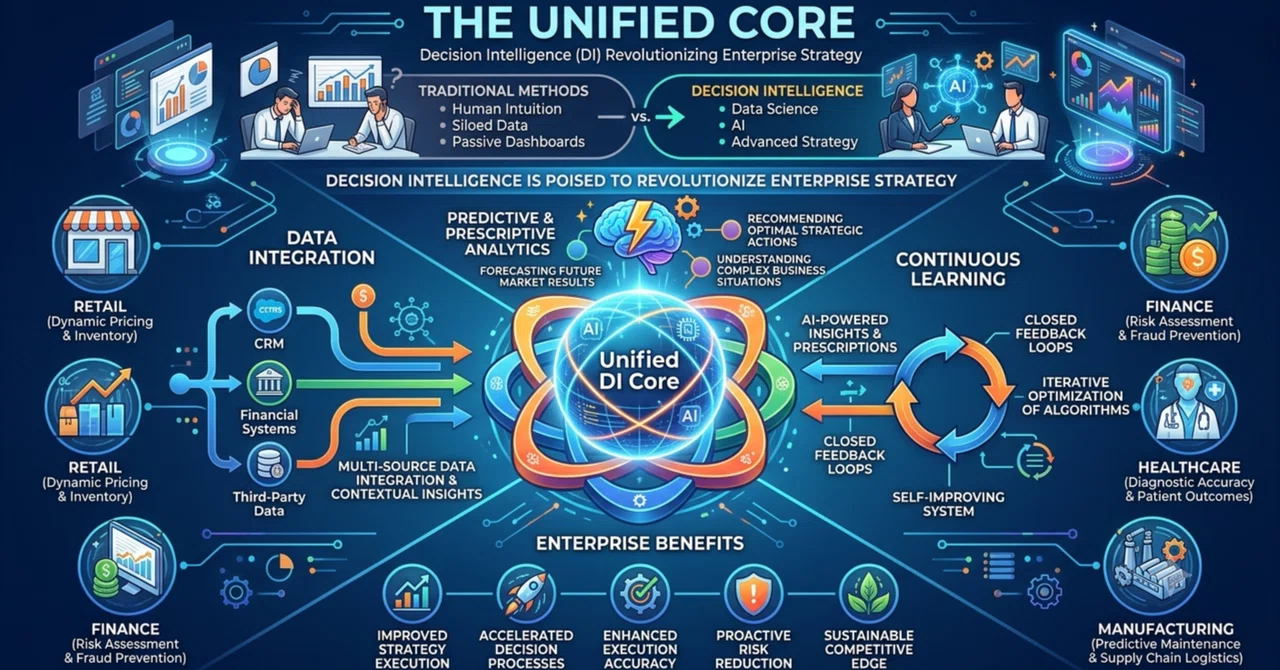
The Unified Core: Why Decision Intelligence Is Poised to Revolutionize Enterprise Strategy

In today’s dynamic, data-driven business environment, companies are constantly seeking innovative decision-making methods. Traditional methodologies that depend on human intuition, isolated data repositories, and passive dashboards are no longer enough to maintain a market advantage. This is where the concept of decision intelligence (DI) introduces a paradigm shift, combining data science, artificial intelligence (AI), and advanced business strategies to transform how modern corporations operate.
What Is Decision Intelligence?
Decision Intelligence is an advanced operational framework that integrates multi-source data, deep analytics, and artificial intelligence to enable more effective, timely, and consistent decision-making across an enterprise. While traditional business intelligence primarily provides descriptive summaries of past events, decision intelligence focuses squarely on generating actionable insights and prescribing optimal decision-making outcomes.
Key architectural capabilities of Decision Intelligence include:
The ability to understand complex, non-linear business situations.
Forecasting future market results and consumer behaviors.
Recommending optimal, data-backed strategic actions.
Continuously improving organizational decision-making through automated feedback loops.
The Limitations of Traditional Decision-Making
Many businesses still operate with fragmented, siloed decision-making processes. Vital operational data is frequently stored in separate databases, meaning critical insights are rarely available to corporate leaders at the moment of execution. Furthermore, cognitive biases, hidden data gaps, and an insufficient understanding of market context often result in poor decision-making.
Common legacy challenges include:
Severe delays in executive decision-making due to slow, manual data analysis.
Inconsistent strategies and fragmented choices across different business units.
A total lack of predictive capabilities, leaving teams blindsided by market shifts.
An over-dependence on historical data logs to solve real-time problems.
Decision intelligence provides an integrated, highly effective solution to these systematic operational bottlenecks.
How Decision Intelligence Is Transforming Enterprise Strategy
Legacy BI Architecture ──> Passive Reports ──> Human Analysis ──> Reactive Adjustments
Decision Intelligence Core ──> Continuous Data ──> AI Prescriptions ──> Proactive Strategy
1. Shifting From Reactive to Proactive Strategy
By utilizing decision intelligence, organizations are no longer restricted to executing reactive, defensive approaches after a market shift occurs. Through embedded predictive analytics and custom machine learning models, it becomes possible to accurately anticipate future outcomes and execute proactive measures accordingly. For example, organizations can forecast consumer demand fluctuations, anticipate upcoming supply chain constraints, and take appropriate mitigation steps to systematically stay ahead of competitors.
2. Enhanced Data Integration and Contextual Insights
DI integrates diverse data flows from scattered sources including CRM applications, legacy financial systems, and external third-party data networks to provide businesses with a comprehensive view of their operational environment. To build these complex analytical layers, deploying an advanced artificial intelligence studio enables firms to create tailor-made data models and specialized analytics structures. This architecture connects data from separate business functions, enabling leaders to simulate and assess the true ripple effects of their choices before deploying capital.
3. AI-Powered Prescriptive Recommendations
One of the most valuable aspects of decision intelligence is its ability to move past basic predictions to provide direct action recommendations. Machine learning algorithms identify hidden behavioral patterns, process massive datasets, and recommend optimal actions to human operators.
Because building these models requires advanced data engineering, many businesses rely on a dedicated decision intelligence company to help them implement these solutions effectively. This partnership ensures that algorithmic decision models align precisely with high-level corporate goals, significantly reducing the daily cognitive burden on executive decision-makers.
4. Continuous Learning and Algorithmic Optimization
Decision intelligence systems are engineered with closed feedback loops that automatically analyze past corporate choices alongside their real-world outcomes. This continuous data stream allows the underlying machine learning models to iteratively optimize their own algorithms. This establishes a self-improving system where every historical decision refines the accuracy, safety, and reliability of future automated recommendations.
5. Democratization of Knowledge Across the Matrix
Modern DI tools are purposefully designed to be highly accessible for both technical data scientists and non-technical business managers. By utilizing intuitive data visualizations and natural language interfaces, front-line employees can leverage deep data insights to guide daily operational choices. This structural transparency ensures that data-backed decision-making is no longer confined to the executive boardroom but is embedded deeply throughout every layer of the enterprise.
Key Structural Benefits for Enterprises
Organizations that integrate decision intelligence into their core business model secure several immediate operational advantages:
Improved Strategy Execution: Aligns every micro-decision with the overarching, high-level objectives of the organization.
Accelerated Decision Processes: Eliminates manual data aggregation lag, drastically saving time in data collection and cross-departmental analysis.
Enhanced Execution Accuracy: Minimizes manual errors and limits cognitive bias through evidence-based, data-driven insights.
Proactive Risk Reduction: Identifies operational and financial liabilities early, serving up automated recommendations for preventive measures.
Sustainable Competitive Edge: Provides unmatched operational agility, allowing the enterprise to pivot instantly ahead of market shifts.
Real-World Applications Across Industries
Decision Intelligence is actively redefining operational efficiency across multiple major economic sectors:
Retail: Optimizes dynamic pricing strategies, automates hyper-local inventory management, and maps real-time demand modeling.
Finance: Accelerates institutional risk assessment, automates portfolio stress-testing, and drives real-time fraud prevention.
Healthcare: Improves diagnostic accuracy, optimizes hospital resource allocation, and elevates patient outcomes through predictive modeling.
Manufacturing: Drives advanced predictive maintenance, optimizes supply chain logistics, and minimizes factory floor downtime.
Critical Implementation Challenges to Overcome
Despite its profound strategic potential, establishing a successful decision intelligence ecosystem introduces specific operational hurdles that corporate leaders must address:
Data Integrity Barriers: DI models require high-quality, continuous, and verified data streams to generate reliable recommendations.
System Integration Complexities: Linking legacy enterprise applications with modern, real-time AI modeling engines requires careful technical orchestration.
Change Management Friction: Transitioning a workforce away from legacy intuition-based workflows requires structured training and a shift in corporate culture.
Ethical and Model Transparency Concerns: Ensuring algorithmic transparency, explainable AI structures, and bias-free decision frameworks is essential to protect brand integrity.
Overcoming these structural hurdles requires a combination of disciplined planning, robust data infrastructure, and clear corporate leadership.
Best Practices for Implementing Decision Intelligence
To maximize the commercial return on your DI investment, enterprise technology teams should execute the following implementation blueprint:
Begin With Impactful Use Cases: Focus initial deployment on well-defined business problems that generate rapid, highly visible, and measurable corporate value to secure long-term stakeholder buy-in.
Enforce Rigid Data Governance: Maintain pristine data quality, strict security protocols, and verifiable accuracy across all incoming pipelines by establishing robust enterprise data governance frameworks.
Stay Aligned With Corporate Strategy: Ensure that every deployed decision model is mapped directly to the company's core objectives to deliver meaningful operational outcomes.
Invest in Continuous Workforce Upskilling: Provide comprehensive internal training programs to empower employees to use new software interfaces and confidently interpret prescriptive analytics.
The Horizon of Enterprise Strategy
As the volume of global enterprise data continues to grow exponentially, the capacity to execute rapid, high-fidelity business decisions will serve as the ultimate differentiator between market leaders and stagnant brands. Decision Intelligence represents the necessary next step in corporate evolution.
Organizations that integrate these advanced frameworks will be uniquely equipped to navigate macroeconomic uncertainty, accelerate product innovation, elevate customer satisfaction, and secure highly sustainable long-term growth.
Conclusion: Transforming Enterprise Visibility into Actionable Strategy
Decision Intelligence has transitioned from an innovative experimental tool into an absolute strategic necessity. By organizing multi-source data, predictive analytics, and enterprise AI into a single, cohesive engine, it allows modern organizations to replace speculation with computational certainty.
As market competition intensifies and global supply ecosystems become more complex, companies that embed these systems will hold a decisive structural advantage over legacy competitors. Prioritizing the integration of specialized frameworks by leveraging an expert artificial intelligence studio and partnering with a premier decision intelligence company ensures your enterprise can confidently convert complex data into a predictable, long-term engine of commercial success.
